• Tribal Kulturkampf: The Role of Race Ideology in Constructing Native American Identity

    Seton Hall Law Review
    Volume 35, Number 4 (2005)
    pages 1241-1260

    Carla D. Pratt, Associate Professor of Law
    Pennsylvania State University

    I. INTRODUCTION

    “Law is embroiled in the politics of identity. It names parties, defines their speech and conduct, and assigns their rights and duties. Its judgments declare, enjoin, and award the tangible and intangible benefits of race and racial privilege.” Law has been deeply involved in the politics of defining racial identity. The rule of hypo-descent, also known as the “one-drop rule,” was codified as law in many states in an effort to define the group of people who were black and therefore subject to the deprivation of liberty through the institution of slavery and later subject to social, economic, and educational subjugation through Jim Crow. Although the rule has been repealed from the statutory compilations of law in those states that once had such a rule, it continues to operate on a cognitive and cultural level in American law and society. On a social and cultural level, most Americans still perceive anyone with known African ancestry and the skin coloration, hair texture, or facial features that serve as evidence of African ancestry, to be “black” or African American.

    Unbeknownst to many, the rule of hypo-descent still operates in law on a structural level, particularly with respect to federal Indian law and the law of some Native American tribes. Within some Native American tribes, the rule is still covertly operating to construct Native American identity. In the struggle to preserve their very existence, some Native American tribes have subscribed to the basic assumptions of the dominant culture, including the assumption that whiteness is to be prized and non-whiteness devalued on a scale relative to the degree of color of one’s skin, with blackness constituting the most devalued state of being.

    Few extant cases are more illustrative of law embroiled in the politics of racial identity than the case of Davis v. United States, which the United States Supreme Court recently declined to review. Davis was brought by two groups of people who are members of a federally recognized Indian tribe called the Seminole Nation of Oklahoma. These groups, or “bands” of people, as they are commonly referred to in Indian discourse, are known as the Dosar-Barkus and Bruner bands of the Seminole Nation. They brought a lawsuit in federal court seeking to obtain treatment equal in nature and degree to the treatment received by other members of their tribe. Specifically, they sought to participate in certain tribal programs that are funded by a judgment paid by the United States for tribal lands taken by the United States government in 1823 when the tribe was in Florida. The federal courts ultimately refused to allow these bands of Seminoles to have their case heard on the merits by holding that Rule 19 of the Federal Rules of Civil Procedure precluded the hearing of the case because the tribe was an indispensable party which could not be joined in the action due to its sovereign immunity. The Seminole tribe’s culture war over the Dosar-Barkus and Bruner bands of Seminoles has even resulted in tribal efforts to amend the Seminole constitution in a manner that would exclude these Seminoles from tribal membership. Why are these bands of Indians treated differently from the remainder of their tribe? Why is their own tribe so hostile to them? What separates them from the majority of their tribe? They are black.

    This Essay explores how law has utilized the master narrative of white supremacy and black inferiority to construct Native American identity in a way that presently enforces the rule of hypo-descent. I must concede that while the Seminole Nation or “tribe” is not culturally representative of the diversity of Indian Nations or tribes in the United States, an inquiry into the experience of the Seminoles provides a basis for identifying how the master narrative of white supremacy and black inferiority is used to construct Native American identity, and how the construction of Native American identity in this fashion serves to further advance white supremacy…

    Read the entire essay here.

  • Multiracial Work: Handing Over the Discretionary Judicial Tool of Multiracialism

    UCLA Law Review
    University of California, Los Angeles School of Law
    Volume 58, Number 5 (June 2011)
    pages 1303-1341

    Scot Rives, Article Editor

    The rise of the mixed-race population and its implications for our society has received attention in current discourse and media coverage. Some see it as a portent of the postracial world to come; others see it as just another challenge to which anti-discrimination law must adjust. Despite this new attention, racial mixing is not a new phenomenon by any measure. What have changed are the methods of categorization. By realizing this fact, we can repudiate the claim that increased declarations of mixed-race identity signal a major shift and instead focus on readjusting outdated legal schemes that were predicated on old methods of monoracial categorization. This Comment addresses the conflict between new categorization methods for mixed race in data gathering as well as the non-cognizable mixed-race- based claims in current Title VII doctrine. Mixed-race individuals face unique harms themselves, and Title VII’s refusal to acknowledge mixed race results in dismissal of claims. After addressing two similar proposals that do not go far enough to remedy harms, this Comment proposes taking the discretion of framing race from judges and placing it in the hands of plaintiffs. Under this Comment’s proposal, plaintiffs can frame race as they experience the discriminatory use of race—including the mixed- race classification—against them, while allowing employers to rebut the plaintiffs’ claimed race by showing that they perceived the plaintiffs’ race differently.

    Table of Contents

    • INTRODUCTION
    • I. CATEGORIZATION PAST AND PRESENT
      • A. Historical Perspective
      • B. Reemergence and Boom
        • 1. Loving, the Multiracial Category Movement, and the 2000 Census
        • 2. Legal Acceptance
        • 3. Legal Rejection in Title VII
          • a. Title VII Doctrinal Background
          • b. Rejecting Mixed-Race-Based Claims Under Title VII
    • II. MIXED-RACE HARMS
      • A. Unique Animus
      • B. Intersectional Obscurement
      • C. Situational Race and Performing White
    • III. PERCEPTION-BASED SOLUTIONS
      • A. Employer-Perception-Based Disparate Treatment Claims
      • B. Unfulfilled Aims
    • IV. A FLEXIBLE BUT SEPARATE CATEGORIZATION IN TITLE VII ACTIONS
      • A. Disparate Impact/Intersection Resolution
      • B. Objections
        • 1. General Concerns About Separate Categorization
        • 2. Excessive Power Grant to Multiracials
        • 3. Essentialization
    • CONCLUSION

    INTRODUCTION

    Recently, I was confronted with an example of the ongoing cultural debate over the proper categorization of multiracial persons. While filling out an equal employment opportunity form for job interviews, I found myself at a loss with what to mark. The form employed a two-tier system. The first tier required a Yes-or-No answer to whether the respondent belonged in the ethnic category of Hispanic or Latino. If the respondent marked No, he or she could move to the second tier and mark: White; Black or African American; Asian, Native Hawaiian or Other Pacific Islander; Native American; or Two or More. Each racial category in the second tier included the parenthetical admonition, “Not Hispanic or Latino.” As someone who identifies as a mixed-race person and has seen many of these forms, I was accustomed to formulations that allowed either selection of only a single monoracial category, selection of all monoracial categories that apply, or, more recently, a separate choice for Two or More. Here was something that I had never seen. As one of partial Latino background, I was locked out from a choice to pick multiple races even though I also identify as being of Asian and white (non-Latino) descent.

    In this example, the limited racial structure only affected my personal feelings and may have had a minor distorting impact on statistics that could be used to show or refute concerns about equal employment opportunity. But similarly fluctuating rules and discourse surrounding racial categorization also play out in settings with more tangible and immediate repercussions involving equally strange and varied rules. As this Comment shows, Title VII jurisprudence has operated in confusion regarding the definition and purpose of multiraciality, how multiraciality relates to and is differentiated from a biracial paradigm, and what various conceptions of identity mean for Title VII’s operation moving forward.

    The majority of multiracial discourse in the United States has arisen in response to a perceived increase in interracial reproduction following the U.S. Supreme Court’s invalidation of anti-miscegenation laws in Loving v. Virginia as well as the increasing demand for a multiracial or mixed-race category, exemplified by the debate surrounding the 2000 Census. This discourse has generally been limited to addressing the benefits or detriments of creating a separate category in the census and other frameworks. However, while battling over the creation of a multiracial category, the debaters have generally overlooked the ramifications of such a category in areas of law where it has potential to further racial justice or hinder it.

    Contrary to the assertions made in recent media coverage, racial mixing is not a new phenomenon, nor is the explicit categorization of mixed race as something separate. However, the periods of explicit categorization occurred briefly during times of de jure racial stigmatization; mixed-race categories were later absorbed into monoracial categories through the rise of the hypodescent rule, prompting elimination of mixed-race categorization. Over the past twenty years mixed-race identity has reemerged in general discourse and on the census in part because of the Multiracial Category Movement (MCM). Mixed-race identity has also received legal acceptance in some areas, even as Title VII jurisprudence has rejected it.

    Despite the historical existence of racial mixing, most laws dealing with race are structured in a monoracial scheme. However, the ability to mark more than one category on the 2000 and 2010 Censuses and the subsequent effect on other federal programs via Directive 15, which seeks to unify categorization across the federal government, make it apparent that the monoracial conception of race is no longer consistent in law. Courts are increasingly confronted  with the conundrum of applying laws predicated on a monoracial conception to a growing mixed-race population’s claims to multiracial identity, which are emboldened by federal, state, and private data-gathering techniques that explicitly use a multiracial category or allow selection of multiple categories. Courts attempting to apply legal rules created for a monoracial scheme to mixed-race individuals have been inconsistent and often appear to use the mixed-race identity of an individual or a population as a legal tool to adjust or bolster arguments. One area in which mixed-race identity has been rejected is Title VII employment discrimination. This rejection involves not only refusal to acknowledge mixed race as a separate protected class, but also hindrance of mixed-race individuals claiming disparate treatment on the basis of a monoracial category. Instead, they are conscripted into other monoracial protected classes, defeating their own monoracial disparate treatment claims as well as claims by others who are replaced by someone of mixed race.

    Title VII rejection is problematic because mixed-race individuals face unique harms, and courts seem unwilling to apply consistency and resolve the tension between this identity and current doctrine. The harms at issue are not only harms of categorization that much of the literature focuses on but harms attached to the category. Harms of categorization are those that arise from simply being classified by a system of rules, separate from any benefit or injury based on that categorization, such as being perceived as belonging to or forced to identify with an ill-fitting category. Harms attached to the category are the negative actions such as refusal to hire someone of that category or violence against those in the category. Individuals who are socially racialized as mixed race or embrace that identity face discrimination from a unique animus independent from the harms based on monoracial identities. Under current law, these unique harms in the employment context cannot be remedied even when attempting to bootstrap a claim onto a color claim or a traditional race claim. Additionally, there are instances in which a mixed-race identity functions to obscure discrimination similar to certain aspects of intersectionality. Despite membership in multiple racial categories, a mixed-race complainant must plead a specific protected class to allege discrimination on the basis of race. Courts will often restructure the claims of those seeking a multiracial class into traditional monoracial terms. Further, some courts have held that a mixed-race individual can be replaced by a member of any racial group to which the mixed-race person owes some of his or her heritage. A mixed-race individual can even be used as a foil to another individual’s traditional monoracial claim because they can be conscripted into the same protected class as that of the traditional claimant—if they share any racial heritage despite possible vast disparities in phenotypical indications of race, self-identification, and social perception. This can be especially problematic where colorism claims’ cognizability is limited.

    Even when framing a complaint under a monoracial category, mixed-race individuals face problems of standing. First, they are especially susceptible to being perceived as belonging to a racial group completely unrelated to their personal identification or ancestry, or as identifying with a particular racial group because of the assumed mutability of their identity. Thus, when courts require proof of membership in a class, mixed-race people are often barred from bringing claims when they are discriminated against for belonging to a race with which they do not identify. Second, those of mixed backgrounds are more susceptible to mutability attacks. For example, a defendant in an employment discrimination suit may point to a mutable characteristic as the reason for the plaintiff’s dismissal when that characteristic may be what triggered an individual’s racialization in the first place. This defense works because the majority of courts still accept race as an immutable characteristic even as mixed-race persons challenge that conception.

    Thus far, multiracial discourse has focused on the concept of separate categorization in data gathering, while ignoring ongoing experiences, problems, and harms created by social perception as mixed race. Two scholars, however, have examined these harms and have proposed to combat them through extensions of current law. While these proposals are helpful, they focus narrowly on disparate treatment claims using employer intent and perception. Focusing on employer intent and perception may remove the barrier of establishing membership in a specific class to which a mixed-race individual may or may not belong, but it also reinforces the perpetrator model of discrimination, eschews disparate impact claims, maintains a significant burden on a claimant to establish a prima facie case by showing employer perception, and does not fully solve intersectional harms.

    While these proposals allude to use of a separate mixed-race category if one is perceived as such, this Comment argues explicitly that a mixed-race category is required in order to remedy ongoing discrimination. At the same time, in order to effectively address all discriminatory harms, mixed-race persons should not be locked into such a category. In this way, this Comment’s proposal echoes the perception-based proposals, but instead of focusing on employer perception, it allows a plaintiff to frame race as he or she desires for the initial complaint. A showing of an inconsistent perception can then be used by a defending party to refute that framing. Allowing plaintiffs to frame perception will make disparate impact claims accessible and assuage concerns over creating a separate category and further fractioning minority groups. Additionally, this proposal places the burden of establishing employer perception on the party best able to access the necessary evidence, instead of on a complainant who in most cases does not reach the discovery phase.

    Several objections are likely to arise from this approach, many of which have been articulated in the debate over the creation of an independent mixed-race category for data gathering. These include concerns about reification of biological race, creation of a new in-between class to further subordinate groups on the bottom, fractioning of minority groups that can lead to losses of political power, and concerns that such a category does not reflect accurate perceptions or experiences. Beyond those articulated about the category generally, there is also a risk of granting greater protection to mixed-race individuals when other subordinated classes may be more or at least equally in need of it. Further, given the inherently diverse nature of mixed-race individuals, the proposal stands to be at greater risk of essentialization objections. However, keeping exclusive control of the categorization out of the hands of any one party and focusing on unique animus towards mixed-race individuals for any claims based on the mixed-race class can eliminate or mitigate many of these concerns.

    Part I of this Comment begins by examining the historical existence of racial mixing and the myth of racial purity in an effort to disarm claims that racial mixing signals a coming racial utopia. It then looks at the meandering progression of separate mixed-race categorization from its initial use, to its absorption into monoracial categories, and its current limited reemergence in legal doctrine. From this point, Part II examines the specific harms that mixed-race individuals face, focusing on those at play in employment discrimination. Part III examines two previously proposed interventions for these harms and finds them to be an incomplete remedy. Finally, Part IV proposes a flexible but separate categorization as an alternative that best addresses the failure of current anti-discrimination jurisprudence to remedy the harms faced by mixed-race people…

    Read the entire comment here.

  • Toward a Philosophy of Race in Education

    University of Tennessee, Knoxville
    May 2011
    221 pages

    Corey V. Kittrell

    A Dissertation Presented for the Doctorate of Philosophy Degree The University of Tennessee, Knoxville

    There is a tendency in education theory to place the focus on the consequences of racial hegemony (racism, Eurocentric education, low performance by racial minorities) and ignore that race is antecedent to these consequences. This dissertation explores the treatment of race within critical theory in education. I conduct a metaphysical analysis to examine the race concept as it emerges from the works of various critical theorists in education. This examination shows how some scholars affirm the scientifically discredited race concept by offering racial essentialist approaches for emancipatory education. I argue that one of consequences of these approaches is the further tightening of racial constraints on the student’s personal autonomy. This mandates that critical theorists gain a deeper understanding of race as a problem, conceptually, epistemically, ideologically, and existentially. I argue that critical theorists of education draw from work conducted in the philosophy of race by theorists such as K. Anthony Appiah, Jorge Gracia, Charles Mills, and Naomi Zack to gain insights on the metaphysics of race to better inform theory and praxis. I further recommend the creation of a critical philosophy of race in education to address and combat race as a problem and its consequences. I contend that the groundwork for philosophy of race in education must entail strategies that encourage and assist theorists and teachers to move toward the elimination of the race in society, while utilizing race only as heuristic tool to address its consequences. Additionally, I argue that a philosophy of race in education must advocate for an education for autonomy as a means to racial liberation for students.

    Table of Contents

    • CHAPTER I
      • Introduction
        • Theoretical Perspective
        • Objects of Investigation
        • Descriptive Analysis of Critical Theory in Education
        • Normative Analysis
        • The Philosophy of Race
        • Toward A Philosophy of Race in Education
    • CHAPTER II
      • The Problem of Reification in Critical Theory in Education
        • The Process of Reification
        • The Problem of Reification
        • The Problem of Reification in Critical Theory in Education
          • Critical Race Theory: Race and Culturally Relevant Teaching
          • Afrocentricity In Education: Constructing Diasporas
          • Critical Multiculturalism: Race and Affirmation
          • Politicizing The Racial Binary
        • Conclusion
    • CHAPTER III
      • Historical Underpinnings of the Problem of Reification in Critical Theory in Education
        • The Hampton Approach
        • Liberal Education
        • New Black Intelligentsia
        • Black Power and Black Studies
        • The History of Black Education and Critical Theory: A Synthesis
        • Conclusion
    • CHAPTER IV
      • Critical Theory in Education and the Problem of Race
        • Race as an Axiomatic System.
        • Autonomy and the Black Individual
        • Autonomy and the Black Social Self
        • Engaging the Problem of Race in Critical Theory in Education
        • Conclusion
    • CHAPTER V
      • The Philosophy of Race
        • Theoretical Positions within the Philosophy of Race
        • The Problem of Race
          • Charles S. Mills
          • Kwame Anthony Appiah
          • Naomi Zack
        • Race and Identity
          • Mills on Racial Identity
          • Zack on Mixed Race Identity
          • Appiah on Racial Identity
          • Jorge Gracia on Race, Ethnicity, and Identity
        • Racialism, Racism, and White Supremacy.
        • Philosophy of Race and Education
        • Conclusion
    • CHAPTER VI
      • Toward a Philosophy of Race in Education
        • Introduction: A Critical Philosophy of Race in Education
        • Eliminativist and Anti-Eliminativist Arguments
          • Arguments for Racial Eliminativism
          • Anti-Eliminativist Arguments
        • Education for Autonomy as Liberatory
          • A Liberatory Role for Reason in a Philosophy of Race in Education
          • A Liberatory Role for Knowledge in a Philosophy of Race in Education
        • Toward a Philosophy of Race of Education
        • Conclusion: Toward A Philosophy of Race For Education
    • CHAPTER VII
      • Conclusion
    • LIST OF REFERENCES
    • Vita

    Read the entire dissertation here.

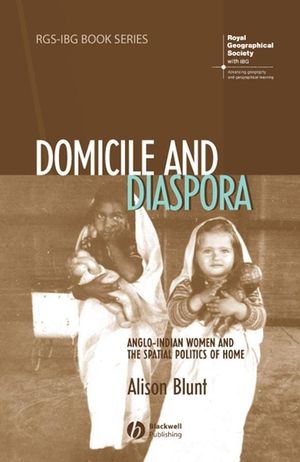
  • Domicile and Diaspora: Anglo-Indian Women and the Spatial Politics of Home

    Wiley-Blackwell
    August 2005
    304 pages
    Hardcover ISBN: 978-1-4051-0054-0
    Papeback ISBN: 978-1-4051-0055-7
    E-book ISBN: 978-1-4051-4130-7

    Alison Blunt, Professor of Geography
    Queen Mary, University of London

    Domicile and Diaspora investigates geographies of home and identity for Anglo-Indian women in the 50 years before and after Indian independence in 1947.

    • The first book to study the Anglo-Indian community past and present, in India, Britain and Australia.
    • The first book by a geographer to focus on a community of mixed descent.
    • Investigates geographies of home and identity for Anglo-Indian women in the 50 years before and after Indian independence in 1947.
    • Draws on interviews and focus groups with over 150 Anglo-Indians, as well as archival research.
    • Makes a distinctive contribution to debates about home, identity, hybridity, migration and diaspora.

    Table of Contents

    • List of Figures.
    • Series Editors’ Preface.
    • Acknowledgements.
    • 1. Domicile and Diaspora: An Introduction.
    • 2. At Home in British India: Imperial Domesticity and National Identity.
    • 3. Home, Community and Nation: Domesticating Identity and Embodying Modernity.
    • 4. Colonization and Settlement: Anglo-Indian Homelands.
    • 5. Independence and Decolonization: Anglo-Indian Resettlement in Britain.
    • 6. Mixed Descent, Migration and Multiculturalism: Anglo-Indians in Australia since 1947.
    • 7. At Home in Independent India: Post-Imperial Domesticity and National Identity.
    • 8. Domicile and Diaspora: Conclusions.
    • Bibliography.
    • Appendix 1 Archival Sources.
    • Appendix 2 Interviews and Focus Groups.
    • Index

    Read chapter one here.

  • Fatherhood Institute Research Summary: African Caribbean fathers

    Fatherhood Institute
    2010-03-10

    The picture for UK fathers of Black Caribbean heritage is complex since as many of their children are now conceived with partners from outside Black Caribbean communities than are conceived within them. This pattern is not yet strong among UK fathers of Black African heritage, 81% of whose children are conceived within their own heritage group (Platt, 2009).
     
    Black and Black British fathers are twice as likely as white British fathers (and three times as likely as British Asian fathers) to live apart from their children; and high rates of non-resident fatherhood are also found where children are of Mixed Heritage (Hunt, 2009a; Platt, 2009).  However, there are substantial social class differences here, and while cultural factors contribute (Reynolds, 2009) the main reasons for non-resident fatherhood in Black and Mixed Heritage families are the same as those found in white families: low socio-economic status, unemployment, low education, and so on (e.g. Amato & Sobolewski, 2004); Maclean & Eekelaar, 1997). Experience of racism, and institutionalised racism, are key to all of these (making them far more common in Black families) and are also relevant to other factors which further contribute to high levels of non-resident-fatherhood in Black families: early fatherhood, poor mental health, imprisonment, having been raised without own father present, and so on…

    Read the entire article here.

  • What about These Children? Assessing Poverty Among the ‘Hidden Population’ of Multiracial Children in Single-Mother Families

    University of Kentucky Center for Poverty Research
    Discussion Paper Series: DP 2010-09
    2010
    ISSN: 1936-9379
    48 pages

    Jenifer L. Bratter, Associate Professor of Sociology
    Rice University

    Sarah Damaske, Assistant Professor of Labor Studies and Employment Relations
    Pennsylvania State University

    Capturing the conditions of children of color living in single-parent families has become more complex due to the growing presence of interracial households. This analysis assesses the size and poverty status of single-female headed families housing multiracial children. Using data from the 2000 Census, we find that 9 percent of female-headed families house either children who are classified with more than one race or are classified as a single race different than their mother’s compared to only 3 percent of married couple families. Logistic regression analyses assessing the odds of poverty status for families finds that being a multiracial family does not constitute a uniform advantage or disadvantage for female headed households. Rather, these families, like most families of color, are more likely to experience poverty than white monoracial families. The two exceptions are White multiracial families who are more likely to be in poverty relative to this reference group and Asian multiracial families who have similar poverty rates as white monoracial families (and a lower rate than Asian monoracial families).

    Read the entire report here.

  • Manufacturing citizenship: Metapragmatic framings of language competencies in media images of mixed race men in South Korea

    Discourse & Society
    Volume 22, Number 4 (July 2011)
    pagesw 440-457
    DOI: 10.1177/0957926510395834

    Adrienne Lo, Assistant Professor of Anthropology and Asian American Studies
    University of Illinois, Urbana-Champaign

    Jenna Kim
    Department of Educational Psychology
    University of Illinois, Urbana-Champaign

    This article examines how discourses of linguistic (in)competency regiment productions of citizenship in the South Korean popular media. Through an analysis of newspaper articles and television programs, we investigate how depictions of language competency become key resources for locating individuals within genealogies of kinship and chronotopic figures of personhood. In some cases, the speech of these celebrities associates them with imaginings of their backwards, low-class Korean kin, the Japanese colonial period, and American military presence, while in other cases, their language is associated with the 21st-century ideal of the modern, elite, globetrotting neoliberal subject. This analysis demonstrates how competence is read in relation to changing notions of citizenship in the new ‘multicultural’ Korea as these men are differentially positioned between multiple raced, classed, and gendered imaginings of Whiteness and Koreanness. More generally, we argue that understandings of linguistic competence are social productions, rather than reflections of language ability.

    Read or purchase the article here.

  • Gender Differences in Ancestral Contribution and Admixture in Venezuelan Populations

    Human Biology
    Volume 83, Number 3 (June 2011)
    pages 345-361
    E-ISSN: 1534-6617 Print ISSN: 0018-7143

    D. Castro De Guerra
    Instituto Venezolano de Investigaciones Científicas

    C. Figuera Perez
    Instituto Venezolano de Investigaciones Científicas

    M. H. Izaguirre
    Instituto Venezolano de Investigaciones Científicas

    E. Arroyo Barahona
    Universidad Central de Venezuela

    A. Rodriguez Larralde
    Instituto Venezolano de Investigaciones Científicas

    M. Vivenes De Lugo
    Universidad de Oriente

    The origin of the contribution of uniparental heritage were analyzed in 615 samples of individuals proceeding from 13 towns classified according to historic differences in their emergence and development as African-derived, European-derived, and admixed/urban. Mitochondrial and Y-chromosome haplogroups were identified by PCR-restriction fragment length polymorphism. The results were compared with previous estimates of admixture made with autosomal markers and with historic aspects. The results show a predominantly indigenous genetic contribution through the female, being more prevalent in urban populations; the African contribution, although dispersed, presents a larger concentration in the African-derived towns, whereas the European contribution is limited to populations with this origin, reflecting isolation and the conservation of the distribution pattern of genes of the Colonial era. With regard to admixture through males, it is almost exclusively of European origin, whereas the African contribution is basically concentrated in the African-derived towns, and the Amerindian lineages are almost nonexistent. The genome of paternal heredity, as opposed to the autosomal and the mitochondrial, shows a homogeneous pattern of admixture that is independent of the origin of the population studied, suggesting that European genes have been introduced into the Venezuelan population through male immigrations, whereas the indigenous contribution has been preserved in the Venezuelan genetic pool through the women. These results provide evidence of the heterogeneity in the genetic origin of the Venezuelan population, which should be taken into account in forensic and epidemiologic genetic studies.

    Read or purchase the article here.

  • Multiracial Teens Launch A ‘Latte Rebellion’

    Tell Me More
    National Public Radio
    2011-07-15

    Michel Martin, Host

    “You’re half Chinese and half European, I’m half Indian, a quarter Mexican and a quarter Irish. We’re mixed up. We’re not really one or the other ethnically. We’re like human lattes.”

    So explains Asha, the main character in Sarah Jamila Stevenson’s debut novel, The Latte Rebellion.

    To raise money for a class trip she and her friends began as selling a few T-shirts and labeled the effort the Latte Rebellion. But the movement soon became something much larger than they could have anticipated.

    Seen through the eyes of adolescents, Asha and her friends tackle the complexities of identifying as multiracial during adolescence, when identifying as anything seems like a challenge.

    “At the time I was writing it … there were still some news stories about South Asians who were getting harassed and insulted, and even assaulted,” Stevenson said in an interview with Tell Me More host Michel Martin. “And because I’m part South Asian myself, it really hit close to home. It had me worried about my relatives who live in the United States. So I felt pretty strongly about working that into my book somewhere.”…

    Read the transcript here.  Listen to the interview here.

  • ‘In The Blink Of An Eye,’ A Change In Racial Identity

    All Things Considered
    National Public Radio
    2011-07-07

    Michele Norris, Host

    Michael Sidney Fosberg grew up thinking he was white. His mother is white. His stepfather is white. And while he never met his biological father, the assumption was that he was white too. But well into his adulthood, Fosberg found out that his father was a black man. Michele Norris speaks to him about his story that he’s told in his one-man play and his book, both called Incognito.

    Read the transcript of the interview here.  Listen to the interview here.