• Negotiating Honor: Women and Slavery in Caracas, 1750-1854

    University of New Mexico, Albuquerque
    May 2011
    214 pages

    Sue E. Taylor

    A Dissertation Submitted in Partial Fulfillment of the Requirements for the Degree of Doctor of Philosophy in History

    This study examines three interrelated groups—female slaves, female slave owners, and free women of African heritage—living in the city and state of Caracas, Venezuela from the middle of the eighteenth through the middle of the nineteenth centuries in order to improve our historical understanding of gender and slavery. Venezuela represented the largest and longest lasting slave-owning regime in Spanish South America. Slavery, as a system of labor, was an integral part of colonial Venezuelan society and affected all segments of the populace. Understanding gender relations within slavery is crucial to understanding the dynamics of gender, power, race, and sexuality in the society as a whole. Women of Spanish, African, and mixed descent were involved in and affected by slavery.

    Each group of women had a concept of what honor meant for them and each sought to preserve honor by demanding fair and humane treatment, to be treated with respect and dignity, and to protect their reputations. They also expected those people who had control over them to behave with honor. Sometimes honor, as seen in the cases and as demanded by slave and free black women, corresponded to traditional concepts of honor as birthright as defined by elite members of society and other times not. In other examples, women of color used honor along the lines of Stewart’s concept of honor as the entitlement of treatment as a worthwhile person. By looking beyond honor as birthright, the women in my study also invoked honor in their expectation that they be treated with dignity and respect and be able to preserve their reputations in society and with their peers. Slave owners, on the other hand, were sensitive to accusations of being overly harsh in their treatment of their human possessions. Their good reputation required both paternalism and firm control. Slave litigants tested the boundaries of appropriate coercion and restraint in their suits against abusive or unreasonable slave owners. They also showed a sophisticated understanding of legal codes and institutions.

    Table of Contents

    • List of Tables
    • Introduction
      • Honor, women, and slavery
      • Historiography
      • Literature on gender and slave women
      • Literature on Honor
      • Honor in Latin America
      • Methodology and Sources
      • Organization of Chapters
    • Part I: Redefining Honor
      • Chapter 2: Mistreatment as an indicator of dishonor
        • Protecting honor through the court
        • Conclusion
      • Chapter 3: Redefining Sexual Honor: Broken Promises and Respectable Work
        • Broken Promises
        • Respectable Work and Honor
        • Conclusion
    • Part II: The slave family
      • Chapter 4: Slave and free black families as seen through Church documentation
        • The Parish of San Pablo
        • Marriage
        • Baptisms
        • Matriculas
      • Chapter 5: Preserving the Family
        • Children and Childhood
        • Enslaved Children: Achieving Freedom
        • The death of an owner
        • Marriage and Honor
        • Families and use of the law
    • Part III: Slavery, freedom, and emancipation in the post-independence Liberal State
      • Chapter 6: Slavery and Independence
        • Venezuela moves toward revolution
        • The Junta de Secuestros
        • Revolution, slaves, and free blacks
        • Slavery in the republic of Venezuela
        • Freedom in the post-independence state
        • Conclusion
      • Chapter 7: Conclusion
    • Bibliography

    List of Tables

    • Table 1: Slave and Free Black Marriages, San Pablo Parish
    • Table 2: Slave Marriages
    • Table 3: Free Black and slave/manumiso baptisms by year
    • Table 4: Slave and Manumiso Baptisms
    • Table 5: Slave and manumiso baptisms 1752-1852 by gender and status
    • Table 6: Godparents
    • Table 7: Heads of Household by race & marital status
    • Table 8: Single heads of household
    • Table 9: Slave Ownership
    • Table 10: Slave Distribution
    • Table 11: Slave Statistics
    • Table 12: Overview of San Pablo Parish

    Chapter 1: Introduction

    Venezuela represented the largest and longest lasting slave-owning regime in Spanish South America. Slavery, as a system of labor, was an integral part of colonial Venezuelan society and affected all segments of the populace. Understanding gender relations within slavery is crucial to understanding the dynamics of gender, power, race, and sexuality in the society as a whole. Women of Spanish, African, and mixed descent were involved in and affected by slavery.

    My study examines three interrelated groups—female slaves, female slave owners, and free women of African heritage—living in the city and state of Caracas, Venezuela from the middle of the eighteenth through the middle of the nineteenth centuries in order to improve our historical understanding of gender and slavery. This study aids in our understanding of gender and power relations within late colonial Venezuela and beyond, and will contribute to our knowledge of slavery in Latin America more broadly. The intersection of power, gender, race, and sexuality is especially important to this study. By power, I mean the socially sanctioned coercion of one category of person over another that permitted domination of masters over slaves, men over women, etc. Gender refers to socially constructed assumptions regarding behaviors, values, and societal roles assigned to men and women; it serves as a lens through which we can study the experiences and actions of historical actors. How power was mediated between masters and slaves and men and women, including female slave owners is a central concern of this study…

    …Winthrop Wright’s monograph on race and class in Venezuela studies the changes in racial attitudes from the colonial period through the first half of the twentieth-century. Wright argues that the cash crop economy and resultant labor arrangements determined the nature of Venezuela’s colonial two-tiered society. The nature of colonial society in Venezuela—relatively under-populated, rural, at the fringe of the empire, with a majority of the population of African descent – mandated racial mixing, according to Wright. However, because miscegenation did not break down the barriers between the elite and the lower classes, race became a “systemic factor in the division of colonial society into distinct castes.” This colonial order persisted until black and mixed race troops were included in the independence movement.

    A useful gender study that transcends race and class boundaries is Verena Stolcke’s (Martinez-Alier) 1974 monograph, Marriage, Class and Colour in Nineteenth-Century Cuba. She uses marriage, specifically deviations from the norm, as a lens to assess nineteenth-century Cuban society. Stolcke examines cases of parents opposed to their child’s marriage, cases of elopement, and instances of interracial marriage, arguing that these deviations not only highlight conflicts within the system, but more importantly, make the norms even more apparent. This book deals specifically with interracial marriage within a slave-owning society. The fact that a large portion of the Cuban population were slaves, ex-slaves, or descendants of slaves is crucial to her argument. Her work raises important issues to colonial Cuban society and gender that are applicable to my case.

    Finally, my study examines free African and mixed-race women living during the era of slavery to discover how their lives, occupations, opportunities, religious practices, and family relationships may have differed from those of their enslaved counterparts. Because slavery continued to expand in Venezuela through the end of the eighteenth century, the free population of color was sizeable, numbering nearly 200,000 free people of color, or forty-six percent of the population, by the end of the century…

    Read the entire dissertation here.
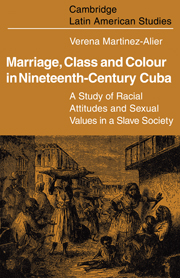
  • Marriage, Class and Colour in Nineteenth-Century Cuba

    Cambridge University Press (available in the United States at University of Michigan Press here.)
    August 1974
    224 pages
    216 x 140 mm
    Paperback ISBN: 9780521098465

    Verena Martinez-Alier (a.k.a. Verena Stolcke), Professor Emeritus of Social Anthropology
    Universitat Autónoma de Barcelona

    An analysis of marriage patterns in nineteenth-century Cuba, a society with a large black population the majority of which was held in slavery but which also included considerable numbers of freedmen. Dr Martinez-Alier uses as her main source of evidence the records in Havana of administrative and judicial proceedings of cases in which parents opposed a marriage, of cases involving elopement, and of cases of interracial marriage. Dr Martinez-Alier develops a model of the relation between sexual values and social inequality. She considers the importance of the value of virginity in supporting the hierarchy of Cuban society, based on ascription rather than achievement. As a consequence of the high evaluation of virginity, elopement was often a successful means of overcoming parental dissent to an unequal marriage. However, in cases of interracial elopement, the seduced coloured woman had little chance of redress through marriage. In this battle of the sexes and the races, the free coloured women and men played roles and acquired values which explain why matrifocality became characteristic of black free families.

    Table of Contents

    • Introduction
    • Part I. Interracial Marriage:
      • 1. Intermarriage and family honour
      • 2. Intermarriage and politics
      • 3. Intermarriage and Catholic doctrine
      • 4. The white man’s view
      • 5. Colour as a symbol of social status
      • 6. Intraracial marriage
    • Part II. Honour and Class:
      • 7. Elopement and seduction
      • 8. Conclusion: Some analytical comparisons.

    Read the introduction here.

    …Nineteenth-century Cuba cannot be treated as a historical and geographical isolate. Political factors outside Cuba were significant in shaping interracial marriage policy. The cultural tradition of Spain which during three centuries had espoused ‘purity of blood’ as the essential requisite of Spanishness must also be taken into consideration. Racism antedates slavery in the Americas and, as W. Jordan has proposed, the question would be to explain why African negroes (and not for instance the American Indians) were enslaved in the first place. To establish, therefore, a direct causal link between slavery as a highly exploitative system of production and racism would be too simple…

  • Interracialism and Contemporary Religion

    Oklahoma State University
    2007
    105 pages
    AAT 1443028

    Wayne S. White

    Submitted to the Faculty of the Graduate College of the Oklahoma State University in partial fulfillment of the requirements for the Degree of Master of Science

    The purpose of this study was to examine the myths and theories related to interracial couples regard to contemporary religious institutions. This study is an exploratory in Nature and focused primarily on the acceptance of heterosexual biracial (Black/White) couples within a religious setting. The methodology used for the purpose of this study was content analysis of literature that was important to the framing of topic from a historical perspective to the present. Method techniques were also borrowed from social constructionism and labeling theory when analyzing the literature.

    The findings of this research project found that religious mythologies and social theories about the nature of interracial marriage among Black/White couples continues to be problematic for religious mixed race couples. These myths and theories are based on the assumption that biracial couples are a threat to a well established White dominant racial hierarchy. Furthermore, the socially constructed image of interracial couples that emerges from these myths and theories become the basis of racist ideology without hard empirical evidence to support these assertions. Nevertheless, the cultural assumption still exist among the general public and within some religious institutions and have real life consequences for some mixed race couples. Thus the social construction of reality is ongoing for some interracial couples. This research is important because it provides insight into human behavior and actions within an institution whose inner workings are often private while outwardly claiming to be accessible to everyone without prejudice.

    Table of Contents

    • I. INTRODUCTION
      • Definition of Terms
      • Purpose of the Study
      • Contribution to Sociology
      • Preview of the Remaining Chapters
    • II. REVIEW OF LITERATURE
      • Introduction
      • Religion and Racism
      • Contemporary Myths and Theories
      • Summary
    • III. THEORETICAL CONCERNS
      • Introduction
      • Discussion of Social Construction
      • Discussion of Contact Theory
      • Summary
    • IV. METHODOLOGY
      • Introduction
      • Content Analysis of Literature
      • Sampling Technique
      • Themes and Classifications
    • V. FINDINGS
      • Authors’ Approach & Perspectives
      • Religious Opposition to Interracial Relationships
      • Coping Mechanism of Interracial Couples
      • Interracial Congregations as the Answer to Racism
    • VI. CONCLUSION
      • Connecting Theory To Findings
      • Limitation of the Study & Future Implications
    • REFERENCES

    LIST OF TABLES AND FIGURES

    • Tables
      1. Chapter and Subheadings Discussing Myths and Theories about Blacks and Interracial Relationships
      2. Authors’ Approach and Perspectives
      3. Participation in Racially Diverse Worship
      4. Methods of Discouraging Interracial Relationships by Religious Leaders
      5. Coping Mechanisms of Interracial Couples
    • Figures
      1. Factors Determining Interracial Contact
      2. Mythologies and Theories Found in Texts
      3. Discussion of Race Relations in Society
      4. Whites Not As Accepting of Interracial Dating

    INTRODUCTION

    Some contemporary Christian leaders use their pulpits to discourage heterosexual interracial relationships while others use their influence to vocalize support for racial intermarriage. A White pastor of a multiracial church in Tulsa, Oklahoma informed his daughter while she was in kindergarten (when he came home and found a little African American boy there), “Hey look we’re friends, we play, we go together in groups but we do not date one another. We don’t mix our races” (Price 2001:32).

    The minister in this example based his objection to mixed race relationships on theological grounds, saying interracial marriages are a direct violation of the Word of God (Price 2001:33-34). But he also argued racial intermarriage ought to be opposed by the Black community as a matter of racial pride and on the basis of racial purity. He said,

    “There’s only 13% of the population that is your color. If we continue to mix it (there) ain’t going to be none of you left. There ain’t nobody going to be able to say Black is beautiful; they’re going to have to say mixed is beautiful” (Price 2001:38).

    What this example illustrates is that segregationist notions about race are constructed from religious ideology. The construction of separatist ideology is an attempt to dictate what constitute legal and illegal sexual contact between Blacks and Whites. Historically the prohibiting of interracial relationships between Blacks and Whites was presented as being for the good of society (Chappell 1998:237-262; Hughey 1987: 23-34).

    For example, Kevin Strom (2000)vargues that race mixing is a crime worse than murder. He wrote:

    “When you commit murder you kill one man, you end one life: you tragically injure one family and circle of friends. When you commit murder, if your victim has had no children you do cut off the potential existence of one small branch of the (white) race’s future. But when you commit the crime of racial mixing you are participating in genocide.” (Strom 2000:30-31)

    Contrary to Strom’s position scholars like Yancey (2002) and Campolo (2005) come to the defense of racial intermarriage. They do not see society being harmed by race mixing nor do they find any theological grounds for opposing interracial marriage. Rather they suggest there are certain scriptures which actually support heterosexual interracial relationships. Yancey (2002) claims that Christ has removed any racial barrier between ethnic groups (Yancey 2002:16-17)2. Campolo cites Galatians 3:283 as another proof text for support of interracial marriages and integrated congregations (Campolo 2005: vii-xi).

    This research project is an exploratory work on the role of Christianity and society in the debate on interracial relationships. The purpose of this research is to examine the formal and informal institutional structures and the social practices that either impede or facilitate biracial couples ability to find a welcoming place to worship despite the fact there is no legal basis for opposing interracial marriages. In examining social interaction between religious biracial couples and the religious world, this paper examines the coping mechanisms of mixed race couples and the effectiveness of contact theory in reducing racial prejudice and discrimination. I expect the literature to show that some biracial couples in the face of religious opposition cease their religious practice, while others may continue their search until they find a congregation where they are accepted or experience a measure of tolerance.

    The literature will show that through fear of mixed race relationships between Blacks and White’s monochromatic congregations were formed in an effort to prevent interracial relationships and to promote social segregations. This material will also demonstrate the efforts of those Christian leaders who support racial intermarriage as a way of solving racial problems in American society. It will examine the notion that biracial congregations are one way of obtaining racial reconciliation through social contact because they promote inclusiveness (Becker 1998:451-472; Bryan 2000: 25-27; DeYoung 2004:128-147; Dougherty 2003)…

    Read the entire dissertation here.

  • The Wormiest of Cans: who gets to be “mixed race”?

    Racialicious
    2011-07-12

    Thea Lim

    A few days ago on Facebook I watched two community activists have a throwdown over the phrase “mixed race.”

    It began when Activist X posted a link to this article about the Mixed Roots Film and Literary Festival and noted with some irritation that despite the festival’s claims to inclusivity, there were no Latin@s mentioned in the article. X asked: if Latin@ people are the largest group of multiracial people in the Americas and the festival is supposed to be open to everybody, why weren’t Latin@ people included? A few people agreed with X, and some people who had been at the festival said that they thought Heidi Durrow and the festival were great, but that they could see X’s point.

    Enter Activist Y: after expressing some trepidation, Y said that the festival was using the term “mixed race” or “multiracial” to refer to people who had parents of two or more different racial categorisations. Activist Y said that if your whole family shared the same ethnic identity, then you were not mixed in the way the festival intended.

    Dear Racializens, I am sure you can imagine what happened next: a veritable Facebook wall brawl — albeit one that was highly intellectual and restrained. Most people sided with X (it was X’s wall to begin with) and Y, after making several long attempts to explain themselves, eventually left in a digital huff.

    This exchange brought back some of the most difficult writing that I have ever done on Racialicious: where readers challenged my right to call myself, as a mixed race person with parents of two different races, mixed in a separate way from those who are mixed race but share the same identity as their whole family, for e.g. folks who are mestizo, Creole, African American, Metis, Peranakan…

    …Using the term “mixed race” in this narrow way is to systematically erase ethnic histories that bear witness to slavery and colonization; or simply, to erase ethnic histories, period. To do so can be read as an act of white supremacy: it covers up the fact that many Americans, regardless of skin colour or the stories elders are willing to tell, have mixed lineages. To do this silences a whole community’s right to express their experience…

    Read the entire article here.

  • Creating the Creole Island: Slavery in Eighteenth-Century Mauritius

    Duke University Press
    2004
    360 pages
    5 illustrations
    Cloth ISBN: 978-0-8223-3402-6
    Paperback ISBN: 978-0-8223-3399-9

    Megan Vaughan, Smuts Professor of Commonwealth History
    Cambridge University

    The island of Mauritius lies in the middle of the Indian Ocean, about 550 miles east of Madagascar. Uninhabited until the arrival of colonists in the late sixteenth century, Mauritius was subsequently populated by many different peoples as successive waves of colonizers and slaves arrived at its shores. The French ruled the island from the early eighteenth century until the early nineteenth. Throughout the 1700s, ships brought men and women from France to build the colonial population and from Africa and India as slaves. In Creating the Creole Island, the distinguished historian Megan Vaughan traces the complex and contradictory social relations that developed on Mauritius under French colonial rule, paying particular attention to questions of subjectivity and agency.

    Combining archival research with an engaging literary style, Vaughan juxtaposes extensive analysis of court records with examinations of the logs of slave ships and of colonial correspondence and travel accounts. The result is a close reading of life on the island, power relations, colonialism, and the process of cultural creolization. Vaughan brings to light complexities of language, sexuality, and reproduction as well as the impact of the French Revolution. Illuminating a crucial period in the history of Mauritius, Creating the Creole Island is a major contribution to the historiography of slavery, colonialism, and creolization across the Indian Ocean.

    Table of Contents

    • Acknowledgments
    • Preface
    • One – In the Beginning
    • Two – Engineering a Colony, 1735-1767
    • Three – Enlightenment Colonialism and Its Limits, 1767-1789
    • Four – Roots and Routes: Ethnicity without Origins
    • Five – A Baby in the Salt Pans: Mothering Slavery
    • Six – Love in the Torrid Zone
    • Seven – Reputation, Recognition, and Race
    • Eight – Speaking Slavery: Language and Loss
    • Nine – Metissage and Revolution
    • Ten – Sugar and Abolition
    • Notes
    • Works Cited
    • Index
  • The Love Story That Made Marriage a Fundamental Right

    Color Lines
    2011-04-27

    Asraa Mustufa

    The Tribeca Film Festival is under way in New York, and one featured documentary delves into the story behind the landmark civil rights case Loving vs. Virginia, which struck down Jim Crow laws meant to prevent people from openly building families across racial lines. 

    Mildred and Richard Loving were an interracial couple that married in Washington, D.C., in 1958. Shortly after re-entering their hometown in Virginia, the pair was arrested in their bedroom and banished from the state for 25 years. The Lovings would spend the next nine years in exile, surreptitiously visiting family and friends back home in Virginia—and fighting for the right to return legally. Their case wound its way to the Supreme Court and, in 1967, the Court condemned Virginia’s Racial Integrity Act as a measure “designed to maintain white supremacy” that violated due process and equal protection. The ruling deemed the anti-miscegenation laws in effect in 16 states at the time unconstitutional. However, it took South Carolina until 1998 and Alabama until the year 2000 to officially remove language prohibiting interracial marriage from their state constitutions.

    The landmark case has returned to popular consciousness in recent years as states have debated same-sex marriage rights. Marriage equality advocates have pointed to the Lovings’ fight as a foundational part of American history, establishing marriage as a basic civil right. But for decades it was left to the footnotes of civil rights history, overshadowed by blockbuster cases like Brown vs. Board of Education.

    Director Nancy Buirski’sThe Loving Story” aims to deepen public understanding of not just the case but the Loving family itself. The filmmakers recreate their story through interviews with their friends, community members and the attorneys fighting their case. Buirski and her team revived unused footage of the Lovings from 45 years ago, including home movies, and dug up old photographs to bring the couple to life. As a result, the film is as much an engaging love story as it is a history of racist lawmaking. 

    “The Loving Story” is making the film festival rounds this year and will air on HBO in February 2012. I spoke with Buirski after the film’s Tribeca screening this week…

    Read the entire article here.

  • The New Face of America: How the Emerging Multiracial, Multiethnic Majority is Changing the United States

    Praeger Publishers
    May 2013
    195 pages
    6 1/8 x 9 1/4
    Hardcover ISBN: 978-0-313-38569-8
    eBook ISBN: 978-0-313-38570-4

    Eric J. Bailey, Professor of Anthropology and Public Health
    East Carolina University, Greenville, North Carolina

    This unique and important book investigates what it means to be multiracial and/or multiethnic in the United States, examining the issues involved from personal, societal, and cultural perspectives.

    The number of Americans who identify themselves as belonging to more than one race has gone up 33 percent since 2000. But what does it mean to identify oneself as multiracial? How does it impact such basics as race relations, health care, and politics? Equally important, what does this burgeoning population mean for U.S. businesses and institutions?

    More and more, the idea of America as a melting pot is becoming a reality. Written from the perspective of multiracial citizens, The New Face of America: How the Emerging Multiracial, Multiethnic Majority is Changing the United States brings to light the values, beliefs, opinions, and patterns among these populations. It assesses group identity and social recognition by others, and it communicates how multiracial individuals experience America’s reaction to their increasing numbers.

    Comprehensive and far-reaching, this thoughtful compendium covers the cultural history of multiracials in America. It looks at multiracial families today, at rural and urban multiracial populations, and at multiracial physical features, health disparities, bone and marrow transplant issues, adoption matters, as well as multiracial issues in other countries. Multiracial entertainers, athletes, and politicians are considered, as well. Among the book’s most important topics is multiracial health and health care disparity. Finally, the book makes clear how America’s current majority institutions, organizations, and corporations must change their relationship with multiracial and multiethnic populations if they wish to remain viable and competitive.

  • Gender, Mixed Race Relations and Dougla Identities in Indo-Caribbean Women’s Fiction

    6th International Conference of Caribbean Women’s Writing: Comparative Critical Conversations
    Goldsmiths, University of London
    Centre for Caribbean Studies
    2011-06-24 through 2011-06-25

    Christine Vogt-William
    Johann Wolfgang Goethe University, Frankfurt, Germany

    Once a pejorative term in Hindi meaning ‘bastard’, dougla is used nowadays to designate those of African and Indian parentage in the Caribbean. Relations between African and Indian communities in the Caribbean have been fraught, due to the divide-and-rule policies implemented by the colonial plantocracy, missionaries and state regimes, in order to discourage interracial solidarity and cooperation. Vijay Prashad observes: “the descendants of the coolies and the slaves have struggled against the legacy of both social fractures and of the mobility of some at the expense of others“ (Prashad, 2001: 95). Yet, despite this there were transcultural alliances between Afro-Caribbeans and Indo-Caribbeans. However the figure of the dougla was considered by many middle class Indians as a potential threat to Indian cultural coherence and by extension to a powerful political lobby under the demographic category of “East Indian” (Prashad, 2001: 83). Indo-Caribbean culture, history and literature cannot be examined without acknowledging the transcultural aspects of dougla heritages.

    The focus of my paper will be on how gender and mixed race relations are addressed in novels by Indo-Trinidadian-Canadian writers Ramabai Espinet and Shani Mootoo. The genre of the novel could be read as an adequate site to address the interrogation of hybrid identities with a view to engendering a Caribbean feminist dougla poetics, since literature is “a medium that is not understood to be exclusively the cultural capital of Indo- or Afro-Trinidadians” (Puri, 2004: 206). Gender roles and expectations from both Indo-Caribbean and Afro-Caribbean communities inform and complicate racial relations—factors which are rendered even more complex due to the histories of slavery and indentured labour and how these served to shape Afro-Caribbean and Indo-Caribbean women’s self-perceptions. In view of these histories, I read The Swinging Bridge (Espinet) and He Drown She in the Sea (Mootoo) with the aim of charting spaces to articulate alternative perspectives normally disallowed by hegemonic racial representations (Afro-Creole and Indian “Mother Culture”), which also repress the gender and class inequalities within Afro-Caribbean and Indo-Caribbean communities. These spaces then might provide the dougla potential of disrupting dominant racial and gendered stereotypes, thus allowing for specifically transcultural feminist interventions in prevalent gender and race imagery.

    For more information, click here.

  • Rebuilding the Tower of Babel

    Pelican Publishing Company, New Orleans
    1957
    24 pages
    Source: Digital Collections of the University of Southern Mississippi Libraries
    USM Identifier: mus-mcc030

    Stuart O. Landry

    From the McCain (William D.) Pamphlet Collection; In this pamphlet, Landry asserts that integrationists are trying to reunite the races that God separated in the Old Testament story of the Tower of Babel. He asserts that new anthropological and psychological theories of racial equality are pseudoscientific and backed by Communist interests. Landry cites some Old Testament quotations that he interprets as implying that segregation is ordered by God, and he asserts that race amalgamation will be lead to the downfall of Christianity. He also compares African Americans’ social condition to that of Jews, Italians, Germans, and Irish in order to support his argument that African Americans’ place at the bottom of the United States’ social structure is a result of their lack of effort.

    FOREWORD

    This is not an attack upon the Church nor a criticism of Christianity. It is not a message of hate or of intolerance. On the contrary, it is a plea for broad-mindness on the part of many Christian groups who are becoming narrow-minded with respect to the ideas and customs of brother Christians.

    It is with reluctance that I emphasize the difference—physical, mental and cultural—between white people and colored people. It looks like I am acting the Pharisee, wearing his phylacteries with an air of “better than thou.” But such is not the case.

    My enumeration of racial differences is no more invidious than making a comparison between men and women between whom there are many physical and mental differences. I am simply trying to show the disadvantage of race-mixing.

    Above all, I am not trying to close the door of opportunity to anyone, or condemn any individual to failure by making him feel inferior. This he can easily disprove. My generalizations apply to large groups. If any man can rise above his environment, more power to him!

    S. O. L.

    And the whole earth was of one language and of one speech… And they said Let us build a city and a tower whose top may reach into heaven… And the Lord said Let us go down there and confound their language that they may not understand one another’s speech… Therefore is the name called Babel because the Lord did there confound the language of all the the earth; and from thence did the Lord scatter them abroad upon the face of all the earth.

    Genesis XI: 1-9.

    The good church people of the United States want to rebuild the Tower of Babel. They wish to do away with races and the confusion of tongues. Can they climb to heaven on such a structure?

    The building of a new tower reaching to high heaven, even if only figurative, transgresses the will of God, who thousands of years ago destroyed the actual attempt and scattered peoples all over the world, and contravenes the laws that govern human nature.

    But most church members seem to have forgotten the story of Babel, and today are much concerned over the alleged discrimination against Negroes and other races.

    The thought of the times is, let’s desegregate and integrate. Let’s bring together men of all colors, races and countries—we are all brothers under the skin. Let’s go back to Babel.

    The movement to do away with all racial segregation in school, church and social life (which eventually means amalgamation of the races and the mongrelization of the white race) has now found favor with all the leading church groups of America…

    …The Presbyterian Church is now taking the lead in the “desegregation revolution.” The 168th General Assembly (Presbyterian Church in the U. S.) in May 1956 called for all-out efforts to end segregation in the fields of education, housing and industry. On June 14th, 1956 the Presbyterian Session of New York unanimously approved a resolution commending the work of the National Association for the Advancement of Colored People.

    Only recently a Presbyterain minister told the General Assembly of the Church of Ireland that inter-marriage between black and white “on an immense scale” would solve the color problem.

    In Connecticut last year a Presbyterian church with a predominantly white congregation called a Negro pastor. What has this great church come to, once the strict interpreter of the Bible, when it now thinks that the Ethiopian can change his skin!…

    The “Scum” Origin Of Integration

    The idea of racial equality and integration has come up from the lower orders of the social scale. The underworld knows no class. Prize fighting, not exactly the underworld, but not a very cultural institution, was the first sport to “integrate.” Now we find kindly old ladies all over the land watching Negro brutes fighting white brutes on television and glorying in knockouts.

    Night clubs, “hot-spots,” and taverns went for racial equality rapidly. Negroes have preempted this form of enlightened entertainment. With sex, obscenity, jazz, rock-and-roll music, the night life of the country is far from being elevating, yet much of it slops over into radio and television to familiarize us all with the idea of non-segregation…

    …There is no Commandment against segregation, no prohibition of it in the Bible nor in any of the great canons of moral law. Segregation was not a sin ten years ago, it was not a sin a hundred years ago, it was not a sin a thousand years ago and it is not a sin now. If right and wrong change with the years then the materialistic philosophy of William Graham Sumner is correct—that is, morals vary with the times and in accordance with the culture of peoples. This is the view of Karl Marx and modern communists. Such a view is against the principles of the Christian religion which believes in the Eternal God and absoluteness of truth. Right does not change with the years. It does not become wrong because of the preaching of false prophets, who, from mistaken or ulterior motives, make the welkin ring with their declamations against what they call injustice and immorality.

    A Practical Solution

    Segregation is a practical working method whereby large numbers of two race?, differing in customs, culture and intelligence, living in the same area, are in constant contact with each other without trouble or dissension. Under the systems employed in countries and states where the population is bi-racial, segregation has worked successfully. In the Southern states of the United States, in spite of the belief to the contrary, Negroes have had all the opportunity the land afforded…

    …The Harm Of Racial Mixing

    The question is asked that if the Bible is vague on the question of segregation, wouldn’t we resolve the problem more in keeping with Christian brotherhood if we declared it against the policy of the Church? What is the harm of mixing the races together in churches, schools and social affairs?

    Well, the harm in the fraternizing and mixing of white and colored people comes in the breaking down of the social inhibition against the intermarriage between whites and Negroes. Race mixing that leads to racial intermarriage is a crime against the future of the white race. To mix the black and white races is bad science, bad eugenics and bad genetics. It is not a matter of Christianity, it is a matter of common sense, a practical matter that affects the future of all our people.

    The Church, in advocating integration or the mixing of the races in schools and social affairs, knows that this will lead to eventual amalgamation and the absorption of the Negro race all to the disadvantage of the race that absorbs them.

    On the same theory that all men are brothers we will then begin to mix in with the Chinese, East Indians and more Africans. Soon we will have one race of people. I do not understand why the good Christians of this country cannot see that in the event we absorb all the races of the world, or rather that we are absorbed by them since there are twice as many colored people as there are whites, religion as we know it today will disappear. We will have no more Christianity. We will have some kind of blended belief such as advocated by Arnold Toynbee. Back to Babel again.

    Not White Supremacy But White Superiority

    No plea is made here for the denial of any of the rights to which the citizens of this country are entitled. The right to liberty, life and the pursuit of happiness belongs to everyone. There is no suggestion of a limit on the exercise of political rights, the advocating of economical and educational restrictions, or belittling the dignity of the members of any minority group.

    My plea is simply that we recognize in a common sense way that there is a difference between the white race and the Negro race, that sensible white people do not want to become too intimate socially with colored people as that only leads to intermarriage and a mongrelization of the Caucasian race…

    …How To Have A Superior People

    Up until recently eugenists—now graduated into geneticists and now soft-pedalling the theory of superior peoples or races—were pointing out to Americans as well as the world the necessity for more careful mating on the part of individuals, and the desirability of superior persons choosing their wives or husbands from outstanding families. Taking their cue from stock breeders and dog fanciers they believed that the way to bring about the evolution of a highly intelligent and moral people was to mate together people who possessed these qualities. But modern ethnologists, sociologists and even geneticists wish us to disregard the principles employed by practical breeders of cattle, dogs, birds, flowers and plants when it comes to race mixing.

    Influenced by propaganda the doctors of these “sciences,” which are still vague and far from exact, are saying in effect that black is white and there are no racial differences that are consequential. They want us to develop into a hybrid or mongrel race…

    Read the entire pamphlet here.

  • The Missing Bi-racial Child in Hollywood

    Canadian Review of American Studies
    Volume 37, Number 2 (2007)
    pages 239-263
    E-ISSN: 1710-114X; Print ISSN: 0007-7720

    Naomi Angel

    The growing interest in issues pertaining to “mixed-race” identities and communities, as well as a surge in films with “mixed-race” characters has prompted this examination of representations of “mixedrace” characters in film. The research consists of an analysis of selected films, including Guess Who’s Coming to Dinner and Jungle Fever, and situates this analysis within a historical framework based on the particular context in which each film was set and/or made. The value in studying “mixed-race” representations in film lies in the reflection it provides of significant moments in “mixed-race” histories and in the portrayal of cultural imaginings of people of “mixed race.”

    Read or purchase the article here.