• The Caste Taboo in William Faulkner’s “Elly” and “Mountain Victory”

    EuroAmerica: A Journal of European and American Studies
    Volume 25, Number 3 (September 1995)
    pages 1-24
    Online ISSN:1991-7864; Print ISSN: 1021-3058  

    Wen-ching Ho
    Institute of European and American Studies, Academia Simca, Republic of China

    Miscegenation is “the ultimate horror.”
    Flannery O’Connor, Everything That Rises Must Converge (414)

    In William Faulkner’s social milieu, white male hegemony fostered a double standard which condoned one form of miscegenation, between white men and black women, while vehemently prohibiting the other form. Both condonement and prohibition had to do with maintaining the existing racial structure. To be more specific, one means of ensuring white dominance was, as James Kinney has pointed out, to extend their mastery over blacks to the bed, where the sex act itself served as ritualistic reenactment of the daily pattern of social dominance. Another means of sustaining white dominance was to deny the offspring produced from miscegenetic liaisons. By relegating mulattoes to the status of blacks, whites could maintain the sharpness of racial distinctions and the attendant power relationships. A corollary of the imposed classification is the evolution after Reconstruction of a more stringent line of racial demarcation called the “one-drop rule.” The rule classed as a Negro any individual with a known trace of Negro blood in his veins. The notion that “one drop of black blood makes a Negro” eventually came to color all discussions on the subject of miscegenation, particularly the taboo form.

    As Gunnar Myrdal has noted, the entire Negro problem in America hinges upon this social definition of “race,” with which came the whole stock of valuations, beliefs, and expectations in the two groups, causing and constituting the order of color caste (117). Joel Williamson expresses a similar view when he says summarily that one central fact about the transformation of race relations during the years from 1850 to 1915 is that the whites of the South led the nation in turning from a society in which some blackness in a person might be overlooked to one in which not a single iota of color was excused (109). Booker T. Washington explained the situation quite graphically at the turn of the century: “It is a fact that, if a person is known to have one per cent of African blood in his veins, he ceases to be a white man. The ninety-nine per cent of Caucasian blood does not weigh by the side of one per cent of African blood. The white blood counts for nothing. The person is a Negro every time” (158).

    Closely associated with the evolution of the one-drop rule were three strains of thought that interacted to shape white America’s attitudes toward interracial mixture and the nature of mulattoes: polygenism, Lamarckism, and Darwinism. Polygenism contributed ideas about racial differences and inferiority, especially through its emphasis upon notions of racial “genius” and of race as a supraindividual entity. Lamarckism offered an explanation for the evolution of races and the development of the racial essence which, once in the blood, passed on to succeeding generations. The Darwinian notion of hereditary variation not only reinforced feelings of racial superiority and inferiority but in its concentration on evolutionary change also underscored the need for care in terms of which characteristics should be perpetuated or eliminated.

    These strains of thought operated together to shape the racial thought in the half-century after Emancipation. They provided late nineteenth- and early twentieth-century academicians the theoretical basis for “scientific” ideas about race in general and miscegenation in particular. The academicians shared the following beliefs: (1) Negroes were temperamentally, physically, and intellectually different from whites; (2) Negroes were also inferior to whites in at least some of the fundamental qualities where-in the races differed, especially in intelligence and in the temperamental basis of enterprise or initiative; (3) Such differences and differentials were either permanent or subject to change only by a very slow process of development; and (4) Because of these permanent or deep-seated differences, miscegenation, especially in the form of intermarriage, was dangerous, for the crossing of such diverse types invariably resulted in a short-lived and unproliflc breed…

    Read the entire article here.

  • Living as Others in Japan

    Japanese Studies Association of Australia 2011 Biennial Conference
    Internationalising Japan: Sport, Culture and Education
    University of Melbourne, Melbourne Law School
    185 Pelham Street
    Carlton, Victoria 3053, Australia
    2011-07-04 through 2011-07-07

    Wednesday, 2011-07-06, 11:00-12:30 AEDT (Local Time)
    Room 102

    This panel will present two historical papers about individuals whose lives were affected by the Pacific War, and a third paper which examines issues involving intercultural communication between Japanese and non-Japanese people. The two historical stories focus on how their respective individuals navigated their life course as “Others” in Japan. Hamilton will shed light on children born to Japanese mothers and Australian fathers during the Allied Occupation in Kure. Tamura’s paper is on a businessman of mixed heritage, English and Japanese, born in Kobe, who was interned in Japan. Parry’s paper provides a look into intercultural communication between Australian students in a homestay among ten Japanese host parents.

    Kure Kids
    Walter Hamilton

    Walter Hamilton has recently completed a book on the mixed-race children of the Occupation, under the working title of Lest We Beget: The Mixed-Race Legacy of Occupied Japan. (www.lestwebeget.com).

    Nearly sixty years have passed since the post-war occupation of Japan. It might be assumed historians will have exhausted all there is to say about its political, economic and social effects. But one unexplored aspect remains vividly alive: the hidden ancestral links that bind Australians, Americans, Britons and others to Japanese blood-relations never known, never met: the unclaimed, mixed-race offspring left in Japan when the troops departed. Their fathers would not or could not acknowledge them: an estimated 10,000 children, including several hundred fathered by Australians.

    So familiar is the idea of military conquest leading to the birth of “unwanted” children outside marriage – across racial, class and cultural divides – they tend to be dismissed as a natural corollary of war. Their appearance in occupied Japan came as no surprise. The “Madame Butterfly” tradition provided a high-toned model of Western men exploiting Japanese women. As if their biological inevitability made them what they were, the children attracted scant attention from Western writers, who acquiesced in facile assumptions about their fate. Surely they were disowned by their fathers, lamented by their mothers and thrust to the lower depths of society. The eminent American historian John Dower has called them “one of the sad, unspoken stories” of the occupation. Japanese historical and fictional treatments of the issue also suffer from a determination to link the children exclusively to prostitution, moral collapse and national humiliation.

    Australia joined the occupation not expecting to convert the former enemy but to punish and ostracise him. With immigration restrictions, in some respects, even tighter than they were in 1941, permission was denied for troops in Japan to marry across the race divide. Anyone defying the ban risked being forcibly removed from his de facto wife and children. Although these measures were relaxed in 1952 to admit the first Japanese war brides, no such right was extended to the unacknowledged or orphaned children of Australian servicemen. In addition, the federal government maintained an elaborate deception to stop the children being adopted by Australian families. Bogus welfare arguments were used to cover a purely political determination. The moment the strategy showed signs of faltering, it was reinforced through public monies being deployed to keep the children in Japan. There were almost no exceptions, even for the sons and daughters of brave men who had fought and died in the Korean War. In the words of a leading churchman of the day, the Reverend Alan Walker: “There have been few more disgraceful incidents in the whole miserable history of Australia’s racial immigration policy.”

    This paper will introduce several individuals born in or near the city of Kure, in Hiroshima prefecture, where the British Commonwealth Occupation Force (BCOF) was based from 1946 until the withdrawn of the last Korean War contingent in 1956. The Kure Kids encountered discrimination because of their physical appearance, dysfunctional family life, low socioeconomic status and social isolation. But the lives of these Japanese “others” represented much more—in quality, variety and achievement—than is suggested by the conventional portrayal of “sad, unspoken stories.”

    Between Father Land and Mother Land: a British-Japanese Dual National and his Pacific War
    Keiko Tamua

    In war, individuals are categorized either as friend or foe, and enemy nationals are seen and treated with suspicion and fear. In December 1941, when the Pacific War started, about 700 out of 2134 civilians of the Allied nations who were residing in Japan were arrested or interned as enemy aliens. Most of them had lived in Japan for a number of years and had become part of the community. Some civilians were repatriated to their home countries on exchange boats in 1942 and 43, but others decided to remain in Japan even though they knew they were going to be interned or kept under police surveillance. Most of them had mixed heritage through their parents and/or having Japanese spouse; they thought their home was Japan rather than Britain or the USA, and they felt they could not leave without their family members.

    F. M. Jonas was one of these expatriates who were caught in the war. He was born in Osaka in 1878, having a British father and a Japanese mother. He had established himself as a respectable British businessman in pre-war Kobe, running a stevedore business at the port. He was highly regarded both in the expatriate and Japanese communities, having been vicechairman of the Kobe Foreign Chamber of Commerce, and president of the Kobe Regatta and Athletic Club – the premier expatriate social club in Kobe. When the war started Jonas was arrested by the Japanese authorities, and later interned as an enemy alien. However, he managed to secure release from internment through British-Japanese dual citizenship, and he changed his name to Morii Kamejirō. When the war ended, he tried to re-establish his formal status as a British national. He died in 1950 before final resolution was officially made. Did he claim citizenship of convenience to suit the circumstances, to avoid internment, and consequently did he betray his father land? Or did he have legitimate reasons to do so? What were the consequences of his action for himself and his family? Japanese nationality laws upheld the principle of paternal succession until 1985, and dual citizenship has never been recognized. How did Jonas convince the authorities of his dual nationality? In this paper, I will discuss the life course of F. M. Jonas, who lived between father land and mother land in the middle of the Pacific War. Through Jonas’ story, I will explore, from a historical point of view, how the nationality of mixed decent people has been interpreted and handled in Japan and Britain.

    For more information, click here.

  • Rights of passage – the coming of the ‘wild west’ Constructs of identity and their effects upon Indigenous people

    Counselling, Psychotherapy, and Health
    Volume 3, Issue 2 (2007), Indigenous Special Issue
    pages 39-45

    Michael Red Shirt Semchison
    M.Ed.Studies; Gr.Cert.Ed.[HE]
    University of Queensland, Australia

    Introduction

    “We did not think of the great open plains, the beautiful rolling hills, and winding streams with tangled growth, as ‘wild.’ Only to the white man was nature a ‘wilderness’ and only to him was the land ‘infested’ with ‘wild’ animals and ‘savage’ people. To us it was tame. Earth was bountiful and we were surrounded with the blessings of the Great Mystery. Not until the hairy man from the east came and with brutal frenzy heaped injustices upon us and the families we loved was it ‘wild’ for us. When the very animals of the forest began fleeing from his approach, then it was that for us the ‘Wild West’ began.”—Luther Standing Bear, Lakota, 1933.

    It was the decade of the 1860s, the time of birth of one of my ancestors Luther Standing Bear who grew to manhood during years of crisis for the Lakota and other nations of the Great Plains. At last the process of colonisation begun in 1492, when we were labeled ‘Indian’, had reached the West. While he was still a young boy the traditional way of life of the Lakota was undergoing dramatic change. Already we had been renamed by the French fur traders and were called the Sioux. The controversial Fort Laramie Treaty of 1868 had been legislated and the great Sioux Reservation had been firmly incorporated. In the years that followed virtually every important aspect and institution of Lakota life was subject to change. The annihilation of the buffalo and other natural food sources, plus confinement to the reservation caused the erosion of old traditions and forced our people to depend upon the government for the necessities of life. Our societies of autonomy were weakened and normal avenues of social and political advancement were closed. Opposition to government programs by traditional leaders caused dramatic confrontations which led to efforts to destroy positions of leadership and to create rival headmen more sympathetic to the will of agents and Washington officials. Agency police were recruited through coercion and made responsible to the already entrenched Bureau of Indian Affairs. This provided another onslaught upon Lakota traditions and further strengthened the position of the appointed Indian Agent. Government support of missionaries and their efforts to convert the ‘heathen’ undermined our religion and spiritual beliefs and practices. The prohibition of sacred ceremonies including the Sun Dance, our most important annual religious and social event, was devastating. Last but not least, education programs were developed to hasten acculturation and prepare the Lakota and other Indigenous Americans for assimilation into the dominant white society (Ellis, 1975)…

    Through this dissertation I will endeavor to present a picture of the world that continues to exist for Indigenous people, one controlled by a dominant society that persists in grinding out old injustices under new guises. There will be a review of some of the complex actions created via political ontology and social influences that offend morality and common sense; actions explained away routinely by a system of administration relying upon obscurity and intricacy to insulate itself from scrutiny and criticism (Cahn and Hearne, 1969). A comparison of Native American and Australian Aboriginal experiences will be used examining some of the issues that brought conflict into Indigenous communities and centering on constructs of identity. This will include imposed caste systems and blood-quantum measurements used to determine and define a person as being ‘real’ in a culture. How these separate and divide individuals, families and whole communities will be of primary concern.

    To better understand the effects of re-identifying people we must step back in historical time to see how the theory and system of ‘other’ came into being. In 15th century Europe use of the term race generally referred to differences between groups within a community based upon rank or social station. When countries such as England and Spain began full scale colonisation during the 16th and 17th centuries the vanquished became regarded as being of a different race because they were unlike their vanquishers. Then the mass movement of people came around the globe by the colonisers and their subjects, especially through the slave trade. The shift in the meaning of race then became crucial as capitalism and nationalism in Europe arose, with the success of these systems dependent upon the accumulation of new resources and military power. These factors and the use of subdued non-European labour led to the belief that Europeans were both culturally and racially superior. By the 18th century racial hierarchies were fixed based on physical differences and a modus operandi for the classification of all natural life as objects, including human beings was established (Hollinsworth, 1998. 35-43). A new worldview had emerged and was readily adopted by most European nations, especially those embroiled in the race for colonial riches to advance their needs for economic and social dominance. By having ‘scientific proof’ through the theory of evolution espoused by Darwin, the dialogue for the identification of humans seen to be inferior and the labeling of them as savages, heathens, deviants or sub-humans became an acceptable tool for exploitation. All non-whites were now categorised as ‘colored’ and put into a place of being ‘other’ to the rest of the world (Blumenbach, 1806). It became legal terminology and thus justified the dehumanisation of all Indigenous people and treatment of them, most notably the Africans, the Native Americans and the Australian Aborigines…

    Removal was one of the deciding factors in the disenfranchisement of indigenous people and had a dual role to play. The first was the establishment of reserves or missions to restrain and control them under the authority of appointed government officials or missionaries from various church groups. This led to further corruption on all levels and miscegenation occurred. Incidences of miscegenation were already in evidence as it was part and parcel of contact with outsiders, be it consensual or forced. However, it seemed to escalate with reservation life and more children of mixed ancestry were born into these communities, which led to the second role of removal. Taking children from families and placing them in specially created residential institutions provided the means to civilize, acculturate and assimilate them into the dominant society. It was here that one of the most insidious elements of fragmentation was to occur, the division of nations by blood quantum and a caste system of identification. Children were separated and identified according to physical appearance and complexion. Those of fairer skin were seen to be less savage, more worthy of saving and easier to blend into white society, while those of darker skin were labeled as less desirable. Already alienated from parents, families, land and cultural knowledge, they were now alienated from each other (Read, 1981). It mattered not if it was the Kinchela Girls Home in New South Wales or the Carlisle Residential School in Pennsylvania; the story was the same and the attitudes of the caretakers similar. Richard Pratt, the Superintendent at Carlisle stated “I am a Baptist, because I believe in immersing the Indians in our civilisation and when we get them under holding them there until they are thoroughly soaked.” All evidence of ancestral culture was to be eliminated and replaced through the processes already legislated (Utley, 1964). Yet another construct of identity and one that has served governments well right into contemporary times.

    By the first half of the 20th century most Native Americans and Australian Aborigines had experienced a deprivation of autonomy through aggression, suppression and institutionalisation. However, it was the caste barrier of color prejudice and discrimination that separated them from mainstream society and made them outcasts in their own lands. Already there was demarcation of identity using terms such as, fullblood, half-breed or half-caste, quarter-blood or just plain ‘breed’, all measured on appearance. Kinship and membership in nations, tribes or clan groups, cultural knowledge and rights to them had been disregarded. Only those seen as full-blooded were acknowledged as being the ‘real’ Indians or Aborigines. This was based on the ‘Rule of Recognition’ established by the British and adapted in the Americas in 1825, which holds that only a person whose non-white ancestry is visible is of that ancestry. While originally formatted to refer to persons of African heritage, this was also applied to Native Americans (Gotanda, 1995. 258). It is also evident in Australia where Aborigines no longer controlled by reserve conditions were controlled by a color bar and caste system that created two distinct social environments of black and white. In this system people can be either assigned or denied opportunities depending on provisos outside their control, regardless of any abilities they might have. One extreme and officially sanctioned example of this existed until 1949 whereby the Education Department of New South Wales could exclude identifiable Aboriginal children from state schools if Anglo/European parents objected to their presence. Racism was entrenched and prejudice rampant. Identity was used as a political tool to enact power over others by putting them in a place of being ‘other’ and this process goes through all the cognitive structures of society. Economically and socially this created a multi-faceted cycle of impoverishment that entrapped Aboriginal communities on every level. Then they were blamed for it, while the real cause of economic deprivation and political powerlessness was overt and covert racial discrimination (Broome, 1994. Ch.9)…

    Read the entire article here.

  • InSide/OutSide Cultural Hybridity: Greenstone as Narrative Provocateur

    Australian Association for Research in Education (AARE)
    International Education Research Conference 2003
    AARE – NZARE
    2003-11-30 through 2003-12-03
    Auckland, New Zealand

    Tess Moeke-Maxwell, HRC Post Doctoral Research Fellow
    Department of Psychology
    University of Waikato

    This paper is a revised chapter located in my PhD thesis ‘Bringing Home The Body: Bi/multi Racial Maori Women’s Hybridity in Aotearoa/New Zealand (2003). An earlier version of this paper is to be published as a chapter in Provocations: On Sylvia Ashton-Warner and Excitability in Education. Editors: Cathryn McConaghy (University of New England) and Judith P. Robertson (University of Ottawa).

    Toward evening—we know it is evening—a canoe puts off from the bank of That Side and sets off over the river. In it are Huia and Memory and Sire paddling back from That Side to This, all chanting a paddle song the old one has recently taught them, keeping instinctive time with the paddles, which is one sure time they know—any instinctive rhythm. It is in Maori of course.

    Behold my paddle!
    See how it flies and flashes;
    It quivers like a bird’s wing
    This paddle of mine….

    But as they reach This Side landing an unrest stirs in Huia. Her allegiance to her koro on That Side confronts her feeling for Puppa on This Side. In the crossing of the polished surface of the river is the crossing from the brown to the white, although she’s too young to know it, and the emotional racial transition is not polished like the face of the river holding the gray of the sky in her waters and the glamorous gold of the trees; it is something with smudges on it, something with jagged angles. The racial transition is a sunken branch cutting the mirror surface (Ashton-Warner, 1966, pp. 63-4).

    Essentially, this paper is a summary of the ideas presented in my doctoral thesis whereby I examined bi/multi racial Maori women’s cultural hybridity in Aotearoa/New Zealand. In my concluding chapter, I utilised Sylvia Ashton-Warner’s (1966) novel Greenstone to highlight bi/multi racial women’s hybridity in her portrayal of Huia’s coming and going, from one side of the river where she lives with her Pakeha family to the Other, the ancestral home of her people and the place where her Maori grandfather still lives. Ashton-Warner’s novel is situated after the First World War. She demonstrates how children of mixed racial ancestries were multiply located across different landscapes and cultures. In Greenstone, Hybrid-Huia’s corporeal body regularly travels backwards and forwards across the river/boundary separating her two cultural worlds, This Side and That Side. The crisscrossing between This Pakeha Side and That Maori Side is portrayed as a journey/process of metaphoric images and competing landscapes that need to be traversed to make the (cultural) transition to the Other Side possible…

    Read the entire paper here.

  • The Cuffee Collaboration: CELS students, faculty reach out to help charter school

    The College of Environmental and Life Sciences, University of Rhode Island
    CELS News Site
    2009-10-27

    Rudi Hempe, CELS News Editor

    Spread over two inner city locations, one a former maintenance garage and the other one rented, the Paul Cuffee School in Providence is a far cry from the bucolic URI campus and yet a bond is being fashioned between the charter school and the university that has teachers beaming, students fascinated and professors excited.

    The collaboration began about four years ago when Dr. J. Stanley Cobb, a professor emeritus in biological sciences, looked around his late mother’s house and saw scores of books and other documents relating to someone called Paul Cuffee, an 18th Century sea captain.

    Cobb’s mother, Rosalind C. Wiggins, was an advocate for social and racial justice who spent much of her life studying and teaching about African-Americans and was editor of Paul Cuffee’s Logs and Letters

    …Born on Cuttyhunk in 1759, Cuffee was one of 10 children. His father, born in Ghana, was a former slave and his mother was a Wampanoag Indian.

    Cuffee became a wealthy sea captain and had his own ship with a crew of black sailors. He owned property in Westport, Massachusetts. In 1797, when his children were barred from attending a local school because of their mixed race, Cuffee decided to start a school for children of all ethnicities, one of several actions he took during his life to improve civil rights in this country…

    Read the entire article here.

  • Book Review Essay – The Legacy of Jim Crow: The Enduring Taboo of Black-White Romance

    Texas Law Review
    Volume 84, Number 3 (February 2006)
    pages 739-766

    Kevin R. Johnson, Dean and Mabie-Apallas Professor of Public Interest Law and Chicana/o Studies
    Univesity of California, Davis

    Dear Senator: A Memoir by the Daughter of Strom Thurmond. By Essie Mae Washington-Williams & William Stadiem. New York: Regan Books, 2005. Pp. 223.

    Unforgivalbe Blackness: The Rise and Fall of Jack Johnson. By Geoffrey C. Ward. New York: Knopf, 2004. Pp. xi, 492.

    Over the last one hundred years, racial equality has made momentous strides in the United States. State-enforced segregation ended. Slowly but surely, the nation dismantled Jim Crow. As part of that dismantling, the Supreme Court struck down bans on interracial marriage, which were popular in many states.

    Interracial relationships have increased dramatically over the last fifty years. In 2006, they meet with much greater acceptance than they did in 1950, especially in the nation’s major urban centers. The United States has begun to grapple with the issues related to interracial intimacy, such as the increasing number of mixed-race people and the controversy over transracial adoption, two topics that would have been wholly unnecessary to mention, much less analyze, just years ago. Ultimately, by transforming notions of race and races, racial mixture promises to transform the entire civil rights agenda in the United States.

    Juxtaposed against this promise of transformed racial notions, however, lies this nation’s continuing battle against the enduring legacy of slavery and Jim Crow. While adeptly shedding light on the complexities of U.S. racial history, Dear Senator: A Memoir by the Daughter of Strom Thurmond and Unforgivable Blackness: The Rise and Fall of Jack Johnson reveal just how far from this legacy the nation has advanced over the twentieth century. At the same time, the books highlight the many ways in which race relations have remained more or less the same.

    Born in 1925, Essie Mae Washington-Williams is the half-black daughter of the late U.S. Senator Strom Thurmond. Dear Senator tells the story of her life as the invisible child of a staunch segregationist and prominent national politician. Raised by her aunt in Coatesville, Pennsylvania, Washington-Williams was first stunned to learn as a teenager that her real mother—not her aunt as she had been told—was Carrie Butler, a young African-American woman who had worked as a domestic in the Strom Thurmond family home in South Carolina. A few years later she met her father, whose identity had been a tightly kept family secret. Only upon Thurmond’s death in 2003 did it become widely known that he had fathered Washington-Williams.

    A generation before Washington-Williams’s birth, Jack Johnson became the first African-American heavyweight boxing champion of the world. Unforgivable Blackness details his capture of the championship as a milestone in the social history of the United States. Previously reserved exclusively for white men, the title served as a high profile symbol of white supremacy. Consequently, Johnson’s championship reign generated great controversy and contributed to heightened racial tensions…

    …Both books reveal much about the deep-seated legal and social taboos that surrounded and influenced black–white relationships before the Supreme Court’s 1967 decision in Loving v. Virginia. The stories of Essie Mae Washington-Williams and Jack Johnson demonstrate how law and policy, combined with strong social forces, sought to enforce the strict separation of the races in intimate relationships. Nonetheless, from the days of Thomas Jefferson, such relationships (often nonconsensual) frequently formed between prominent white men and subservient African-American women. Interracial sex was kept secret; this secrecy served to maintain the myth of complete racial separation.

    Dear Senator and Unforgivable Blackness also reveal much about the social and legal double standards used to judge interracial relationships. African Americans like Jack Johnson were harshly punished for crossing the color line. Strom Thurmond, of course, legally married a series of glamorous “All-American” women and was able to keep his relationship with an African-American domestic service worker—and his half-black daughter—a secret from the general public. That liaison crossed the same line violated by Jack Johnson but was not sanctioned in the least; indeed, it fit comfortably into a long history of white men exploiting black women.

    The legacy of Jim Crow and the legal and social separation of the races continues to affect the formation of interracial relationships in the modern United States. Most Americans marry persons of the same race. Although increasing, white–black relationships are relatively rare and much less common than Asian American–white, Latino–white, and Native American– white relationships.

    A body of legal scholarship analyzing racial mixture has emerged in recent years. Some of that scholarship is autobiographical, including James McBride’s best-selling book The Color of Water: A Black Man’s Tribute to His White Mother. Adding to this body of literature, Dear Senator and Unforgivable Blackness tell memorable stories of the lives of two remarkable people and, at the same time, offer fascinating glimpses of how law and policy indelibly influenced them and their relationships.

    This Essay analyzes how these books reveal the lasting impacts of slavery and Jim Crow on modern social relations. For even with the demise of the legal prohibition on interracial relationships, the social taboo on black–white relationships remains. So long as we live in a socially segregated society, low intermarriage rates between African Americans and whites will likely remain.

    Part I of this Essay briefly summarizes the two books and places them in their proper historical, legal, and social contexts. Part II analyzes the enduring legacies of Jim Crow that Dear Senator and Unforgivable Blacknesshig highlight and discuss. These legacies include: (A) the persistence of social disfavor for black–white relationships; (B) the continued portrayal of African-American men as stereotypical criminals and hypersexual beings; (C) the endurance of the longstanding conflict between assimilation and nationalism as strategies for minorities seeking social change, personal survival, success, and happiness; and (D) the existence of white privilege in the United States, then and now…

    One is left to conclude that Washington-Williams did not really know her father. The relationship was a formally cold one; one of her most lasting memories of Strom Thurmond was his strong handshake. This lack of love, or formal public acknowledgment, could not have been anything other than deeply hurtful, even though Washington-Williams refuses to condemn any of her father’s conduct.

    …Despite family difficulties, Washington-Williams led a productive and successful life. She married an African-American man she met in college, who became a civil rights lawyer and died prematurely. Washington-Williams completed her undergraduate studies and later earned a master’s degree. Settling in the Los Angeles area, she was a school teacher and guidance counselor and raised a family. By all accounts, Washington-Williams self-identified as African American, growing up and living in African-American communities throughout her life. Though half-white, she suffered no burning ambiguity about her racial identity, showing again that race is a social, not a biological, construct. In this way, Washington-Williams self-identified as did many mixed-race African Americans, including W.E.B. DuBois and Frederick Douglass.

    At the individual level, the painful experiences of Washington-Williams show an extreme example of the racial identity issues mixed-race people in the United States face. Importantly, she went public after Thurmond’s death to clear the air and end the years of media speculation about whether Strom Thurmond was her father. Now claiming to feel “completely free,” Washington-Williams is exploring her white roots and has gone so far as to seek membership in the National Society Daughters of the American Revolution and the United Daughters of the Confederacy.

    It was the cruelest of ironies that not only was Essie Mae Washington-Williams’s father white, but he was also one of the most well-known segregationists of his generation. Strom Thurmond, along with many other Southern politicians, used segregation for political gain in post-World War II America. The despised race mixing was the evil thrown out like meat to the dogs when the issue of African-American civil rights was raised; campaign promises to attack this evil won many votes. Thurmond embraced racist views in spite of his long-time relationship with a black woman, thus himself engaging in race-mixing by fathering a child and maintaining a relationship with his half-black daughter. The inconsistencies between Thurmond’s personal and professional lives, of course, are in no way unheard of in U.S. history.

    Racial mixture is part of this nation’s heritage. However, U.S. society historically went to great lengths to keep it underground. But when social norms failed to maintain the public separation of the races, law intervened with a vengeance, as it did in Jack Johnson’s life…

    Read the entire article here.
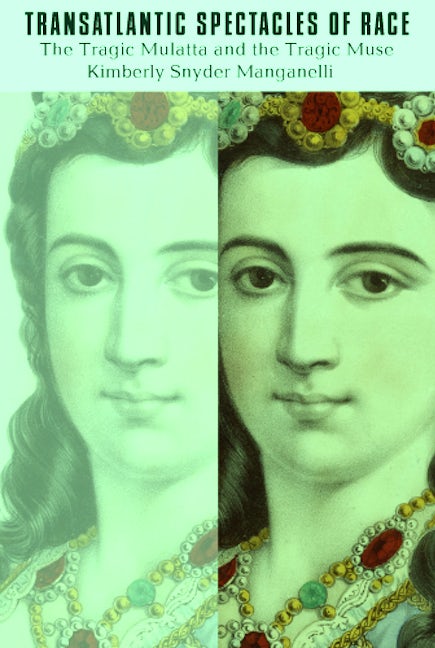
  • Transatlantic Spectacles of Race: The Tragic Mulatta and the Tragic Muse

    Rutgers University Press
    2012-02-28
    256 pages
    Paper ISBN: 978-0-8135-4988-0
    Cloth ISBN: 978-0-8135-4987-3

    Kimberly S. Manganellia, Associate Professor of 19th-Century British and American Literature
    Clemson University, Clemson, South Carolina

    The tragic mulatta was a stock figure in nineteenth-century American literature, an attractive mixed-race woman who became a casualty of the color line. The tragic muse was an equally familiar figure in Victorian British culture, an exotic and alluring Jewish actress whose profession placed her alongside the “fallen woman.”

    In Transatlantic Spectacles of Race, Kimberly Manganelli argues that the tragic mulatta and tragic muse, who have heretofore been read separately, must be understood as two sides of the same phenomenon. In both cases, the eroticized and racialized female body is put on public display, as a highly enticing commodity in the nineteenth-century marketplace. Tracing these figures through American, British, and French literature and culture, Manganelli constructs a host of surprising literary genealogies, from Zelica to Daniel Deronda, from Uncle Tom’s Cabin to Lady Audley’s Secret. Bringing together an impressive array of cultural texts that includes novels, melodramas, travel narratives, diaries, and illustrations, Transatlantic Spectacles of Race reveals the value of transcending literary, national, and racial boundaries.

  • ENGLISH 56N: Mixed Race in the New Millennium: Crossings of Kin, Culture and Faith (Stanford Introductory Seminar)

    Stanford University
    Winter Quarter, 2011-2012

    Michele Elam, Martin Luther King, Jr. Centennial Professor of English and Olivier Nomellini Family University Fellow in Undergraduate Education
    Stanford University

    Our course examines how literature, theater, graphic art and popular culture shape understandings of contemporary “mixed race” identity and other complex experiences of cultural hybridity. Course explores implications for racial identity, art, and politics for the new millennium.

    For more information, click here.

  • Mixed in America: Race, Religion, and Memoir (RELI 280, AFAN 282, or AMST 242)

    Wesleyan University
    Spring 2012

    Elizabeth McAlister, Associate Professor of Religion

    This course examines the history of “mixed-race” and “interfaith” identities in America. Using the genre of the memoir as a focusing lens, we will look at the various ways that Americans of mixed heritage have found a place, crafted an identity, and made meaning out of being considered “mixed.” How has being multiracial or bi-religious changed in the course of history in the United States? What has occasioned these changes, and what patterns can we observe? We will explore questions of racial construction; religious boundary-making; rites of passage, gender, sexuality and marriage; and some literary and media representations of mixed-heritage people.

    For more information, click here.

  • Hybrid Identities, Authentic Selves (SS-0217)

    Hampshire College, Amherst, Massachusetts
    Spring Term 2011

    Kimberly Chang, Associate Professor of Cultural Psychology

    This course explores two related concepts—hybridity and authenticity—that underlie many present-day struggles over cultural identity and representation. The former calls attention to the multiplicity of social identities that vie for recognition within a person, while the latter emphasizes what is unique or essential to the self. While the hybrid is often charged with being inauthentic or fake, claims to authenticity are frequently criticized for being exclusive or reactionary. How do we negotiate among multiple and often contending identities? When do we feel the need to claim an authentic self? What are the pressures to do so and what purpose do such claims serve? We will read across disciplinary perspectives—including history, philosophy, psychology and literature—and explore these questions through both analytical and creative forms. While the “mixed race” experience will be the primary lens for the course, we will interrogate the ways that racial categories intersect with other axis of difference in the making of selves, identities, and communities.

    For more information, click here.