• On College Forms, a Question of Race, or Races, Can Perplex

    The New York Times
    2011-06-13

    Susan Saulny

    Jacques Steinberg

    HOUSTON — At the beginning of the college application season last fall, Natasha Scott, a high school senior of mixed racial heritage in Beltsville, Md., vented about a personal dilemma on College Confidential, the go-to electronic bulletin board for anonymous conversation about admissions.

    “I just realized that my race is something I have to think about,” she wrote, describing herself as having an Asian mother and a black father. “It pains me to say this, but putting down black might help my admissions chances and putting down Asian might hurt it.”

    “My mother urges me to put down black to use AA” — African-American — “to get in to the colleges I’m applying to,” added Ms. Scott, who identified herself on the site as Clearbrooke. “I sort of want to do this but I’m wondering if this is morally right.”

    Within minutes, a commenter had responded, “You’re black. You should own it.” Someone else agreed, “Put black!!!!!!!! Listen to your mom.”

    No one advised marking Asian alone. But one commenter weighed in with advice that could just as well have come from any college across the country: “You can put both. You can put one. You’re not dishonest either way. Just put how you feel.”…

    …Some scholars worry that the growth in multiracial applicants could further erode the original intent of affirmative action, which is to help disadvantaged minorities. For example, families with one black parent and one white parent are on average more affluent than families with two black parents. When choosing between two such applicants, some universities might lean toward the multiracial student because he will need less financial aid while still counting toward affirmative-action goals.

    “How do we include multiracials in our view of an egalitarian society and not do it in a way that disadvantages other groups?” said Ulli K. Ryder, visiting scholar at the Center for the Study of Race and Ethnicity in America at Brown University…

    A Growing Category

    Rice University in Houston might, given its early history, seem an unlikely place to find admissions officers wrestling with questions of race as they size up their applicants. A private and highly selective institution, it was founded in the early 1900s by a wealthy Houston businessman as an exclusively white institution, a designation it maintained through the late 1960s.

    And yet these days, white students are now only 43 percent of the student body at Rice, where an applicant’s racial identification can become an admissions game changer. This can be especially true during the “committee round” in early spring, when only a few dozen slots might remain for a freshman class expected to number about 1,000.

    At that stage, a core group of five to seven bleary-eyed admissions officers will convene for debate around a rectangular laminate table strewn with coffee cups and half-eaten doughnuts as the applications of those students still under consideration are projected onto a 60-inch plasma TV screen.

    For most of the nearly 14,000 who applied this year, the final decision — admit or deny — was a relatively straightforward one resolved early on, based on the admissions officers’ sampling of factors like test scores, grades, extracurricular activities and recommendations.

    But there are several thousand applicants whose fate might still be in limbo by the committee round because their qualifications can seem fairly indistinguishable from one another. This is when an applicant’s race — or races — might tip the balance.

    “From an academic standpoint, the qualifying records, the test scores, how many AP courses, they may all look alike,” said Chris Muñoz, vice president for enrollment at Rice since 2006. “That’s when we might go and say, ‘This kid has a Spanish surname. Let’s see what he wrote about.’ Right or wrong, it can make a difference.”…

    Read the entire article here.

  • Defining multiracial citizens

    The Boston Globe
    2011-06-12

    Brittany Danielson
    , Globe Correspondent

    Evolving ideas about identity mean mixed-race people don’t have to settle for ‘other’

    n a suburban Massachusetts classroom in 1985, a 7-year-old Chris Olds raised his hand to grab his teacher’s attention; he wasn’t sure which bubble to fill in for race on a standardized test.

    “I don’t know what I am,’’ he told the teacher, while other students in the class laughed in the background.

    Olds — who has white, black, and Native American roots — wanted to fill in more than one bubble, but was told to pick one. “The problem wasn’t that I didn’t know what I am,’’ said Olds, who is now a 33-year-old Cambridge resident. “The problem was that I knew exactly what I am, but that I wasn’t presented with an option for it.’’

    Today, millions of multiracial US citizens like Olds have an option when defining their race through the census, which has helped to paint a clearer picture of one of the country’s fastest growing demographic groups. Since 2000, when people were first allowed to check more than one box when describing their races on census forms, the multiracial population has increased by about 35 percent to 9 million in 2010, representing 2.9 percent of the overall population.

    How the nation defines and counts the multiracial population has evolved. Between 1850 and 1920, the census included a range of categories for individuals of black and white parentage — which included terms like “mulatto,’’ “quadroon,’’ and “octoroon’’ to describe percentages of black ancestry. That ended by 1930, when those classifications gave way to the “one drop rule,’’ which stated that any traceable minority heritage — even one drop of blood — made that person, by default, a minority…

    …John Tawa, a doctoral student at University of Massachusetts Boston who teaches a course about the multiracial experience and is himself of Japanese and European heritage, said multiracial people do have some positive experiences. For example, he said they have an ability to relate in a variety of racial contexts. But multiracial US citizens also can feel marginalized by the racial groups in which they are members, can be constantly questioned about their racial identity, and can sometimes be misidentified by others, he said.

    “Multiracial people get used as a marker of being in a postracial society. People say soon everyone will be the same, so we don’t need to pay attention to racism anymore,’’ Tawa said. “That kind of ideology can obscure the reality of racism today, and the challenges that multiracial people face.’’…

    Read the entire article here.

  • Giving Loving Day Its Due

    Truthdig
    2011-06-11

    Marcia Alesan Dawkins, Visiting Scholar
    Brown University

    If you’re reading this, then you’ve probably been invited to commemorate or at least think about Loving Day this year. And with good reason. In 1958, newlyweds Mildred Jeter and Richard Loving were indicted on charges of violating Virginia’s ban on interracial marriages and were banished from their home state. The U.S. Supreme Court overturned the law in 1967.

    Many multiracial individuals and interracial couples celebrate the anniversary of the Loving v. Virginia decision, June 12, as Loving Day. While celebrating this important civil rights milestone, we should remember that increased visibility of interracial couples and offspring does not promise increased racial harmony. Let’s face facts. It’s very sexy to congratulate ourselves based on reports that today’s interracial families can live harmoniously in the former Confederacy. We’re entertained as we watch Khloe and Lamar’s relationship work out. It makes us feel good to think that we have overcome, that we have reached a state of racial harmony and that we are all finally equal—and becoming equally beige and beautiful.

    But a desire to congratulate ourselves doesn’t erase the fact that racial mixing has been occurring in our nation and hemisphere for more than 500 years. Colonists and indigenous people married and engaged in extramarital sexual relations. White indentured servants mixed with African indentured servants and then with African slaves. And there’s a long history of black freedmen and freedwomen intermarrying with Native Americans, as well as white males (often forcibly) having sex with black females. There are the interracial children fathered by U.S. soldiers and born to foreign lovers and “comfort women” in war-torn Asian and Middle Eastern nations. Add this to centuries’ worth of Asian and Hispanic immigration and 40 years’ worth of official interracial marriage patterns and you have what many might call the recipe for a melting pot where race doesn’t matter.

    Sadly, this isn’t the case…

    Read the entire article here.

  • Panel by Hapa and Critical Mixed Race Studies Scholars and Artists

    Oregon Nikkei Legacy Center
    Japanese American History Museum
    2011-08-04

    Emily Momohara, Assistant Professor of Art
    Art Academy of Cincinnati

    Laura Kina, Associate Professor of Art, Media and Design
    DePaul University

    Dmae Roberts

    Moderated by

    Tim DuRoche, Director of Programs
    World Affairs Council of Oregon

    This talk will showcase their work as the artists talk about how they address hapa identity through art. Emily Momohara is currently an Assistant Professor of Art at the Art Academy of Cincinnati where she heads the photography major. Dmae Roberts is a two-time Peabody award-winning independent radio artist and writer who has written and produced more than 400 audio art pieces and documentaries for NPR and PRI programs. Laura Kina is Associate Professor of Art, Media, and Design; Global Asian Studies affiliated faculty member; and a distinguished Vincent de Paul Professor at DePaul University in Chicago, where she has also been involved in the emerging field of critical mixed race studies. This panel will be moderated by Tim DuRoche, Director of Programs for the World Affairs Council of Oregon.

    For more information, click here.

  • Through Eyes Like Mine

    Createspace Publishing
    2010-11-20
    164 pages
    5.2 x 0.4 x 8 inches
    ISBN-13: 978-1450535786

    Nori Nakada

    Through Eyes Like Mine is the story of a childhood told through the present-tense voice of Nori Nakada. Born to a Japanese American father and German-Irish mother in rural Oregon, Nori’s family becomes increasingly diverse when they adopt a six-year-old boy from Korea. She struggles to find comfort within a family, a community and a world that is both simple and complex. By examining her family’s silences, she begins to understand life, death and her own identity. The joys and challenges of growing up invite the reader to recall the world through eyes like mine.

  • Drôle de Félix : A Search for Cultural Identity on the Road

    Wide Screen
    Volume 3, Number 1 (2011)
    ISSN: 1757-3920

    Zélie Asava

    With the emergence of la culture beur in the 1980s—and the birth of a new type of filmmaking influenced by postcolonial politics, world cinema, the new hood films of the African-American community and its hip hop culture—questions of identity, multiculturalism and being mixed-race came to the fore.  Since then, many films have tackled the representation of France’s ethnic minorities onscreen and attempted to  move towards representing the dream 2007 presidential candidate Ségolène Royal expressed of a ‘Mixed-Race France’. This article will explore representations of ethnicity, gender and sexuality in Drôle de Félix/The Adventures of Felix (1999), through the figure of Félix, a homosexual, mixed-race (French-North African) man searching for his absent father and his ‘true’ identity.  The film focuses on the demystification of imperialist absolutes and divisions to reveal what lies between, in the interstices. Through its focus on transgressive identity it transforms traditional representations to explore what lies beyond.  This article interrogates the representational schema of Drôle de Félix, by exploring the cinematic stereotypes and taboos challenged and maintained in the film in comparison to traditional beur cinema and established ideas of Maghrebi-French characters in French cinema.

    Read the entire article here.

  • “You Think You Cute!” Perceived Attractiveness, Inter-Group Conflict, And Their Effect On Black/White Biracial Identity Choices

    Vanderbilt University
    December 2006
    31 pages

    Jennifer Patrice Sims

    Thesis Submitted to the faculty of the Graduate School of Vanderbilt University In partial fulfillment of the requirements for the degree of Master of Arts in Sociology

    The 2000 Census was the first time in United States’ history that citizens could indicate more than one race to describe their racial identity. Who does so is due to a multi-factored, complex process. For Black/White biracial women, research has suggested that appearance plays a role in the development of the woman’s racial identity (Rockquemore, 2002; Root, 1992). Attractive Black/White biracial women supposedly choose non-Black identities due to negative treatment from Black women; the latter of whom are accused of having animosity against biracial women due to their supposed greater appeal to Black men.

    My aim in this project was to explore this phenomenon. Using data from the Pubic Use Data Set of the National Survey on Adolescent Health, I examined whether perceived physical attractiveness affected the odds of Black/White biracial individuals choosing a Biracial identity and whether such a process was limited to women only.

    Results from multinomial logistic regression suggest that perceived physical attractiveness is not a statistically significant factor in choosing a Biracial identity for women or men. Limitations of this study which may explain why my hypotheses were not supported are discussed in the conclusion along with suggestions for future research on biracial identity.

    Table of Contents

    • LIST OF TABLES.
    • LIST OF FIGURES
    • I. INTRODUCTION
    • II. THEORY AND LITERATURE REVIEW
      • Identity
      • Factors in Identity Choice
      • The Role of Appearance
    • III. STATEMENT OF RESEARCH QUESTION
    • IV. DATA AND METHODS
    • V. RESULTS
    • VI. DISCUSSION AND CONCLUSION
    • REFERENCES

    List of Tables

    1. Tabulation of Identity Choices
    2. Tabulation of Attractiveness
    3. Tabulation of Skin Color
    4. Factors in Identity Choice

    List of Figures

    1. Parental Income Distribution

    Read the entire thesis here.

  • The Hemingses of Monticello: An American Family [Review]

    The Journal of American History
    Volume 98, Issue 1 (2011)
    Pages 154-155
    DOI: 10.1093/jahist/jar004

    Brenda E. Stevenson, Professor of History
    University of California, Los Angeles

    The Hemingses of Monticello: An American Family. By Annette Gordon-Reed. (New York: Norton, 2008. 802 pp. Cloth, ISBN 978-0-393-06477-3. Paper, ISBN 978-0-393-33776-1.)

    Annette Gordon-Reed’s much-lauded book (it has won the Pulitzer Prize and the National Book Award, and was a national best seller) is an ambitious attempt to re-create the lives of several generations of one slave family in the American South. Gordon-Reed traces this family from one of their original African ancestors, who arrived in Virginia during the colonial era, through the antebellum decades. This is not just any extended enslaved family, however. Her black and mixed-race subjects are the Hemingses—the founding father Thomas Jefferson’s slaves and family, by marriage and blood.

    Building on the research and analysis of her book, Thomas Jefferson and Sally Hemings: An American Controversy (1997), Gordon-Reed, a legal scholar by training, adds admirably to her primary- and secondary-source research base for this work, carefully synthesizing the historiography descriptive of the social relationships in American slavery and drawing on the rich data and analysis supplied by historians and archeologists at Monticello. Gordon-Reed treats readers to a journey of no short distance (the book is almost seven hundred pages in length!) in which she explores several avenues of possibility that might shed light on the social lives, relationships, and family ties…

    Read or purchase the review here.

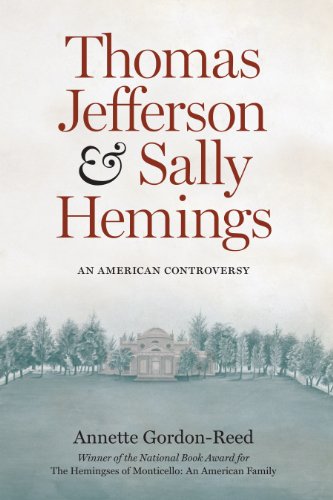
  • Thomas Jefferson and Sally Hemings: An American Controversy

    University of Virginia Press
    1998
    305 pages
    6 x 9
    Paper ISBN: 978-0-8139-1833-4

    Annette Gordon-Reed, Charles Warren Professor of American Legal History; Carol K. Pforzheimer Professor, Radcliffe Institute for Advanced Study; Professor of History
    Harvard University

    When Annette Gordon-Reed’s groundbreaking study was first published, rumors of Thomas Jefferson’s sexual involvement with his slave Sally Hemings had circulated for two centuries. Among all aspects of Jefferson’s renowned life, it was perhaps the most hotly contested topic. The publication of Thomas Jefferson and Sally Hemings intensified this debate by identifying glaring inconsistencies in many noted scholars’ evaluations of the existing evidence. In this study, Gordon-Reed assembles a fascinating and convincing argument: not that the alleged thirty-eight-year liaison necessarily took place but rather that the evidence for its taking place has been denied a fair hearing.

    Friends of Jefferson sought to debunk the Hemings story as early as 1800, and most subsequent historians and biographers followed suit, finding the affair unthinkable based upon their view of Jefferson’s life, character, and beliefs. Gordon-Reed responds to these critics by pointing out numerous errors and prejudices in their writings, ranging from inaccurate citations, to impossible time lines, to virtual exclusions of evidence—especially evidence concerning the Hemings family. She demonstrates how these scholars may have been misguided by their own biases and may even have tailored evidence to serve and preserve their opinions of Jefferson. This updated edition of the book also includes an afterword in which the author comments on the DNA study that later confirmed the Jefferson and Hemngs liaison.

    Possessing both a layperson’s unfettered curiosity and a lawyer’s logical mind, Annette Gordon-Reed writes with a style and compassion that are irresistible. Each chapter revolves around a key figure in the Hemings drama, and the resulting portraits are engrossing and very personal. Gordon-Reed also brings a keen intuitive sense of the psychological complexities of human relationships—relationships that, in the real world, often develop regardless of status or race. The most compelling element of all, however, is her extensive and careful research, which often allows the evidence to speak for itself. Thomas Jefferson and Sally Hemings: An American Controversy is the definitive look at a centuries-old question that should fascinate general readers and historians alike.

  • The Hidden History of Mestizo America

    The Journal of American History
    Volume 82, Number 3 (December, 1995)
    pages 941-964
    5 illustrations

    Gary B. Nash, Professor Emeritus of History
    University of California, Los Angeles

    This essay was delivered as the presidential address at the national meeting of the Organization of American Historians in Washington, March 31, 1995.

    La Nature aime les croisements (Nature loves cross-breedings).
    Ralph Waldo Emerson

    On a dank January evening in London in 1617, the audience was distracted from a performance of Ben Johnson’s The Vision of Delight by the persons sitting next to King James I and Queen Anne: a dashing adventurer who had just returned from the outer edge of the fledgling English empire and his new wife, ten years his junior. The king’s guests were John Rolfe and his wife Rebecca—a name newly invented to anglicize the daughter of another king who ruled over a domain as big and populous as a north English county. She was Pocahontas, the daughter of Powhatan. The first recorded interracial marriage in American history had taken place because Rebecca’s father and the English leaders in the colony of Virginia were eager to bring about a detente after a decade of abrasive and sometimes bloody European-Algonkian contact on the shores of the Chesapeake Bay.

    The Rolfe-Pocahontas marriage might have become the embryo of a mestizo United States. I use the term mestizo in the original sense—referring to racial intermixture of all kinds. In the early seventeenth century, negative ideas about miscegenation had hardly formed; indeed, the word itself did not appear for another two and a half centuries. King James was not worried about interracial marriage. He fretted only about whether a commoner such as Rolfe was entitled to wed the daughter of a king. Nearly a century later, Robert Beverley’s History and Present State of Virginia (1705) described Indian women as “generally beautiful, possessing uncommon delicacy of shape and features,” and he regretted that Rolfe’s intermarriage was not followed by many more.

    William Byrd, writing at the same time, was still commending what he called the “modern policy” of racial intermarriage employed in French Canada and Louisiana by which alliances rather than warfare were effected. Byrd confessed his preference for light-skinned women (a woman’s skin color, however, rarely curbed his sexual appetite), but he was sure that English “false delicacy” blocked a “prudent alliance” that might have saved Virginians much tragedy. Most colonies saw no reason to ban intermarriage with Native Americans (North Carolina was the exception).

    In 1784, Patrick Henry nearly pushed through the Virginia legislature a law offering bounties for white-Indian marriages and free public education for interracial children. In the third year of his presidency, Thomas Jefferson pleaded “to let our settlements and theirs [Indians] meet and blend together, to intermix, and become one people.” Six years later, just before returning to Monticello, Jefferson promised a group of western Indian chiefs, “you will unite yourselves with us,… and we shall all be Americans; you will mix with us by marriage, your blood will run in our veins, and will spread with us over this great island.”

    In 1809, almost two hundred years after Pocahontas sat in the theater with James I, the sixteen-year-old Sam Houston, taking a page from the book of Benjamin Franklin, ran away from his autocratic older brothers. The teenage Franklin fled south from Boston to Philadelphia, but Houston made his way west from Virginia to Hiwassee Island in western Tennessee. There he took up life among the Cherokees and was soon adopted by Ooleteka, who would become the Cherokee chief in 1820. Reappearing in white society in 1818, Houston launched a tumultuous, alcohol-laced, violent, and roller-coaster political career, but he retained his yen for the Cherokee life. After his disastrous first marriage at age thirty-six, he rejoined the Cherokee, became the ambassador of the Cherokee nation to Washington (in which office he wore Indian regalia) in 1829, and married Ooleteka’s niece, the widowed, mixed-blood Cherokee woman Tiana Rogers Gentry.

    …This brings us to a consideration of the virulent racial ideology that arose among the dominant Euro-Americans and that profoundly affected people of color. How most Americans came to believe that character and culture are literally carried in the blood, and how the idea of racial mixture was almost banished officially, has its own history. How would it come to happen, as Barbara Fields has expressed it, that a white woman can give birth to a Black child but a Black woman can never give birth to a white child? How would it come to be that the children of Indian-white marriages would contemptuously be referred to by whites as half- breeds?

    The sequence of legal definitions of Blacks in Virginia demonstrates this progression. In 1785, the revolutionary generation defined a Black person as anyone with a Black parent or grandparent, thus conferring whiteness on whomever was less than one-quarter Black. Virginia changed the law 125 years later to define as “Negro,” as the term then was used, anyone who was at least one-sixteenth Black. In 1930, Virginia adopted the notorious “one-drop” law—defining as Black anyone with one drop of African blood, however that might have been determined…

    There is nothing new about crossing racial boundaries; what is new is the frequency of border crossings and boundary hoppings and the refusal to bow to the thorn-filled American concept, perhaps unknown outside the United States, that each person has a race but only one. Racial blending is undermining the master idea that race is an irreducible marker among diverse peoples—an idea in any case that always has been socially constructed and has no scientific validity. (In this century, revivals of purportedly scientifically provable racial categories have surfaced every generation or so. Ideas die hard, especially when they are socially and politically useful.) Twenty-five years ago, it would have been unthinkable for Time-Life to publish a computer-created chart of racial synthesizing; seventy-five years ago, an issue on “The New Face of America” might have put Time out of business for promoting racial impurity…

    Read the entire article here.