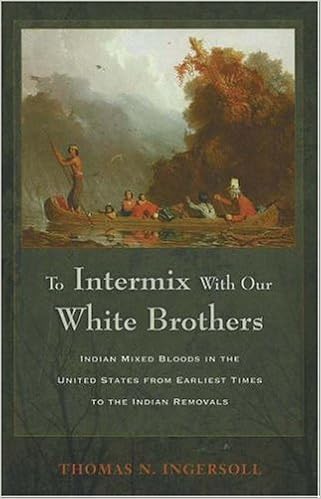
• To Intermix With Our White Brothers: Indian Mixed Bloods in the United States from Earliest Times to the Indian Removals

    University of New Mexico Press
    2006
    472 pages
    6 x 9 in.; 10 halftones
    Hardcover ISBN: 978-0-8263-3287-5

    Thomas Ingersoll, Associate Professor of History
    Ohio State University

    “I think that I or any of my brethren have a right to choose a wife for themselves as well as the whites, and as the whites have taken the liberty to choose my brethren, the Indians, hundreds of thousands of them, as partners in life, I believe the Indians have as much right to choose their partners among the whites if they wish.”—William Apess, An Indian’s Looking-Glass for the White Man, 1833

    In this groundbreaking study, Thomas Ingersoll argues the Jacksonian American Indian removal policy appealed to popular racial prejudice against all Indians, including special suspicion of mixed bloods. Lawmakers also perceived a threat to white Americans’ transatlantic reputation posed by the potential for general racial mixture, or “amalgamation.” Beginning in the 1780s, and for the ensuing half-century, alarmed government officials attempted to separate full blood and mixed-blood Indians into enclaves in the Far West, to isolate them from white migrants out of the eastern states and prevent the rise of a new, genuinely alternative mixed society.

    Ingersoll begins by examining the origins and early history of mixed bloods in North America. He follows with the lives of individual mixed bloods, an exploration of how the growing mixed population informed racial thought in the Early National Period, and the role of mixed-blood chiefs in opposing the Indian Removal Act of 1830.

  • Racial mixture, racial passing, and white subjectivity in Absalom, Absalom!

    The Faulkner Journal
    Volume 23, Issue 2 (Spring 2008)
    pages 3-22

    Masami Sugimori, Instructor of English
    University of South Alabama

    In his 1987 study of the critical reception of Absalom, Absalom! Bernd Engler points out that “since the mid-Seventies the only interpretations to gain favour have been those which, at least partly, regard Absalom, Absalom! as the conscious realization of an open work of art” (246). Somewhat testifying to how the text’s indeterminacy specifically concerns the interconnection of race and narrative, Engler’s survey also shows that noteworthy monographs from the decade include those concerning “Faulkner’s attitude towards racial questions” (252) as well as “the novel as a study in narratology and/or epistemology” (256). Indeed, even as Quentin and Shreve finalize their reconstruction of the endlessly uncertain past by reading Charles Bon’s white-looking body as “passing white,” Faulkner does not supply any evidence for Bon’s racial mixture outside the white character-narrators’ invention.

    Engler is quick to note, however, that most race-related scholarship does not fully attend to the novel’s open-endedness, as exemplified by four studies from 1983: “Walter Taylor,  Eric J. Sundquist, Thadious M. Davis, and Erskine Peters begin, as do most others, with the dubious assumption that Bon’s identity as Sutpen’s part-negro son has been clearly established in the text” (253). And it seems that this problem is still compromising the Absalom, Absalom! scholarship. (1) For example, while critiquing the discursive domination of “‘legitimate’ white caretakers of history,” Maritza Stanchich bases her postcolonial reading upon the same white “legitimacy” and uncritically follows Quentin and Shreve’s re-creation of Bon as “a free mulatto who can ‘pass’ as white”: “When the narrators of different generations are faced with Bon, a free mulatto who can ‘pass’ as white and threatens to upset the South’s rigid race caste, their pre-Civil War and post-Civil War fears overlap and intermingle… The strategy of the narrative seeks to uphold white domination by representing all characters of color through Rosa, Quentin, General Compson and Shreve, the ‘legitimate’ white caretakers of history” (608)…

    Read the entire article here.

  • Les Cenelles

    Centenary College of Louisiana Press / Editions Tintamarre
    January 2003
    208 pages
    ISBN: 0-9723258-9-1

    Armand Lanusse

    The text is in French.

    With few exceptions, the poets of Les Cenelles–the very first collection of poetry by Creoles of color–do not directly address their precarious situation in a South that was ever increasingly hostile to the racial caste to which they belonged. On the contrary, a naive reader might only discover the most pedestrian sorts of romantic subjects in these poems written by seventeen free men of color. However , why would Valcour B… refer to himself as an “unrecognized son of New Orleans?” What “cruel fate” might have forced P. Dalcour into exile? What is the source of the regret, the preoccupation with departure and the fear of betrayal that seeps from every line of these works?

    However gifted and diligent they might have been, free people of color were forced to live within the constraints of their fate as second class citizens. May the modern reader delve into these “modest Cenelles” conscience of the troubling context that underpins their creation. Without this awareness, the profound depths of their melancholy spirit will escape him completely.

  • Racial Identity Development and Psychological Adjustment in Biracial Individuals of Minority/Minority Racial Group Descent

    Marquette University
    Spring 2011

    Kizzie Paule Walker

    A Dissertation submitted to the Faculty of Psychology in partial fulfillment of the requirments for the degree of Doctor of Philosophy

    Based on the theoretical framework of symbolic interactionism and race as a social construct, individuals with biological parents racially distinct from each other have biracial identity options (i.e., Singular, Border, Protean, and Transcendent) (e.g., Rockquemore and Brunsma, 2002). The purpose of the current study was to examine factors that influenced biracial individuals’ level of racial/ethnic identity development and the impact on biracial identity and psychological adjustment (i.e., self-esteem and psychological well-being). A total of 199 biracial individuals, who ranged in age from 18 to 55 years, completed an online survey that measured factors such as the rule of hypodescent (i.e., one-drop rule), physical appearance, self-monitoring, and exposure to multicultural experiences. Although the one-drop rule was not a significant predictor of biracial identity options, there were other significant findings within this population. Physical resemblance to two or more racial groups and exposure to multicultural experiences predicted biracial individuals’ identification with a Border or Protean identity. Second, this study found that a high level of exposure to multicultural experiences best predicted a high level of ethnic identity development and positive interactions with other racial groups. Lastly, the current study found that the previously mentioned factors also contributed to biracial individuals’ psychological adjustment (i.e., self-esteem and psychological well-being). Limitations of the current study and recommendations for future research with this population were also discussed.

    Read the entire dissertation here.

  • Shades of gray: Black-white multiracialism in contemporary American literature

    York University (Canada)
    2011
    294 pages
    Publication Number: AAT NR71345
    ISBN: 9780494713457

    Molly Littlewood McKibbin

    A Dissertation submitted to the Faculty of Graduate Studies in English in partial fulfillment of the requirments for the degree of Doctor of Philosophy

    The American construction of whiteness and blackness as dichotomous racial categories and subsequent black refashioning of the one-drop rule as a method of empowering and mobilizing African Americans have meant that whiteness has developed in terms of purity (and not-blackness) while blackness has absorbed mixture into one racial category. However, since the Civil Rights Movement and the Multiracial Movement (begun shortly after the Loving v. Virginia decision invalidated antimiscegenation laws in 1967), American treatment of racial mixture has undergone consistent change. My dissertation addresses how literature at the turn of the millennium ultimately offers a new exploration of black-white multiracialism. I examine four texts in detail: Danzy Senna’s Caucasia (1998), Rebecca Walker’s Black White and Jewish (2001), Emily Raboteau’s The Professor’s Daughter (2005), and Rachel Harper’s Brass Ankle Blues (2006).

    The introduction outlines the historical development of racial blackness in the U.S. and traces the possibilities and limitations of racial identity for multiracial figures throughout African American literary history. In the first chapter, I analyze more recent multiracial theory and advocacy to establish and critique the state of current discourse surrounding (multi)racial identity and also examine the ways in which contemporary writers depict the negotiation of racial identity within a new social climate that permits self-identification but still clings to recognized labels. In the second chapter, I use white studies and an understanding of the historical development of racial whiteness in the U.S. to analyze how contemporary writing is transforming the apparent homogeneity of whiteness into a heterogeneous classification by racializing and diversifying the otherwise normative, generic category of whiteness. In the third chapter, I use the context of black racial identity politics to analyze the difficulty multiracial figures have in claiming blackness, since on the one hand they are “not black enough” to claim blackness and on the other they are seen as “race traitors” for not claiming monoracial blackness.

    My research emphasizes that multiracial discourse is still in its formative stages but is working towards articulating multiracial identities and writing them into the American literary landscape even if current literature can only gesture towards such identities at present.

    Table of Contents

    • Introduction: Black and White in the United States
    • Chapter One: “What are you, anyway?”: Mixture, Identity Formation, and the Social Context of Race Classification
    • Chapter Two: Racializin’ and Diversifyin’: Negotiating Whiteness
    • Chapter Three: “Black Like Me”: Negotiating Blackness
    • Conclusion: The (Continuing) Work of Multiracial Literature
    • Bibliography

    Purchase the dissertation here.

  • The one-drop aesthetic: How literary formalism reinvented race in the United States

    Harvard University
    2009
    233 pages
    Publication Number: AAT 3365201
    ISBN: 9781109254617

    Kevin Brian Birmingham

    A dissertation presented by Kevin Brian Birmingham to The Department of English in partial fulfillment of the requirements for the degree of Doctor of Philosophy in the subject of English.

    The One-Drop Aesthetic argues that late twentieth-century theories of race and identity are translations of the early twentieth century’s aesthetic formalism, the New Criticism. The first cohesive formalism in the United States was an aesthetic ideology shaped by the imperfections of the South, which the southern New Critics took as a social model for their aesthetic ideals. They imagined literature not as a solid structure or an organic wholeness but as a welter of contingencies—a terrain that, like the South, was besieged by science and industry and whose beauty resided in fragments and ashes. The New Criticism was largely a dialogue between Allen Tate’s faith in transcendent wholeness and Ransom’s attention to art’s “infinite residue.”

    The southern institution capable of relating fragments to organic wholes as well as bringing the idealized past into the industrialized present was, perhaps surprisingly, the cornerstone of segregation: the one-drop rule. A guiding principle of American race ideology was the belief that a trace of blackness is powerful enough to constitute blackness itself . Though it was a powerful weapon of oppression, several American writers in the twentieth century turned the implications of the one-drop rule into aesthetic virtues. Abiding, contaminating racial traces provided not only a model for cultural continuity over time and for imagining parts as transcendent wholes, but it intensified the complexity of W. E. B. Du Bois’s double consciousness, a modern American version of both Hegel’s self-consciousness and Friedrich Schiller’s aesthetics.

    This project covers a fifty-year period from the New Criticism of the 1930s to the New Mestiza of the 1980s. Several writers used the idea of overwhelming racial traces to reframe the European aesthetic ideals of the eighteenth and nineteenth centuries in immediate social terms. William Faulkner’s powerful imagination of the one-drop aesthetic in his 1936 novel Absalom, Absalom! was foundational, and the unlikely inheritor of Faulkner was James Baldwin, who amplifies Faulkner’s race-based apocalyptic mode in his essays. This dissertation then turns to the central importance of the racially-mixed Schwarzkommando in Thomas Pynchon’s Gravity’s Rainbow (1973). It ends with a discussion of Gloria Anzaldúa’s Borderlands/La Frontera: The New Mestiza (1987), which provides yet another vision of a lost aesthetic society recoverable from traces of both memory and blood.

    Table of Contents

    • Introduction
    • Chapter One – Hellenic Dixie: The Soil of American Formalism
    • Chapter Two – The Master/Trash Dialectic: William Faulkner and the Origin of an American Aesthetic
    • Chapter Three – “History’s Ass Pocket”: The Bind of Identity and Aesthetics in James Baldwin
    • Chapter Four – Revolutionaries of the Trace: Thomas Pynchon’s Schwarzkommando and the One-Drop Sublime
    • Chapter Five – Gods Out of Entrails: The Old Aesthetic of the New Mestiza
    • Works Cited

    Purchase the dissertation here.

  • Passing for Black: Sermon

    Unitarian Church of Norfolk
    Norfolk, Virginia
    2010-08-29

    Dr. Walter Skip Earl

    OPENING WORDS

    Forty-seven years ago yesterday, on August 28, 1963, before a huge crowd of African and other Americans gathered in front of the Lincoln Memorial, Dr. Martin Luther King Jr. said:

    In a sense, we’ve come to our nation’s capital to cash a check. When the architects of our republic wrote the magnificent words of the Constitution and the Declaration of Independence, they were signing a promissory note to which every American was to fall heir. This note was a promise that all men, yes, black men as well as white men, would be guaranteed the “unalienable rights” of “Life, Liberty and the pursuit of Happiness”. It is obvious today that America has defaulted on this promissory note, insofar as her citizens of color are concerned. Instead of honoring this sacred obligation, America has given the negro people a bad check, a check which has come back marked “insufficient funds.”

    But we refuse to believe that the bank of justice is bankrupt. We refuse to believe that there are insufficient funds in the great vaults of opportunity of this nation. And so, we’ve come to cash this check, a check that will give us upon demand the riches of freedom and the security of justice…

    …READING:

    Our reading this morning comes from the jacket (show) previews of Clarence E. Walker’s 2009 University of Virginia press, MONGREL NATION, The America Begotten by Thomas Jefferson and Sally Hemings. The term “mongrel” is usually used as a derogatory term for “Mixed Race” .

    The first quote is from Annette Gordon-Reed, New York Law School and author of THE HEMINGSES OF MONTICELLO: An American Family.

    America has indeed been a mongrel nation, not just in terms of blood, but in terms of culture and politics, from the very beginning. Walker very rightly challenges the assumption that the Jefferson-Hemings liaison was either unusual or exceptional.

    Secondly, from the author himself, Clarence E. Walker, Professor of History at the University of California, Davis and also the author of WE CAN’T GO HOME AGAIN: An Argument about Afrocentrism.

    The debate over the affair between Thomas Jefferson and Sally Hemings rarely rises above the question, “Did they or didn’t they?” But lost in the argument over the existence of such a relationship are equally urgent questions about a history that is more complex, both sexually and culturally, than most of us realize.

    (T)he relationship between Jefferson and Hemings must be seen not in isolation but in the broader context of interracial affairs within the plantation complex. Viewed from this perspective, the relationship ..was fairly typical. For many, this is a disturbing realization because it forces us to abandon the idea of American exceptionalism and reexamine slavery in America as part of a long, global history of slaveholders frequently crossing the color line.

    More than many other societies—and despite our obvious mixed-race population—our nation has displayed particular reluctance to acknowledge this dynamic….From Jefferson’s time to our own, the general public denied—or remained oblivious to—the possibility of the affair. Historians, too, dismissed the idea, even when confronted with compelling arguments by fellow scholars. It took the DNA finds of 1998 to persuade many (although to this day, doubters remain).

    The president’s apologists, both before and after the DNA findings, have constructed an iconic Jefferson that tells us more about their own beliefs—than it does about the interaction between slave owners and slaves. Much more than a search for the facts about two individuals , the debate over Jefferson and Hemings is emblematic of tensions in our society between competing conceptions both of race and of our nation. (underlining is mine)

    This sermon is not meant to be a history lesson. Nor is it meant to be a summary of the contents of MONGREL NATION.

    Rather, it is my RESPONSE to having read the book. It is my attempt to react to the thesis of Clarence Walker’s latest book within the time frame of these next 15 to 20 minutes. And I appreciate your sharing this with me by listening…

    Read the entire sermon here.

  • Re-articulating the New Mestiza

    Journal of International Women’s Studies
    Vol 12, #2 (March 2011)
    Special Issue: Winning and Short-listed Entries from the 2009 Feminist and Women’s Studies Association Annual Student Essay Competition
    pages 61-74

    Zalfa Feghali
    University of Nottingham

    This essay provides an overview, critique, and the beginning of a refiguration of Gloria Anzaldúa’s theorization of the new mestiza as set out in her seminal 1987 book Borderlands/La Frontera: The New Mestiza. By examining both Anzaldúa’s precursors and the articulations of hybrid identities of her contemporaries, this essay depicts the complex dynamic that characterizes the mestiza’s need to develop, beyond borders and attempts to fashion a more contemporary, transnational mestiza. Using the writing and criticism of Françoise Lionnet alongside Anzaldúa’s and other critics, and utilizing postcolonial and feminist theories, this essay hopes to provide an alternative articulation to conventional understandings of hybridity and mestizaje in contemporary thought.

    Introduction

    The purpose of this essay is to provide an overview, a critique, and the beginning of a refiguration of Gloria Anzaldúa’s theorization of the new mestiza. Anzaldúa’s mestiza exists in borderlands, and is “neither hispana india negra española / ni gabacha;”1 rather, she is “mestiza, mulata, half-breed / caught in the crossfire between camps / while carrying all five races on [her] back / not knowing which side to turn to, run from” (Borderlands/La Frontera 216). However, according to Anzaldúa, and despite the difficulties engendered by her very existence, the mestiza is also a figure of enormous potential, as her multiplicity allows a new kind of consciousness to emerge. This mestiza consciousness moves beyond the binary relationships and dichotomies that characterize traditional modes of thought, and seeks to build bridges between all minority communities in order to achieve social and political change. Anzaldúa locates the new mestiza consciousness at a site that, as Françoise Lionnet suggests, “is not a territory staked out by exclusionary practices” (“The Politics and Aesthetics of Métissage” 5).

    Although there are clear precursors to Anzaldúa’s work, one of which I discuss at length below, many critics and thinkers choose her work to engage with. This has to do with her unique place in the “canon” of Chicana/Mexican American writing—what she calls the “Moveimento Macha.” Writing from the position(s) of queer Chicana womanhood, code-switching between English and Spanish, and mixing poetry and prose, Anzaldúa’s Borderlands/La Frontera, at the time of publication in 1987, represented an important break from the mainly male-dominated pool of “traditional” Chicano writers and inspired a generation of women, Chicana and non-Chicana alike, to write about their experiences as border-crossers with hybrid identities. Anzaldúa’s work remains popular because it retains much of its original subversive potential, its cross-disciplinarity providing new and varied methodologies to analyze borders. In many ways, it has also played an important role in refocusing American studies as a transnational discipline. In her presidential address to the American Studies Association in 2004, Shelley Fisher Fishkin identified Anzaldúa’s Borderlands/La Frontera as epitomizing the transnational nature of American studies, and credited her work for opening up a space for “American studies scholars [to] increasingly recognize that understanding requires looking beyond the nation‟s borders, and understanding how the nation is seen from vantage points beyond its borders” (“Crossroads of Cultures” 20)…

    …A “Cosmic Race”

    In his original essay of 1925, Vasconcelos lauds the people inhabiting the area of Mexico for their mestizo/a culture, which, as Rafael Pérez-Torres has put it, “locates itself within a complex third space neither Mexican nor American but in a transnational space of both potential and restraint” (“Alternate Geographies and the Melancholy of Mestizaje” 322). In its traditional meaning, mestizaje “reflects a simultaneously racial, sexual, and national memory, an embodiment of colonization and conquest” (Bost, Mulattas and Mestizas 9). In fact, one of the reasons that Jose Vasconcelos won popular acclaim for his theories was the attractiveness of the idea that an entire population, which literally embodies a history of violence, can forge an identity that moved beyond such a violent history—and flourish. Anzaldúa herself refers to this very specific history in her hope that the emergence of the new mestiza will bring an end to rape, violence, and war.

    For the purposes of his essay, Vasconcelos sees this group as the first stage in the creation of a new, cosmic race that will eventually take on characteristics and subsume genetic streams from all the races on earth. This cosmic race will take on the best or most desirable traits from each respective race. Eventually, according to Vasconcelos, the lines between the “original” races will blur to the point that any one individual’s “racial heritage” would be completely indistinguishable from another‟s, thus becoming the ultimate mestizo/a (something akin what critics would now call a “post-ethnic” or “post-racial” world). This emphasis on the special character and potential of the mestiza/o Mexican subject has made Vasconcelos‟ theory very attractive to Mexican and Chicano/a activists, particularly nationalists. As many Chicano/a activists have done, Anzaldúa uses a narrow interpretation of Vasconcelos’ essay in the hope of finding a solid theoretical grounding for her own project. However, this has brought her much criticism, as Vasconcelos’ theory has been rigorously undermined. As Didier Jaén puts it:

    It is true that mestizaje is one of the central concepts of the Vasconcelos essay, but of course, it is also clear that the racial mixture Vasconcelos refers to is much wider, much more encompassing, than what can be understood by the mestizaje of the Mexican or Chicano…But even if we expand the concept of mestizaje to include all other races, this biological mixture would not fulfill what Vasconcelos expresses with the idea of the Cosmic race (“Introduction” xvi).

    Clearly, Vasconcelos’ utopian vision of mestizaje leading to a new, privileged subject that lives in a race-less world does not hold up theoretically or pragmatically. For example, he clearly delineates the “four major races of the world” before envisioning a fifth, cosmic race which embraces the four “original” races of the world. Despite the fact that the original text was written in 1925 and must be read with one eye trained on that time’s theoretical and scientific reach, it is problematic in the way it combines scientific language and terms with a more mystical outlook (something that is echoed in Anzaldúa‟s work, albeit for a different purpose). It thus presents itself as scientific fact and knowledge while in fact holding little or no solid scientific basis.

    My main objection to Vasconcelos’ analysis comes from the implications of his own underlying premise, namely, that there are four races of humans: the Black, the Indian (as in American native), the Mongol, and the White. Out of these four races, Vasconcelos imagines that the fifth, mestizo, cosmic race will resemble a symphony:

    Voices that bring accents from Atlantis; depths contained in the pupil of the red man, who knew so much, so many thousand years ago, but now seems to have forgotten everything. His soul resembles the old Mayan cenote of green waters, laying deep and still…This infinite quietude is stirred with the drop put in our blood by the Black, eager for sensual joy, intoxicated with dances and unbridled lust…There also appears the Mongol, with the mystery of his slanted eyes that see everything according to a strange angle…The clear mind of the White, that resembles his skin and his dreams, also intervenes…

    Clearly Vasconcelos’ theory is based on fundamental racism on his part. Yet despite having borne heavy criticism for his theory, Vasconcelos’ essay was reprinted in 1948 and became a rallying point for Chicano activist and Mexican nationalist movements. In addition to Vasconcelos’ popularity as an alternative Mexican historian, this is most likely why Anzaldúa espouses his theory. However, as I plan to show, Anzaldúa’s work also falls into many of the same traps as Vasconcelos’. It has been important to look at Vasconcelos’ work in such depth as I will show that Anzaldúa’s work, while in many ways vastly different, may have the effect of re-inscribing Vasconcelos’ racism…
    Read the entire article here.

  • Mistaken identity

    The Boston Globe
    2005-02-20

    Holly Jackson

    What if a novelist celebrated as a pioneer of African-American women’s literature turned out not to be black at all?

    IN THE LATE 1980s, scholars of African-American studies carried out the most impressive American literary recovery project to date, excavating and reprinting the works of numerous unjustly forgotten African-American writers. The most ambitious of these efforts was Oxford University Press’s 40-volume Schomburg Library of Nineteenth-Century Black Women Writers, published in 1988 under the direction of Henry Louis Gates Jr., currently the chair of Harvard’s department of African and African American Studies.

    Here at last, Gates explained in his foreword, were the literary ancestors of Zora Neale Hurston, Alice Walker, and Toni Morrison. With one exception, all these works had been previously out of print, making it difficult for scholars to track down copies. In fact, it was Gates’ discovery of one such ”lost” novel, ”Four Girls At Cottage City” (1895) by Emma Dunham Kelley-Hawkins, that prompted him to put these neglected texts back into print-”in part,” he wrote, ”so that I could read them myself.”

    In the following decade, scholarship on black women’s fiction exploded alongside popular interest in the work of contemporary African-American writers. In particular, the flourishing of black literature in the 1890s-the decade that saw Jim Crow become federal law and witnessed the highest number of lynchings in American history-has remained a fruitful area of scholarly inquiry. For African-American writers of that period, the creation of a literary tradition was a political imperative. As Pauline Hopkins wrote in 1900, ”We must ourselves develop the men and women who will faithfully portray the inmost thoughts and feelings of the Negro with all the fire and romance which lie dormant in our history.”

    But despite continual scholarly interest in Kelley-Hawkins as an important voice of the period, the woman who Gates credits with inspiring the Schomburg Library has never fit comfortably within the African-American canon. Most puzzling has been the apparent whiteness of her characters, who are repeatedly described with blue eyes and skin as white as ”pure” or ”driven” snow-a conundrum that critics have largely sidestepped by arguing that these women would have been understood as ”white mulattos,” or very light-skinned women of color, by Kelley-Hawkins’s original audience of black readers. Furthermore, while the novels of contemporaries like Frances E.W. Harper or Pauline Hopkins are explicitly concerned with racial uplift and protest, ”Four Girls at Cottage City” and ”Megda” follow a group of adolescent female friends in eastern Massachusetts from carefree youth through Christian conversion to appropriate wifehood, with no mention of the difficulties facing black women.

    Meanwhile, Kelley-Hawkins herself remained a complete historical cipher. While she had been identified as an African-American writer as early as the 1970s, when her first novel, ”Megda,” was mentioned in several reference works, the most basic facts of her life-down to the date and place of her birth-were totally unknown.

    As it turns out, these novels, and their author, are far more anomalous than scholars have realized. Judging from archival documents that I have recently uncovered, Kelley-Hawkins does not appear to have been African-American at all…

    Read the entire article here.

  • The Mulatto: an unspeakable concept

    Working Papers on the Web
    Department of English Studies at Sheffield Hallam University
    Volume 5 (September 2003) (Racial Disciplines)
    ISSN: 1478-3703

    Julian Murphet, Senior Lecturer of English
    The University of Sydney

    The discourse of race has necessarily produced its own supplements; and there has been no more intriguing categorical supplement to racial discourse than that of the ‘mulatto’. In this essay, I explore some of the meanings of this supplement as it was produced, accepted, and then retracted in the late nineteenth and early twentieth centuries—first as a legalistic and sociological category, and second as an ideological signifier in the domain of fictional and autobiographical literary genres.

    Shifting and stuttering between a ‘both/and’ and a ‘neither/nor’ binary logic of racial identification, the mulatto is a peculiarly homeless signifier that hesitates in the no-man’s-land between monolithic racial alternatives and casts an immanent doubt upon both their houses. As early as the 1910s, meditation on the mulatto would precipitate speculation that, far from being an isolated ‘problem’, the ‘man of mixed blood’ was the springboard of societal progress: ‘the advance of civilization is dependent upon this process of racial intermixture’, which could be spotted everywhere across Europe and the rest of the world. As racial discourse has evolved in a myriad of directions and forms according to the structures of the political and sexual economies in which it operates, this supplement has of course known various, often incompatible applications. Nowhere, perhaps, has the supplement been as ‘dangerous’ as in the USA, for reasons, and with results, which will be discussed in this essay. Nevertheless, if there is a consensus of opinion about this supplement today, it would seem to be that it is unspeakable. The ‘strategic essentialisms’ employed by the various Black peoples since the 1960s in the name of civil and human rights have finally settled all doubts in favour of a performative ‘one drop of blood’ rule whose essentialist origins are, precisely, those of the ultra-racist American South. As a recent article on the subject in Australia has put it, ‘When “self-identification” was introduced in the early 1970s as the means by which Aboriginality would be determined, it was a repudiation of all those racist notions of half-caste, quarter-caste, and “quadroon” which had been used to deny indigenous people their culture, their land and their children … [P]eople could claim Aboriginality if they fitted three criteria: indigenous ancestry, self-identification and community acceptance.’  The presumptions here are as perplexing as they are inescapable: the notion of the ‘mulatto’ or ‘half-caste’ is a racist one, that has been superseded by a new performative identity which nonetheless contains an appeal to a dualistically conceived ancestry. There are Aborigines and there are white people, and this is notracist. Only the supplement is.

    The unspeakableness of ‘mulatto’ today is, of course, an index of its historicity—our retrospective distaste for it springing from its contamination by an essentialist doctrine of races, from which we have emerged into the broad light of ‘culturalist’ day. Any such transcendence of nineteenth century racialism, which invariably decodes for us as racism, is surely a boon of the great modern revolutions in ethnography, biology and social science. What is less clear, however, is how, in the context of a specifically American state-racism, this concept in particular once helped to open a loophole in the dominant ideologies of racial identity, and uniquely contributed to the development of our very ‘culturalist’ paradigm of race; and how, in that same context, the mulatto has always been unspeakable anyway: a dirty secret or scandalous aporia to be resolved back into the imperturbable binarism of black and white (which is rather a different binary from that of Negro and Caucasian)…

    Read the entire article here.