Mixed Race Studies

Scholarly perspectives on the mixed race experience.

    • About This Site
    • Bibliography
    • Contact Information
    • Date and Time Formats
    • Forthcoming… (Updated 2021-09-01)
    • Likely Asked Questions
    • List of Book Publishers
    • List of Definitions and Terms
    • My Favorite Articles and Papers
    • My Favorite Posts
    • My Recent Activities
    • Praise for Mixed Race Studies
    • Tag Listing
      • Tag Listing (Ordered by Count)
    • US Census Race Categories, 1790-2010
    • 1661: The First ‘Mixed-Race’ Milestone
    • 2010 U.S. Census – Some Thoughts

recent posts

  • The Routledge International Handbook of Interracial and Intercultural Relationships and Mental Health
  • Loving Across Racial and Cultural Boundaries: Interracial and Intercultural Relationships and Mental Health Conference
  • Call for Proposals: 2026 Critical Mixed Race Studies Conference at UCLA
  • Participants Needed for a Paid Research Study: Up to $100
  • You were either Black or white. To claim whiteness as a mixed child was to deny and hide Blackness. Our families understood that the world we were growing into would seek to denigrate this part of us and we would need a community that was made up, always and already, of all shades of Blackness.

about

  • Twitter
  • Facebook
  • Instagram
  • Analogizing Interracial and Same-Sex Marriage

    2015-12-09

    Analogizing Interracial and Same-Sex Marriage

    Philosophy and Rhetoric
    Volume 48, Number 4, 2015
    pages 561-582

    Isaac West, Associate Professor of Communication Studies
    Vanderbilt University, Nashville, Tennessee

    “Like race” analogies have been critiqued from various perspectives, and this article enters that conversation to engage those criticisms from a rhetorical perspective. In short, this article makes a case for resisting proscriptive judgments about these analogies until they have been contextualized and afforded their complexity as rhetorical figures. A rhetorical perspective of analogies engages them not as truth statements or as part of propositional logic (a monological view of communication) but instead as invitations to explore similar sets of relationships that are qualified through continued dialogue (a dialogical view of communication). Through a case study of a highly recirculated issue of the Advocate, this essay demonstrates the productive possibilities and limitations of analogical reasoning.

    Read or purchase the article here.

  • Crossing the Line: Multiracial Comedians

    2015-12-09

    Crossing the Line: Multiracial Comedians

    University of Michigan
    Shapiro Undergraduate Library
    919 South University Avenue
    Screening Room 2160
    Ann Arbor, Michigan 48109-1185
    2016-01-21, 16:00-17:00 CST (Local Time)

    Karen E Downing, Host Contact

    This full-length documentary (2007, 59 mins.) analyzes how mixed-race comedians mediate multiracial identities and humor. Crossing lines of racial, ethnic, and cultural acceptability by their very existence, multiracial comedians reveal that meanings of race vary across ethnic combination, gender, place, and time.

    The film features the experiences, perspectives, and performances of American comedians of more than one racial ancestry. The timeliness of multiracial comedians’ roles as crossracial mediators is underscored as they provide insight into controversies over how comedians express race (i.e., Michael Richards’ use of the N-word, Rosie O’Donnell’s slurs), and other debated meanings of race in an increasingly diverse society. Exploring these questions exposes the very nature of where pain and laughter come from in a racially divided world.

    This is one of a year-long series of events that explore what it means to be multiracial in a monoracially conceived world.

    This film will be followed by discussion. For more information, click here.

  • Chasing Daybreak: A Film About Mixed Race in America

    2015-12-09

    Chasing Daybreak: A Film About Mixed Race in America

    University of Michigan
    Shapiro Undergraduate Library
    919 South University Avenue
    Screening Room 2160
    Ann Arbor, Michigan 48109-1185
    2016-01-19, 12:00-14:00 CST (Local Time)

    Karen E Downing, Host Contact

    This is one of a year-long series of events that explore what it means to be multiracial in a monoracially conceived world.

    In 2005, the MAVIN Foundation, the nation’s largest mixed race organization, sponsored the Generation MIX National Awareness Tour to raise awareness of America’s multiracial baby boom. Chasing Daybreak (2006, 71 min.) follows the five Generation MIX crew members as they travel 10,000 miles across the country in a 26-foot R.V. and spark discussions on race, mixed race and diversity. As the crew meets with hundreds of people from U.S. Senator Barack Obama to Bubba the tow truck driver, they share their hopes, fears and aspirations for the future of race in America.

    The screening will be followed by a discussion. For more information, click here.

  • Sock and Buskin’s new production combines history and mysticism

    2015-12-09

    Sock and Buskin’s new production combines history and mysticism

    The Brown Daily Herald
    Providence, Rhode Island
    2015-11-16

    Jennifer Shook, Staff Writer

    ‘The Road Weeps, The Well Runs Dry’ examines journey of Black Seminoles to Oklahoma

    In Sock and Buskin’s newest production “The Road Weeps, The Well Runs Dry,” legend and history come together to present a portrait of mid-19th-century life from a segment of the American population not usually depicted: the Black Seminoles, a group of black and Native American people.

    Written by Marcus Gardley, assistant professor in playwriting, and directed by Kym Moore, associate professor of theatre arts and performance studies, “The Road Weeps, The Well Runs Dry” follows a community of Black Seminoles forced to relocate from Florida to Oklahoma on the Trail of Tears. There, they create a new community and culture that is entirely their own while struggling with their racial and cultural histories. The Black Seminoles also face continued rivalries both within their community and with the neighboring Creek tribe. While the play depicts the plight of the diverse Seminole community, it also incorporates a mystical undercurrent that allows for a more metaphorical interpretation of its larger themes…

    Read the entire article here.

  • People Of Color With Albinism Ask: Where Do I Belong?

    2015-12-09

    People Of Color With Albinism Ask: Where Do I Belong?

    Code Switch: Frontiers of Race, Culture and Ethnicity
    National Public Radio
    2015-12-07

    Anjuli Sastry

    Growing up, Natalie Devora always questioned how she fit into her African-American family.

    “Everyone was brown, and then there was me,” Devora says. “I’m a white-skinned black woman. That’s how I navigate through the world. That’s how I identify.”

    Devora has albinism, a rare genetic expression that leads to little or no melanin production. No matter what race or ethnicity someone with albinism is, their skin and hair appear white because of a lack of pigment. It is estimated that one out of every 18,000 to 20,000 people born in America each year has some form of albinism, according to the National Organization for Albinism and Hypopigmentation.

    Devora grew up in Oakland, Calif., where, every so often, strangers would ask her mother about her “white” child. It made Devora question where she belonged…

    …That brings us back to the original question. In a society where race is intrinsic to the fabric of our society — leaving aside the myths of post-racialism and colorblind politics — where do people of color, but without color, fit? Do they need to fit? And how should everyone else change their own perceptions about albinism?…

    Read the entire article here.

  • Proclaiming “race doesn’t matter anymore” is willfully ignorant, colorblind, avoidant, and worse – in being complicit – perpetuates racism itself through inaction.

    2015-12-08

    “Race absolutely still matters and racism persists in every sector of society. We can easily see evidence of these realities every day in the news, on social media, in film, television, publishing, academia, the workplace, medicine, government, politics, law, etc. Proclaiming “race doesn’t matter anymore” is willfully ignorant, colorblind, avoidant, and worse – in being complicit – perpetuates racism itself through inaction. To make the point how powerfully shaping racial reality is: The finely-tuned concept of race alone (i.e. belief that human beings can be organized into a handful of hierarchically organized groups based on the way they look) has not changed in centuries. Elite white male thinkers fully congealed value-laden racial categories by the late 1700s which are still the very same categories we use today. This way of thinking has been infused into the fiber of society; the words we use; the way we interact with each other; even our Constitution. Every time we check a race box on a form, every time we read a report where people are filed into races (e.g. Pew Research), every time we watch a news anchor talk about Black Lives Matter protestors – we are living the reality of the racist foundation this country was built on. Nobody is immune or escapes that history that continues to shape us all today.” —Sharon H. Chang

    Grace Hwang Lynch “Interview With Sharon H. Chang on Raising Mixed Race,” Hapa Mama: Asian Fusion Family and Food, December 7, 2015. http://hapamama.com/2015/12/07/qa-on-raising-mixed-race-with-sharon-h-chang/.

  • Interview With Sharon H. Chang on Raising Mixed Race

    2015-12-08

    Interview With Sharon H. Chang on Raising Mixed Race

    Hapa Mama: Asian Fusion Family and Food
    2015-12-07

    Grace Hwang Lynch (HapaMama)

    I’ve been reading a new book by Sharon H. Chang called Raising Mixed Race. You might remember Sharon, a Seattle-based writer and scholar, from her guest post A Multiracial Asian Mom Wonders How Her Son Will See Himself (Routledge 2015). With chapter titles that are analogies to home construction (Foundation, Framing, Wiring, etc.), the book aims to get to the historical ideas behind the way we talk about race, including the concept of mixed race identity. I was especially interested because the research focuses specifically on Asian multiracials. Recently, I had a chance to interview Sharon about her work. Read on…

    HapaMama: First of all, tell us a little bit about yourself, how the idea for Raising Mixed Race: Multiracial Asian Children in a Post-Racial World came about and the process of researching and writing it.

    Sharon H. Chang: I’ve worked with families and children for over a decade in various capacities: as a teacher, parent educator, administrator, school owner, etc. I hold a Master’s degree in Human Development with an Early Childhood Specialization and Raising Mixed Race actually grew out of my Master’s thesis. At the time I had just had my son and was struggling to find resources that would support our mixed race family. Frustrated beyond belief (particularly since I thought things would have changed by now) I finally decided to head into the field and conduct research myself. I interviewed 68 parents of 75 young multiracial Asian children around questions of race, racism and identity. I then compiled and analyzed those interviews, about 800 pages of transcripts, while simultaneously researching critical mixed race studies. Several years later I am at last thrilled to debut the book we are about to see today…

    Read the entire interview here.

  • Third film festival

    2015-12-08

    Third film festival

    La Voz News: The voice of De Anza College since 1967
    Cupertino, California
    2015-10-22

    Bojana Cvijic, Staff Writer

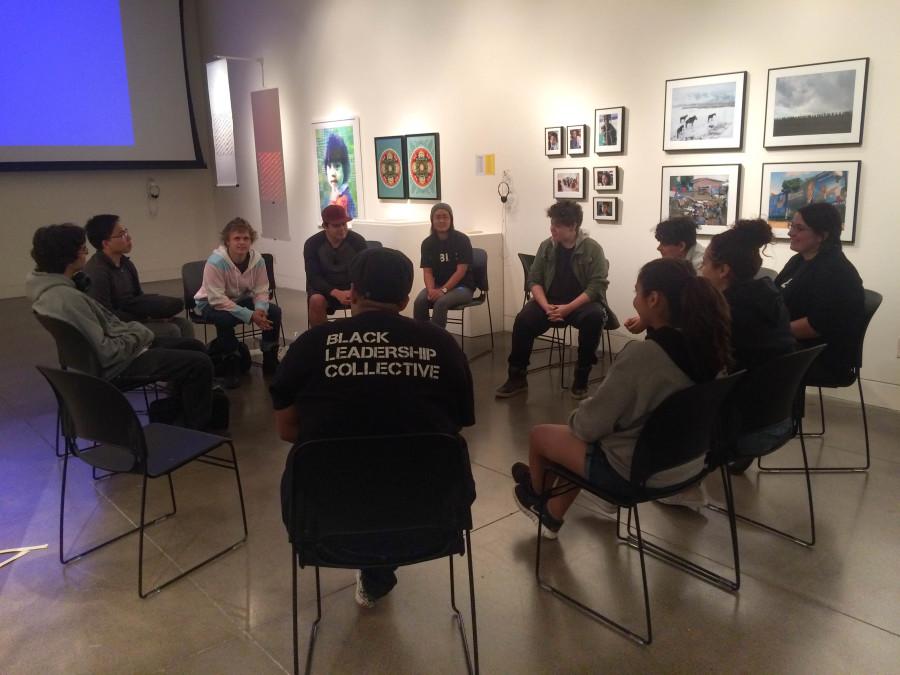
    De Anza students saw the Lacey Schwartz’s film “Little White Lie” and had a discussion about race and identity issues during the Third Film Festival on Oct. 15 at Euphrat Museum.

    Members of the Black Leadership Collective chose the film, discussion questions and overall theme for the festival.

    “This is all the students work,” said Julie Lewis, Department Chair of African American Studies, advisor to the Black Leadership Collective, and coordinator for the festival.

    The framework for the festival correlated with the Euphrat museum’s ongoing exhibition “Endangered” which also touches on social justice issues.

    “Some of the themes that they’ll be talking about is identity, what does it mean to be of a particular identity, who makes those rules, in particular around race, which is a socially constructed concept yet has very real world and lasting implications,” Lewis said before the event….

    Read the entire article here.

  • “I wasn’t white! It’s so hard to explain this to people: I don’t feel white.”

    2015-12-08

    “I wasn’t white! It’s so hard to explain this to people: I don’t feel white.” —Rachel Dolezal

    Mitchell Sunderland, “In Rachel Dolezal’s Skin,” Broadly, December 7, 2015. https://broadly.vice.com/en_us/article/rachel-dolezal-profile-interview.

  • Studying multiracialism and critical mixed race studies with Steven Riley, Ep. 42

    2015-12-07

    Studying multiracialism and critical mixed race studies with Steven Riley, Ep. 42

    Multiracial Family Man
    2015-12-06

    Alex Barnett, Host

    Steven F. Riley, Creator and Founder
    MixedRaceStudies.org

    I’m really excited to let you know that I was just interviewed on the Multiracial Family Man podcast to discuss issues confronting multiracial people and multiracial families. It was great fun, and I really hope you’ll download, listen to, and share the podcast. You can find the podcast here:

    • iTunes
    • Libsyn Podcast Network
    • Stitcher
Previous Page
1 … 502 503 504 505 506 … 1,428
Next Page

Designed with WordPress