Mixed Race Studies

Scholarly perspectives on the mixed race experience.

    • About This Site
    • Bibliography
    • Contact Information
    • Date and Time Formats
    • Forthcoming… (Updated 2021-09-01)
    • Likely Asked Questions
    • List of Book Publishers
    • List of Definitions and Terms
    • My Favorite Articles and Papers
    • My Favorite Posts
    • My Recent Activities
    • Praise for Mixed Race Studies
    • Tag Listing
      • Tag Listing (Ordered by Count)
    • US Census Race Categories, 1790-2010
    • 1661: The First ‘Mixed-Race’ Milestone
    • 2010 U.S. Census – Some Thoughts

recent posts

  • The Routledge International Handbook of Interracial and Intercultural Relationships and Mental Health
  • Loving Across Racial and Cultural Boundaries: Interracial and Intercultural Relationships and Mental Health Conference
  • Call for Proposals: 2026 Critical Mixed Race Studies Conference at UCLA
  • Participants Needed for a Paid Research Study: Up to $100
  • You were either Black or white. To claim whiteness as a mixed child was to deny and hide Blackness. Our families understood that the world we were growing into would seek to denigrate this part of us and we would need a community that was made up, always and already, of all shades of Blackness.

about

  • Twitter
  • Facebook
  • Instagram
  • 44 on 44: Forty-Four African American Writers on the Election of Barack Obama, 44th President of the United States

    2015-12-05

    44 on 44: Forty-Four African American Writers on the Election of Barack Obama, 44th President of the United States

    Third World Press
    2011-03-29
    319 pages
    Paperback ISBN: 978-0883783177

    Edited by: Lita Hooper, Sonia Sanchez, and Michael Simanga

    To give voice to the historic election of President Barack Obama as the 44th President of the United States, this anthology of essays, poetry, and creative non-fiction documents the conversation on President Obama’s campaign within the African American community, and the dialogue after his election and since he has taken the Oath of Office. Included are perspectives on the historical moments during President Barack Obama’s 2008 campaign, the finale of the 2008 general election, and Obama’s new plans and policies since he took office in January 20, 2009. Editors Lita Hooper, Michael Simanga, and Sonia Sanchez have assembled an impressive list of forty-four contributors to capture the energy and excitement, the expectation and hope. Featured are works from Lita Hooper, Michael Sigmanga, Sonia Sanchez, Amiri Baraka, Haki Madhubuti, Askia Toure, Quincy Troupe, Chuck D, Pearl Cleage, Natasha Trethewey, Tony Medina, Jessica Care Moore, Nathan McCall, Jasmine Guy, Farai Chideya, Keith Gilyard, Opal Moore, Sharan Strange, and Tina McElroy Ansa.

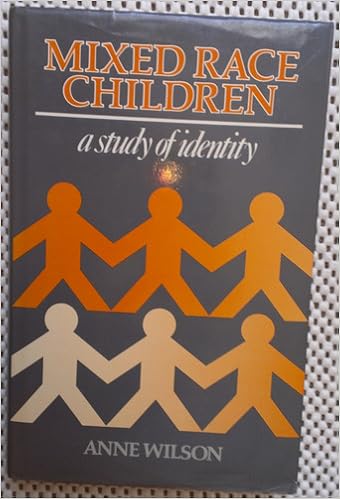
  • Mixed Race Children: A Study of Identity

    2015-12-05

    Mixed Race Children: A Study of Identity

    Unwin Hyman
    July 1987
    230 pages
    Hardcover ISBN: 978-0043701683
    8.5 x 5.7 x 1 inches

    Anne Wilson (1955-)

    Wilson’s research was conducted in England from October 1979 to May 1980 and focused on children of white/black (mainly West Indian) parentage. Using ‘snowball’ methods of recruitment, she was able to achieve a sample of 39 mothers and their 51 children of ages six to nine. The measurement instrument used with the children comprised 21 photographs, 14 of individual children and 7 of pairs of adults, and the book published the children’s and mothers’ interview schedules in its appendices…

    Continue to read a synopsis of the book here.

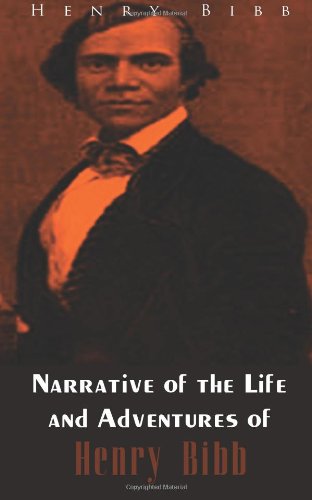
  • Narrative of the Life and Adventures of Henry Bibb: An American Slave

    2015-12-05

    Narrative of the Life and Adventures of Henry Bibb: An American Slave

    Lushena Books
    2014-02-20 (Originally published in 1849)
    104 pages
    0.2 x 4.9 x 7.9 inches
    Paperback ISBN-10: 1631820060
    Paperback ISBN-13: 978-1631820069

    Henry Bibb (1815-1854)


    Read the entire narrative, courtesy of Documenting the American South (DocSouth) here.

  • Multiracial kids—since mixed race is still not often considered a “legitimate” group (by both whites and people of color alike)—often experience an added layer of invisibility that is so damaging for their self-esteem.

    2015-12-05

    “Children of color in general either tend to get left out of school curriculum and societal teachings or hyper-visibilized in negative, harmful ways. Multiracial kids—since mixed race is still not often considered a “legitimate” group (by both whites and people of color alike)—often experience an added layer of invisibility that is so damaging for their self-esteem. Multiracial children don’t fit typical racial constructs and complicate the conversation in a way folks don’t like. When others feel discomfort and disequilibrium, it leads them to dismiss, gloss over, minimize or scoff at mixed race experiences. This often then leads multiracial children to feel they cannot be their whole authentic self on any front unless they’re willing to subscribe to prescribed racial categories.” —Sharon H. Chang

    Alice Wong, “Parents (of multiracial kids) Just Don’t Understand,” AsAmNews, December 3, 2015. http://www.asamnews.com/2015/12/03/parents-of-multiracial-kids-just-dont-understand/.

  • Black Enough/White Enough: The Obama Dilema

    2015-12-05

    Black Enough/White Enough: The Obama Dilema

    Third World Press
    February 2009
    199 pages
    Paperback ISBN: 978-0883783092

    Rickey Hendon

    Foreword by: Hermene D. Hartman
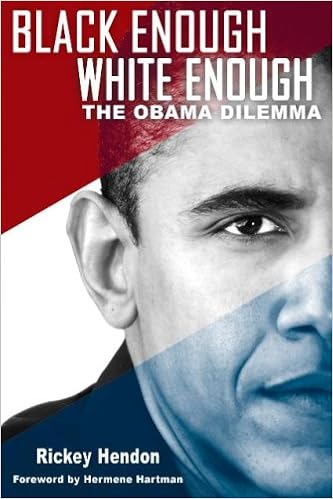
    Barack is caught between two worlds and struggles for acceptance by either side-Black enough? White enough? It’s a fine line that he must walk, writes Illinois state Senator Rickey Hendon, in Black Enough/White Enough: The Obama Dilemma, a personal memoir of the historic 2008 presidential election. Hendon, an African American senator from Chicago’s blighted West Side, was a veteran politico firmly aligned with other Black leaders when the man who would go on to become the golden presidential hopeful was an upstart balancing atop America’s cultural fence in one the most notoriously segregated cities in the nation. This newcomer was of a different stock than Chicago’s old guard, which boasted icons such as Rev. Jesse Jackson, late Mayor Harold Washington and Minister Louis Farrakhan, and was initially eyed with some suspicion-even by Hendon himself as the two served side by side in the Illinois state Senate. And as Hendon explains in this book, the phenomenon that became Barack Obama, the audacious presidential hopeful, was created not just by wooing America’s whites, but also by winning acceptance by America’s Blacks.

    Hendon begins Black Enough/White Enough: The Obama Dilemma with Obama’s announcement of his presidential bid on February 10, 2007, and follows his entire campaign in a journal-like fashion, all the way to the November 4, 2008 election. This running account is peppered with Hendon’s own observations, insights, inside information, and personal anecdotes of his long history with Barack Obama. Hendon pulls no punches and offers a warts-and-all look at how Obama’s campaign tiptoed across a tightrope to gain the confidence of white Americans without angering African Americans-the latter not always being successful. Since the book was compiled from a journal that Hendon kept of events as they were unfolding during the marathon campaign, we find ourselves transported back to Super Tuesday to race endlessly against a tenacious Senator Hillary Clinton, dodge scandals involving militant pastors and terrorist friends, to play running mate roulette with Republican opponent Senator John McCain. Some of the discussion deals with issues and incidents that have long since been resolved, and perhaps even forgotten, however, the memory of the uncertainty, the tough choices, the curve balls, the dirty tricks, the surprise game changers, and most of all, the nail biting stress, is preserved just as we should all want to remember it-when we were there!

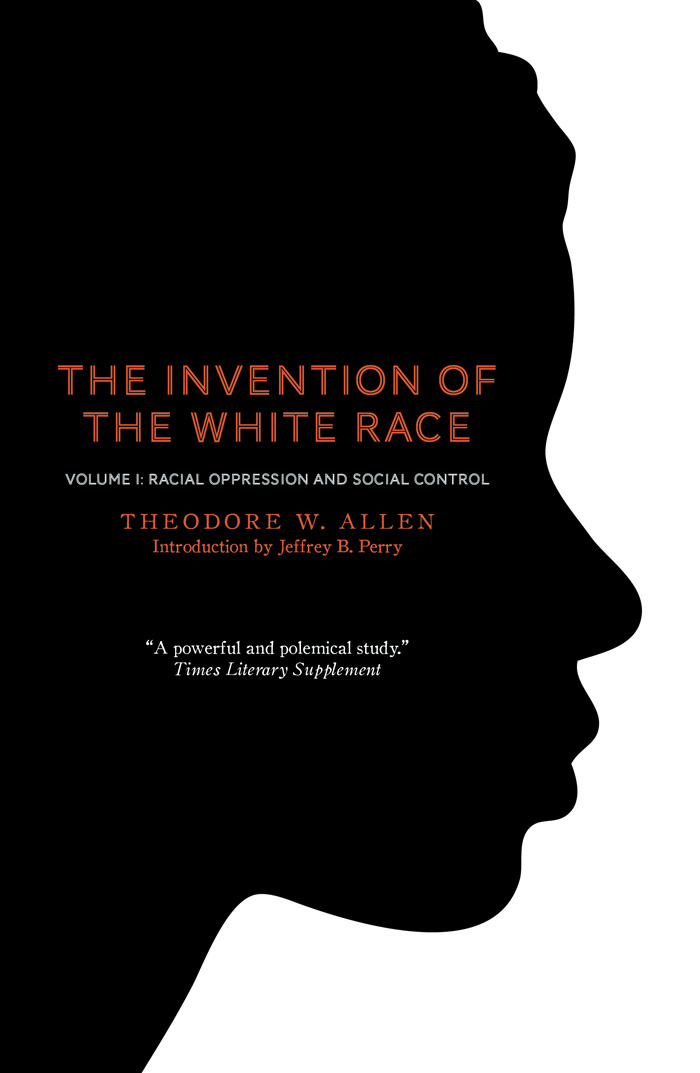
  • The Invention of the White Race, Volume 1: Racial Oppression and Social Control

    2015-12-05

    The Invention of the White Race, Volume 1: Racial Oppression and Social Control

    Verso Books
    November 2012 (Originally published in August, 1997)
    372 pages
    Paperback ISBN: 9781844677696
    Ebook ISBN: 9781844678433

    Theodore W. Allen (1919-2005)
    Introduction and notes by Jeffrey B. Perry

    Groundbreaking analysis of the birth of racism in America.

    When the first Africans arrived in Virginia in 1619, there were no “white” people there. Nor, according to colonial records, would there be for another sixty years. In this seminal two-volume work, The Invention of the White Race, Theodore W. Allen tells the story of how America’s ruling classes created the category of the “white race” as a means of social control. Since that early invention, white privileges have enforced the myth of racial superiority, and that fact has been central to maintaining ruling-class domination over ordinary working people of all colors throughout American history.

    Volume I draws lessons from Irish history, comparing British rule in Ireland with the “white” oppression of Native Americans and African Americans. Allen details how Irish immigrants fleeing persecution learned to spread racial oppression in their adoptive country as part of white America.

    Since publication in the mid-nineties, The Invention of the White Race has become indispensable in debates on the origins of racial oppression in America. In this updated edition, scholar Jeffrey B. Perry provides a new introduction, a short biography of the author and a study guide.

  • Kansas City Artist Shane Evans, Co-Author Taye Diggs Demystify Mixed-Race Families In New Book

    2015-12-05

    Kansas City Artist Shane Evans, Co-Author Taye Diggs Demystify Mixed-Race Families In New Book

    KCUR 89.3
    Kansas City, Missouri
    2015-12-04

    Laura Ziegler, Special Correspondent


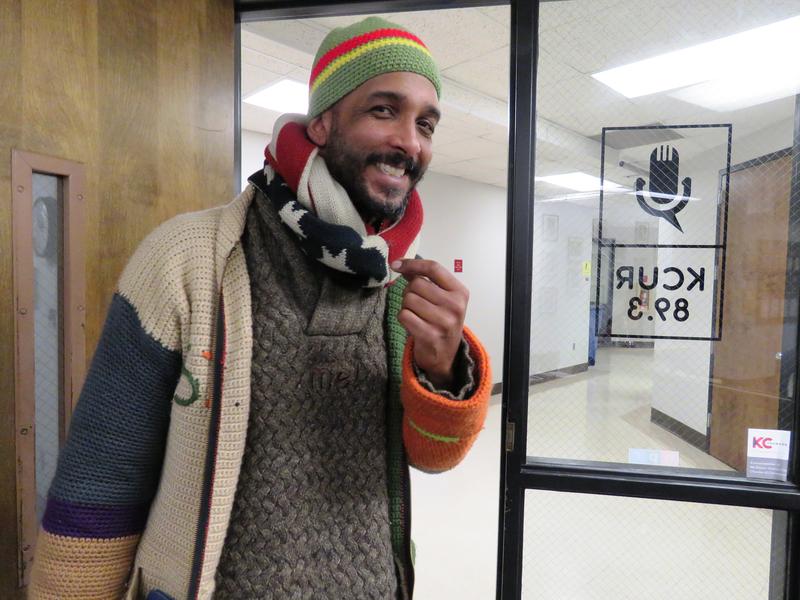
    Shane Evans at KCUR studios to talk about illustrating new children’s book (Laura Ziegler KCUR)

    Kansas City artist Shane Evans was raised by a mother and father whose racial and cultural backgrounds were different from one another. But to Evans they were just mom and dad. He’s also raising a mixed-race daughter.

    That’s why Evans was eager to collaborate with his friend, actor Taye Diggs, on a children’s book that takes on the complex issues of growing up in a mixed-race household. Diggs has a six-year-old son with actress and singer Idina Menzel, who is white.

    The book, Mixed Me, came out in October. Evans is the illustrator…

    Listen to the interview (00:30:46) here.

  • Parents (of multiracial kids) Just Don’t Understand

    2015-12-04

    Parents (of multiracial kids) Just Don’t Understand

    AsAmNews
    2015-12-03

    Alice Wong

    Talking about race is complicated enough but how do parents of multiracial Asian American children talk to their kids about race and racial identity? What are the experiences of multiracial Asian American children? What’s missing in the media representations of multiracial kids?

    Writer, scholar and activist Sharon H. Chang talked with AsAmNews about her multiracial family and the findings from her research on multiracial Asian American children from her new book Raising Mixed Race: Multiracial Asian Children in a Post-Racial World. Below are some edited excerpts from their conversation.

    You and your husband are both multiracial Asian Americans—describe your family’s cultural mash-up.

    Our collective family ancestry is Japanese, Taiwanese/Chinese, Slovakian, German, French Canadian, British, Welsh – American. But culturally we feel multiethnic, mixed, 2nd gen Asian American.

    How do you and your husband talk about your child about being multiracial in America?

    We talk pretty openly about systemic racial inequities in front of him. We don’t hide those struggles and even encourage him to participate in the conversations when he’s interested. Then regarding his own identity (i.e. relationship to those racial struggles) we don’t tell him he’s white. Because he’s not. He’s certainly asked, “Am I white?” And we’re very clear, “No.” Instead we offer Asian, Asian American, and mixed…

    Read the entire interview here.

  • Having mixed raced children will not end racism and result in a racial utopia, as questions and experiences of race cannot be bred away, but often appear with greater force when mixed bodies appear.

    2015-12-04

    Race is deeply entrenched in our lives and communities. Whether we agree with it and accept its logic, or challenge its history, factual basis and presence in our realities, it is an organising principle of societies that determines much of our experiences of ourselves. Having mixed raced children will not end racism and result in a racial utopia, as questions and experiences of race cannot be bred away, but often appear with greater force when mixed bodies appear.

    Danielle Bowler, “OPINION: Mixed raced children will not fix racism,” Eyewitness News, December 2, 2015. http://ewn.co.za/2015/12/02/OPINION-Danielle-Bowler-Mixed-raced-children-will-not-fix-racism.

  • OPINION: Mixed raced children will not fix racism

    2015-12-04

    OPINION: Mixed raced children will not fix racism

    Eyewitness News
    Johannesburg/Cape Town, South Africa
    2015-12-02

    Danielle Bowler


    Images courtesy of Tarryn Hatchett.

    Danielle Bowler says being a visibly mixed-raced person is often to encounter yourself as a perpetual question.

    Logging onto social media last week, I came across a meme that is frequently posted without interrogation of what it means or implies. ‘End Racism. Have mixed babies’. The images that appeared alongside these words are of light-skinned children, with blue eyes or masses of curls. A popular idea of what mixed raced children look like. A popular ‘type’ that is favoured, because of an appearance that is close to white, yet simultaneously ‘exotic’ and ‘other’.

    The problematic idea that we can fix racism through outbreeding it, shares a similar logic with the notion that mixed babies are cuter, and the assumption that if we date, marry or befriend people across racial lines we cannot still be racist. It ignores how we can and often do make exceptions out of people who we are in intimate relationships or friendships with.

    As Ella Sackville Adjei points out in her story about her ‘racist one night stand’, ‘racists don’t wear badges’ and not being racist is not as simple as being intimate with someone of another race to you. But it also ignores the fact that those mixed raced children are born into a world structured by race.

    But the idea that we can fix racism through making everyone visibly mixed still has currency. Despite the existence of mixed raced people and race-homogenous societies in the world, where race still matters. Despite evidence that race’s logic runs deep. Despite reality…

    Read the entire article here.

Previous Page
1 … 504 505 506 507 508 … 1,428
Next Page

Designed with WordPress