• Race-Crossing

    Sacramento Daily Union
    Volume 2, Number 4 (1890-06-08)
    page 1, column 4
    Source: California Digital Newspaper Collection

    Lima, the capital of Peru, is pronounced to be the headquarters of all the world’s mongreldom. Its population is the product of three centuries of race-crossing, and a scientific investigator finds easily distinguishable among the inhabitants the following crosses:

    Cholo, offspring of white father and Indian mother.
    Mulatto, offspring of white father and negro mother.
    Quadroon, offspring of white father and mulatto mother.
    Quinteroon, offspring of white father and quadroon mother.
    Chino, offspring of Indian father and negro mother.
    Chino Cholo, offspring of Indian father and Chinese mother.
    Chino Oscuro, offspring of Indian father and mulatto mother.
    Sambo China, offspring of negro father and mulatto mother.
    Sambo, offspring of a mulatto father and Sambo Chino mother.
    Sambo Claro, offspring of Indian father and Sambo Chino mother.

    These are the most notable crosses, but there are many others.

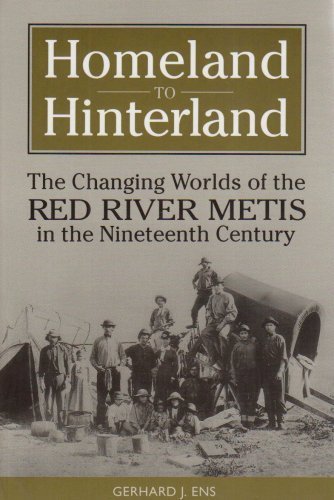
  • Homeland to Hinterland: The Changing Worlds of the Red River Métis in the Nineteenth Century

    University of Toronto Press
    November 1996
    268 pages
    Cloth ISBN: 9780802008350
    Paper ISBN: 9780802078223

    Gerhard J. Ens, Professor of History
    University of Alberta

    Most writing on Métis history has concentrated on the Resistance of 1869-70 and the Rebellion of 1885, without adequately explaining the social and economic origins of the Métis that shaped those conflicts. Historians have often emphasized the aboriginal aspect of the Métis heritage, stereotyping the Métis as a primitive people unable or unwilling to adjust to civilized life and capitalist society.

    In this social and economic history of the Métis of the Red River Settlement, specifically the parishes of St Francois-Xavier and St Andrew’s, Gerhard Ens argues that the Métis participated with growing confidence in two worlds: one Indian and pre-capitalist, the other European and capitalist. Ens maintains that Métis identity was not defined by biology or blood but rather by the economic and social niche they carved out for themselves within the fur trade.

    Ens finds that the Métis, rather than being overwhelmed, adapted quickly to the changed economic conditions of the 1840s and actually influenced the nature of change. The opening of new markets and the rise of the buffalo robe trade fed a `cottage industry’ whose increasing importance had significant repercussions for the maintenance of ethnic boundaries, the nature of Métis response to the Riel Resistance, and the eventual decline of the Red River Settlement as a Métis homeland.

  • The Color Line: A Brief in Behalf of the Unborn

    McClure, Phillips & Co.
    1905
    261 pages
    ISBN 10: 0837113962
    Open Library ID: OL7174992M

    William Benjamin Smith (1850-1934), Professor of Mathematics and Philosophy
    Tulane University

    Contents

    • Chapter One: The Individual? or the Race?
    • Chapter Two: Is the Negro Inferior?
    • Chapter Three: Nurture? or Nature?
    • Chapter Four: Plea and Counterplea
    • Chapter Five: A Dip Into the Future
    • Chapter Six: The Argument from Numbers

    Read the entire book here or here.

  • The Métis of Senegal: Urban Life and Politics in French West Africa

    Indiana University Press
    2013-03-18
    296 pages
    9 b&w illustrations, 5 maps
    6 x 9
    Paperback ISBN: 978-0-253-00674-5
    Cloth ISBN: 978-0-253-00673-8
    eBook (PDF) ISBN: 978-0-253-00705-6

    Hilary Jones, Assistant Professor of History
    University of Maryland, College Park

    The Métis of Senegal is a history of politics and society among an influential group of mixed-race people who settled in coastal Africa under French colonialism. Hilary Jones describes how the métis carved out a niche as middleman traders for European merchants. As the colonial presence spread, the métis entered into politics and began to assert their position as local elites and power brokers against French rule. Many of the descendants of these traders continue to wield influence in contemporary Senegal. Jones’s nuanced portrait of métis ascendency examines the influence of family connections, marriage negotiations, and inheritance laws from both male and female perspectives.

    Table of Contents

    • Introduction: Urban Life, Politics, and French Colonialism
    • 1. Signares, Habitants, and Grumets in the Making of Saint Louis
    • 2. Métis Society and Transformations in the Colonial Economy (1820-1870)
    • 3. Religion, Marriage, and Material Culture
    • 4. Education, Association, and an Independent Press
    • 5. From Outpost to Empire
    • 6. Electoral Politics and the Métis (1870-1890)
    • 7. Urban Politics and the Limits of Republicanism (1890-1920)
    • Conclusion
    • Appendix: Family Histories
    • Notes
    • Bibliography
    • Index
  • Transracial mothering and maltreatment: are black/white biracial children at higher risk?

    Child Welfare
    Volume 91, Number 1 (January-February 2012)
    pages 55-77

    Mary E. Rauktis, Research Assistant Professor of Social Work
    University of Pittsburgh

    Rachel A. Fusco, Assistant Professor of Social Work
    University of Pittsburgh

    The number of people identifying as biracial is rapidly growing, though little is known about the experiences of interracial families. Previous work indicates that biracial children may be at elevated risk of entering the child welfare system. This could underscore additional risks faced by these families. This document includes data from the Longitudinal Studies of Child Abuse and Neglect (LONGSCAN), a project funded by the Administration on Children, Youth, and Families, U.S. Department of Health and Human Services, and distributed by the National Data Archive on Child Abuse and Neglect. LONGSCAN data were used to examine familial risks associated with child maltreatment. White mothers of white children were compared to white mothers of biracial children with the hypothesis that interracial families would have less social and community support. Results showed that the women were similar in terms of mental health and parenting behaviors. There were no differences in maternal age, employment status, or presence of a partner. However, mothers of biracial children were poorer, had more alcohol use, and decreased social support. They experienced more intimate partner violence and lower neighborhood satisfaction. Findings have implications for intervention programs focused on reducing social isolation within interracial families.

  • Racial and Ethnic Identity Development in White Mothers of Biracial, Black-White Children

    Affilia
    Volume 19, Number 1 (February 2004)
    pages 68-84
    DOI: 10.1177/0886109903260795

    Margaret O’Donoghue, Adjunct Assistant Professor of Social Work
    New York University

    This article reports on a qualitative research study of the racial and ethnic identity of 11 White mothers who were married to Black (specifically African American) men and were raising biracial children. The uniqueness of these women’s lives, as Whites with an intimate knowledge of the Black experience, makes it difficult to place them within the levels described by current models of racial identity. Through their parenting of biracial children, the mothers had come to a greater sense of their own racial identity and to recognize White privilege and their own White identity. Their specific ethnic identity, as ethnic Whites, has not been passed on to their children.

    …Most of the women revealed that in raising their children, they focused on a Black identity, with a somewhat unconscious understanding that the traditions that they, the mothers, could provide were either “just American” or not something their children needed to incorporate into their identities.   Essential to this process of White mothers fostering Black culture in their  biracial children was the presence of Black husbands. All the women were in  long-term marriages with Black men. Their husbands had educated them about Black culture and fostered their knowledge of this ethnicity. Without their husbands’ presence, the women may have found it difficult to impart this sense of ethnic identity to their children….

    …In general, the women did not think that their identity had essentially changed since they married, nor did they feel they had somehow “crossed over” and become Black. Many noted, however, that they had become more aware of their own identity as a racial being, as a White person. As was noted in the previous section, before their relationships with their husbands, they had never been placed in a situation of having to consider themselves as having a race. White privilege had previously enabled them to move through social situations without having to consider the impact of their racial identification….

    Read the entire here.

  • Are the Tsarnaevs White?

    The Daily Beast
    2013-04-24

    Peter Beinart, Senior Political Writer and Associate Professor of Journalism
    City University of New York

    also Editor-in-chief
    Open Zion

    In a word, yes. But why is this so hard for Americans to grasp? Peter Beinart on our country’s long track record of conflating religion and race.

    The day after last week’s attack in Boston, David Sirota wrote a column for Salon entitled “Let’s Hope the Boston Marathon Bomber Is a White American,” arguing that this would limit the resulting crackdown on civil liberties. At first, conservatives were appalled. Then, when police fingered the Tsarnaev brothers, they were triumphant. “Sorry, David Sirota, Looks Like Boston Bombing Suspects Not White Americans,” snickered a headline in Newsbusters. “Despite the most fervent hopes of some writers over at Salon.com,” added a blogger at Commentary, “the perpetrators of the Boston Marathon bombing are not ‘white Americans’.”

    But the bombers were white Americans. The Tsarnaev brothers had lived in the United States for more than a decade. Dzhokhar was a U.S. citizen. Tamerlan was a legal permanent resident in the process of applying for citizenship. And as countless commentators have noted, the Tsarnaevs hail from the Caucasus, and are therefore, literally, “Caucasian.” You can’t get whiter than that.

    So why did conservatives mock Sirota for being wrong? Because in public conversation in America today, “Islam” is a racial term. Being Muslim doesn’t just mean not being Christian or Jewish. It means not being white…

    Read the entire article here.

  • Race, Policy, and Culture: An Identity Crisis for Sickle Cell Disease in Brazil

    Melissa S. Creary, MPH, Doctoral Candidate
    Graduate Institute of Liberal Arts
    Emory University

    Professor Howard Kushner, Chair
    Professor Jeffrey Lesser, Co-Chair

    Abstract of Dissertation Prospectus

    In 2001, Cândida and Altair, a married couple, started a national organization to increase the rights of sickle cell patients, and thereby gave birth to the sickle cell disease (SCD) movement in Salvador, Bahia, Brazil. Cândida, the wife, who carries sickle cell trait, now heads the municipal SCD unit for Salvador. She, with light skin and wavy brown hair, might be considered white in the United States, but when I asked her why she had created the organization she responded: “Eu sou negra!” (I am black). Her darker-skinned husband, who considers himself a black activist, coordinates the national SCD association and helped craft policy for SCD. As a family, Cândida and Altair shift between multiple roles: genetic carrier, parent, government official, and SCD advocate. Together these two activists have helped shape the racial discourse on SCD by associating the disease with “blackness” on the individual, organizational, and national level.

    Sickle cell disease is the most common hereditary hematologic disorder in Brazil and throughout the world. In Brazil, the estimated prevalence is between 2% and 8% of the population. My research explores how patients, non-governmental organizations, and the Brazilian government, at state and federal levels, have contributed to the discourse of SCD as a “black” disease, despite a prevailing cultural ideology of racial mixture. Specifically, this project analyzes how the Brazilian state, advocacy, and patient communities within the nation have, at times, branded SCD an Afro-Brazilian disease. At the state level, I’ll describe the reigning racial ideology and how the development of racialized health policy contests their own viewpoint. On the organizational level, I’ll investigate the alignment of the SCD movement with the black movement of Brazil and the decisions made by some of these organizations to influence health policy using anti-racist motives. Lastly, I will explore the actual embodiment of SCD in the patient population and the “identity crisis” many may experience upon being diagnosed with a “black” disease.

    With this framework in mind, I aim to answer the question—How are different actors (re)defining race and health through culture, biology, policy and politics in contemporary Brazil? This multi-level identity crisis is in constant contestation of competing racial frameworks at the micro, meso, and macro level. I will manage these complexities with a flexible notion of biological citizenship that considers frameworks of biology, social determinants, and policy in ways that is uniquely responsive to the cultural and historical specifics of how race, identity, health, and legitimacy operate in Brazil.

    To do this, I will spend ten months in Brasília, Salvador, and Rio de Janeiro investigating the construction of sickle cell disease on three different levels: advocacy organization around patient rights, individual patient and family experience, and governmental policy development and implementation. To assess the social, geographical, and political context of my subjects, I will use a series of historical and qualitative methodologies.

    My work will deepen and re-think narratives of Brazil’s racial history through the lens of SCD. It also stands to generate a better understanding of the historical genealogy as it informs the current implementation of SCD policy. This analysis can provide lessons to both Brazil and the US on how future policy can be designed. Specifically, whether policy developed around populations (or sub-set of populations) can be measured against and be as effective as policy developed around disease.
  • Also by Mail

    Edition Assemblage: Begleiterscheinungen emanzipatorischer Theorie und Praxis
    2013-02-20
    96 pages
    Paperback, 142×205 mm
    ISBN 978-3-942885-38-6
    Series: Witnessed Edition 2

    Olumide Popoola

    Also by Mail is a modern family comedy-drama that follows the experiences of Nigerian German siblings Funke and Wale who fly to Nigeria to bury their suddenly deceased father. Their upbringing clashes with their uncle’s expectations and initial misunderstandings soon come to an éclat. When Wale returns to Germany, frustrated, he is bitterly reminded of how little his father acknowledged and prepared them for racist encounters there.

    Loss and racism, sibling rivalry and cross-cultural etiquette, the play incorporates and subverses it’s urban, neo-African elements of story-telling to give a contemporary picture of a family that struggles not only with the legacy of its patriarch but with being racialized within the German context as well. Where does each stand in a circle of relations and needs? Where does each want to end up? And who is willing to help? It takes an inside-outside job to lighten the mood and the surprise startles them all.