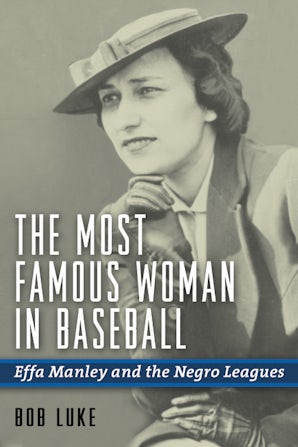
• She Just Loved Baseball

    Black Athlete Sports Network
    2010-02-28

    Bill Carroll

    NEW YORK—Effa Manley was seemingly yet another “lost” pioneer in Negro Leagues Baseball before being posthumously honored in 2006 with induction into the Baseball Hall of Fame.

    She was part of a class of players and executives selected by a special committee chaired by former baseball commissioner Fay Vincent. But a plaque for the only woman inducted in the Hall of Fame barely touches the surface of an often controversial life.

    Manley was born in Philadelphia, Pennsylvania. Her mother, Bertha Ford Brooks, was of German and East-Indian descent. Bertha, who was a seamstress, gave birth to Effa after becoming pregnant by her wealthy White employer, John M. Bishop.

    Bertha’s husband, Benjamin Brooks, who was Black, sued Bishop and received a settlement of $10,000 before he and Bertha divorced.  Bertha later remarried, and Effa was raised in a household with a Black stepfather and Black half-siblings.

    Inheriting somewhat dark skin from her mother, she chose to live as a Black person, leading most people to assume her stepfather was her biological father and to classify her as Black.

    After graduation from high school in Philadelphia, she moved to New York to work in the millinery business. She met Abe Manley, an African-American man 24 years older than she, at the 1932 World Series at Yankee Stadium, where she had gone to see her favorite player, Babe Ruth

    …The Newark Eagles were founded in 1936 when the Newark Dodgers merged with the Brooklyn Eagles. The Eagles sported the likes of Hall-of-Famers Larry Doby, Monte Irvin, Ray Dandridge, Leon Day, and Willie Wells.  The Eagles shared Ruppert Stadium with the Newark Bears, beginning in 1936…

    …In addition to managing her baseball team, Manley was also a social activist for Civil rights. She organized a boycott of Harlem stores when they wouldn’t hire Black salesclerks. It took only six weeks for the stores to give in.

    As a result, one year after the boycott, 300 stores employed Blacks. She held an “Anti-Lynching Day” at Ruppert Stadium and was treasurer for the Newark chapter of the National Association for the Advancement of Colored People (NAACP)…

    Read the entire article here.

  • Documentary Genocide: Families Surnames on Racial Hit List

    Richmond Times-Dispatch
    2000-03-05

    Peter Hardin, Former Washington Correspondent
     
    Long before the Indian woman gave birth to a baby boy, Virginia branded him with a race other than his own.
     
    The young Monacan Indian mother delivered her son at Lynchburg General Hospital in 1971. Proud of her Indian heritage, the woman was dismayed when hospital officials designated him as black on his birth certificate. They threatened to bar his discharge unless she acquiesced. The original orders came from Richmond generations ago.
     
    Virginia’s former longtime registrar of the Bureau of Vital Statistics, Dr. Walter Ashby Plecker, believed there were no real native-born Indians in Virginia and anybody claiming to be Indian had a mix of black blood.
     
    In aggressively policing the color line, he classified “pseudo-Indians” as black and even issued in 1943 a hit list of surnames belonging to “mongrel” or mixed-blood families suspected of having Negro ancestry who must not be allowed to pass as Indian or white.
     
    With hateful language, he denounced their tactics.
     
    “ . . . Like rats when you are not watching, [they] have been ‘sneaking’ in their birth certificates through their own midwives, giving either Indian or white racial classification,” Plecker wrote.
     
    Twenty-eight years later, the Monacan mother’s surname still was on Plecker’s list. She argued forcefully with hospital officials. She lost…

    …“It’s not that we’re trying to dig him [Plecker] up and re-inter him again,” said Gene Adkins, assistant chief of the Eastern Chickahominy Tribe.
     
    “We want people to know that he did damage the Indian population here in the state. And it’s taken us years, even up to now, to try to get out from under what he did. It’s a sad situation, really sad.”
     
    Said Chief William P. Miles of the Pamunkey Tribe: “He came very close to committing statistical genocide on Native Americans in Virginia.”…

    Read the entire article here.

  • Black Liverpool, Black America, and the Gendering of Diasporic Space

    Cultural Anthropology
    Volume 13, Issue 3 (August 1998)
    pages 291–325
    DOI: 10.1525/can.1998.13.3.291

    Jacqueline Nassy Brown, Associate Professor of Anthropology
    Hunter College of the City University of New York

    The terms black Liverpool and black America, no less than the African diaspora, refer to racialized geographies of the imagination. The mapping of racial signifiers onto geographical ones lends such terms the illusion of referring to physical rather than social locations. That there is no actual space that one could call “the African diaspora,” despite how commonly it is mapped onto particular locales, points attention to the ways that social spaces are constructed in tandem with processes of racial formation…

    Inspired by Paul Gilroy’s first book, There Ain’t No Black in the Union Jack: The Cultural Politics of Race and Nation (1987), I set out in 1991 to study the meanings and practices surrounding “race” andnation in Liverpool, England. Set in a city with one of the longest-settled black populations in the United Kingdom, my research investigated why and how black identity is constituted as the mutual opposite of English and British identities. Yet in pursuing these themes, I became increasingly amazed at how frequently my informants would make discursive forays into “black America.” Nested at key moments in their narratives were references to the formative influence that black America—in many forms—has had on racial identity and politics in their city. The experiences they narrated were varied, and the narratives themselves were rich, poignant, and deeply gendered. Black Liverpudlians told of their relations with the black American servicemen (or “GIs”) who were stationed outside their city for some 25 years following World War II. Men and women also spoke about the travels of their own African, Afro-Caribbean, and native black Liverpudlian fathers who were employed as seamen by Liverpool shipping companies. The global wanderings of the city’s black men often brought them to black Atlantic ports of call-many in the United States. Narratives of black Liverpudlians’ diasporic encounters also referred to the emigration of local women to the mythical place called “black America.” Finally, and crucially, men and women told of how and why they have accessed the many black American cultural productions that have, for decades, circulated around the social space of black Liverpool.

    Setting Sail: The Birth of Liverpool’s Black Community

    When black Liverpudlians narrate their history, three themes often emerge. The first concerns the participation of black men in the city’s shipping industry; the second concerns the birth of the black population-a process narrated with special reference to the prevalence of interracial  marriage in Liverpool; and the third concerns the transformation of their racial identity from “half-caste” to “black.” These related processes, to be examined briefly below, have given rise to the contemporary form of black Liverpudlians’ local and racial identities…

    African seamen, as has been suggested, are heralded in Liverpool for essentially giving birth to the black community. Yet they are also noted for setting another phenomenon into motion: the institution of interracial marriage. The prevalence of interracial marriage is a crucial theme in narratives on local history. During their careers at sea, African men commonly docked in Liverpool’s port, formed romantic relationships with local women, mostly white, and later married them, had children, retired from seafaring, and settled in the city—so the dominant narrative goes, both in social scientific and local discourse. Diane Frost’s recent explanation is exemplary of the former. She writes,

    Transient work patterns that derive from the nature of seafaring… led to short-term relationships with local women. Permanent and long-standing relationships with local women through marriage (formal or common-law) usually occurred when these seamen became permanently domiciled in Liverpool or in some cases this became a reason for gaining domicile. [1995-96:51]

    Several black Liverpudlians told me of a much earlier study of this phenomenon. Published in 1930, it was written by an anthropologist named Muriel Fletcher and given the revealing title Report on an Investigation into the Colour Problem in Liverpool and Other Ports (Fletcher 1930). Mark Christian marks the publication of “the Fletcher Report” as the dawn of philanthropic racism in Liverpool because it expressed “concern” both for the “morally degenerate” white women who consorted with African seamen, and for their haplessly pathological “half-caste” children (1995-96). The sexualized interpretation of seafaring lends specificity to the racialization not only of interracial unions, but also of the children born of them.

    Major and minor publications on blacks in Liverpool always condemn the Fletcher Report for essentially developing a non-category (“neither black nor white”) to speak of blacks of mixed racial parentage. Their struggles to overcome that inscription is an absolutely central theme in black Liverpudlian accounts of the way they became black. While some blacks of mixed parentage specifically cite black American influences on the rise of a black identity in Liverpool, the blacks I knew with two black parents tended to boast that “we were always ‘black’ in our family”—speaking somewhat disparagingly, perhaps, of those who took longer to claim that identity. Yet the narratives of black Liverpudlians of mixed parentage reveal the difficulty of that process, for these Liverpudlians indicated rather painfully that their African fathers, whom they said they looked to for racial identity, often perceived their children as racially different than themselves. Blacks of mixed parentage in Liverpool commonly reported that their African fathers referred to them as “half-caste.” While this is not the place to historicize the term, we must grant the obvious possibility that West African societies colonized by the British were heavily influenced by Victorian constructions of “race” that were characterized by a concern for “purity” (Lorimer 1978). African informants in Liverpool reported that they, too, grew up with the term, and never recognized it as derogatory. A relatively recent immigrant to England explained, “Growing up in Nigeria, it was acceptable to call people of mixed race ‘half-caste’ because to a lot of Nigerians it was not an abusive term. It was purely a biological description of somebody who comes from a mixed race.”…

    Read the entire article here.
  • “My Long Trip Home: A Family Memoir,” by Mark Whitaker

    The Washington Post
    2011-10-14

    Jonathan Yardley, Critic

    Now in his mid-50s, Mark Whitaker has had an impressive journalistic career. Fresh out of Harvard in the late 1970s, he went to work at Newsweek and rose steadily through various assignments, eventually becoming its editor. In 2006 he moved to NBC, at first as “the number two executive in the news division,” then as chief of its Washington bureau. Now he is executive vice president and managing editor of CNN Worldwide, an immensely influential position given that CNN reaches into almost every nook and cranny of the world.

    All of which makes for quite a resume, but it also makes for the least interesting part of “My Long Trip Home,” Whitaker’s memoir. It’s worth reading because it’s a thoughtful account of growing up bi-racial at a point in this country’s history when racial identities are in flux and when people of mixed race are ever more common…

    …“My Long Trip Home” is not a confessional memoir of the sort so popular these days, especially among younger memoirists who have nothing to confess except the cruelties allegedly inflicted upon them by others or simply by life itself. For the most part Whitaker’s tone is objective, almost reportorial, which permits the reader to see his story clearly rather than through the mists of hyperventilated emotion. It’s a good book.

    Read the entire review here.

  • First woman among 17 elected to baseball Hall

    Associated Press
    2006-02-27

    TAMPA, Fla.—Effa Manley became the first woman elected to the baseball Hall of Fame when the former Newark Eagles executive was among 17 people from the Negro Leagues and pre-Negro Leagues chosen Monday by a special committee.

    “This is a historic day at the Hall of Fame,” shrine president Dale Petroskey said. “I hoped that someday there would be a woman in the Hall. It’s a pretty proud moment.”…

    …Manley co-owned the New Jersey-based Eagles with her husband, Abe, and ran the business end of the team for more than a decade. The Eagles won the Negro Leagues World Series in 1946—one year before Jackie Robinson broke the major-league color barrier.

    “She was very knowledgeable, a very handsome woman,” said Hall of Famer Monte Irvin, who played for the Eagles while the Manleys owned the team, as did Don Newcombe and Larry Doby.

    “She did a lot for the Newark community. She was just a well-rounded, influential person,” Irvin said. “She tried to organize the owners to build their own parks and have a balanced schedule and to really improve the lot of the Negro League players.”

    Manley was white but married a black man and passed as a black woman, said Larry Lester, a baseball author and member of the voting committee.

    “She campaigned to get as much money as possible for these ballplayers, and rightfully so,” Lester said.

    Manley used baseball to advance civil rights causes with events such as an Anti-Lynching Day at the ballpark. She died in 1981 at age 84.

    “She was a pioneer in so many ways, in terms of integrating the team with the community,” said Leslie Heaphy, a Kent State professor on the committee. “She’s also one of the owners who pushed very hard to get recognition for Major League Baseball when they started to sign some of their players.”…

    Read the entire article here.

  • Author Talk and Book Signing: Bob Luke

    National Portrait Gallery
    Bookstore
    Eighth and F Streets NW
    Washington, D.C.
    2011-10-19, 18:00-19:00 EDT (Local Time)

    Bob Luke discusses and signs copies of The Most Famous Woman in Baseball: Effa Manley and the Negro Leagues. Manley’s life played out against the backdrop of the Jim Crow years, when discrimination forced most of Newark’s blacks to live in the Third Ward, where prostitution flourished, housing was among the nation’s worst, and only menial jobs were available. Manley and the Eagles gave African Americans a haven, Ruppert Stadium. She was a force of nature—and, as Bob Luke shows, one to be reckoned with. From 1936 to 1948, she ran the Negro league Newark Eagles, which her husband, Abe, owned for roughly a decade. Because of her business acumen, commitment to her players, and larger-than-life personality, she would leave an indelible mark not only on baseball but also on American history.

    For more information, click here.

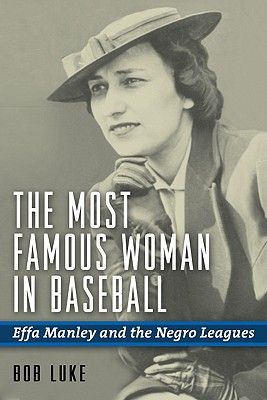
  • The Most Famous Woman in Baseball: Effa Manley and the Negro Leagues

    Potomac Books, Inc.
    March 2011
    256 pages
    26 b&w Images; Notes; Suggested Reading; Appendix; Index
    6″ x 9″
    Cloth ISBN: 978-1-59797-546-9

    Bob Luke

    Never one to mince words, Effa Manley once wrote a letter to sportswriter Art Carter, saying that she hoped they could meet soon because “I would like to tell you a lot of things you should know about baseball.”

    From 1936 to 1948, Manley ran the Negro league Newark Eagles that her husband, Abe, owned for roughly a decade. Because of her business acumen, commitment to her players, and larger-than-life personality, she would leave an indelible mark not only on baseball but also on American history.

    Attending her first owners’ meeting in 1937, Manley delivered an unflattering assessment of the league, prompting Pittsburgh Crawfords owner Gus Greenlee to tell Abe, “Keep your wife at home.” Abe, however, was not convinced, nor was Manley deterred. Like Greenlee, some players thought her too aggressive and inflexible. Others adored her. Regardless of their opinions, she dedicated herself to empowering them on and off the field. She meted out discipline, advice, and support in the form of raises, loans, job recommendations, and Christmas packages, and she even knocked heads with Branch Rickey, Bill Veeck, and Jackie Robinson.

    Not only a story of Manley’s influence on the baseball world, The Most Famous Woman in Baseball vividly documents her social activism. Her life played out against the backdrop of the Jim Crow years, when discrimination forced most of Newark’s blacks to live in the Third Ward, where prostitution flourished, housing was among the nation’s worst, and only menial jobs were available. Manley and the Eagles gave African Americans a haven, Ruppert Stadium. She also proposed reforms at the Negro leagues’ team owners’ meetings, marched on picket lines, sponsored charity balls and benefit games, and collected money for the NAACP.

    With vision, beauty, intelligence, discipline, and an acerbic wit, Manley was a force of nature—and, as Bob Luke shows, one to be reckoned with.

    Table of Contents

    • Introduction
    • 1. The Lady Makes a Splash
    • 2. The Manleys Come to Baseball
    • 3. Abe Trades Brooklyn for Newark
    • 4. Effa Steps Up
    • 5. Effa Comes Into Her Own
    • 6. Fireworks
    • 7. Cobbling Together a Lineup
    • 8. War Comes to Newark
    • 9. The Eagles Adapt to the War
    • 10. Branch Rickey Drops the Color Bar
    • 11. A Reunited Team
    • 12. Striving for Respectability
    • 13. Effa’s Life After the Eagles
    • Epilogue
    • Appendix
    • Acknowledgments
    • Notes
    • Index
    • Suggested Readings
    • About the Author
  • Mixed Race Literature

    Intercultural Happenings: Thoughts and experiences towards creating a more culturally inclusive community
    Stonehill College, Easton, Massachusetts
    2011-03-28

    Each month, we highlight some of the reflective posts of our work study students. Unedited, they blog about observations, experiences and thoughts about diversity in their lives as seen through their lenses.

    Today’s post is from Ariel, a multiracial student at Stonehill:

    Mixed race literature is a genre by authors and about individuals who identify as being mixed-race. This ranges from Native-European, African-European, Native-African American, and other multiracial identities. I feel as if the majority of these writers collectively dread the idea of being limited to only one category or genre of literature because some might think they are responsible for multiple identities. Lately I’ve been reading works by contemporary Native American authors who are challenging their audiences to view topics of mixed- blood individuals as a subsection of Native literature rather than a collection of works which “question the authority” of Native American identity. What I’ve also noticed is both Native Americans and African Americans are similar in the sense that their histories are plagued by the paradigm of the colonizer versus the colonized…

    Read the entire article here.

  • An Analysis of the Fiction of Charles W. Chesnutt

    Drake University
    February 1988
    121 pages

    Harold James Bruxvoort

    A Dissertation Presented to The College of Arts and Sciences Drake University In Partial Fulfillment of the Requirements for the Degree Doctor of Arts

    Summary of Author: Charles W. Chesnutt (1858-1932) is a black short story author and novelist whose two volumes of short stories and three novels of purpose depict racial tensions present in the South during the post-Reconstruction era. He addressed a culture dominated by the myth of white superiority and black inferiority. Chesnutt’s purpose in his fiction is to present a perspective of racial tensions and social issues confronting Southern whites and blacks that differed from the perspective presented by writers of the plantation tradition fiction.

    Rationale: Since black authors from 1853 to the 1890s basically reflected the themes of plantation tradition fiction and thus ignored social and political issues facing blacks in the 1890s, this analysis of Chesnutt’s fiction is made to determine whether he did present a differing perspective of slavery and of white-black issues in the South.

    Procedure: This study is based on the reading and analysis of primary sources—The Conjure Woman, The Wife of his Youth and Other Stories of the Color Line, The House Behind the Cedars, The Marrow of Tradition, and The Colonel’s Dream—as well as his letters collected by Helen, his daughter. Material from the Charles Chesnutt Collection was also incorporated into this study. Secondary sources include articles by Chesnutt’s contemporaries as well as articles and books by later scholars.

    Findings: Charles Chesnutt is the first black American author to ask his publishers for the freedom to treat social and racial issues from a black’s perspective: issues such as racial intermarriage, the franchise, and convict labor practices. He also explored the ramifications of “passing” into white society and other problems confronting people of mixed-race in the South and in the North. He pleaded for a quickening of conscience and for moral renewal in the hearts of Southern whites.

    Conclusions: Chesnutt projects a sense of optimism for racial acceptance in The House Behind the Cedars and to a lesser degree in The Marrow of Tradition. However, his third novel, The Colonel’s Dream reflects his frustration concerning the absence of meaningful change in the South in 1905. Negative responses by white supremacy groups and apathy on the part of Northern whites are two factors which led to his decline as an early twentieth-century novelist.

    Table of Contents

    • I. Chapter 1 Introduction
    • II. Chapter 2 An Analysis of Plantation Tradition Fiction
    • III. Chapter 3 An Analysis of the Fiction of Charles W. Chesnutt: His Hope for the South
    • IV. Chapter 4 An Analysis of the Fiction of Charles W. Chesnutt: His Growing Pessimism
    • V. Chapter 5 Conclusions

    Read the entire dissertation here.

  • Voorhees author addresses growing up biracial

    South Jersery Sunne.ws
    2011-10-17

    Sean Patrick Murphy

    A Voorhees woman has written a book that she hopes will help parents of biracial children deal with unique challenges.
     
    Color Blind” is life coach Tiffany Rae Reid’s attempt to provide a guide for parents, caregivers, and family members raising biracial children as well as for educators impacting the lives of biracial children.

    Originally from northeastern Ohio, Reid’s mother is Hungarian and her father is African American.
     
    Raised in a very conservative Hungarian household, Reid had no exposure to her black side…

    Read the entire article here.