• Race and Ethnicity in Society: The Changing Landscape, 3rd Edition

    Cengage Learning
    2012
    480 pages
    ISBN-10: 1111519536; ISBN-13: 9781111519537

    Edited by

    Elizabeth Higginbotham, Professor of Sociology, Women’s Studies, and Criminology
    University of Delaware

    Margaret L. Andersen, Edward F. and Elizabeth Goodman Rosenberg Professor of Sociology
    University of Delaware

    This engaging reader is organized in four major thematic parts, subdivided into thirteen different sections. Part I (“The Social Basis of Race and Ethnicity”) establishes the analytical frameworks that are now being used to think about race in society. The section examines the social construction of race and ethnicity as concepts and experience. Part II (“Continuity and Change: How We Got Here and What It Means”) explores both the historical patterns of inclusion and exclusion that have established racial and ethnic inequality, while also explaining some of the contemporary changes that are shaping contemporary racial and ethnic relations. Part III (“Race and Social Institutions”) examines the major institutional structures in contemporary society and investigates patterns of racial inequality within these institutions. Persistent inequality in the labor market and in patterns of community, residential, and educational segregation continue to shape the life chances of different groups. Part IV (“Building a Just Society”) concludes the book by looking at both large-scale contexts of change, such as those reflected in the movement to elect the first African American president.

    • Major themes include coverage showing the diversity of experiences that now constitute “race” in the United States; teaching students the significance of race as a socially constructed system of social relations; showing the connection between different racial identities and the social structure of race; understanding how racism works as a belief system rooted in societal institutions; providing a social structural analysis of racial inequality; providing a historical perspective on how the racial order has emerged and how it is maintained; examining how people have contested the dominant racial order; exploring current strategies for building a just multiracial society.
    • Each section includes several pages of analysis that outline the main concepts to be covered, providing a clear initial roadmap for reading and a convenient resource students can use with assignments and while preparing for exams.
    • The text’s unique organization according to overarching themes and relevant subtopics, including identity, social construction of race, why race matters, inequality, and segregation, places the articles into a broader context to promote greater understanding.
    • This innovative text looks beyond a simple black/white dichotomy and focuses more broadly on an extremely wide range of ethnic groups, providing a much more realistic and useful exploration of key topics that is more relevant and compelling for today’s diverse student population.

    Table of Contents

    • PART I: THE SOCIAL BASIS OF RACE AND ETHINICITY
      • 1. The Social Construction of Race and Ethnicity
        • Introduction by Elizabeth Higginbotham and Margaret L. Andersen
        • 1. Howard F. Taylor, “Defining Race”
        • 2. Joseph L. Graves, Jr., “The Race Myth”
        • 3. Abby Ferber, “Planting the Seed: The Invention of Race”
        • 4. Karen Brodkin, “How Did Jews Become White Folks?”
        • 5. Michael Omi and Howard Winant, “On Racial Formation”—Student Exercises
      • 2. What Do You Think? Prejudice, Stereotyping, and Racism
        • Introduction by Elizabeth Higginbotham and Margaret L. Andersen
        • 6. Matthew Desmond and Mustafa Emirbayer, “American Racism in the Twenty-First Century”
        • 7. Charles A. Gallagher, “Color-Blind Privilege: The Social and Political Functions of Erasing the Color Line in Post Race America”
        • 8. Judith Ortiz Cofer, “The Myth of the Latin Woman: I Just Met a Girl Named Maria”
        • 9. Rainier Spencer, “Mixed Race Chic”
        • 10. Rebekah Nathan, “What a Professor Learned by Becoming a Student”—Student Exercises
      • 3. Representing Race and Ethnicity: The Media and Popular Culture
        • Introduction by Elizabeth Higginbotham and Margaret L. Andersen
        • 11. Craig Watkins, “Black Youth and the Ironies of Capitalism”
        • 12. Fatimah N. Muhammed, “How to NOT Be 21st Century Venus Hottentots”
        • 13. Rosie Molinary, “María de la Barbie”
        • 14. Charles Springwood and C. Richard King, “‘Playing Indian’: Why Native American Mascots Must End”
        • 15. Jennifer C. Mueller, Danielle Dirks, and Leslie Houts Picca, “Unmasking Racism: Halloween Costuming and Engagement of the Racial Order”—Student Exercises
      • 4. Who Are You? Race and Identity
        • Introduction by Elizabeth Higginbotham and Margaret L. Andersen
        • 16. Beverly Tatum, interview with John O’Neil, “Why are the Black Kids Sitting Together?”
        • 17. Priscilla Chan, “Drawing the Boundaries”
        • 18. Michael Omi and Taeku Lee, “Barack Like Me: Our First Asian American President”
        • 19. Tim Wise, “White Like Me: Reflections on Race from a Privileged Son”—Student Exercises
    • PART II: CONTINUITY AND CHANGE: HOW WE GOT HERE AND WHAT IT MEANS
      • 5. Who Belongs? Race, Rights, and Citizenship
        • Introduction by Elizabeth Higginbotham and Margaret L. Andersen
        • 20. Evelyn Nakano Glenn, “Citizenship and Inequality”
        • 21. C. Matthew Snipp, “The First Americans: American Indians”
        • 22. Susan M. Akram and Kevin R. Johnson, “Race, Civil Rights, and Immigration Law After September 11, 2001: The Targeting of Arabs and Muslims”
        • 23. Peggy Levitt, “Salsa and Ketchup: Transnational Migrants Saddle Two Worlds”—Student Exercises
      • 6. The Changing Face of America: Immigration
        • Introduction by Elizabeth Higginbotham and Margaret L. Andersen
        • 24. Mae M. Ngai, “Impossible Subjects: Illegal Aliens and the Making of Modern America”
        • 25. Nancy Foner, “From Ellis Island to JFK: Education in New York’s Two Great Waves of Immigration”
        • 26. Charles Hirschman and Douglas S. Massey, “Places and Peoples: The New American Mosaic”
        • 27. Pew Research Center, “Between Two Worlds: How Young Latinos Come of Age in America”—Student Exercises
      • 7. Exploring Intersections: Race, Class, Gender and Inequality
        • Introduction by Elizabeth Higginbotham and Margaret L. Andersen
        • 28. Patricia Hill Collins, “Toward a New Vision: Race, Class and Gender as Categories of Analysis and Connection”
        • 29. Yen Le Espiritu, “Theorizing Race, Gender, and Class”
        • 30. Roberta Coles and Charles Green, “The Myth of the Missing Black Father”
        • 31. Nikki Jones, “From Good to Ghetto”
        • 32. Gladys García-Lopez and Denise A. Segura, “‘They Are Testing You All the Time’: Negotiating Dual Femininities among Chicana Attorneys”—Student Exercises
    • PART III: RACE AND SOCIAL INSTITUTIONS
      • 8. Race and the Workplace
        • Introduction by Elizabeth Higginbotham and Margaret L. Andersen
        • 33. William Julius Wilson, “Toward a Framework for Understanding Forces that Contribute to or Reinforce Racial Inequality”
        • 34. Deirdre A. Royster, “Race and The Invisible Hand: How White Networks Exclude Black Men from Blue-Collar Jobs”
        • 35. Pierrette Hondagneu-Sotelo, “Families on the Frontier”.
        • 36. Angela Stuesse, “Race, Migration and Labor Control”—Student Exercises
      • 9. Shaping Lives and Love: Race, Families, and Communities
        • Introduction by Elizabeth Higginbotham and Margaret L. Andersen
        • 37. Joe R. Feagin and Karyn D. McKinney, ”The Family and Community Costs of Racism”
        • 38. Dorothy Roberts, “Shattered Bonds: The Color of Child Welfare”
        • 39. Kumiko Nemoto, “Interracial Relationships: Discourses and Images”
        • 40. Zhenchao Qian, “Breaking the Last Taboo: Interracial Marriage in America”—Student Exercises
      • 10. How We Live and Learn: Segregation, Housing, and Education
        • Introduction by Elizabeth Higginbotham and Margaret L. Andersen
        • 41. John E. Farley and Gregory D. Squires, “Fences and Neighbors: Segregation in the 21st Century”
        • 42. Melvin L. Oliver and Thomas M. Shapiro, “Sub-Prime as a Black Catastrophe”
        • 43. Gary Orfield and Chungmei Lee, “Historic Reversals, Accelerating Resegregation and the Need for New Integration Strategies”
        • 44. Heather Beth Johnson and Thomas M. Shapiro, “Good Neighborhoods, Good Schools: Race and the ‘Good Choices’ of White Families”—Student Exercises
      • 11. Do We Care? Race, Health Care and the Environment
        • Introduction by Elizabeth Higginbotham and Margaret L. Andersen
        • 45. H. Jack Geiger, “Health Disparities: What Do We Know? What Do We Need to Know? What Should We Do?”
        • 46. Shirley A. Hill, “Cultural Images and the Health of African American Women”
        • 47. David Naguib Pellow and Robert J. Brulle, “Poisoning the Planet: The Struggle for Environmental Justice”
        • 48. Robert D. Bullard and Beverly Wright, “Race, Place and the Environment”—Student Exercises
      • 12. Criminal Injustice? Courts, Crime, and the Law
        • Introduction by Elizabeth Higginbotham and Margaret L. Andersen
        • 49. Bruce Western, “Punishment and Inequality”
        • 50. Rubén Rumbaut, Roberto Gonzales, Goinaz Kamaie, and Charlie V. Moran, “Debunking the Myth of Immigrant Criminality: Imprisonment among First and Second Generation Young Men”
        • 51. Christina Swarns, “The Uneven Scales of Capital Justice”
        • 52. Devah Pager, “The Mark of a Criminal Record”—Student Exercises
    • PART IV: BUILDING A JUST SOCIETY
      • 13. Moving Forward: Analysis and Social Action
        • Introduction by Elizabeth Higginbotham and Margaret L. Andersen
        • 53. Thomas F. Pettigrew, “Post-Racism? Putting Obama’s Victory in Perspective”
        • 54. Frank Dobbins, Alexandra Kalev, and Erin Kelly, “Diversity Management in Corporate America”
        • 55. Southern Poverty Law Center, “Ways to Fight Hate”—Student Exercises
  • Founding Families: Power and Authority of Mixed French and Native Lineages In Eighteenth Century Detroit

    Yale University
    May 2011
    365 pages
    Publication Number: AAT 3467517
    ISBN: 9781124807232

    Karen L. Marrero

    A Dissertation Presented to the Faculty of the Graduate School of Yale University in Candidacy for the Degree of Doctor of Philosphy

    This dissertation highlights French and Native contributions to Detroit’s development in the eighteenth century as one of the busiest and most politically and economically pivotal locations in the continental interior. The focus of this study are the “métis family networks,” a group of tightly interrelated mixed-blood kinship conglomerates of French and Native individuals. Members of these networks hailed predominantly from the Great Lakes, Montreal and the Laurentian Valley, but their commercial activities took them to Boston, New York, Louisiana, Hudson’s Bay, and in some cases, England, France, and Holland. They capitalized on their role as imperial representatives and emissaries to amass considerable prestige and personal fortune, becoming “coureurs de ville” or “runners of the city.” Their activities in this regard at Detroit made it a bustling thoroughfare, through which resources flowed east and west. By the mid-eighteenth century, they had become so powerful, incoming British traders and imperial officials courted their favor and influence among Native nations. As a topic of study in the history of early North American Native-European relations, Detroit has until recently been ignored. This is due to a historiographical divide between U.S. and Canadian renditions of colonial America which have artificially parsed out geographies according to nineteenth century concepts of nation that did not exist in the eighteenth century.

    For this reason, this dissertation begins by examining how renditions of Detroit’s past written in the nineteenth century sacrificed nuanced depictions of French and Native early history to fit Detroit into a prevailing national story, marginalizing the significant contributions of these two groups. This author utilizes Anglo-Canadian, French- Canadian, American, and Native historiographies to reassemble what has been artificially separated since the nineteenth century. The reader is then introduced to themes, concepts, and pivotal seventeenth and eighteenth century imperial policy decisions that were the backdrop for the development of the métis family networks, including the roles of women and mothers in French and Native worlds, imperial attitudes to race and gender, and metaphors of kinship. One chapter is a microhistory of these family networks, tracing their travels, activities, and kinship ties across the continent and, at times, the Atlantic Ocean to show their geographic, political, and economic range. The story also concentrates on the extensive role of women in the transformation of members of the networks into the bourgeois coureurs de ville who would control the fur trade in the pays d’en haut by mid century. These women were married to, born of, or siblings of men who were similarly highly mobile due to their participation in the trade with Native groups. The trade also exposed French women to alternative gendered arrangements and notions of domesticity in Native communities. French women mimicked the manners of Iroquoian and Algonquian women, who moved their homes and families to seasonal hunting and in reaction to agricultural demands. Combined with the rapidly increasing ability of merchants in New France to control policy-making due to the state’s dependency on their business activities, the women of the networks had unprecedented opportunities to participate at every level. The dissertations ends when the winds of change from rebellious American colonists meeting in the first continental congress in the east threatened British hegemony and caused British imperial agents to lean more heavily on Great Lakes Native groups for support. This is also the year the Quebec Act was passed, which constituted, among other things, a concession by the British, fifteen years after the Conquest, to some aspects of the culture of métis populations. It was in 1774 that the troubled marriage of one Native woman and one French man came under the scrutiny of British imperial agents at all levels, from the local commandant at Detroit to Thomas Gage, Commander-in-Chief of British troops in North America and governor of Massachusetts. Such attention to one marriage and one family is rare in the administrative records of imperial powers, but this was no ordinary marriage. Because it involved members of an extremely powerful métis network, resolving the domestic disputes of one married couple held the potential for the resolution of the larger domestic dispute brewing between the British and their colonists.

    TABLE OF CONTENTS

    • ABSTRACT
    • DEDICATION
    • ACKNOWLEDGEMENTS
    • CHAPTER 1 – Writing the Chenail Ecarte: Hidden Histories and Half-Told Truths of Detroit
    • CHAPTER 2 – Creating the Place Between: Euro and Native Notions of Domesticity in Early Detroit
    • CHAPTER 3 – War, Slavery, Baptism and the Launching of the Métis Family Networks at Detroit
    • CHAPTER 4 – “Tho’ Not To Run After the Indians”: The Indigeneity of Women of the Métis Family Networks
    • CHAPTER 5 – Bastards and Bastions: Domestic Disorder and the Changing Status of the Métis Family Networks
    • BIBLIOGRAPHY

    Purchase the dissertation here.

  • Dreaming with the Ancestors: Black Seminole Women in Texas and Mexico (review)

    Southwestern Historical Quarterly
    Volume 115, Number 2, October 2011
    E-ISSN: 1558-9560 Print ISSN: 0038-478X
    pages 214-215

    William M. Clements, Professor of English
    Arkansas State University

    Shirley Boteler Mock, Dreaming with the Ancestors: Black Seminole Women in Texas and Mexico, Norman: Oklahoma University Press, 2010, 400 pp.

    In the early 1700s, Spanish and Native communities in Florida were offering refuge for runaway slaves from the British colonies. Meanwhile, dissidents from the Creek Nation were forming an independent confederation using the name “Seminole.” Persons of African descent found the Seminole communities particularly welcoming, and many developed relationships of servitude with the Indians. Although sometimes considered to be “slaves,” these blacks, in fact, enjoyed much more independence than their counterparts in the colonies that became the states of the Old South, particularly in their ability to maintain African-derived cultural forms while integrating with the Seminoles, often through marriage. Nevertheless, when Congress passed the Indian Removal Act of 1830, these blacks were considered property and, despite the armed resistance known as the Second Seminole War, accompanied the Seminoles who were transported to Indian Territory in 1838. There they became subject to stricter slave codes. Finding these…

    Read or purchase the review here.

  • Midnight’s Orphans: Anglo-Indians in Post/Colonial Literature

    Peter Lang
    2006
    265 pages
    Weight: 0.370 kg, 0.816 lbs
    Paperback ISBN: 978-3-03910-848-0
    Series: Studies in Asia-Pacific “Mixed Race”

    Glenn D’Cruz, Senior Lecturer
    School of Communication and Creative Arts
    Deakin University, Australia

    Anglo-Indians are the human legacy of European colonialism. These descendants of European men and Indian women regularly appear as disconsolate and degenerate figures in colonial and postcolonial literature, much to the chagrin of contemporary Anglo-Indians. Many significant writers, such as Rudyard Kipling, Maud Diver, John Masters, Salman Rushdie and Hari Kunzru, have created Anglo-Indian characters to represent the complex racial, social and political currents of India’s colonial past and postcolonial present.

    This book is the first detailed study of Anglo-Indians in literature. Rather than simply dismissing the representation of Anglo-Indians in literary texts as offensive stereotypes, the book identifies the conditions for the emergence of these stereotypes through close readings of key novels, such as Bhowani Junction, Midnight’s Children and The Impressionist. It also examines the work of contemporary Anglo-Indian writers such as Allan Sealy and Christopher Cyrill.

    Presenting a persuasive argument against ‘image criticism’, the book underscores the importance of contextualizing literary texts, and makes a timely contribution to debates about ‘mixed race’ identities, minoritarian literature and interculturalism.

    Table of Contents

    • Acknowledgements
    • Introduction
    • Chapter One: Seven Deadly Stereotypes
    • Chapter Two: Regulating Bodies: Dangerous ‘Others’ and Colonial Governmentality
    • Chapter Three: Beyond the Pale: Imperial Power and Scientific Regimes of Truth
    • Chapter Four: The Poor Relation: Social Science and the Production of Anglo-Indian Identity
    • Chapter Five: Midnight’s Orphans: Stereotypes in Postcolonial Literature
    • Chapter Six: ‘The Good Australians’: Australian Multiculturalism and Anglo-Indian Literature
    • Chapter Seven: Conclusion: Bringing it all Back Home
    • Bibliography
    • Index
  • Chica da Silva: A Brazilian Slave of the Eighteenth Century

    Cambridge University Press
    January 2009
    348 pages
    228 x 152 mm; 0.6kg
    Hardback ISBN: 9780521884655

    Júnia Ferreira Furtado, Professor of Modern History
    Federal University of Minas Gerais, Brazil

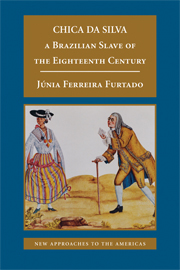
    Júnia Ferreira Furtado offers a fascinating study of the world of a freed woman of color in a small Brazilian town where itinerant merchants, former slaves, Portuguese administrators and concubines interact across social and cultural lines. The child of an African slave and a Brazilian military nobleman of Portuguese descent, Chica da Silva won her freedom using social and matrimonial strategies. But her story is not merely the personal history of a woman, or the social history of a colonial Brazilian town. Rather, it provides a historical perspective on the cultural universe she inhabited, and the myths that were created around her in subsequent centuries, as Chica de Silva came to symbolize both an example of racial democracy and the stereotype of licentiousness and sensuality always attributed to the black or mulatta female in the Brazilian popular imagination.

    • Explores issues of slavery, racial distinction, gender, social mobility, and local colonial policy
    • Draws on a wide range of sources, including major archives in Brazil and Portugal, as well as literature on the colonial period in Portuguese and English
    • For scholars in Atlantic history, African diaspora, slavery, gender, and Latin American history

    Read the beginning of the introduction here.

  • Interracial Marriage in the Last Portuguese Colonial Empire

    Journal of Portuguese History
    Volume 5, Number 1, Summer 2007
    23 pages
    ISSN: 1645-6432

    Maria Eugénia Mata, Associate Professor of Economic History and History of Economics
    University of Lisbon

    The paper presents both the institutional background and the government philosophy regarding equality and non-prejudice within all of the territories under Portuguese sovereignty in the 1940s and 1950s, as well as tests carried out to discover if the decision to marry and racial homogamy could be considered independent variables, using annual data from statistical yearbooks relating to the colonies.

    The conclusions demonstrate the existence of a social prejudice towards inter-racial marriage. The paper supports the belief that social divisions based on ethnicity must be included as part of the explanation for decolonization and independence.

    The Government’s philosophy on cohesion during the last Portuguese Empire

    In the last phase of the Portuguese empire (1930s-1974/5), the government’s political philosophy in relation to the colonial territories was based on considerable propaganda about the respectful relationship between the Portuguese and other peoples in their colonies. It is the aim of this study to describe the official Portuguese literature on these issues and check its accuracy for interpreting social interaction through marriage in the Portuguese colonial territories of the period.

    In political speeches, Portugal was presented as a vast and great nation. Its domains and sovereignty spread over a vast range of territory and were distributed across all the continents of the planet. This was a supreme achievement, according to J. M. da Silva Cunha, one of Salazar’s Secretaries of State, later appointed Overseas Minister: “Providence led Portugal to the mission of bringing all the peoples of Europe and other continents together, taking to them the Christian message, along with European civilization”. Official speeches usually presented Portugal as an honorable nation that had set sail from Portuguese coasts to discover the whole world. This heritage was still present in the Portuguese empire, made up of a mainland territory in Western Europe, four archipelagoes in the Atlantic (the Madeira Islands, Azores, Cape Verde and São Tomé and Príncipe), Angola and Mozambique on the African continent, several territories in India, a special pearl close to China, namely Macau, and the territory of East Timor in the Pacific Ocean. So, Portuguese territory was comprised of several provinces, beginning in the northern mainland province of Minho (near Spanish Galicia) and reaching all the way to the antipodes, in Timor.

    Also, according to the language of its government, the Portuguese people were a cohesive nation, speaking the same language (Portuguese), sharing the same faith (Christianity), working under the same political rule (the Portuguese administration), and taking pride in the same flag (the Portuguese flag), which was flown in all of the national territory on every continent. There were no ethnic conflicts: “We arrived where we are now, more than five centuries ago, to spread Christianity and to remain”. School children were taught that all Portuguese were equal. Whatever might be their birth, their geographical origin, or the color of their skin, they were all equal. As Cunha (1964) puts it: “So, from the beginning we considered Africans as our equals, in this way eliminating all racial discrimination”.

    The Portuguese culture was a single culture, it was said. Even considering that local conditions might be different, the official ideology always stressed that, although they might differ, there were no superior or inferior cultures. Miscegenation was to be the rule, as nineteenth-century literature accused Portugal of a weakness in terms of colonization, which stemmed from miscegenation: “(…) specialist literature of the nineteenth century and the beginning of the twentieth (…) accused us of a colonizing disability (as was said at the time), because we could not preserve the purity of our race”.

    So, the Portuguese nation, according to the government, was a multi-continental, multi-racial unit based on a Portuguese identity of high moral and political standards: “Portugal will continue to remain integral, with her own features of a State and multi-continental Nation, made up of the most varied ethnicities”.8 Even scholars and academics shared a good deal of this vision. According to Boxer (1961), “It is to the credit of Portugal (…) that she made no distinction of race and color and that all her subjects, once they had become Catholics, were eligible for official posts.” Despite abandoning the thesis of  a shared religious faith, a Portuguese professor of economics at the Technical University of Lisbon was to write in an academic work: “We have created throughout five centuries the most extraordinary multi-racial, national community of all times, in which merit comes from the value of the human being and not from the color of the skin. (…) Historically and currently, the Portuguese nation is, as a consequence, a mosaic of multi-continental, multi-racial populations with religious diversity”.

    Sometimes a “civilization-bas” argument was added, and contradictions about the “non-superior character” of some cultures appeared: “While the Portuguese policy for human relationships in the overseas territories is impressive because of the vastness of the territories in which it applies, it is even more impressive because of its purpose of transforming aborigines into Portuguese, as Portuguese as anyone born in mainland Portugal, as it is high moral and social standards that lead them to Lusitanity, and to complete integration in the Nation”.

    Did such honorable official aims result in a social cohesion that could be expressed in terms of statistical categories or indicators? Did territorial discontinuities encapsulate different societies, with different literacy levels and prejudice? Was this philosophy confirmed in terms of race relationships, inter-racial marriage and miscegenation? Is it possible to find such a Lusitanity expressed in attitudes towards marriage that lie hidden in the data of registered marriages recording different colored skins throughout the empire? It is a fact that Portugal had one of the most far-reaching colonial empires in world history and that the Portuguese had a reputation for particularly integrative and intimate relations with the indigenous groups that were colonized. In order to unify all of the territories under the same legal rules, to endow them with the same status, and to prove that they were considered as a homogeneous territory, each of the colonies was designated a province, an institutional status that was introduced in the constitutional reform of 1951. In this new institutional framework, overseas provinces and mainland provinces were partners in the same empire. However, did this predominant official discourse reflect the truth? Can we believe in this perspective for the Portuguese colonial empire in the period after the Second World War?

    The aim of this paper is to test the accuracy of the language used in official political speeches during these decades, by observing how different kinds of local cultural cleavages led to different social experiences of marriage in the various territories. As far as culture, education and ethnicity are concerned, interracial marriage and miscegenation were two important aspects to be observed in Portuguese colonial territories. This paper observes that social and color differences can help to explain how there was a racial prejudice in the Portuguese Empire that must be recognized as yet one more factor helping to explain the success of the colonial wars for independence.

    There is a long bibliography on the period, dating from the creation of the Estado Novo to the independence of the territories that were previously under Portuguese sovereignty (1920s-30s to 1974-75). However, most of the contributions are devoted to imperial, political or economic aspects, and even those studies devoted to analyzing the colonial philosophy, social prejudice and social cleavages do not approach the aspects of inter-racial marriage in a quantitative way.15 A recent work (Matos, 2006) is quite exhaustive in dealing with questions of racial representations and color from the 16th century to the 1970s, although it follows an anthropological approach and does not use any consistency checks.

    The independence achieved by the different colonies also makes the study of ethnic and social cleavages much more interesting in so many countries, since they have such different features and geographical locations, while nonetheless sharing a common Portuguese colonial past. This paper seeks to shed some light on the study of all of these colonies today…

    Read the entire article here.

  • The Rise of a New Consciousness: Early Euro-African Voices of Dissent in Colonial Angola

    Journal of Portuguese History
    Volume 5, Number 2, Winter 2007
    15 pages
    ISSN: 1645-6432

    Jacopo Corrado

    Events such as the 1820 Liberal Revolution in Portugal and the 1822 declaration of independence in Brazil appeared to the Creole elite based in the coastal centers of Portuguese West Africa as the prelude to a new socio-political order. Moreover, the arrival of hundreds of political refugees and convicts in Angola—from Brazil as well as from Europe—during the decade of 1820-30 helped considerably in spreading revolutionary ideas on that side of the Atlantic Ocean, fueling the hopes and aspirations of a society in which individuals or families were exposed to sudden and at times unpredictable alterations of their social status—often more than once in a lifetime, as the cases of Arsénio Pompílio Pompeude Carpo and Joaquim António de Carvalho e Meneses would seem to confirm.

    This paper focuses on these two paradigmatic figures who embodied the discontent that spread among Luanda and Benguela traders and who confronted the authorities as nobody else dared to do in order to defend the interests of a Euro-African elite that, already during the first half of the 19th century, was struggling for more power and was progressively assuming an attitude suggestive of some kind of economic nationalism.

    During the first half of the 19th century, Angolan society was characterized by the presence of a semi-urbanized commercial and administrative elite of Portuguese-speaking Creole families – white, black, some of mixed race, some Catholic and others Protestant, some long-established and others cosmopolitan—who were mainly based in the coastal towns of Luanda and Benguela. As well as their wealth, derived from the functions that they performed in the colonial administrative, commercial and customs apparatus, their European-influenced culture and habits clearly distinguished them from the broad population of black African peasants and farm workers. In order to expand its control over the region, Portugal desperately needed the support of this kind of non-colonizing urban elite, which was also used as an assimilating force, or better as a source for the dissemination of a relevant model of social behavior. Thus, great Creole merchants and inland chiefs dealt in captive slaves, bound for export to Brazil: the tribal aristocracy and the Creole bourgeoisie thrived on the profits of overseas trade and used them to live in style, consuming large quantities of imported alcoholic beverages and wearing fashionable European clothes.

    The suppression of the slave trade, however, put an end to this situation of mutual advantage and altered forever more the relationship between colonizers and the so-called sons of the country.

    In order to understand and contextualize the specificity of the subsequent opposition to the colonial regime put forward by the local Creole elite, it is necessary to retrace the events which unfolded in the Portuguese-speaking world during the 19th century, taking into account different moments of rupture or external influences, together with the most important channels of cultural dissemination of the time. It has to be recognized that the cultural identity of this particular social group strongly relied on metropolitan or Brazilian models in both their forms and contents, but it would be superficial to claim that the cultural imaginary formed in Angola during this period of time totally lacked any original or peculiar features.

    On the other hand, how could people’s ways of thinking fail to be influenced by the ideological origins of the revolutions that had been taking place in Europe and America since the late 18th century? Events such as the 1820 Liberal Revolution in Portugal and the 1822 declaration of independence in Brazil appeared as the prelude to a new socio-political order and the arrival of hundreds of political refugees and convicts during the decade of 1820-30, from Brazil as well as from Europe, considerably helped in spreading revolutionary ideas. The political debate was fueled by journals and pamphlets mainly originating in Brazil but, on the other hand, the most conservative aspects of Portuguese liberalism were strongly and officially emphasized in Angola because of the constant fear of a possible social and political uprising.

    As a matter of fact, the two personalities to whom this article is dedicated suffered systematic persecution at the hands of the Portuguese authorities and their tormented lives are evidence of the trials awaiting those who decided to assume a critical attitude towards the colonial establishment. On the one hand, we have a former convict born on the periphery of the empire, who had adventurously managed to climb the social ladder and become a serious threat to the establishment. On the other hand, we have the scion of a noble Luanda family who, thanks to the education received in Europe and his long-term experience in diverse fields of colonial administration, breathed life into a revolutionary project that sought to achieve progressive autonomy for his country. Arsénio de Carpo’s life and Carvalho e Meneses’ work perfectly represent both the spirit of the Creole elite and all its contradictions, providing a privileged starting point for better understanding and contextualizing it, focusing our attention on a society in which family, business or social links acquired a special value. In mid-19th century Angola, a good deal or a good position, for instance, often depended on these links, and individuals or families were exposed to sudden, and at times unpredictable, alterations of their social status.This often occurred more than once in a lifetime, as the cases of Arsénio Pompílio Pompeude Carpo and Joaquim António de Carvalho e Meneses would seem to confirm….

    Read the entire article here.

  • The Creole Elite and the Rise of Angolan Proto-Nationalism, 1870–1920

    Cambria Press
    2008-09-08
    340 pages
    ISBN: 9781604975291

    Jacopo Corrado

    This book is about Angolan literature and culture. It investigates a segment of Angolan history and literature, with which even Portuguese-speaking readers are generally not familiar. Its main purpose is to define the features and the literary production of the so-called ‘creole elite’, as well as its contribution to the early manifestations of dissatisfaction towards colonial rule patent during a period of renewed Portuguese commitment to its African colonies, but also of unrealised ambitions, economic crisis, and socio-political upheaval in Angola and in Portugal itself.

    Nineteenth-century Angolan society was characterised by the presence of a semi-urbanised commercial and administrative elite of Portuguese-speaking creole families––white, black, some of mixed race, some Catholic and others Protestant, some old established and others cosmopolitan––who were based in the main coastal towns.

    As well as their wealth, derived from the functions performed in the colonial administrative, commercial and customs apparatus, their European-influenced culture and habits clearly distinguished them from the broad native population of black peasants and farm workers. In order to expand its control over the region, Portugal desperately needed the support of this kind of non-coloniser urban elite, which was also used as an assimilating force, or better as a source of dissemination of a relevant model of social behaviour. Thus, until the 1850s great creole merchants and inland chiefs dealt in captive slaves, bound for export to Brazil via Cape Verde and São Tomé: the tribal aristocracy and the creole bourgeoisie thrived on the profits of overseas trade and lived in style, consuming imported alcoholic beverages and wearing European clothes.

    After the abolition, however, their social and economic position was eroded by an influx of petty merchants and bureaucrats from Portugal who wished to grasp the commercial and employment opportunities created by a new and modern colonial order, anxious to keep up with other European colonial powers engaged in the partition of the African continent.

    This book thus considers the first intellectuals, the early printed publications in the country, and the pioneers of Angolan literature who felt the need to raise their roots to higher dignity. Thus, they wrote grammar, dictionaries, poetry, fiction, and of course, incendiary articles denouncing exploitation, racism, and the different treatment afforded by the colonial authorities to Portuguese expatriates and natives.

    Table of Contents

    • Foreword
    • Acknowledgments
    • List of abbreviations
    • Introduction
    • Chapter 1: Cherished Myths
      • The greatest and most Portuguese overseas possession
      • Lusotropicalism
    • Chapter 2: The Intellectual Setting
      • The Luso-Atlantic cultural triangle
      • Brazil
      • Portugal
      • The literary and cultural influences
      • Diffusion
      • Association
    • Chapter 3: Luanda
      • The advent of modernity
      • Between journalism and literature
      • The new century: Hope and failure
    • Chapter 4: The ‘Creole’ Elite and Early ‘Nationalism’
      • The term ‘Creole’
      • The term ‘Nationalism’
    • References
    • Index
  • Mulattoes, octoroons and quadroons are much more susceptible to the ravages of syphilis and gonorrhea than are their more deeply tinted brethren. Negroes of all shades are extremely susceptible to tuberculosis, and also to measles. In my experience extending over a period of nearly twenty years, I do not recall having seen a case of scarlet fever, diphtheria, mumps or tonsillitis in black negroes, and since beginning this paper I have made inquiries of all the physicians with whom I have come in contact and have received practically the same answer as to the immunity of the pure-blooded negro from these diseases.

    H. M. Folkes, M.D., “The Negro as a Health Problem,” The Journal of the American Medical Association, Volume 55, Number 11 (1910): 1246-1247.

  • The Latin American Identity and the African Diaspora: Ethnogenesis in Context

    Cambria Press
    2010-08-08
    360 pages
    ISBN: 9781604977042

    Antonio Olliz-Boyd, Emeritus Professor of Latin American Literature
    Temple University

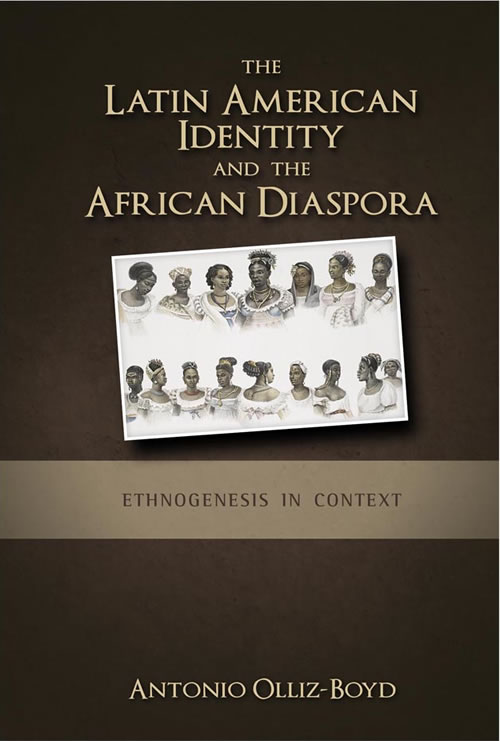
    Just beneath the surface of most scholars’ research on the ethno-racial composition of Spanish-speaking America lies a definitive connection between the African Diaspora and the Latin American identity. Although to a lesser extent, this is also true of Portuguese-speaking Brazil—the existence of African-related people and their role as an integral part of the total Latin ethnicity currently appears to be more readily accepted and discussed in Brazil than in other Latin American countries. Afro-Peruvians, Afro-Colombians, Afro-Venezuelans, Afro-Uruguayans, or Afro-Mexicans—to name just a few—are rarely openly acknowledged in most of Spanish-speaking Latin America. However, one cannot deny that African slavery was a fact of life in all the territories colonized and settled by Spain and Portugal in the Americas, and with this, of course, came widespread miscegenation between the European male and the subjugated African female.

    More than likely, because of the diversity of racial features, most non-natives do not see the extent to which Latin America’s genetic amalgam can often mask the phenotypic effects of race-mixing. As a result, many researchers and scholars of the area are reluctant to divulge that someone is a descendant of African forebears because doing so might run the risk of one being considered politically incorrect or having debased that person’s character. Whereas in the United States there is little to no stigma attached to the president’s African ancestry, for any president of a Latin American country, one cannot overtly attribute a genetic link to African heritage.

    There is extensive research found both in books and articles on the various topics of Afro Latinism/Afro Hispanism that is directed mainly at the non-native. Nonetheless, one still notices either cultural confusion or political reluctance to accept the identity of Blackness that the Latin American native lives with—for himself or for others—on a daily basis. For the average Cuban, Venezuelan, Peruvian, and so forth, along with their Latin counterparts, Blackness in racial terms surfaces as a matter of degrees of African-relatedness that is then counterbalanced by degrees of European and/or Amerindian genomic components. It is only in non-native cultures that one encounters such disparate comparisons as “statistics for Hispanics versus statistics for Blacks.” But is it not possible to find persons that are ethnoracially Black included in the demographics for Hispanics?

    The overarching aim of this book, then, is to determine whether it is possible to perceive a constituency within the Latin American whole who is also an integral part of the African Diaspora. It examines the concept of African-relatedness within the totality of the Latin American sphere—not just in one isolated country or region—through a careful process of literary analysis. By exploring the works of Latin American novelists, poets, and lyricists, this study shows how they creatively expose their most intimate feelings on ethnic Blackness through a semiotic reliance on the inner voice. At the same time, the reader becomes a witness to the writers’ associations with a sense of Africanness as it artistically affects them and their communities in their formulations of self-identity.

    Unique to this volume is the scholarly presentation of the presence of a group of people in Ghana, West Africa, who owe their raison d’être as a clan to their ancestral origins in Brazil. Having been accepted and received by an endemic tribe of what was called the Gold Coast at an historical moment in the nineteenth century, a community of escaped slaves and deported ex-slaves from Brazilian bondage regrouped as an ethnic whole. The reality of their existence gives new meaning to the term African Diaspora. To this day, their descendants identify themselves as displaced Latin Americans in Africa. Undoubtedly, both this surprising feature of Latin Americans returning to the African continent and the book as a whole will stimulate further discussion on the issue of who is Black and who is Hispanic as well as generate continued, in-depth research on the relationship between two continents and their shared genotypology.

    Table of Contents

    • Acknowledgments
    • Prologue
    • Essay I: Aesthetic Blackness in the Creative Literature of the Latin/Hispanic Reality
    • Essay II: The Aesthetics of Language as an Experience of the Afro Latin/Afro Hispanic Reality
    • Essay III: An Aesthetic Experience: The Reality of Phenotypes and Racial Awareness in Dominican Literature (Julia Alvarez and Loida Maritza Pérez)
    • Introduction to Essay IV
    • Essay IV: A Latin Identity, An African Experience: The Tabom Brazilians of Ghana
    • Epilogue
    • Notes
    • Index