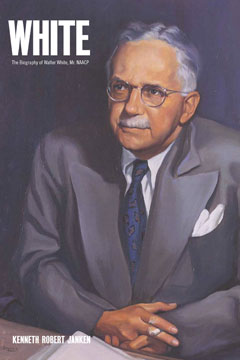
• White: The Biography of Walter White, Mr. NAACP

    The New Press
    Fall 2002
    496 pages
    Trim: 6 1/8 x 9 1/4
    Hardcover ISBN: 978-1-56584-773-6

    Kenneth R. Janken, Professor, African and Afro-American Studies
    University of North Carolina, Chapel Hill

    A publishing landmark, the first biography of the man who brought the NAACP to national prominence

    From his earliest years, Walter White was determined to transcend the rigid boundaries of segregation-era America. An African American of exceptionally light complexion, White went undercover as a young man to expose the depredations of Southern lynch mobs. As executive secretary of the NAACP from 1931 until his death in 1955, White was among the nation’s preeminent champions of civil rights, leading influential national campaigns against lynching, segregation in the military, and racism in Hollywood movies.

    White is portrayed here for the first time in his full complexity, a man whose physical appearance enabled him to negotiate two very different worlds in segregated America, yet who saw himself above all as an organization man, “Mr. NAACP.” Deeply researched and richly documented, White’s biography provides a revealing vantage point from which to view the leading political and cultural figures of his time—including W.E.B. DuBois, Eleanor Roosevelt, and James Weldon Johnson—and an unrivaled glimpse into the contentious world of civil rights politics and activism in the pre–civil rights era.

  • Walter White and Passing

    Du Bois Review: Social Science Research on Race
    Volume 2, Issue 1 (2005)
    pages 17-27
    DOI: 10.1017/S1742058X05050034

    Kenneth R. Janken, Professor, African and Afro-American Studies
    University of North Carolina, Chapel Hill

    Walter White, the blond, blue-eyed Atlantan, was a voluntary Negro, that is, an African American who appears to be White but chooses to live in the Black world and identify with its experiences. He joined the NAACP national leadership in 1918 as assistant secretary and became secretary in 1931, serving at this post until his death in 1955. His tenure was marked by an effective public antilynching campaign and organizational stability and growth during the Depression years and by controversy over his leadership style. For him, posing as a Caucasian—and then telling all who would listen about his escapades—had three interrelated purposes. First, he developed inside information about mob psychology and mob violence, publicity of which was critical to the NAACP’s campaign against lynching. Second, White hoped to show Whites in particular the fallacy of racial stereotyping and racial categorization. Third, by emphasizing the dangers he courted—and even embellishing on them—he enhanced his racial bona fides at key times when his Black critics called into question his leadership.

  • The Awareness of Walter White

    The Land Press
    Okiecentric
    2011-05-05

    Adrian Margaret Brune

    I grew up in Tulsa, but was raised knowing next to nothing about the Race Riot of 1921. Though I considered myself educated when I left for Northwestern University at the age of 18 in 1994, I had never taken a black history course, nor ventured over to Greenwood to hear jazz and blues. Four years later, while attending Columbia Journalism School in New York, I came home and learned about the journalist and civil rights activist Walter White. In May of 2002, just over 80 years after White investigated Tulsa—one of his last riots—I loaded up my car in Brooklyn and drove across America to trace his footsteps.

    When Walter White, then 28 years old, came to Tulsa in late June of ’21, he had already experienced a lifetime of racial dilemmas, ensconced within the pigment of his skin.

    “Walter White’s parents were enslaved; his parents were black. They maintained a presence in Atlanta’s black community, though they could have made a decision to pass up that hardship and pass as white,” said Kenneth Janken, author of White: The Biography of Walter F. White, Mr. NAACP. “He was not conflicted by their choice, or ultimately his. He formed a chapter of the NAACP and he chose a job investigating race riots when he could have done quite well as insurance salesman.

    The ascension of Walter Francis White from the inquisitive schoolboy who tailed his father during his afternoon postal routes, to the NAACP’s preeminent riot investigator seemed a natural one. That metamorphosis began on Sept. 22, 1906—the first day of the Atlanta Race Riot. That day was the first day White would understand that, despite his alabaster skin, he was black...

    Read the entire article here.

  • Measuring Race and Ethnicity: Why and How?

    The Journal of the American Medical Association
    Volume 292, Number 13 (2004)
    pages 1612-1614
    DOI: 10.1001/jama.292.13.1612

    Margaret A. Winker, MD, Deputy Editor and Online Editor
    Journal of the American Medical Association

    Race and enthnicity are constantly evolving concepts, deceptively easy to measure and used ubiquitously in the biomedical literature, yet slippery to pinpoint as definitive individual characteristics. A current dictionary definition of race is “a family, tribe, people, or nation belonging to the same common stock, or a class or kind of people unified by shared interests, habits, or characteristics.” For 154 years, the US government has defined race for its census takers, and for many years census takers then defined it for US residents. The terms used reflect the nation’s changing demographics and increasing recognition of human diversity. The 1850 enumerators used a form that assumed a default race of white, with a checkmark indicating nonwhites as black or mulatto, with additional indications for free or slave. Indian was added as a category in 1860. Since 1960, individuals have been able to specify their own race and ethnicity, and by 2000 the census enumerated 126 racial and ethnic categories.

    Medical definitions of race have lagged behind, although thankfully the former Medical Subject Headings (MeSH) terms such as Caucasoid, Mongoloid, Negroid, and Australoid rarely appear in biomedical literature. Given that the connotations and definitions of race and ethnicity are constantly evolving, the use of the terms and concepts of race and ethnicity in the biomedical literature deserves examination…

    …The use of race as a proxy for unmeasured confounders, such as cultural, social, and environmental influences, is commonplace, but race is a poor proxy for these measures. The life experience and cultural milieu of US immigrants may be completely different from those who grew up in the United States, despite being assigned to similar racial or ethnic categories. Socioeconomic status, not race, is likely the greater determinant of health and health-related qualities. Therefore, race is not a substitute for carefully assessed social and cultural characteristics.

    On the other hand, race can be an important indicator of health disparities and health care delivery. An American College of Physicians position paper attests to “…ample evidence illustrating that minorities do not always receive the same quality of health care, do not have the same access to health care, are less represented in the health professions, and have poorer overall health status than nonminorities.” While race is just a departure point when evaluating such disparities, the article by Bradley et al in this issue of JAMA illustrates how race can be used along with specifically defined characteristics to begin to explore some of the reasons behind health disparities. In this retrospective, observational study of inpatients from the US-based National Registry of Myocardial Infarction, who were hospitalized during 1999 through 2002 with ST-segment elevation or myocardial infarction or left bundle-branch block and receiving acute reperfusion therapy, Bradley et al assessed time from hospital arrival to acute reperfusion therapy. As previous studies have shown, nonwhites had longer times from hospital entry to reperfusion therapy, as much as 7.3 minutes longer for blacks receiving thrombolytic therapy and 18.9 minutes longer for blacks receiving percutaneous transluminal coronary angioplasty

    Read the entire article here.

  • The Negro as a Health Problem

    The Journal of the American Medical Association
    Volume 55, Number 15 (1910-10-08)
    pages 1246-1247
    DOI: 10.1001/jama.1910.04330150006002

    H. M. Folkes, M.D.
    Biloxi, Mississippi

    In the South, regardless of hair-splitting dictionary or legal definitions, it is customary to regard as negro any person who is known to have any negro blood in his veins; this despite the fact that the Supreme Court of Louisiana has lately handed down a decision restricting the term “negro” to those having a greater proportion of negro blood than would occur in an octoroon. This decision, however much it may be law, has not been the custom.

    It may not be commonly known in the North that prior to the war it was the custom in the South among the better class of slave owners to give the very best care and attention to the slaves—to the house-servants as well as every other class of laborer generally. Of course, while due credit must be given to the humane motive at the bottom of this, it must be acknowledged that the economic consideration was also largely influential, as each negro, old, or young, possessed considerable cash value. Hence it was decidedly to the interest of the property owner to take care of his investment.

    The natural result of this was a higher standard of physical health among negro children than has ever been attained since the emancipation, for among other unfortunate sequelæ folloing this perfectly righteous step was the handing over of the lives and care of negro progeny to their more or less fatalistic parens, who, removed from the control of intelligent direction, soon lapsed into their African condition of irresponsibility. The unfortunate creatures (as the negro race has done in all history) then reverted, in a  large measure, to aboriginal conditions.

    The negro, due to his heredity and environment, is essentially a fatalist, and when moved at all it is by his emotions, and not by judgement….

    Mulattoes, octoroons and quadroons are much more susceptible to the ravages of syphilis and gonorrhea than are their more deeply tinted brethren.  Negroes of all shades are extremely susceptible to tuberculosis, and also to measles.  In my experience extending over a period of nearly twenty years, I do not recall having seen a case of scarlet fever, diphtheria, mumps or tonsillitis in black negroes, and since beginning this paper I have made inquiries of all the physicians with whom I have come in contact and have received practically the same answer as to the immunity of the pure-blooded negro from these diseases.

    Mulattoes, quadroons, and octoroons are decidedly more susceptible to scarlet fever, diphtheria, mumps and tonsillitis, but with rather large experience among the different shades of negro people, I can recall at this moment but very few instances of these diseases among them.

    It might not be out of place at this point to call attention to the fact that mulattoes, quadroons, and octoroons, as they are at present in the South, are mostly descendedants of their own type of people, and not the result of crossing of white and black bloods; in other words, mulatto man and woman have progeny mulattoes; quadroons present the same as themselves, as also do octoroons.  There is, however, a marked tendency toward a decrease in the number of children born to these light-colored negroes and the nearer they approach to pure white blood the fewer children they have, as a rule…

    Read or purchase the article here.
  • THE CONGRESS: Black’s White

    TIME Magazine
    1938-01-24

    To Negro Lee Jones, a 31-year-old mill-hand of Greensboro, Ala., last week’s doings in the U. S. Senate were good news. Negro Jones had been arrested, charged with jumping on the running board of a car to kidnap Mrs. Robert Knox Greene, wife of a white planter. When Mrs. Greene’s friends began to gather he did not need to be told what familiar, ugly thought they had in mind. At the crucial moment when Sheriff Calvin Hollis was trying to calm the crowd, up stepped Planter Robert Knox Greene himself. How Planter Greene, a cousin of Alabama’s Representative Sam Hobbs, persuaded the mob to disperse he was soon explaining to the Associated Press. “I told them I was the aggrieved person,” said he, with some self-satisfaction, “and I ought to have the final say. I also reminded them our Southern Senators were fighting an anti-lynching bill in Washington and violence might hamper them…

    …But Jimmy Byrnes dropped the first real bomb. Pointing straight at a small man seated quietly in the gallery, his voice tense with passion, the wiry South Carolinian cried: “The South may just as well know , . . that it has been deserted by the Democrats of the North. . . . One Negro . . . has ordered this bill to pass and if a majority can pass it, it will pass. . . . If Walter White,” and Jimmy Byrnes was fairly shouting his angry tribute, “should consent to have this bill laid aside, its advocates would desert it as quickly as football players unscramble when the whistle of the referee is heard.”

    Paleface-The Negro who did not acknowledge this extraordinary attention was Secretary Walter Francis White of the National Association for the Advancement of Colored People. Not the least reason for Southern hatred of antilynching bills is that for the past decade they have been inextricably associated with Walter White, and that the gradual growth of the anti-lynching movement had by last week made spunky, dapper, 44-year-old Negro White the most potent leader of his race in the U. S.

    Son of a fair-skinned Georgia postman and his fair-skinned wife, Walter White is blond and palefaced. He himself does not know how much Negro blood runs in his veins; Harvard’s far-ranging Anthropologist Earnest Alfred Hooton computes it at 1/64. But despite a skin that last week fooled fellow guests at Washington’s Hay-Adams House, Walter White has always regarded himself as a Negro. He remembers that his father’s house was almost burned down during an Atlanta race riot in his childhood. He recalls too that his father died in agony when the surgeons of the white ward of an Atlanta hospital, to which he had been mistakenly taken for an emergency operation, balked upon learning his race and insisted on shipping him in the rain to the Negro ward across the street…

    …In 1935, Walter White was able to get the ear of Franklin Roosevelt. Secretary Marvin Mclntyre refused him an appointment with the President, but the President’s Negro Valet Irvin H. McDuffie who sometimes leaves notes on his employer’s pillow and tactfully gets unofficial callers in through the White House kitchen, was able to arrange a private meeting. What effect Walter White’s address to the President may have had Washington last week was not sure…

    Read the entire article here.

  • PLAIN PEOPLE: Is There Anywhere?…

    Time Magazine
    1946-03-11

    Prewar Britain’s Negro problem was as minuscule as prewar Britain’s Negro population. But the 70,000 U.S. Negro troops who served in Britain during the war left behind hundreds of illegitimate mulatto babies. Last fortnight London’s League of Colored Peoples reported that already 544 children of U.S. Negro soldiers and British women were in social or economic straits.

    So long as the Negro fathers were in the U.S. Army and acknowledged paternity, the mothers received support allowances. In the British provinces $85 a month was comparative riches. But when Negro soldiers were demobilized in the U.S., allowances ceased; some Negro fathers neglected to make any other provision. Then the social pressure of British provincial respectability became unbearable. Said one British mother of a Negro’s child: “I am shunned by the whole village. . . . The inspector for the National Society for the Prevention of Cruelty to Children has told my friend to keep her children away from my house… as didn’t she know that I had two illegitimate colored children? Is there anywhere I can go where my children will not get… pushed around?”…

    Read the entire article here.

  • Science: Savants

    TIME Magazine
    1924-08-18

    Women’s barber shops call themselves beauty parlors. Drug stores call themselves ice cream parlors. Clerks call themselves salesmen. Politicians call themselves statesmen. Flappers call themselves young ladies. But scientists call themselves scientists, and only newspapers call them savants.

    But the word “savants” has been spread in the headlines of newspapers for the greater part of the week. What this signified was that some 2,000 hardworking men of science were assembled at Toronto at the meeting of the British Association for the Advancement of Science. The Association, which makes a practice of meeting everywhere save in London—in order to stimulate interest elsewhere—gathered to its meeting more than 500 British scientists, about the same number each of Canadians and Americans, and a scattering number from the rest of the world. The presence of Americans was, indeed, due to the fact that the British Association very thoughtfully gave the members of the American Association of the same name membership in the British Association for the purpose of the meeting.

    ¶ The meeting was opened at Toronto University by Major-General Sir David Bruce, President of the Association…

    …¶ John W. Gregory, President of the Geographical Section of the Association, spoke on the “Color” problem of the earth, in which the white race, composed of some 520,000,000 out of a total population of about 1,700,000,000, controls eight-ninths of the habitable earth. He suggested that there were four possible solutions of the color problem: 1) amalgamation by miscegenation; 2) coresidence without fusion; 3) ‘disfranchisement of the colored population; 4) segregation into separate communities. He inclined to the belief that the last will be the solution, and foresaw that in 100 years or so, by natural processes, a sort of free state of Negroes would develop in the Southern U. S…

    Read the entire article here.

  • Mammy versus mulatta: A rhetorical analysis of the act of passing and the influence of controlling images in Fannie Hurst’s “Imitation of Life”

    Arizona State University
    May 2010
    189 pages
    Publication Number: AAT 3407107
    ISBN: 9781109743265

    Allison Parker

    A Dissertation Presented in Partial Fulfillment of the Requirements for the Degree Doctor of Philosophy

    Fannie Hurst’s 1933 novel, Imitation of Life, and the two movies that followed in 1934 and 1959, address the issue of racial passing in a way that no text ever has before. The theme of Imitation of Life is imitation, and as a result, it lends itself to a discussion of race performativity. Imitation of Life is the first text to juxtapose the mammy character with the tragic mulatto character, and this makes it conducive to studying the category of race and how race performativity functions. In addition, instead of focusing exclusively on passing, this analysis focuses more specifically on the way that resistance to (or condemnation of) passing, mainly through the power of confession, produces a specific mode of performativity.

    Each of the versions of Imitation of Life is analyzed separately in order to use the specific version of the text to examine not only how the mores of the time affect the outcome of the story to contextualize each story within its respective time period, but also to examine how each of the characters is constructed in order to evaluate the relationships between black and white women living in the same household. The focus is on the specific features of the mammy and the mulatto characters–their history, their attributes, and their significant features, in order to understand how they work in context and to understand their significance in terms of race performativity. Finally, an examination of the category of race in terms of performative reiteration is presented. Scenes from the book and the two films are scrutinized in an attempt to provide a vehicle to understand the means by which racial norms function. These sections work together to examine the condemnation of passing in Imitation of Life through the lens of race as a speech act. Imitation of Life is a passing narrative that is a crucial text for assisting theorists in understanding the complicated features of race performativity.

    TABLE OF CONTENTS

    • PREFACE
    • CHAPTER 1 REVIEW OF LITERATURE
      • Introduction and Scope
      • Theoretical Approach
      • Organization of Research
      • Concluding Remarks
    • CHAPTER 2 THE 1933 NOVEL
      • Fannie Hurst: Racial Activist
      • Hurston and Hurst
      • The Conflicts in Imitation of Lite
      • A Warning for Ambitious Womem
      • Aunt Jemima: The Most Famous Mammy
      • The Influence of Zora Neale Hurston
      • Delilah—the Ultimate Mammy
      • Peola—the Tragic Mulatto
      • Peola’s Passing
      • Critical Reception and Debate
    • CHAPTER 3 THE 1934 FILM
      • The Plot Thickens
      • The Embodiment of Miscegenation
      • From Page to Screen
      • The Subservient Mammy Stereotype Continues
      • An Updated Bea
      • An Updated Peola
      • Critical Reception
      • Hurston, Hughes, Morrison, and hooks Respond
    • CHAPTER 4 THE 1959 FILM
      • Lana’s Imitation of Life
      • Colorblind Casting?
      • Imitation in Imitation of Life
      • Starring Sarah Jane
      • The Rhinelander Case
      • Controlling Images
    • CHAPTER 5 RACE PERFORMATIVITY
      • Austin, Derrida, Butler, and Performativity
      • Foucault and Confession
      • Assumptions of Whiteness and the Contradictions of Race
      • Judith Butler and Imitation of Life
      • The Punishment for Passing
      • Mammy Versus Mulatto
      • Conclusion
    • WORKS CITED

    Purchase the dissertation here.

  • Métis/Mulâtre, Mulato, Mulatto, Negro, Moreno, Mundele Kaki, Black,… The Wanderings and Meanderings of Identities

    Chapter in: Problematizing Blackness: Self Ethnographies by Black Immigrants to the United States
    Routledge
    2003-09-30
    240 pages

    Edited by

    Jean Muteba Rahier, Associate Professor of Anthropology and African & African Diaspora Studies
    Florida International University

    Percey C. Hintzen, Professor of African American Studies
    University of California, Berkeley

    Chapter 6
    pages 85-112

    Jean Muteba Rahier, Associate Professor of Anthropology and African & African Diaspora Studies
    Florida International University

    I have no race except that which is forced upon me. I have no country except that to which I’m obliged to belong. I have no traditions. I’m free. I have only the future.

    Richard Wright

    I was born in 1959, in what was then the Belgian Congo, of a Congolese colonized mother and a Belgian colonial father. I grew up in Belgium.

    Belgian Explorations: My Father’s Congo

    The Congo Free State (C.F.S.) was created as a private property of the Belgian King Leopold II in 1884–85 at the Berlin Conference and lasted until 1908. It was succeeded by the Belgian Congo, which lasted from 1908 until 1960, when the country gained its independence (see Vangroenweghe 1986; Ndaywel è Nziem 1998; Hochschild 1998). During the short history of colonial rule, the organization and implementation of the colonial enterprise were conducted almost exclusively by males. There was a contingent development of the institution of the ménagères, wherein African women and the male colonizers developed relationships of sexual intimacy. These relations occurred between female “housekeepers” (the ménagères) and the male colonizers whom they were serving. These relationships developed within the context of the absence of European women—an absence legitimized by their supposed biological unsuitability for the African tropical climate (Habig 1944, 10–11; Stoler 2002). The practice of sexual relations between the male colonizers and the colonized African women was universal and widespread, particularly outside the most important urban centers of Leopoldville, Elisabethville, and Stanleyville. Once in the Congo, many agents of the state and many employees of private colonial companies looked for the companionship of African women, who provided them with housekeeping, affection, and sexual favors. Usually, Belgian men kept their ménagères with them until the end of their tour of duty.

    State employees and agents of private companies were contractually employed for a three-year term. They would normally leave at the end of the term, usually spending six months’ vacation in Belgium, after which they had the option of returning to the colony for another three-year tour of service. This could continue indefinitely.Upon their return to the colony, it was customary for them either to retain the same ménagères in their “employ” or to choose another from among the “available African women.” Sometimes, the ménagères would become pregnant. If she did, she was typically sent back to her village with a small “financial indemnity” and material compensation. Usually, the colonial agent would then choose a new, young African woman to replace her in his house and in his bed.

    The number of children born out of the widespread practice of sexual intimacy forced the colonial administration and the Belgian Parliament to debate what they termed the problème des métis, “the mulatto problem.” The issue was the treatment of the mulatto offspring of these unions: whether they should endure the same status as the rest of the Congolese population or whether they should be considered an intermediate group above the latter but beneath the Europeans. Attempts at resolving the dilemma produced a series of contradictory policies, resulting in considerable ambiguity. This ambiguity came to characterize the lives of the growing population of métis throughout the entire colonial period (Jeurissen 1999; Stoler 2002). Usually, the status of the métis depended upon the degree of recognition and acknowledgment of parenthood by their fathers. Those who were not recognized were often abandoned by their mothers because of the ostracism that they faced when returning to their native villages. The abandoned children usually ended up living in Catholic and Protestant missionary boarding schools, which were created for this purpose.

    Read the entire chapter here