•  Mixed Dreams: A Symposium on Multiracial Identities in the United States

    2010-10-15 through 2010-10-20
    Oberlin College
    Oberlin, Ohio

    At its root, Mixed Dreams: A Symposium on Multiracial Identities in the U.S. aims to create a space to discuss and interrogate historical and contemporary perspectives on multiraciality and the “multiracial experiences” of people identifying as bi-racial, mixed, and/or transracial/transnational adoptees in the United States. Through public lectures and panels it will explore current trends and dilemmas in understanding multiraciality historically, socially and politically as well as the growing narratives and spaces being created to express these “mixed” subjectivities. Featured guests will be Paul Spickard, Eric Hamako, Debra Yepa-Pappan, Alicia Arrizón and a video conference discussion with G.Reginald Daniel.

    For more information, click here.

  • The ‘Native’ Undefined: Colonial Categories, Anglo-African Status and the Politics of Kinship in British Central Africa, 1929-38

    The Journal of African History
    Volume 46, Issue 3 (2005)
    pages 455-478
    DOI: 10.1017/S0021853705000861

    Christopher Joon-Hai Lee
    University of North Carolina, Chapel Hill

    This article examines the categorical problem that persons of ‘mixed-race’ background presented to British administrations in eastern, central and southern Africa during the late 1920s and 1930s. Tracing a discussion regarding the terms ‘native’ and ‘non-native’ from an obscure court case in Nyasaland (contemporary Malawi) in 1929, to the Colonial Office in London, to colonial governments in eastern, central and southern Africa, this article demonstrates a lack of consensus on how the term ‘native’ was to be defined, despite its ubiquitous use. This complication arrived at a particularly crucial period when indirect rule was being implemented throughout the continent. Debate centered largely around the issue of racial descent versus culture as the determining factor. The ultimate failure of British officials to arrive at a clear definition of the term ‘native’, one of the most fundamental terms in the colonial lexicon, is consequently suggestive of both the potential weaknesses of colonial state formation and the abstraction of colonial policy vis-à-vis local empirical conditions. Furthermore, this case study compels a rethinking of contemporary categories of analysis and their historical origins.

  • The Chinese Mestizos and the Formation of the Filipino Nationality

    Archipel
    Volume 32, 1986
    pages 141-162
    DOI: 10.3406/arch.1986.2316

    Antonio S. Tan

    The recorded history of the Philippines would be incomplete as a basis for understanding contemporary society unless it takes into account the Chinese mestizos’ contributions to our development as a nation.  The Chinese mestizos were an important element of Philippine society in the 19th century.  They played a significant role in the formation of the middle class, in the agitation for reforms, in the 1898 revolution and the formation of what is now known as the Filipino nationality.  In contemporary times their role in nation-building continues.

    Read the entire article here.

  • UCLA needs more than just one multiethnic club

    Daily Bruin
    University of California, Los Angeles
    2010-10-11

    Salim Zymet

    Only one student group promoting multiracialism is not enough for a campus as diverse as ours

    Where are you from?

    Answering that question can be difficult for some multiracial students. Perhaps you’re inclined to believe that despite your ethnic background, you’re simply an American, born and raised. Maybe you introduce yourself with all of your ethnic background included. Uncertainty may still plague your ethnic and cultural identity.

    Enter the Hapa Club at UCLA. Hapa is a Hawaiian word traditionally meaning someone of mixed Asian or Pacific Islander descent – but the club aims to be a place where all multiracial students can come together. As the only club which represents all mixed ethnic backgrounds, it has large shoes to fill, even more so when you take into account that there are over 70 clubs, fraternities and sororities on campus devoted to various Asian ethnicities. I don’t take issue with the existence of these clubs, merely the staggering volume of them…

    …If we are to be part of a truly diverse campus, more multiracial groups are going to have to be part of the solution…

    …As an American of Indian, Syrian and Polish descent, I hope that next year’s incoming mixed students can be greeted by a more diverse group of ethnic clubs. As it stands now, if they want to join a club they are forced to either “choose” one of their backgrounds to identify as or join Hapa Club…

    Read the entire article here.

  • New multiracial category has effects nationally, few at Smith

    The Smith College Sophian
    Northampton, Massachusetts
    2010-09-30

    Gina Charusombat

    While Smith students speculate about the lack of diversity across disciplines of study, colleges and universities across the U.S. continue to track diversity on their campuses. On Sept. 19, the Chronicle of Higher Education revealed that the U.S. Department of Education now requires colleges to report students who check the “two or more races” category. Previously, reports listed “race unknown” for students who marked more than one category.

    Students who mark several race categories in addition to “two or more races” are only counted in the multiracial category. However, there is one exception: if a student marks “two or more races” and marks Hispanic/Latino/Latina, the student is counted within that one category.

    “[The multiracial category] is set against the politics of how we define or don’t define race,” said Dean of Enrollment Audrey Smith…

    Read the entire article here.

  • The Chinese Mestizo in Philippine History

    The Journal of Southeast Asian History
    Volume 5, Number 1 (March 1964)
    pages 62-100
    DOI: 10.1017/S0217781100002222

    Edgar Wickberg (1927-2008), Professor Emeritus of History
    University of British Columbia

    Our knowledge is still insufficient to allow us to assess the overall significance of the mestizo in Philippine history. But on the basis of what we now know we can make some generalizations and some hypotheses for future study. It is clear, in the first place, that the activities I have described are those of Chinese mestizos – not Spanish mestizos. While the Chinese mestizo population in the Philippines exceeded 200,000 by the late nineteenth century, the Spanish mestizo population was probably never more than 35,000. Furthermore, those who commented at all on the Spanish mestizo noted that he was interested in military matters or the “practical arts” – never in commerce. The aptitudes and attitudes of the Chinese mestizo were in sharp contrast to this.

    Secondly, the Chinese mestizo rose to prominence between 1741 and 1898, primarily as a landholder and a middleman wholesaler of local produce and foreign imports, although there were also mestizos in the professions. The rise of the mestizos implies the existence of social change during the Spanish period, a condition that has been ignored or implicitly denied by many who have written about the Philippines. It needs to be emphasized that the mestizo impact was greatest in Central Luzon, Cebu, and Iloilo. We cannot as yet generalize about other areas.

    Third, the renewal of Chinese immigration to the Philippines resulted in diversion of mestizo energies away from commerce, so that the mestizos lost their change to become a native middle class, a position then taken over by the Chinese.

    Fourth, the Chinese mestizos in the Philippines possessed a unique combination of cultural characteristics. Lovers of ostentation, ardent devotees of Spanish Catholicism – they seemed almost more Spanish than the Spanish, more Catholic than the Catholics. Yet with those characteristics they combined a financial acumen that seemed out of place. Rejecters of their Chinese heritage, they were not completely at home with their indio heritage. The nearest approximation to them was the urbanized, heavily-hispanized indio. Only when hispanization had reached a high level in the nineteenth century urban areas could the mestizo find a basis of rapport with the indio. Thus, during the late nineteenth century, because of cultural, economic, and social changes, the mestizos increasingly identified themselves with the indios. in a new kind of “Filipino” cultural and national consensus.

    Those are my conclusions. Here are some hypotheses, which I hope will stimulate further study:

    1. That today’s Filipino elite is made up mostly of the descendants of indios and mestizos who rose to prominence on the basis of commercial agriculture in the lattetf part of the Spanish period. That in some respects the latter part of the Spanish period was a time of greater social change, in terms of the formation of contemporary Philippine society, than the period since 1898 has been.
    2. That in the process of social change late in the Spanish period it was the mestizo, as a marginal element, not closely tied to a village or town, who acted as a kind of catalytic agent. In this would be included the penetration of money economy into parts of the Philippines. There were areas where the only persons with money were the provincial governors and the mestizos.
    3. That the Chinese mestizo was an active agent of hispanization and the leading force in creating a Filipino culture characteristic now of Manila and the larger towns.
    4. That much of the background explanation of the Philippine Revolution may be found by investigating the relationships between landowning religious orders, mestizo inquilinos, and indio kasamahan laborers.

    It is my hope that these hypotheses may stimulate investigation into this important topic which can tell us so much about economic, social, and cultural change during- the Spanish period of Philippine history.

    Read the entire article here.
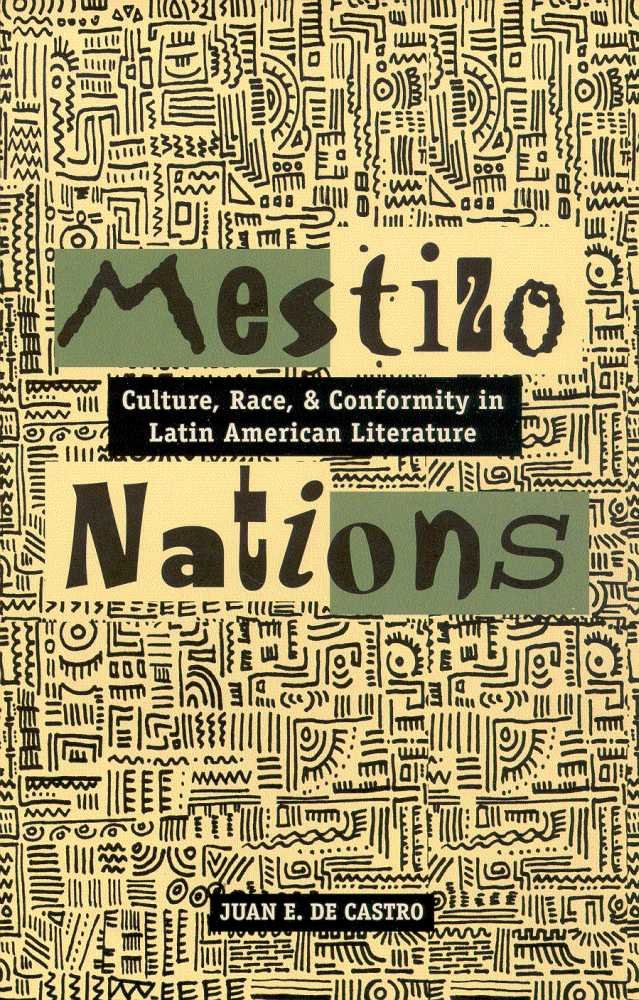
  • Mestizo Nations: Culture, Race, and Conformity in Latin American Literature

    University of Arizona Press
    May 2002
    161 pages
    9.6 x 6.4 x 0.7 inches
    ISBN-10: 0816521921
    ISBN-13: 978-0816521920

    Juan E. De Castro, Assistant Professor of Literature
    The New School

    Nationality in Latin America has long been entwined with questions of racial identity. Just as American-born colonial elites grounded their struggle for independence from Spain and Portugal in the history of Amerindian resistance, constructions of nationality were based on the notion of the fusion of populations heterogeneous in culture, race, and language. But this rhetorical celebration of difference was framed by a real-life pressure to assimilate into cultures always defined by Iberian American elites. In Mestizo Nations, Juan De Castro explores the construction of nationality in Latin American and Chicano literature and thought during the nineteenth and twentieth centuries. Focusing on the discourse of mestizaje—which proposes the creation of a homogenous culture out of American Indian, black, and Iberian elements—he examines a selection of texts that represent the entire history and regional landscape of Latin American culture in its Western, indigenous, and neo-African traditions from Independence to the present. Through them, he delineates some of the ambiguities and contradictions that have beset this discourse. Among texts considered are the Indianist novel Iracema by the nineteenth-century Brazilian author José de Alencar; the Tradiciones peruanas, Peruvian Ricardo Palma’s fictionalizations of national difference; and historical and sociological essays by the Peruvian Marxist José Carlos Mariátegui and the Brazilian intellectual Gilberto Freyre. And because questions raised by this discourse are equally relevant to postmodern concerns with national and transnational heterogeneity, De Castro also analyzes such recent examples as the Cuban dance band Los Van Van’s use of Afrocentric lyrics; Richard Rodriguez’s interpretations of North American reality; and points of contact and divergence between José María Arguedas’s novel The Fox from Up Above and the Fox from Down Below and writings of Gloria Anzaldúa and Julia Kristeva. By updating the concept of mestizaje as a critical tool for analyzing literary text and cultural trends—incorporating not only race, culture, and nationality but also gender, language, and politics—De Castro shows the implications of this Latin American discursive tradition for current critical debates in cultural and area studies. Mestizo Nations contains important insights for all Latin Americanists as a tool for understanding racial relations and cultural hybridization, creating not only an important commentary on Latin America but also a critique of American life in the age of multiculturalism.

    Read the preface here.

  • “Race” and the Construction of Human Identity

    American Anthropologist
    Volume 100, Issue 3 (September 1998)
    pages 690-702
    DOI: 10.1525/aa.1998.100.3.690

    Audrey Smedley, Professor Emeritus of Anthropology and African American Studies
    Virginia Commonwealth University

    Race as a mechanism of social stratification and as a form of human identity is a recent concept in human history. Historical records show that neither the idea nor ideologies associated with race existed before the seventeenth century. In the United States, race became the main form of human identity, and it has had a tragic effect on low-status “racial” minorities and on those people who perceive themselves as of “mixed race.” We need to research and understand the consequences of race as the premier source of human identity. This paper briefly explores how race became a part of our culture and consciousness and argues that we must disconnect cultural features of identity from biological traits and study how “race” eroded and superseded older forms of human identity. It suggests that “race” ideology is already beginning to disintegrate as a result of twentieth-century changes.

    …The Non-Problem of “Mixed-Race” People

    One of the more tragic aspects of the racial worldview has been the seeming dilemma of people whose parents are identifiably of different “races.” Historically, “race” was grounded in the myth of biologically separate, exclusive, and distinct populations. No social ingredient in our race ideology allowed for an identity of “mixed-races.” Indeed over the past century and a half, the American public was conditioned to the belief that “mixed-race” people (especially of black and white ancestry) were abnormal products of the unnatural mating of two species, besides being socially unacceptable in the normal scheme of things. The tragedy for “mixed” people is that powerful social lie, the assumption at the heart of “race,” that a presumed biological essence is the basis of one’s true identity. Identity is biology, racial ideology tells us, and it is permanent and immutable. The emphasis on and significance given to “race” precludes any possibility for establishing our premier identities on the basis of other characteristics. In this sense it may be argued that the myth of ”race” has been a barrier to true human identities.

    The unfortunate consequence of race ideology is that many of the people with this “mixed-race” background have also been conditioned to the belief in the biological salience of “race.” Their efforts to establish a “Mixed-Race” category in the American census forms show a total misunderstandinogf what “race” is all about, and this is, of course, a major part of the tragedy. Their arguments imply a feeling of having no identity at all because they do not exist formally (that is, socially) as a “biological” category.

    The fact is that from the standpoint of biology, there have been “mixed” people in North America ever since Europeans first encountered indigenous Americans and the first Africans were brought to the English colonies in the 1620s. The average African American has about one quarter of his or her genes from non-African (nonblack ancestors, although most estimates are likely to be conservative (cf. Marks 1995; Reed 1969). There is a greater range of skin colors, hair textures, body sizes, nose shapes, and other physical features among black Americans than almost any other people identified as a distinct population. Virtually all of them could identify as of “mixed-race.” But the physical markers of race status are always open to interpretation by others. “Race” as social status is in the eye of the beholder. “Mixed” people will still be treated as black if their phenotypes cause them to be so perceived by others. Insistence on being in a separate classification willbnot change that perception or the reaction of people to them…

    Read the entire article here.

  • The Invisible Weight of Whiteness: The Racial Grammar of Everyday Life in Contemporary America (Lecture by Eduardo Bonilla-Silva)

    Fall 2010 Honors Colloquium: RACE
    University of Rhode Island
    Edwards Auditorium, URI Kingston Campus
    Tuesday, 2010-10-12, 19:00 ET (Local Time); (23:00Z)

    Eduardo Bonilla-Silva, Professor of Sociology
    Duke University

    A series of public programs at the University of Rhode Island presented by the URI Honors Program

    Join us! The public is invited to attend this series of free events.

    Perceptions about race shape everyday experiences, public policies, opportunities for individual achievement, and relations across racial and ethnic lines. In this colloquium we will explore key issues of race, showing how race still matters.

    Other works by Eduardo Bonilla-Silva:

  • Race, Identity, and Medical Genomics in the Obama Age (Lecture by Duana Fullwiley)

    Fall 2010 Honors Colloquium: RACE
    University of Rhode Island
    Edwards Auditorium, URI Kingston Campus
    Tuesday, 2010-10-05, 19:00 ET (Local Time); (23:00Z)

    Duana Fullwiley, Assistant Professor of African and African American studies and of Medical Anthropology
    Harvard University

    A series of public programs at the University of Rhode Island presented by the URI Honors Program

    Join us! The public is invited to attend this series of free events.

    Perceptions about race shape everyday experiences, public policies, opportunities for individual achievement, and relations across racial and ethnic lines. In this colloquium we will explore key issues of race, showing how race still matters.

    Watch the lecture below:

    Other articles by or about Duana Fullwiley:

    From “Race in a Genetic World”:

    “I am an African American,” says Duana Fullwiley, “but in parts of Africa, I am white.” To do fieldwork as a medical anthropologist in Senegal, she says, “I take a plane to France, a seven- to eight-hour ride. My race changes as I cross the Atlantic. There, I say, ‘Je suis noire,’ and they say, ‘Oh, okay—métisse—you are mixed.’ Then I fly another six to seven hours to Senegal, and I am white. In the space of a day, I can change from African American, to métisse, to tubaab [Wolof for “white/European”]. This is not a joke, or something to laugh at, or to take lightly. It is the kind of social recognition that even two-year-olds who can barely speak understand. Tubaab,’ they say when they greet me.”