• Political partisanship influences perception of biracial candidates’ skin tone

    Proceedings of the National Acadamy of Sciences
    Volume 106, Number 48 (2009-12-01)
    pages 20168-20173
    DOI: 10.1073/pnas.0905362106

    Eugene M. Caruso, Assistant Professor of Behavioral Science
    Booth School of Business, University of Chicago

    Nicole L. Mead, Researcher
    Tilburg Institute for Behavioral Economics Research
    Tilburg University, The Netherlands

    Emily Balcetis, Assistant Professor of Psychology
    New York University

    Edited by Richard E. Nisbett, Theodore M. Newcomb Distinguished University Professor of Psychology
    University of Michigan, Ann Arbor

    People tend to view members of their own political group more positively than members of a competing political group. In this article, we demonstrate that political partisanship influences people’s visual representations of a biracial political candidate’s skin tone. In three studies, participants rated the representativeness of photographs of a hypothetical (Study 1) or real (Barack Obama; Studies 2 and 3) biracial political candidate. Unbeknownst to participants, some of the photographs had been altered to make the candidate’s skin tone either lighter or darker than it was in the original photograph. Participants whose partisanship matched that of the candidate they were evaluating consistently rated the lightened photographs as more representative of the candidate than the darkened photographs, hereas participants whose partisanship did not match that of the candidate showed the opposite pattern. For evaluations of Barack Obama, the extent to which people rated lightened photographs as representative of him was positively correlated with their stated voting intentions and reported voting behavior in the 2008 Presidential election. This effect persisted when controlling for political ideology and racial attitudes. These results suggest that people’s visual representations of others are related to their own preexisting beliefs and to the decisions they make in a consequential context.

    Read the entire article here.

  • BEYOND ‘OTHER’: A special report.;More Than Identity Rides On a New Racial Category

    The New York Times
    1996-07-06

    Linda Mathews

    Edward Cooper, a Portland, Ore., businessman, is black. His wife and business partner, Barbara McIntyre, is white. Their 12-year-old son, Ethan McCooper, is, like his name, a blend of his parents, and harder to classify.

    On Ethan’s school forms and other official papers, his parents sometimes check both the “white” and the “black” boxes. If “other” is available, they check that and write in “interracial.” When ordered to choose between “black” and “white,” they resolutely leave the form blank.

    What they would like to call the light-skinned, dark-eyed boy with the reddish-brown hair is “multiracial.” They may yet get their way, if the Federal Government yields to growing pressure and adds a “multiracial” category to the census in the year 2000.

    “This is an issue that isn’t going away,” said Mary Waters, a Harvard professor of sociology who teaches a course on race. “We’re riding such a big wave of interracial marriages that inevitably there are going to be many more people who can claim a multiracial identity if it’s permitted.”…

    Read the entire story here.

  • Immigration’s Racial Complexity

    The Washington Post
    Political Bookworm: Where tomorrow’s must-read political books are discovered today
    2010-07-09

    Steven E. Levingston

    Will today’s Latino and Asian immigrants become incorporated into American society like their European predecessors? Or will race remain a stumbling block to full assimilation? Jennifer Lee and Frank Bean explore these questions in their new book “The Diversity Paradox: Immigration and the Color Line in Twenty-First Century America,” recently released by the Russell Sage Foundation. What they discover is that second-generation Asians and Latinos are not as constrained by racial categories as are African-Americans. A key to the question may lie in the state of intermarriage.

    By Jennifer Lee and Frank D. Bean

    The United States is more racially diverse than ever before. New non-European immigrant groups such as Latinos and Asians made up only 5 and 1 percent of the nation’s population in 1970, but today, they account for 15 and 5 percent, respectively. According to Census projections, by 2050, they will soar to 30 and 9 percent.

    Immigration alone, however, is only one factor contributing to the country’s new diversity. Interracial marriages, which increased from 1 percent in 1960 to 7 percent in 2008, are contributing to this growing diversity. According to a Pew Research Center study released June 3, 1 in 6 marriages in the U.S. is interracial.

    Along with the growth in intermarriage is the rise in the number of Americans who chose to identify multiracially. Accounting for just 2.2 percent of the U.S. population in 2008, some analysts project that multiracial Americans will account for 1 in 5 Americans by 2050, and 1 in 3 by 2100. Such trends appear to portend a post-racial society where racial divides are disappearing. However, a closer look at racial group differences tells a bleaker story…

    Read the entire article here.

  • Sociologist links poverty and employment to racial identity

    University of California, Irvine
    2009-01-05

    Laura Rico, University Communications

    Andrew Penner studies how social status shapes ethnicity

    Andrew Penner studies how perception of race can change, depending on one’s social status.Losing your job or doing jail time can affect how people perceive your racial background, according to a recent study co-authored by Andrew Penner, UC Irvine sociology assistant professor. His research shows people who were identified by others as white were significantly less likely to be seen in the same way over time if they had fallen below the poverty line or spent time in prison. Participants who self-identified as white also were less likely to see themselves the same way if they encountered those hardships. The study suggests that racial identity is fluid and changes with one’s position in society. Penner discussed the impact of his research and why race still matters…

    Q: What surprised you most about your findings?

    A:  The widespread pattern of our results was surprising. Many people assume that our findings apply only to people who don’t fit readily into racial categories, such as those who are multiracial. But we found that roughly 20 percent of the population experiences at least one change in how they are seen by others, which is much higher than you would expect if this were true only for multiracial people. What we actually found is that once we removed all of the multiracial people from the sample, we still got the same pattern of results. The same thing is true for Hispanics; many people assume that we got this pattern of results because people are not sure how to classify Hispanics, but when we looked only at non-Hispanics, the same pattern emerged. This suggests our results say something more general about definitions and perceptions of race in the U.S…

    Read the entire article here.

  • How Social Status Shapes Race

    Proceedings of the National Academy of Sciences
    Volume 105, Number 50 (2008-12-16)
    pages 19628-19630
    DOI: 10.1073/pnas.0805762105

    Andrew M. Penner, Associate Professor of Sociology
    University of California, Irvine

    Aliya Saperstein, Assistant Professor of Sociology
    Stanford University

    Edited by Michael Hout, Professor of Sociology
    University of California, Berkeley

    We show that racial perceptions are fluid; how individuals perceive their own race and how they are perceived by others depends in
    part on their social position. Using longitudinal data from a representative sample of Americans, we find that individuals who are unemployed, incarcerated, or impoverished are more likely to be seen and identify as black and less likely to be seen and identify as white, regardless of how they were classified or identified previously. This is consistent with the view that race is not a fixed individual attribute, but rather a changeable marker of status.

    Read the entire article here.

  • One Drop of Blood

    The New Yorker
    1994-07-24

    Lawrence Wright, Staff Writer

    Washington in the millennial years is a city of warring racial and ethnic groups fighting for recognition, protection, and entitlements. This war has been fought throughout the second half of the twentieth century largely by black Americans. How much this contest has widened, how bitter it has turned, how complex and baffling it is, and how far-reaching its consequences are became evident in a series of congressional hearings that began last year in the obscure House Sub-committee on Census, Statistics, and Postal Personnel, which is chaired by Representative Thomas C. Sawyer, Democrat of Ohio, and concluded in November, 1993.

    Although the Sawyer hearings were scarcely reported in the news and were sparsely attended even by other members of the subcommittee, with the exception of Representative Thomas E. Petri, Republican of Wisconsin, they opened what may become the most searching examination of racial questions in this country since the sixties. Related federal agency hearings, and meetings that will be held in Washington and other cities around the country to prepare for the 2000 census, are considering not only modifications of existing racial categories but also the larger question of whether it is proper for the government to classify people according to arbitrary distinctions of skin color and ancestry. This discussion arises at a time when profound debates are occurring in minority communities about the rightfulness of group entitlements, some government officials are questioning the usefulness of race data, and scientists are debating whether race exists at all…

    In this battle over racial turf, a disturbing new contender has appeared. “When I received my 1990 census form, I realized that there was no race category for my children,” Susan Graham, who is a white woman married to a black man in Roswell, Georgia, testified. “I called the Census Bureau. After checking with supervisors, the bureau finally gave me their answer: The children should take the race of their mother. When I objected and asked why my children should be classified as their mother’s race only, the Census Bureau representative said to me, in a very hushed voice, ‘Because, in cases like these, we always know who the mother is and not always the father.’”…

    …Actual interracial marriages, however, were historically rare. Multiracial children were often marginalized as illegitimate half-breeds who didn’t fit comfortably into any racial community. This was particularly true of the off spring of black-white unions. “In my family, like many families with African-American ancestry, there is a history of multiracial offspring associated with rape and concubinage,” G. Reginald Daniel, who teaches a course in multiracial identity at the University of California at Los Angeles, says. “I was reared in the segregationist South. Both sides of my family have been mixed for at least three generations. I struggled as a child over the question of why I had to exclude my East Indian and Irish and Native American and French ancestry, and could include only African.”…

    …Kwame Anthony Appiah, of Harvard’s Philosophy and Afro- American Studies Departments, says, “What the Multiracial category aims for is not people of mixed ancestry, because a majority of Americans are actually products of mixed ancestry. This category goes after people who have parents who are socially recognized as belonging to different races. That’s O.K.–that’s an interesting social category. But then you have to ask what happens to their children. Do we want to have more boxes, depending upon whether they marry back into one group or the other? What are the children of these people supposed to say? I think about these things because–look, my mother is English; my father is Ghanaian. My sisters are married to a Nigerian and a Norwegian. I have nephews who range from blond- haired kids to very black kids. They are all first cousins. Now, according to the American scheme of things, they’re all black-even the guy with blond hair who skis in Oslo. That’s what the one drop rule says. The Multiracial scheme, which is meant to solve anomalies, simply creates more anomalies of its own, and that’s because the fundamental concept–that you should be able to assign every American to one of three or four races reliably-is crazy.”…

    …Multiracial people, because they are now both unable and unwilling to be ignored, and because many of them refuse to be confined to traditional racial categories, inevitably undermine the entire concept of race as an irreducible difference between peoples. The continual modulation of racial differences in America is increasing the jumble created by centuries of ethnic intermarriage. The resulting dilemma is a profound one. If we choose to measure the mixing by counting people as Multiracial, we pull the teeth of the civil-rights laws. Are we ready for that? Is it even possible to make changes in the way we count Americans, given the legislative mandates already built into law? “I don’t know,” Sawyer concedes. “At this point, my purpose is not so much to alter the laws that underlie these kinds of questions as to raise the question of whether or not the way in which we currently define who we are reflects the reality of the nation we are and who we are becoming. If it does not, then the policies underlying the terms of measurement are doomed to be flawed. What you measure is what you get.”…

    Read the entire article here or here.
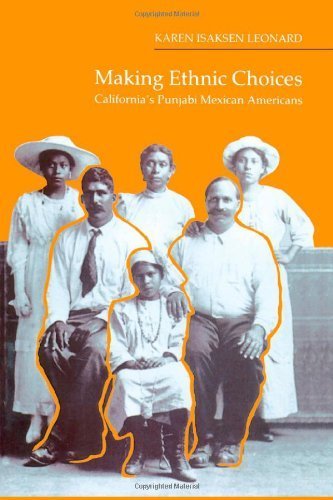
  • Making Ethnic Choices: California’s Punjabi Mexican Americans

    Temple University Press
    May 1992
    352 page
    6×9
    Paper EAN: 978-1-56639-202-0, ISBN: 1-56639-202-0
    Cloth EAN: 978-0-87722-890-5, ISBN: 0-87722-890-6
    Electronic Book: EAN: 978-1-43990-364-3

    Karen Isaksen Leonard, Professor of Anthropology
    University of California, Irvine

    This is a study of the flexibility of ethnic identity. In the early twentieth century, men from India’s Punjab province came to California to work on the land. The new immigrants had few chances to marry. There were very few marriageable Indian women, and miscegenation laws and racial prejudice limited their ability to find white Americans. Discovering an unexpected compatibility, Punjabis married women of Mexican descent and these alliances inspired others as the men introduced their bachelor friends to the sisters and friends of their wives. These biethnic families developed an identity as “Hindus” but also as Americans. Karen Leonard has related theories linking state policies and ethnicity to those applied at the level of marriage and family life. Using written sources and numerous interviews, she invokes gender, generation, class, religion, language, and the dramatic political changes of the 1940s in South Asia and the United States to show how individual and group perceptions of ethnic identity have changed among Punjabi Mexican Americans in rural California.

    Read chapter 1 here.

    Table of Contents

    • Preface
    • Part I: Introduction
    • Part II: The World of the Pioneers
      • 2. Contexts: California and the Punjab
      • 3. Early Days in the Imperial Valley
      • 4. Marriages and Children
      • 5. Male and Female Networks
      • 6. Conflict and Love in the Marriages
    • Part III: The Construction of Ethnic Identity
      • 7. Childhood in Rural California
      • 8. The Second Generation Comes of Age
      • 9. Political Change and Ethnic Identity
      • 10. Encounters with the Other
      • 11. Contending Voices
    • Appendixes
    • Notes
    • Bibliography
    • Index
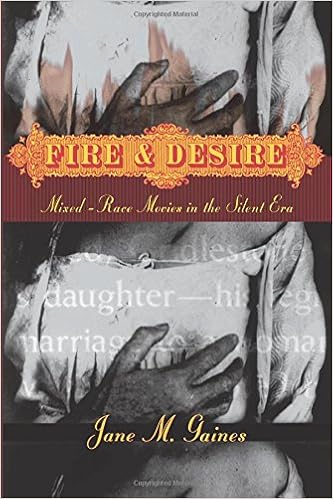
  • Fire and Desire: Mixed-Race Movies in the Silent Era

    University of Chicago Press
    February 2001
    352 pages
    36 halftones  6 x 9
    Cloth ISBN: 9780226278742
    Paper ISBN: 9780226278759

    Jane M. Gaines, Professor of Film Studies
    Columbia University School of the Arts

    Winner of the Katherine Singer Kovacs Award

    In the silent era, American cinema was defined by two separate and parallel industries, with white and black companies producing films for their respective, segregated audiences. Jane Gaines’s highly anticipated new book reconsiders the race films of this era with an ambitious historical and theoretical agenda.

    Fire and Desire offers a penetrating look at the black independent film movement during the silent period. Gaines traces the profound influence that D. W. Griffith’s racist epic The Birth of a Nation [(1915)] exerted on black filmmakers such as Oscar Micheaux, the director of the newly recovered Within Our Gates [(1920)]. Beginning with What Happened in the Tunnel [(1903)], a movie that played with race and sex taboos by featuring the first interracial kiss in film [View the short film (00:01:02) by Thomas Edison from 1903-11-06 here.], Gaines also explores the cinematic constitution of self and other through surprise encounters: James Baldwin sees himself in the face of Bette Davis, family resemblance is read in Richard S. Roberts’s portrait of an interracial family, and black film pioneer George P. Johnson looks back on Micheaux.

    Given the impossibility of purity and the co-implication of white and black, Fire and Desire ultimately questions the category of “race movies” itself.

    Table of Contents

    • List of Illustrations
    • Acknowledgments
    • Note on Film Dates
    • Introduction – The “Race” in Race Movies
    • 1. “Green Like Me”
    • 2. Desiring Others
    • 3. Race Movies: All-Black Everything
    • 4. World-Improving Desires
    • 5. Fire and Desire
    • 6. The Body’s Story
    • 7. Race/Riot/Cinema
    • Conclusion – Mixed-Race Movies
    • Notes
    • Index
  • The Punjabi Mexican American community, the majority of which is localized to Yuba City, California is a distinctive cultural phenomenon holding its roots in a migration pattern that occurred almost a century prior. The first meeting of these cultures occurred in the Imperial Valley in 1907, near the largest irrigation system in the Western hemisphere…

    Wikipedia

  • History 328: American Mixed Blood

    Oberlin College
    Department of History
    Fall 2009

    Pablo Mitchell, Eric and Jane Nord Associate Professor of History and Comparative American Studies
    Oberlin College

    From the coyote and the half-breed to the “tragic” mulatto, people of mixed ethnic and racial heritage occupy a conflicted and controversial place in American history. This course will chart the histories of people of mixed heritage from the colonial period to the present, exploring the relationship between the historical experiences of mixed heritage and broader trends in American history including slavery, imperialism, legal transformation, and changing cultural patterns. We will also consider current social theories of hybridity and mestizaje.

    Required Texts:

    Haunted by Empire: Geographies of Intimacy in North American History, Ann Stoler, ed., selected essays
    Martha Hodes, The Sea Captain’s Wife: A True Story of Love, Race, and War in the Nineteenth Century
    Earl Lewis, Heidi Ardizzone, Love on Trial: An American Scandal in Black and White
    Renee Christine Romano, Race Mixing: Black-White Marriage in Post-War America
    Jane M. Gaines, Fire and Desire: Mixed-Race Movies in the Silent Era
    Susan Koshy, Sexual Naturalization: Asian Americans and Miscegenation
    Joel Williamson, New People: Miscegenation and Mulattoes in the United States
    Karen Leonard, Making Ethnic Choices: California’s Punjabi Mexican Americans
    Lauren Basson, White Enough to be American? Race Mixing, Indigenous People, and the Boundaries of State and Nation