• Legend of the Free State of Jones

    University Press of Mississippi
    2009-10-07
    143 pages
    3 maps, 7 b&w illustrations
    5 1/2 x 8 1/2 inches
    Paper ISBN: 978-1-60473-571-0
    Ebook ISBN: 978-1-60473-572-7

    Rudy H. Leverett

    The original, full accounting of a rebellion in the heart of Dixie

    A maverick, unionist district in the heart of the Old South? A notorious county that seceded from the Confederacy? This is how Jones County, Mississippi, is known in myth and legend.

    Since 1864 the legend has persisted. Differing versions give the name of this new nation as Republic of Jones, Jones County Confederacy, and Free State of Jones. Over the years this story has captured the imaginations of journalists, historians, essayists, novelists, short story writers, and Hollywood filmmakers, although serious scholars long ago questioned the accuracy of local history accounts about a secessionist county led by Newt Knight and a band of renegades.

    Legend of the Free State of Jones was the first authoritative explanation of just what did happen in Jones County in 1864 to give rise to the legend. This book surveys the facts, the records, and the history of the “Free State of Jones” and well may provide the whole story.

    Rudy H. Leverett was born in an unplumbed cabin in the woods outside of Hattiesburg, Mississippi. He had a doctoral degree in education and spent his life writing extensively on the subjects of philosophy, the American South, and the McLemore family. He died on his birthday in 1999.
  • Blacks & Jews Entangled

    The New York Review of Books
    2016-07-14

    Darryl Pinckney

    Oreo by Fran Ross, with a foreword by Danzy Senna and an afterword by Harryette Mullen, New Directions, 230 pp., $14.95 (paper)

    Google wasn’t around when Oreo was first published in 1974. You are hit with Greek mythology and Yiddish right away and just the look of the pages of Fran Ross’s novel about an Afro-Jewish girl’s quest to find her white father can discourage or intimidate. Oreo, by an African-American writer who died in 1985, promises a degree of difficulty; the chapter titles, paragraph titles (“Helen and Oreo shmooz”), different font sizes, a graph showing shades of blackness, letters, an elaborate five-page menu of a daughter’s homecoming meal, footnotes, and mathematical equations say this is no naturalistic tale of two ghettoes. The protagonist is called “Oreo” not because of the cookie—i.e., because she is mixed-race or reluctantly black, as in black on the outside but white on the inside. Her black grandmother had been trying to give Oreo the nickname “Oriole,” but couldn’t make herself understood to the family.

    In addition to Greek myth and Yiddish, Ross makes use of black slang, popular culture of the time, puns, raunch, her own made-up words—but this is not vernacular, not jive. Ross’s voice is literary, and thrilled with itself, joking about Villon or Bellow, totally into what it takes to get up to outrageous parody. Nothing about the narrative is restful; you have to stay on the alert. Oreo is quick, obscure, sly, and every line is working hard, doing its bit. Ross makes Oreo relentless in her shtick. “Oreo was soon engrossed in ‘Burp: The Course of Smiling Among Groups of Israeli Infants in the First Eighteen Months of Life,’ the cover story in Pitfalls of Gynecology.”

    In fractured, short chapters, Oreo decides arbitrarily that she has fulfilled a given task and therefore deserves another cryptic clue from her father. Ross gives us not a send-up of Theseus’s journey of labors, but her appropriation of his battles as her structure, her frame for her provocative urban picaresque…

    Read the review here.

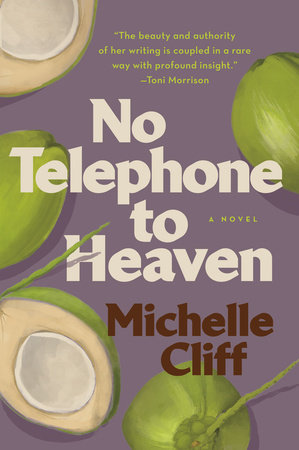
  • No Telephone to Heaven

    Plume
    March 1996 (Originally published in 1987)
    224 Pages
    Paperback ISBN: 9780452275690

    Michelle Cliff (1946-2016)

    A brilliant Jamaican-American writer takes on the themes of colonialism, race, myth, and political awakening through the experiences of a light-skinned woman named Clare Savage. The story is one of discovery as Clare moves through a variety of settings – Jamaica, England, America – and encounters people who affect her search for place and self.

    The structure of No Telephone to Heaven combines naturalism and lyricism, and traverses space and time, dream and reality, myth and history, reflecting the fragmentation of the protagonist, who nonetheless seeks wholeness and connection. In this deeply poetic novel there exist several levels: the world Clare encounters, and a world of which she only gradually becomes aware – a world of extreme poverty, the real Jamaica, not the Jamaica of the middle class, not the Jamaica of the tourist. And Jamaica – almost a character in the book – is described in terms of extraordinary beauty, coexisting with deep human tragedy.

    The violence that rises out of extreme oppression, the divided loyalties of a colonized person, sexual dividedness, and the dividedness of a person neither white nor black – all of these are truths that Clare must face. Overarching all the themes in this exceptionally fine novel is the need to become whole, and the decisions and the courage demanded to achieve that wholeness.

  • Journey into Speech-A Writer between Two Worlds: An Interview with Michelle Cliff

    African American Review
    Volume 28, Number 2, Black Women’s Culture Issue (Summer, 1994)
    pages 273-281
    DOI: 10.2307/3041999

    Opal Palmer Adisa, Professor of Creative Writing
    California College of the Arts

    Among the subjects Jamaican born writer Michelle Cliff explores in her writings are ancestry, the impact of colonization on the Caribbean, the relationships among and interconnection of African people in the diaspora, racism, and the often erroneous way in which the history of black people is recorded. In her latest novel, Free Enterprise (1993), Cliff attempt: to rewrite the story of Mary Ellen Pleasant, the African American woman who supplied money with which John Brown bought arms for the raid at Harper’s Ferry. Her other two novels, No Telephone to Heaven (1987) and Abeng (1984), are semi-autobiographical and explore the life of Clare Savage, fair-skinned girl raised between Jamaica and North America, who must reconcile her mixed heritage in a changing society. Other works by Cliff include Bodies of Water (1990), The Land of Look Behind (1985), and Claiming an Identity They Taught Me to Despise (1980).

    The following text is based on two separate interviews: one done in person in Albany, California, in December 1989, and the other conducted over the telephone in September 1993.

    Adlsa: When did you find your voice, when did you decide that you wanted to be a writer?

    Cliff: I always wanted to write. Actually there was a terrible incident. I don’t know if I should tell you, but I will. When I was at Saint Andrews I was keeping a diary. I had been very influenced by The Diary of Anne Frank, and as a result of seeing the movie and reading her diary, I got a diary of my own. I wasn’t living with my mother and father at this time; I was living with my aunt in Kingston [Jamaica] and going to Saint Andrews. This aunt also had a house in Saint Ann, where we used to stay on the weekends. Anyway, my parents broke into my bedroom in Kingston when we were not at the house. They went into my room, broke open my drawer, took out and broke the lock on my diary, and read it. Then they arrived at the other house. My father and mother had my diary in their hands and sat down and read it out loud in front of me, my aunt, and everybody else. My sister was there. There were very intimate details; there were a lot of things about leaving school and not going to class and playing hookey, but there was also the experience of the first time I menstruated, and I remember just being shattered. My father read it, and my mother was in total collaboration. (Pause.) Anyway I remember just crying and being sad and whatnot. I spoke to my sister about it once, and she remembered, even though she was seven at the time. And she said, “Don’t you remember screaming and saying, ‘Don’t I have any rights?’”…

  • Oral history interview with Benny Andrews, 1968 June 30

    Archives of American Art
    Smithsonian Institution

    Andrews, Benny, b. 1930 d. 2006
    Painter
    Active in New York, N.Y.

    Size: Transcript: 29 pages

    Format: Originally recorded on 1 sound tape reel. Reformated in 2010 as 2 digital wav files. Duration is 2 hrs., 12 min.

    Collection Summary: An interview of Benny Andrews conducted 1968 June 30, by Henri Ghent, for the Archives of American Art.

    Andrews remembers his childhood on a sharecropping farm in Georgia, difficulties he faced being light-skinned, and his struggle to get an education. He speaks of the role of the 4-H Club in his escape from that life and his attempts at painting using improvised materials. Andrews describes how he worked his way to college and joined the Air Force. He recalls passing himself off as white in certain situations, the insights into race relations he was able to gain that way, and his consciousness of being black as it affects his art. He notes the importance of other artists who encouraged him, and ends with a general characterization of his work.

    Biographical/Historical Note: Benny Andrews (1930-2006) was a painter and lecturer from New York, New York.

    This interview is part of the Archives’ Oral History Program, started in 1958 to document the history of the visual arts in the United States, primarily through interviews with artists, historians, dealers, critics and others.

    Funding for the digital preservation of this interview was provided by a grant from the Save America’s Treasures Program of the National Park Service.

    For more information, click here.

  • The Optics of Interracial Sexuality in Adrian Tomine’s Shortcomings and Sherman Alexie’s The Lone Ranger and Tonto Fistfight in Heaven

    College Literature
    Volume 41, Number 1, Winter 2014
    pages 119-148
    DOI: 10.1353/lit.2014.0004

    Jolie A. Sheffer, Associate Professor, English and American Culture Studies
    Bowling Green State University, Bowling Green, Ohio

    This essay focuses on the racial and sexual politics undergirding interracial relationships between men of color and white women. Alexie and Tomine’s works reveal how legal and cinematic histories of interracial romance continue to shape ethnic men’s sense of individual and community identity. An example of comparative ethnic-studies scholarship, this essay explores how minority subjects in the US are shaped by distinct racial logics. Alexie’s collection reflects the influence of the cinematic tropes of the Western and the history of US government attempts to weaken tribal ties on contemporary Native American male characters. Tomine’s graphic novel reveals the racial and sexual conventions of mainstream pornography and the individualist logic of the model minority myth on Asian-American men. Both authors suggest that queerness functions as an alternative ethical relation between parties, one grounded in equality rather than domination and relatively free of the visual logic of racialization.

    Read the entire article here.

  • Chan

    Bloodaxe Books
    2016-06-23
    72 pages
    234 x 156 mm
    Paperback ISBN: 9781780372839
    E-book ISBN: 9781780372846

    Hannah Lowe

    Chan is a mercurial name, representing the travellers and shape-shifters of the poems in this collection. It is one of the many nicknames of Hannah Lowe’s Chinese-Jamaican father, borrowed from the Polish émigré card magician Chan Canasta. It is also a name from China, where her grandfather’s story begins. Alongside these figures, there’s Joe Harriott, the Jamaican alto saxophonist, shaking up 1960s London; a cast of other long-lost family; and a ship full of dreamers sailing from Kingston to Liverpool in 1947 on the SS Ormonde.

    Hannah Lowe’s second collection follows her widely acclaimed debut, Chick, which took readers on a journey round her father, a gambler who disappeared at night to play cards or dice in London’s old East End to support his family.

  • Unreasonable Histories: Nativism, Multiracial Lives, and the Genealogical Imagination in British Africa

    Duke University Press
    2014
    368 pages
    51 illustrations
    Cloth ISBN: 978-0-8223-5713-1
    Paperback ISBN: 978-0-8223-5725-4

    Christopher J. Lee, Research Associate
    WITS Institute for Social and Economic Research
    University of the Witwatersrand, Johannesburg, South Africa

    In Unreasonable Histories, Christopher J. Lee unsettles the parameters and content of African studies as currently understood. At the book’s core are the experiences of multiracial Africans in British Central Africa—contemporary Malawi, Zimbabwe, and Zambia—from the 1910s to the 1960s. Drawing on a spectrum of evidence—including organizational documents, court records, personal letters, commission reports, popular periodicals, photographs, and oral testimony—Lee traces the emergence of Anglo-African, Euro-African, and Eurafrican subjectivities which constituted a grassroots Afro-Britishness that defied colonial categories of native and non-native. Discriminated against and often impoverished, these subaltern communities crafted a genealogical imagination that reconfigured kinship and racial descent to make political claims and generate affective meaning. But these critical histories equally confront a postcolonial reason that has occluded these experiences, highlighting uneven imperial legacies that still remain. Based on research in five countries, Unreasonable Histories ultimately revisits foundational questions in the field, to argue for the continent’s diverse heritage and to redefine the meanings of being African in the past and present—and for the future.

  • Dwayne Johnson – “Race Shifter” in a “Post-Racial” World?

    Shadow and Act: On Film, Television and Web Content of Africa and Its Diaspora
    2016-06-13

    Sergio Mims


    Dwayne Johnson

    With “Central Intelligence” hitting theaters this weekend, starring Dwayne Johnson and Kevin Hart, a conversation worth having…

    I’m sure we’ve all privy to all the chatter about how we’re now living in a so-called “post-racial” society. Though I think most of us would respond to that with a “Yeah right!” But things are changing, albeit slowly. And it dawned on me, with Johnson becoming one of Hollywood’s most dependable actors today, starring in blockbuster after blockbuster, and carrying some of them almost alone, that he’s the one person who could be an example of this “post-racial” utopia we’re supposed to be living in.

    It should be very obvious by now that Johnson has been positioning himself to become a major movie star. He easily could have gone on to be a B-movie actor, content with taking supporting roles in action/exploitation films, and starring in direct-to-video movies, like some of his former WWE cohorts. But Johnson has much higher aspirations. And it’s not just the film projects that he’s attached himself to; either by design or by happenstance, it’s also how he’s been perceived racially by the public. He has become a “race shifter” for lack of a better word.

    Through his obviously ethnic, but not clearly defined looks (he’s black Canadian/Samoan), he has managed to become “identified” as it were, by different audiences, as different things, and has used that to his advantage, whether intentionally or not. I should say that, of course, we identify him as a black actor here on S&A, or else we wouldn’t be covering him at all. And Johnson has never obscured, or refused to acknowledge his bi-racial heritage, unlike let’s say Vin Diesel, who has seemingly gone out of his way to not publicly acknowledge his mixed heritage, preferring to instead let people think he’s, perhaps, Italian…

    Read the entire article here.

  • Confounding Anti-racism: Mixture, Racial Democracy, and Post-racial Politics in Brazil

    Critical Sociology
    July 2016, Volume 42, Numbers 4-5
    pages 495-513
    DOI: 10.1177/0896920513508663

    Alexandre Emboaba Da Costa, Assistant Professor, Theoretical, Cultural and International Studies in Education
    University of Alberta, Canada

    In this article, I analyze the particularity of post-racial ideology in Brazil. I examine recent deployments of mixture and racial democracy as re-articulations of historically hegemonic versions of these ideologies that minimize the problem of racism, deny its systemic nature, and deem ethno-racial policies as threats to achieving nonracial belonging and citizenship. Drawing on scholarship on race and racism from the United States, Brazil, and elsewhere in Latin America, I delineate a relational framework for analyzing the post-racial and apply this framework to three examples of post-racial ideology. Through these examples, I illustrate the problematic logics shaping aggressive investments in the post-racial as future promise to the detriment of addressing the unequal effects racial difference presents for inclusion/exclusion today. The article asserts the necessity of mounting transnational and interdisciplinary theoretical, epistemological, and practical strategies to challenge the ways post-racial ideologies rearticulate racial hierarchies, maintain racial subordination, and delimit social change.

    Read or purchase the article here.