• On Being Mixed Race: I am Not a Percentage or a Fraction

    The Radical Notion
    2016-01-12

    Nicola Codner
    Leeds, Yorkshire, United Kingdom

    I’ve noticed frequently when I’m having a conversation with someone about my racial identity, I start to feel frustrated by some of the language that comes up. To clarify my father is black Jamaican, Nigerian and white British, and my mother is white British.

    My earliest memories are of being described racially as ‘half-caste’. This was an acceptable term back in the 80’s, in the UK, to describe someone whose parents are of different races. People don’t tend to use this word anymore unless they are from older generations and unaware that it is not politically correct. The word ‘caste’ originates from the Spanish/Portuguese word ‘casta’ which means ‘pure’. Describing someone as half-caste is to imply they are only half pure which has obvious racist implications. This term was my first introduction to the idea that I had an identity that could be broken down into numerical fractions…

    Read the entire article here.

  • TS Eliot prize: poet Sarah Howe wins with ‘amazing’ debut

    The Guardian
    2016-01-11

    Mark Brown, Arts correspondent


    Sarah Howe, a fellow at Harvard’s Radcliffe Institute, could ‘change British poetry’. Photograph: Hayley Madden/FMcM/PA

    Judges hail daring use of form in a collection that examines poet’s joint British and Chinese heritage

    A new voice, who judges say “will change British poetry”, has won the TS Eliot poetry prize. Sarah Howe, a fellow at Harvard University’s Radcliffe Institute, was awarded the £20,000 prize for Loop of Jade, which explores her dual British and Chinese heritage.

    Howe’s work – the first debut poetry collection to win the British prize since it was inaugurated in 1993 – triumphed over a particularly strong shortlist, which featured some of poetry’s biggest names, including Don Paterson, Claudia Rankine, Sean O’Brien and Les Murray

    Read the entire article here.

  • Book review: Loop of Jade by Sarah Howe

    The Scotsman: Scotland’s National Newspaper
    2015-05-03

    Roger Cox, Arts Editor

    Sarah Howe, Loop of Jade (London: Chatto & Windus, 2015)

    DOUBLE takes haunt poet Sarah Howe on her return to memory’s fragrant harbour, writes Roger Cox

    In her poem Sirens, Sarah Howe writes “I had one of those blurrings – glitch, then focus – / like a put-off optician’s trip, when you realise / how long you’ve been seeing things wrongly.” This sinuous, shimmering, mirage-like debut collection is littered with such moments of sudden realisation, and also haunted by the suspicion that there must be more to everything than meets the eye.

    In Sirens, the blurring occurs when, reflecting on a line in a poem by Theodore Roethke, Howe suddenly twigs that a description of a girl’s “sidelong pickerel smile” is not a reference to juvenile pike, as she had always supposed, but to a small wading bird.

    She knows she must now update her mental image of the girl from fish to fowl, yet try as she might she can’t shake the original image of the girl’s fishy grin. Could both images be right? Did the poet intend the double meaning?…

    …Howe was born in Hong Kong in 1983 to an English father and a Chinese mother, and moved to England as a child. She still has vivid memories of her time as a schoolgirl in Hong Kong – as demonstrated by the wonderfully evocative poem Islands, in which she recalls the girls at her boarding school sleeping three to a bed shelf, “like dumplings stacked in steamers” – but this collection is billed as a voyage of discovery, a journey in search of her roots…

    Read the entire review here.

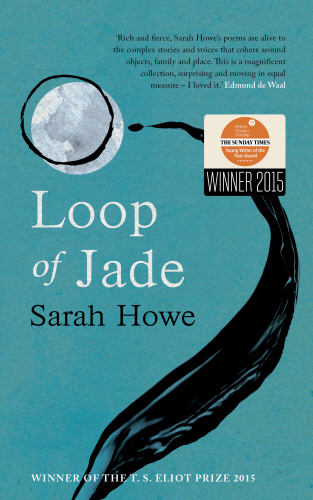
  • Loop of Jade

    Chatto & Windus, part of Vintage Publishing
    2015-05-07
    80 pages
    Paperback EAN: 9780701188696
    eBook EAN: 9781448190683

    Sarah Howe

    • WINNER OF THE T. S. ELIOT PRIZE 2015
    • WINNER OF THE SUNDAY TIMES / PETERS FRASER + DUNLOP YOUNG WRITER OF THE YEAR AWARD 2015
    • SHORTLISTED FOR THE FORWARD PRIZE FOR BEST FIRST COLLECTION 2015

    There is a Chinese proverb that says: ‘It is more profitable to raise geese than daughters.’ But geese, like daughters, know the obligation to return home. In her exquisite first collection, Sarah Howe explores a dual heritage, journeying back to Hong Kong in search of her roots.

    With extraordinary range and power, the poems build into a meditation on hybridity, intermarriage and love – what meaning we find in the world, in art, and in each other. Crossing the bounds of time, race and language, this is an enthralling exploration of self and place, of migration and inheritance, and introduces an unmistakable new voice in British poetry.

  • Both native and foreign: How being of mixed race affects Japanese students

    The Cavalier Daily
    Charlottesville, Virginia
    2014-07-01

    Emily Gorham

    I have now entered week five of my three month stay in Japan as an intern for the Ibaraki Christian University’s English department. A couple of weeks ago, I wrote about what I’ve termed the gaijin stare — a phenomenon in which, as one of very few foreigners living in the Japanese countryside, I get stares from just about everyone, wherever I go.

    This concept got me thinking: what happens when the gaijin stare is misplaced? Japan used to think of itself as a homogenous nation. Some people still think of it this way — though times are certainly changing and interracial marriage is growing increasingly common.

    By one statistic, one in every 49 babies born in Japan today is considered “mixed race” — or “haafu,” which natives presumably take to mean half-Japanese and half-foreign. While this number may not sound staggering, it means Japan’s mixed raced demographic cannot be ignored.

    After experiencing the gaijin stare myself, I spoke to a few students at the university who are considered “haafu” for their take on racial perception in Japan…

    Read the entire article here.

  • This assimilation should disabuse us of the fantasy of the imminent demise of the white majority and its loss of power. Not all the newcomers to the mainstream will identify as whites, and its visibly growing diversity will be a key development of the early 21st century, as the election of the nation’s first black president unmistakably signals. “Whiteness,” however, has never been fixed; it is a malleable concept, and it is on its way to changing again, as it has before.

    Yet it is critical not to lapse immediately into another fantasy, namely, the belief that assimilation will prove a panacea for still-glaring ethno-racial disparities. Contemporary assimilation is simply not on the same scale as that of the mid-20th century, when, for example, Italians caught up to other whites in education and socioeconomic attainment in just a 25-year period after World War II. Assimilation today is crimped by greatly heightened inequalities and is leaving many outside its reach, including many Hispanics, such as the undocumented and their children, even those who are U.S. citizens because they were born here. In one respect, however, the earlier and current patterns of assimilation are similar: African Americans are participating only to a limited extent. Indeed, one could even say they are being bypassed.

    Richard Alba, “The Likely Persistence of a White Majority,” The American Prospect, Winter 2016, Volume 27, Number 1 (January 11, 2016). http://prospect.org/article/likely-persistence-white-majority-0.

  • The Case for Scholarly Reparations

    Berkeley Journal of Sociology
    2016-01-11

    Julian Go, Professor of Sociology
    Boston University

    Race, the history of sociology, and the marginalized man – lessons from Aldon Morris’ book “The Scholar Denied

    If Aldon Morris in The Scholar Denied is right, then everything I learned as a sociology PhD student at the University of Chicago is wrong. Or at least everything that I learned about the history of sociology. At Chicago, my cohort and I were inculcated with the ideology and ideals of Chicago School. We were taught that American sociology originated with the Chicago School. We were taught that sociology as a scientific enterprise, rather than a philosophical one, began with Albion Small and his successors; that The Polish Peasant by W.I. Thomas and Florian Znaniecki was the first great piece of American sociological research; and that the systematic study of race relations and urban sociology originated with Robert E. Park and his students. We were taught that we should not only read the Chicago school but also venerate it, model our work after it, and pass its wisdom on through the generations. But The Scholar Denied shows that the Chicago school was not the founding school of sociology in the United States. Neither Small, Park, Thomas and Znaniecki nor their students originated scientific sociology. The real credit goes to W.E.B. Du Bois, whom leading representatives of the Chicago School like Robert E. Park marginalized – perhaps wittingly. Moreover, and perhaps more contentiously, The Scholar Denied suggests that Park plagiarized Du Bois, and that venerated sociologists like Max Weber were perhaps more influenced by Du Bois rather than the other way around.

    The implications are far-reaching. If the Chicago school is not the originator of sociology, then why spend so much time reading, thinking about, or debating it? If Morris is right, graduate students should instead focus upon the real innovators and founders: Du Bois and his “Atlanta School” of sociology. It only struck me after reading this book that Du Bois had barely if ever appeared on any my graduate school syllabi. Yet, this is not a question of adding more thinkers to the sociology canon. If Morris is right, there is an argument to made that Du Bois and the Atlanta School should replace the Chicago School, not just be added alongside it. For, with The Scholar Denied, Du Bois can no longer be seen as the “first black sociologist”, the originator of “African-American sociology,” or the one who pioneered the study of African-American communities. He must instead be seen as the first scientific sociologist who is the rightful progenitor of American sociology itself…

    Read the entire article here.

  • The Likely Persistence of a White Majority

    The American Prospect
    Winter 2016, Volume 27, Number 1 (2016-01-11)

    Richard Alba, Distinguished Professor of Sociology
    Graduate Center, City University of New York

    Has the notion of demography as destiny ever enjoyed so much credence? The disappearance of a white majority in the United States by the middle of this century is now widely accepted as if it were an established fact. Projections by the Census Bureau have encouraged those expectations, and people on both the right and left have seized on them in support of their views. On the right, the anxieties about the end of white majority status have fueled a conservative backlash against the growing diversity of the country. On the left, many progressives anticipate an inexorable change in the ethno-racial power hierarchy. Numerous sites on the web offer advice and counsel on how whites can handle their imminent minority status.

    But what if these different reactions are based on a false premise—actually two false premises? The first stems from the Census Bureau’s way of classifying people by ethnicity and race, which produces the smallest possible estimate of the size of the non-Hispanic white population. Whenever there is ambiguity about ethno-racial identity, the statistics publicized by the bureau count an individual as minority. This statistical choice is particularly important for population projections because of the growing number of children from mixed families, most of whom have one white parent and one from a minority group. In the Census Bureau’s projections, children with one Hispanic, Asian, or black parent are counted as minority (that is, as Hispanic or nonwhite). The United States has historically followed a “one-drop” rule in classifying people with any black ancestry as black. The census projections, in effect, extend the one-drop rule to the descendants of other mixed families. A great deal of evidence shows, however, that many children growing up today in mixed families are integrating into a still largely white mainstream society and likely to think of themselves as part of that mainstream, rather than as minorities excluded from it…

    Read the entire article here.

  • The Black Irish Onscreen: Representing Black and Mixed-Race Identities on Irish Film and Television by Zélie Asava (review)

    Black Camera
    Volume 7, Number 1, Fall 2015 (New Series)
    pages 267-270

    Isabelle Le Corff

    Asava, Zélie, The Black Irish Onscreen: Representing Black and Mixed-Race Identities on Irish Film and Television (Oxford, Bern, Berlin, Bruxelles, Frankfurt am Main, New York, Wien: Peter Lang, 2013)

    The Black Irish Onscreen makes an original contribution to the field of Irish film studies. Author Zélie Asava has gone to great lengths to confront the political hierarchies of black and white in Ireland and question the links between visual culture and social reality. Pointing at Ireland’s long history of cultural and ethnic heterogeneity, the general introduction shows how, although Ireland has shifted from a land of emigrants to one of immigrants, it continues to consider foreigners as people who come to work rather than to settle permanently, the immigrant probably reminding the nation of its own migrant past and present.

    Challenging the idea that “being Irish is still often seen as a question of being the product of two Irish people descended from a long line of Irish ancestors,” Asava describes her familial and cultural roots in Ireland and explains that her politics as a heterosexual mixed-race woman have been deeply influenced by the cultural productions of Ireland. As an Irish woman with dual citizenship, her experiences of misrecognition have framed her intellectual interrogation. She can thus assert that the personal is highly political, and stress the importance of using art to challenge socioeconomic and cultural norms.

    Since the emergence of the Celtic Tiger and mass immigration as a new phenomenon, there have been enduring problems of racism and acceptance in Ireland. Asava ironically observes that Irish identity now expands to include the seventy million of the diaspora but still excludes non-Europeans living in Ireland, the majority of whom are African. Questioning the link between reality and onscreen representations, she insists that despite a marked increase in the visibility of gay, lesbian, minority-ethnic, and socially excluded characters on the Irish screen, it is still extremely difficult nowadays to find images of mixed-race or black people in Irish visual culture, and the existing representations are frequently stereotyped and prejudiced. Asava cherishes the hope that, with more focus on commonalities than differences, the black and hyphenated Irish may come to be seen as part of the nation rather than as a fractional ethnic group defined as “Other.” Being critical of the way Otherness may be referred to in cultural products is imperative. Different aspects of Irish public culture are pointed out as a means of de-legitimizing the Irishness of anyone who isn’t white or the product of Irish ancestors. Such aspects range from the constant media references to the men of 1916 to the focus on parochial origins, which inevitably position all hybrids as foreigners, albeit foreigners born and bred on Irish soil. Asava’s book is the first in Irish film studies to consider Ireland as a black mixed-race country and explore manifestations of Irishness which challenge the concept of Irish identity as a static, homogeneous ethnicity, seeking to produce a more inclusive and far reaching vision of Irish identity. It complements Debbie Ging’sGoldfish Memories? On Seeing and Hearing Marginalised Identities in Contemporary Irish Cinema,” published in 2008.

    The Black Irish Onscreen is divided into six chapters. The first chapter is devoted to Neil Jordan’s The Crying Game (1992) and Breakfast on Pluto (2005), two Irish films featuring mixed-race protagonists. Jordan’s work was among the first to explore racial narratives in Northern Ireland during the Troubles, and to draw parallels between the political situation in Northern Ireland and interracial and queer/trans* love. His film Mona Lisa (1986) is also cited for starring Cathy Tyson and comparing mixed-race Great Britain and white Ireland. In this chapter Asava briefly refers to Diane Negra and Richard Dyer’s pioneering works on racializing whiteness and showing how representations of gender, sexuality and race have been shaped by the film industry. Sexuality and race are thus equated as alien in an Irish screen culture characterized by major gender imbalances, male directors and male protagonists dominating an industry that favors historical and gangster genres.

    The second chapter focuses on black or mixed-race women on Irish television. Different television programs such as Prosperity (RTE, 2007), Love is The Drug (RTE, 2004), and Fair City (RTE, 1989–) are considered for the way they portray black or mixed-race female protagonists. While…

    Read or purchase the article here.