• President Barack Obama: A More Perfect Union

    Routledge
    2010
    272 pages
    Paperback ISBN: 9781594514777

    John K. Wilson

    Barack Obama’s “improbable quest” has become a fact of American life and a benchmark in American history. Striving now toward “a more perfect union,” Obama and the nation confront obstacles unforeseen at the outset of the 2008 electoral campaign. John K. Wilson tracks the sweep of this progress from the beginning of Obama’s political career through his move into the White House. With his critical journalistic eye and his sympathetic “native son” perspective, Wilson shows us a side of Obama we haven’t seen as well as a view of the media we need to understand-even more now as the Obama administration begins to govern. The paperback edition of this popular book includes a new introduction, updates throughout, and two new chapters on the electoral victory and the transition from campaigning into governing. New photos and new insights include a focus on the continued importance of race in American politics.

    Table of Contents

    • Introduction to the Paperback Edition
    • Chapter 1: Generation Obama: The Youth Movement for Barack
    • Chapter 2: Are You Experienced? Obama and the Media
    • Chapter 3: Race and the President: Is Obama Black Enough?
    • Chapter 4: The Vast Right-Wing Conspiracy: The Conservative Attack on Obama
    • Chapter 5: Why Leftists Hate A Liberal: The Far Left Attacks on Obama
    • Chapter 6: “This Is My House, Too”: Obama and the Liberal God
    • Chapter 7: From Quest to Reality: Politics and Policy in an Obama Administration
    • Chapter 8: The Victory: Barack Obama’s Improbable Triumph
    • Chapter 9: The Obama Administration: Turning Hope into Change Conclusion: Obama’s Hopes and Dreams
    • Notes
    • Index
    • About the Author
  • Thai beauty ad: ‘Just being white, you will win’

    Cable News Network (CNN)
    2016-01-08

    Wilfred Chan

    (CNN)—It’s hard to imagine anything more blatant than this.

    A new Thai beauty ad claiming white skin is the key to success has unleashed a storm of criticism in Thailand, especially online, where people complain the ad perpetuates damaging, racist ideas.

    “Just being white, you will win,” says Cris Horwang, a smiling pale-skinned actress, in the 50-second spot by Seoul Secret, a Thai beauty company.

    Without the advertised pill, “the whiteness I have invested in, will just vanish,” she warns.

    On screen, the actress’ expression turns despondent as her skin is digitally altered to turn black.

    Horwang promises that the product, called Snowz, “will help you not to return to being dark.”

    “Eternally white, I am confident,” she adds.

    On Friday evening, Seoul Secret pulled the video from its online platforms and issued a statement.

    “(We) would like to apologize for the mistake and claim full responsibility for this incident. Our company did not have any intention to convey discriminatory or racist messages,” it said.

    “What we intended to convey was that self-improvement in terms of personality, appearance, skills, and professionality (sic) is crucial.”…

    Read the entire article and view the ad here.

    [Note from Steven F. Riley: See the article, “Skin Bleaching and Global White Supremacy: By Way of Introduction.”]

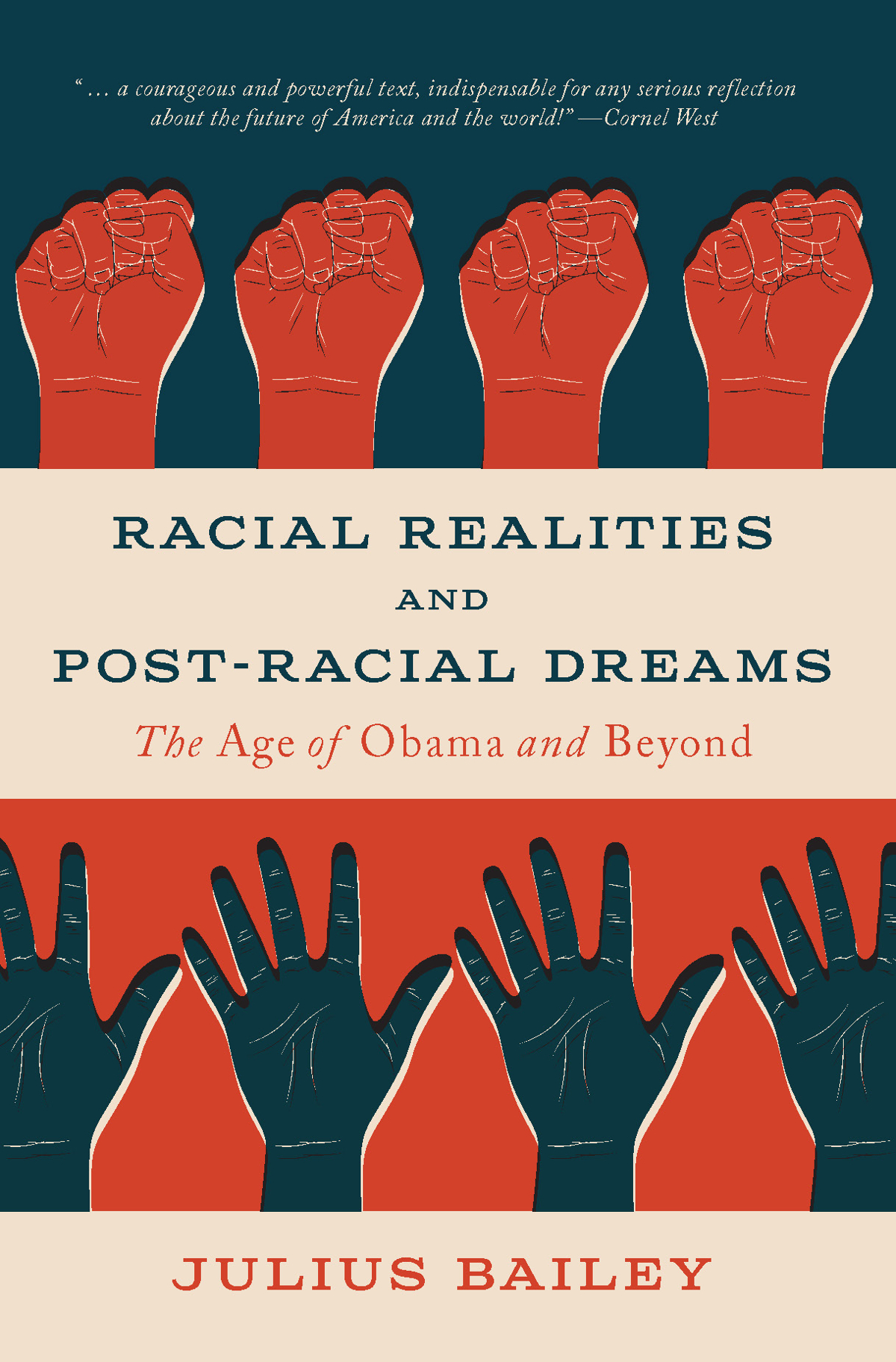
  • Racial Realities and Post-Racial Dreams: The Age of Obama and Beyond

    Broadview Press
    2016-01-05
    190 pages
    Paperback ISBN: 9781554813162

    Julius Bailey, Associate Professor of Philosophy
    Wittenberg University, Springfield, Ohio

    Racial Realities and Post-Racial Dreams is a moral call, a harkening and quickening of the spirit, a demand for recognition for those whose voices are whispered. Julius Bailey straddles the fence of social-science research and philosophy, using empirical data and current affairs to direct his empathy-laced discourse. He turns his eye to President Obama and his critics, racism, income inequality, poverty, and xenophobia, guided by a prophetic thread that calls like-minded visionaries and progressives to action. The book is an honest look at the current state of our professed city on a hill and the destruction left on the darker sides of town.

    Table of Contents

    • Foreword by Rev. Dr. Michael L. Pfleger
    • Acknowledgments
    • Introduction: “I, Too, Sing America”
    • Chapter 1: “I Can’t Breathe!” “So What! F??? Your Breath”
    • Chapter 2: Obama and the Myth of a Post-Racial America
    • Chapter 3: Racism: The Long March to Freedom and the New Jim Crow
    • Chapter 4: Xenophobia: America Inside Out
    • Chapter 5: Poverty: A Load Too Heavy to Bear
    • Chapter 6: Income Inequality: The Unbridgeable Gap
    • Chapter 7: Repositioning the Moral Arc
    • Works Cited
  • Al Sharpton says some criticism of de Blasio is related to his mixed race family

    The New York Daily News
    2016-01-05

    Jennifer Fermino, City Hall Bureau Chief

    The Rev. Al Sharpton thinks that some of Mayor de Blasio’s woes stem from his mixed race family.

    Speaking Tuesday morning at an interfaith breakfast, Sharpton said that de Blasio, whose wife is black and has two mixed-race kids, and President Obama have upset the status quo.

    “We elected a President of a different race, and a different bent. And not long after this city elected a mayor, after years of developers and others setting the tone in this city, that set a different tone in New York,” said Sharpton.

    “And when many looked up and saw an African-American family in the White House, and a biracial family in Gracie Mansion at the same time, they tried to trump them.”

    The comment — and veiled barb at White House contender Donald Trump — drew laughter from the crowd, which included many faith leaders as well as de Blasio and First Lady Chirlane McCray.

    “God always has the prophets for the time in which they live,” said Sharpton.

    “You’re in the age of Obama. You’re in the age of de Blasio. Put away your sermons from the age of Nixon.”…

    Read the entire article here.

  • The Story of French New Orleans: History of a Creole City

    University Press of Mississippi
    January 2016
    208 pages (approx.)
    1 map, bibliography, index
    6 x 9 inches
    Hardcover ISBN: 9781496804860

    Dianne Guenin-Lelle, Professor of French
    Albion College, Albion, Michigan

    Why New Orleans is considered America’s distinctly French city

    What is it about the city of New Orleans History, location, and culture, continue to link it to France while distancing it culturally and symbolically from the United States. This book explores the traces of French language, history, and artistic expression that have been present there over the last three hundred years. This volume focuses on the French, Spanish, and American colonial periods to understand the imprint that French socio-cultural dynamic left on the Crescent City.

    The migration of Acadians to New Orleans at the time the city became a Spanish dominion and the arrival of Haitian refugees when the city became an American territory oddly reinforced its Francophone identity. However, in the process of establishing itself as an urban space in the antebellum south, the culture of New Orleans became a liability for New Orleans elite after the Louisiana Purchase.

    New Orleans and the Caribbean share numerous historical, cultural, and linguistic connections. The book analyzes these connections and the shared process of creolization occurring in New Orleans and throughout the Caribbean Basin. It suggests “French” New Orleans might be understood as a trope for unscripted “original” Creole social and cultural elements. Since being Creole came to connote African descent, the study suggests that an association with France in the minds of whites allowed for a less racially-bound and contested social order within the United States.

  • Brazil’s Federal Universities Approach Racial Quota Implementation Deadline

    Truthout
    2015-12-30

    Marlenee Blas Pedral, Fulbright Fellow
    Comissão Fulbright Brasil

    In 2016, Brazil’s prestigious federal universities will be required to confirm that fifty percent of their incoming students come from public schools. Furthermore, slots for self-identifying Black, mixed-race and Indigenous students must correspond to the proportion of the local population.

    Implemented in accordance with Brazil’s Lei de Cotas (Law of Social Quotas), these measures seek to ensure that Brazil’s public universities reflect the country’s diverse population. The implementation of these measures represents a big leap, but Brazil still faces many hurdles to making its higher education system more democratic.

    More than half of the population in Brazil identified in the census as Black or mixed race, yet only 10 percent of this group made it to the university. In response to these high educational gaps, Brazil’s congress voted in 2012 for a plan to implement the Lei de Cotas…

    Challenges in Higher Education

    The residual effects of slavery are acute in Brazil, a country where roughly 4 million African people arrived through enslavement, compared to the estimated 400,000 Africans who arrived in the US.

    While the US suffered from Jim Crow laws and one-drop rules, Brazil’s aim of branqueamento (whitening) and its push for imaginary “racial democracy” has yielded a different form of racism…

    Read the entire article here.

  • Arguing That Black Is White: Racial Categorization of Mixed-Race Faces

    Perception
    Published online before print: 2015-12-29
    DOI: 10.1177/0301006615624321

    Michael B. Lewis, Reader in Psychology
    Cardiff University, Wales, United Kingdom

    Previous research has demonstrated that racially ambiguous faces (blended from Black and White parent faces) are categorized as being Black more often than White. This has been taken as support for social concept of hypodescent: mixed-race people are categorized with the same race as the socially subordinate parent. The current research explores racial categorization further by using two sets of participants: those with greater experience of White faces and those with greater experience of Black faces. It was found that mixed-race faces were categorized as being Black more often than White by the former but White more often than Black by the latter group. Racial categorization of a mixed-race face, therefore, depends upon who is doing the categorizing. A face that may be argued as appearing racially Black to one person would be argued as appearing racially White to another depending on their experience.

    Read or purchase the article here.

  • BOOK REVIEW – Raising Mixed Race: Multiracial Asian Children in a Post Racial World

    Mixed Roots Stories
    2015-12-10

    Chandra Crudup, PhD, MSW

    Sharon H. Chang’s inaugural book, Raising Mixed Race: Multiracial Asian Children in a Post Racial World, lays out a blue print that outlines the history of white supremacy and how it has corrupted the way people treat each other, specifically Mixed Race/Multiracial and Multiracial Asian individuals. She develops an important foundation that provides a glimmer of hope for moving forward toward improving our future world, despite the powerful suppressive system before us.

    The title might make you think it is a parenting book, and it is (or could be), but it so much more! The language/verbiage used in the book makes this potentially academic/research strong book accessible for those who might have the most questions…parents. Though this book has a focus on multiracial Asian children, it is not just a book for parents of multiracial Asian children. It is a book for all children of color…and even for parents of white children! This book is for anyone who comes in contact with children in any way. This means if you are a teacher/educator, a child care worker, do research with children or on race and intersectionaility…or if you are a parent, sibling, aunt, uncle, grandparent, or once was a child. This book is for everyone!…

    Read the entire review here.

  • Multiracial Identity Recognition – Why Not? A Comparison Between Multiracialism in the United States and Brazil

    University of Ottawa, Ontario, Canada
    2015
    143 pages

    Ana Carolina Miguel Gouveia

    Thesis submitted to the Faculty of Graduate and Post-Graduate Studies in partial fulfillment of the requirements for a LLM Master degree in Law Graduate Studies in Law

    Scholars debate the importance of multiracial identity recognition as the increasing number of self-identified multiracial individuals challenges traditional racial categories. Two reasons justify the count of multiracial individuals on censuses. One is the right to self-identification, derived from personal autonomy. The other is social: the category allows governments to accurately assess affirmative action programs’ results and society’s acceptance of multiracialism. Critical Race Theory and Critical Mixed-Race Studies serve as basis for my analysis over multiracial identity formation and its recognition. Comparing multiracialism in America and Brazil, I verify that both countries are in different stages regarding categorization and social acceptance of multiracial identity. Neither uses multiracial data for social programs, though. I conclude that the growth of mixed-race individuals makes the identification of race-based social programs’ beneficiaries difficult, which demands the use of diverse criteria. Moreover, official recognition can serve to improve the way society deals with race.

    Read the entire thesis here.

  • At a Santo Domingo Hair Salon, Rethinking an Ideal Look

    The New York Times
    2015-12-30

    Sandra E. Garcia

    On my first trip back to the Dominican Republic in 10 years, as I wandered down the streets of La Zona Colonial, I noticed how their names were weighted with history. Calle de las Damas, a street made specifically for the wives and daughters of noblemen from colonial times to walk down. Calle José Gabriel García, named for a Dominican historian and journalist, among other things, who shares a first and last name with my father and made me think of him while I was there. Calle Isabel La Católica where I felt a connection to my paternal grandmother, Isabel Mireya Garcia. Born in Bani, she lived and died on the right side of Hispaniola and raised my father in Santo Domingo.

    During my trip I would text my father pictures of the streets, and he would always text me back a story from his youth that occurred close to or near the street I was on.

    “That’s the street where I shook Pope John Paul II’s hand in 1979,” he texted me, referring to Calle Padre Billini.

    He likened La Zona Colonial to Times Square, but to me it resembled too much of the Old World.

    The cobblestones, the colonial-style houses that were more like haciendas, Christopher and Diego Columbus’s house-turned museum — this all reminded me of the Spanish who once lived here and the continuing reverence for their influence in a country whose residents have African, European and Asian ancestry.

    Before I knew it, I was standing in front of the Miss Rizos Salon on Calle Isabel La Católica. This was a departure from that reverence.

    Long hair that hangs down your back has so long been the prevalent beauty ideal in the Dominican Republic that many residents who mastered hair-straightening on the island emigrated to the United States and opened successful salons throughout the country…

    Read the entire article here.