• Mothering, Mixed Families and Racialised Boundaries

    Routledge
    2014-02-10
    120 pages
    Paperback ISBN: 9781138953697
    Hardback ISBN: 9780415733748

    Edited by:

    Ravinder Barn, Professor of Social Policy
    Royal Holloway, University of London, United Kingdom

    Vicki Harman, Senior Lecturer
    Royal Holloway, University of London, United Kingdom
    This pioneering volume draws together theoretical and empirical contributions analyzing the experiences of white mothers in interracial families in Britain, Canada and the USA. The growth of the mixed race population reflects an increasingly racially and culturally heterogeneous society, shaped by powerful forces of globalisation and migration. Mixed family formations are becoming increasingly common through marriage, relationships and adoption, and there is also increasing social recognition of interracial families through the inclusion of mixed categories in Census data and other official statistics. The changing demographic make-up of Britain and other Western countries raises important questions about identity, belonging and the changing nature of family life. It also connects with theoretical and empirical discussions about the significance of ‘race’ in contemporary society.

    In exploring mothering across racialised boundaries, this volume offers new insights and perspectives. The notion of racialisation is invoked to argue that, while the notion of race does not exist in any meaningful sense, it continues to operate as a social process. This crucial resource will appeal to academics, researchers, policy makers, practitioners and undergraduate and postgraduate students.

    This book was originally published as a special issue of Ethnic and Racial Studies.

    Table of Contents

    1. Introduction / Ravinder Barn and Vicki Harman
    2. ‘Doing the right thing’: transracial adoption in the USA / Ravinder Barn
    3. The experiences of race in the lives of Jewish birth mothers of children from black/white interracial and inter-religious relationships: a Canadian perspective / Channa C. Verbian
    4. Researching white mothers of mixed-parentage children: the significance of investigating whiteness / Joanne Britton
    5. Social capital and the informal support networks of lone white mothers of mixed-parentage children / Vicki Harman
    6. Narratives from a Nottingham council estate: a story of white working class mothers with mixed-race children / Lisa McKenzie
  • Not Ready

    North Bay Bohemian
    Santa Rosa, California
    2015-12-31

    Tom Gogola, News Editor

    2015 was an ugly year in America

    When the question is asked near the beginning—”Is America ready for its first black president?”— it needs to be answered near the end. And as Barack Obama comes into the homestretch of his term in 2016 the answer, sadly, is no.

    If nothing else, 2015 offered a rolling reminder of the first year of Barack Obama’s presidency with its numerous parallel events and template-setting episodes that have now come to a full head of hateful steam in the emergent American Serbia of the mind, if not deed. The embodiment is Donald Trump, presidential candidate, notorious birther, resident American fascist and bomb-thrower.

    If hope and change were the Obama buzzwords in 2009, the lesson of 2015 is that a bunch of overstimulated, hopelessly right-wing pseudo statesmen haven’t changed, grown up, dropped the sub rosa race-bait narrative—even as Obama delivered on his fair share of what he promised way back when…

    Read the entire article here.

  • Exhibit by Penn cultural anthropologist showcases Afro-Latinos in Philadelphia

    Penn Current: News, ideas and conversations from the University of Pennsylvania
    2015-12-10

    Jacquie Posey

    Free and enslaved Africans shaped and built Latin America and the Spanish-speaking Caribbean. Their descendants, known as Afro-Latinos, are featured in a new photo exhibition by cultural anthropologist Sandra Andino, associate director of the Latin American and Latino Studies Program at Penn.

    Afro-Latino in Philadelphia: Stories from El Barrio,” which opened on Dec. 4 at Taller Puertorriqueño, a community-based multidisciplinary arts organization in North Philadelphia, explores the intersection of African heritage and Latino identity.

    Visitors can view the photographs and listen to an audio tour of the exhibit on their smartphone by scanning a designated QR code or going to the artist’s website and clicking the audio tour link

    Read the entire article here.

  • Once sidelined, Taiwan’s mixed-race children find new embrace

    Christian Science Monitor
    2015-07-01

    Ralph Jennings

    As more Taiwanese men marry Southeast Asian women, the island nation is beginning to think of itself as multi-ethnic, in a distinct departure from the mainland. The change is supported by younger generations.

    Taipei — Huang Hui-mei used to dread being asked about her racial heritage. The daughter of a Vietnamese mother and Taiwanese father, she knew that having Southeast Asian heritage was seen as a marker of low status in Taiwan.

    But now, Hui-mei, a high school sophomore whose mother was driven by poverty to come to Taiwan, is finding that people are more curious – in a good way – about her background.

    Taiwanese are increasingly thinking of themselves as a multi-ethnic society – a concept that is reshaping Taiwan’s story of its basic identity. That has larger significance now as a generation of younger Taiwanese move to more clearly distinguish their island and its culture from that of political rival, China…

    Read the entire article here.

  • The Race Relations Act at 50: Davina’s story

    BBC Radio 5
    In Short
    2015-12-07

    It is 50 years since Britain’s first Race Relations Act was passed, banning racial discrimination in public places.

    Davina Looker, an English teacher and blogger from London has spoken to BBC Radio 5 live about her “desperate” search to find an identity, growing up as a child of mixed heritage. Her father Austin moved to the UK from Nigeria in 1988.

    “There were struggles growing up mixed race and struggling to find an identity”, she said, adding:

    “I remember going on holiday […] and being told certain children didn’t want to play with me because I was black or brown […] or going to church and no one learning my name, referring to me as ‘lighty’ rather than actually getting to know me as a person”.

    Davina says she feels that things are improving now there are more mixed race people in the UK, It’s easier to understand when you’ve got people around you going through the exact same thing”.

    This clip is originally from Up All Night on Monday 7 December 2015.

    Watch the video here.

  • Diving Into Race, Identity of Multiracial Families In ‘Raising Mixed Race’

    NBC News
    2015-12-31

    Frances Kai-Hwa Wang


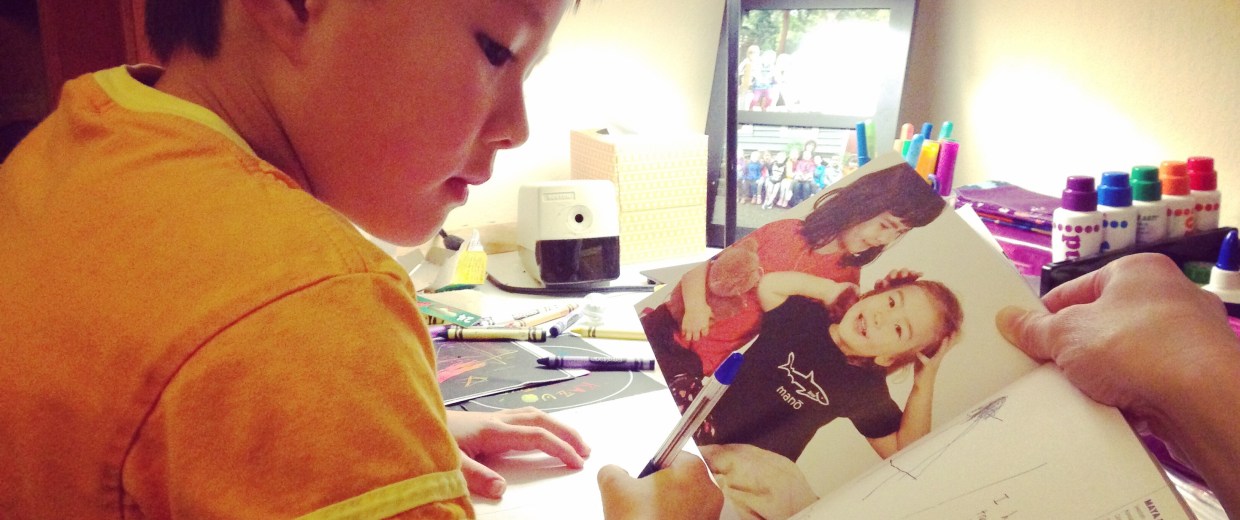
    Sharon H. Chang’s son with a copy of Kip Fulbeck’sMixed: Portraits of Multiracial Kids.” Photograph Courtesy of Sharon H. Chang

    Scholar and activist Sharon H. Chang’s new book, “Raising Mixed Race: Multiracial Asian Children in a Post-Racial World,” published in December by Routledge, is generating excitement among reviewers and readers. More than a research study and more than a parenting guide, the book was awarded #1 New Release on Amazon before it had even begun shipping, and it sold out the first weekend it was released.

    “‘Raising Mixed Race’ represents not only years of work on my end but a multitude of others’ lived racial realities; stories about and involving mixedness that are poignant, sharp, relevant and vital, and yet – remain mostly untold in America and around the world,” wrote Chang in her blog, Multiracial Asian Families, when announcing her book. “It is my sincere belief if we engage with ‘Raising Mixed Race,’ it can (will) challenge our thinking on mixedness to go deeper and contribute to moving society as a whole towards justice, healing and true transformation.”

    With interviews with 68 parents of 75 young multiracial Asian children about race, racism and identity, Chang delves into history, critical mixed race studies, changing demographics, personal experiences, and includes advice for parents, families, teachers, and friends of multiracial Asian children.

    NBC News spoke with Chang about her new book, her research on mixed race families, and why it’s important for parents and children to talk about identity.

    Please tell us a little about your family background and how you came to this project. Why did you decide to write this book?

    My father is a Taiwanese immigrant who came to America in the 1970’s, not long after the Immigration Act of 1965 lifted anti-Asian exclusionary restrictions which had been in place for decades. He met and married my white mother in that same decade which, of course, was also not long after the landmark civil rights Supreme Court case Loving v. Virginia which struck down laws prohibiting interracial marriage. My mother is white American of fairly recent Slovakian, German, and French Canadian descent — my Slovakian great grandmother escaped Eastern Europe when she was sixteen and migrated alone through Ellis Island. [The people in] her family were farmers and she became a factory worker in the U.S.

    Today I am married to a mixed race man whose mother is a Japanese immigrant, came in her 20s as well, and whose father is white of longtime white American descent, many generations back, it is thought, to colonization…

    Read the entire interview here.

  • Best of 2015: 12 authors on remarkable transformations

    Christian Science Monitor
    2015-12-28

    Randy Dotinga, President
    American Society of Journalists and Authors

    This year, I’ve interviewed many authors about moments of transformation for Q&A features in the Monitor. Here are some of my favorite answers.

    Transformation is an integral part of story-telling: How do we get from there to here, and what have we become? For some of us, these tales are monumental in scope.

    We may embrace a new gender, declare ourselves to be another race, or find long-elusive happiness in our final days. Or we might disrupt the world of fiction, turn crime-fighting into crime-supporting or replace old obsessions with new ones.

    This year, I’ve interviewed many authors about moments of transformation for Q&A features in the Monitor. Among other things, we’ve talked about the paths from teen to terrorist, from nobody to military hero, from laughingstock to landmark.

    Here are excerpts from a dozen of our conversations.

    4. Allyson Hobbs comments on the black response to “passing

    “Most blacks were pretty sympathetic, although there were definitely some who were not. Particularly during the years of Jim Crow, people recognized how difficult life was for blacks and recognized this was a way of getting ahead.

    There was some humor or levity to it, a kind of practical joke at the expense of whites. It was very delicious for some blacks.

    But there were some blacks who definitely disagreed with the practice of passing. They felt it was important for blacks to stay within the race and fight for the race.”

    – Allyson Hobbs, author of “A Chosen Exile: A History of Racial Passing in American Life,” on how blacks responded to those who “passed” as white. (Click here for full interview.)…

    Read the entire article here.

  • Before Rachel Dolezal, what did it mean to ‘pass’?

    Christian Science Monitor
    2015-06-22

    Randy Dotinga, President
    American Society of Journalists and Authors

    Allyson Hobbs, author of ‘A Chosen Exile,’ says the debate stirred up by Rachel Dolezal’s resignation from the NAACP hits historic chords.

    Allyson Hobbs, a history professor at Stanford University, remembers hearing a story from her aunt about a distant cousin who grew up on the South Side of Chicago during the 1920s and 1930s.

    The cousin was African-American, like Hobbs. But she was light-skinned, “and when she was in high school, her mother wanted her to go to Los Angeles and pass as a white woman,” Hobbs recalls. “Her mother thought this would be the best thing she could do.”

    The cousin didn’t want to go but followed her mother’s wishes. She married a white man and had children. About a decade later, Hobbs says, the cousin’s mother contacted her: “You have to come home immediately, your father is dying.”

    But it was not to be. “I can’t come home. I’m a white woman now,” the cousin replied. “There’s no turning back. This is the life that you made for me, and the life I have to live now.”

    This remarkable tale inspired Hobbs to investigate the long history of blacks passing as whites in her well-received 2014 book A Chosen Exile: A History of Racial Passing in American Life.

    The topic of racial passing has filled the airwaves this month amid the controversy over a once-obscure local civil-rights official named Rachel Dolezal. Hobbs adds to the debate this week with New York Times commentary that offers an unexpectedly sympathetic take amid vitriol aimed at Dolezal…

    Read the entire interview here.

  • Obama’s skin looks a little different in these GOP campaign ads

    The Washington Post
    2015-12-29

    Max Ehrenfreund

    A new study shows that negative ads targeting President Obama in 2008 depicted him with very dark skin, and that these images would have appealed to some viewers’ racial biases.

    The finding reinforces charges that some Republican politicians seek to win votes by implying support for racist views and ethnic hierarchies, without voicing those prejudices explicitly. The purported tactic is often called “dog-whistle politics” — just as only canines can hear a dog whistle, only prejudiced voters are aware of the racist connotations of a politician’s statement, according to the theory…

    Read the entire article here.

  • One Drop of Love 2015

    Fanshen Cox DiGiovanni
    2015-12-30

    Love & Gratitude to all who contributed to making 2015 an amazing year for One Drop of Love!

    One Drop of Love is a multimedia one-woman show exploring the intersections of race, class, gender, justice and LOVE.

    For more information, click here.