• How Green Was My Surname; Via Ireland, a Chapter in the Story of Black America

    The New York Times
    2003-03-17

    S. Lee Jamison

    Happy St. Patrick’s Day, Shaquille O’Neal!

    So many African-Americans have Irish-sounding last names—Eddie Murphy, Isaac Hayes, Mariah Carey, Dizzy Gillespie, Toni Morrison, H. Carl McCall—that you would think that the long story of blacks and Irish coming together would be well documented. You would be wrong.

    Randall Kennedy, a professor at Harvard Law School and the author of ”Interracial Intimacies; Sex, Marriage, Identity and Adoption,” said that when it comes to written historical exploration of black-Irish sexual encounters, ”there are little mentions, but not much.”

    And most African-Americans do not know a lot about their family names.

    “Quite frankly, I always thought my name was Scotch, not Irish.” said Mr. McCall, the former New York State comptroller.

    But the Irish names almost certainly do not come from Southern slaveholders with names like Scarlett O’Hara. Most Irish were too poor to own land. And some blacks, even before the Civil War, were not slaves.

    …Elizabeth Shown Mills, who recently retired as the editor of the National Genealogical Society Quarterly, said that unlike native-born whites, “Irish were more willing to accept and acknowledge interracial allegiances.”

    Before the Civil War, she said, “the free mulatto population had the same number of black moms as white moms.”

    Ms. Mills said that mixed-race children would have been given Irish surnames when their Irish fathers married their black mothers, or when their unmarried Irish mothers named children after themselves.

    The Irish ended up in the Caribbean, too. Britain sent hundreds of Irish people to penal colonies in the West Indies in the mid-1600’s, and more went over as indentured servants.

    Mr. [Charles L.] Blockson noted that “Lord Oliver Cromwell’s boatloads of men and women” sent to Barbados and Jamaica intermingled with the African slaves already there.

    Montserrat ended up with the largest Irish community in the West Indies…

    Read the entire article here.
  • Why It Was Easy for Rachel Dolezal to Pass as Black

    Pacific Standard
    2015-06-15

    Lisa Wade, Associate Professor of Sociology
    Occidental College, Los Angeles, California

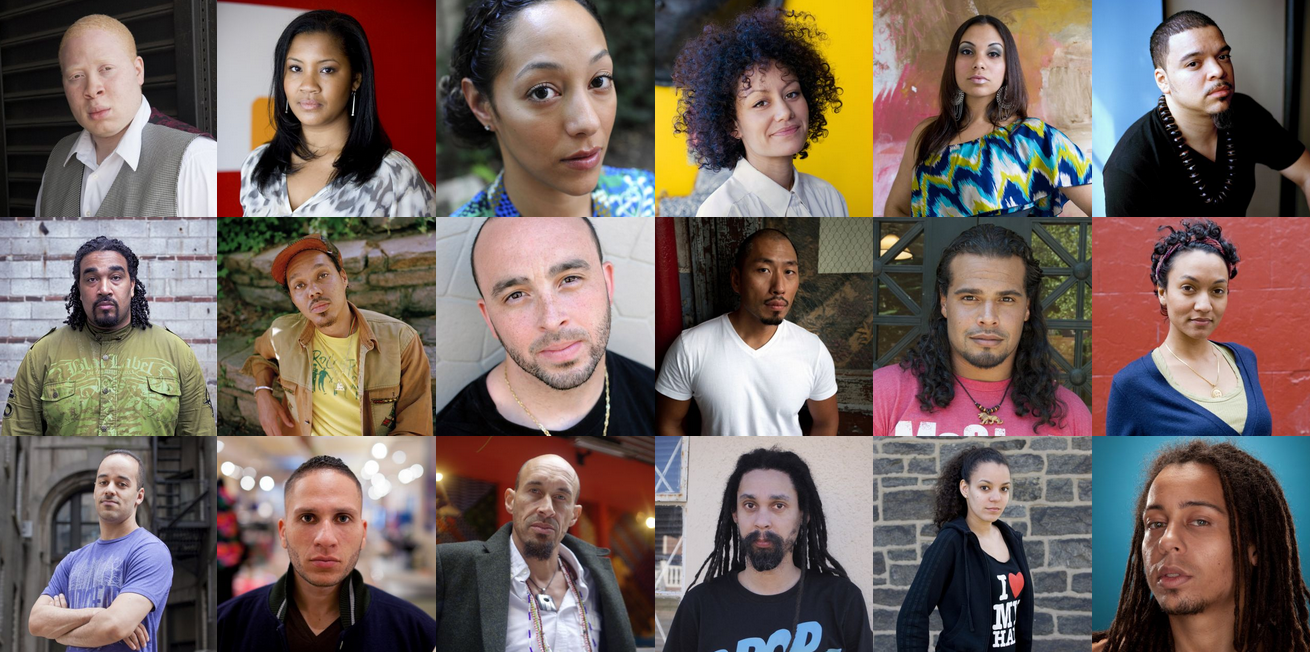
    Race is more social than biological.


    Source: (1)ne Drop Project

    Earlier this year a CBS commentator in a panel with Jay Smooth embarrassingly revealed that she thought he was white (Smooth’s father is black) and last week the Internet learned that Rachel Dolezal was white all along (both parents identify as white). The CBS commentator’s mistake and Dolezal’s ability to pass both speak to the strange way we’ve socially constructed blackness in this country.

    The truth is that African Americans are essentially all mixed race. From the beginning, enslaved and other Africans had close relationships with poor and indentured servant whites, that’s one reason why so many black people have Irish last names. During slavery, sexual relationships between enslavers and the enslaved, occurring on a range of coercive levels, were routine. Children born to enslaved women from these encounters were identified as “black.” The one-drop rule—you are black if you have one drop of black blood—was an economic tool used to protect the institution of racialized slavery (by preserving the distinction between two increasingly indistinct racial groups) and enrich the individual enslaver (by producing another human being he could own). Those enslaved children grew up and had children with other enslaved people as well as other whites…

    Read the entire article here.

  • A More Perfect Union: Black Freedoms, White Houses

    Public Culture
    Volume 28, Number 1, January 2016
    pages 63-87
    DOI: 10.1215/08992363-3325016

    Jasmine Nichole Cobb, Assistant Professor in the Department of Communication
    Northwestern University, Evanston, Illinois

    President Barack Obama signifies both the power of the institutional presidency and the legacy of black freedom struggles. His post in the White House provides an opportunity to think through the process by which these themes became intertwined and the manner in which the US presidency became a site for resolving the black freedom struggle. This essay traces the routes through which the US state, in the form of the presidency, appropriated black images to suppress autonomous black freedom struggles and promote less threatening racial narratives. It critiques the production and reproduction of black freedom imagery for state utility. The materials investigated reveal the value of black visibility to state interests at key moments in US race relations—namely, during slavery, enfranchisement, and national elections.

    Read or purchase the article here.

  • Taken Identity

    The UC Santa Barbara Current
    Santa Barbara, California
    2015-12-21

    Jim Logan

    A new book by a UC Santa Barbara historian traces the bright and fuzzy lines of race in America

    The United States’ long record on race is, shall we say, checkered. Even in a time when an African-American sits in the White House and mixed-race families are common, issues of race and identity still roil the national conversation. How do we make sense of this seeming contradiction?

    Paul Spickard, a UC Santa Barbara historian and one of the country’s foremost scholars of race, has some ideas on the matter. In his new book, “Race in Mind: Critical Essays” (University of Notre Dame Press, 2015), Spickard tackles a range of issues, including racial categories, identity, multiethnicity, Whiteness studies and more. In 14 essays that span more than 20 years of scholarship, he dissects the history of race as a social construct and assesses the present and future of race in America with insight and wit…

    …Spickard doesn’t just study race, he’s lived with and observed its peculiarities his whole life. Growing up in inner-city Seattle, his high school was roughly 60 percent black and 30 percent Asian. He calls it “the accident of where I grew up. Except for family members and two friends in high school, I had never had a five-minute conversation with a white person in my life until I went away to college. Racial questions are kind of the questions of my life.” His two adult children are half Chinese American. Both identify as mixed, but one lives in an entirely Chinese American social world and the other a mostly white one…

    Read the entire article here.

  • Allyson Hobbs. A Chosen Exile: A History of Racial Passing in American Life. [Smith-Pryor Review]

    The American Historical Review
    Volume 120, Issue 5, December 2015
    pages 1903-1904
    DOI: 10.1093/ahr/120.5.1903

    Elizabeth M. Smith-Pryor, Associate Professor of History
    Kent State University, Kent, Ohio

    Allyson Hobbs. A Chosen Exile: A History of Racial Passing in American Life. Cambridge, Mass.: Harvard University Press, 2014. Pp. 382. $29.95.

    In A Chosen Exile: A History of Racial Passing in American Life, Allyson Hobbs provides a well-written and sweeping overview of the phenomenon of passing from the colonial era through the present. With five chapters, a prologue, and an epilogue Hobbs charts a “longue duree” (27) of passing as white, while tracing its connections to changing meanings of race and racial identity in America. Drawn to the topic through her own family stories of long lost relatives, Hobbs contends too many historians and literary scholars only view passing as an act that leads to the benefits of whiteness. Instead, Hobbs suggests we cannot fully understand passing without “reckoning with loss, alienation, and isolation that accompanied, and often outweighed, its rewards” (6). For, Hobbs argues, “the core issue of passing” is not becoming white but losing a black identity (18). Consequently, she suggests the study of passing allows us to see how people live and experience “race.”

    Hobbs’s study relies on the…

    Read or purchase the review here.

  • Crossing Gender, Fantasizing Bodies

    Transgender Studies Quarterly
    Volume 2, Number 4, November 2015
    pages 717-719
    DOI: 10.1215/23289252-3151664

    Michael Davidson, Professor Emeritus of American Literature; Distinguished Professor
    University of California, San Diego

    Fantasies of Identification: Disability, Gender, Race. Ellen Samuels. New York: New York University Press, 2014. 263 pp.

    Ellen Samuels’ Fantasies of Identification is about attempts since the mid-nineteenth century to establish legal identity on some scientific, empirical basis as part of a national, biopolitical imperative. In this regard, the book contributes to the intersection of US literary history, disability, gender, queer, and critical race studies. Samuels chronicles a range of methods that were developed to regularize identity and naturalize the belief that identity could be read on the body. Examples include finger printing, the infamous one-drop rule for persons of African descent, current DNA testing for disabilities, blood quantum rules to establish Native American tribal identity, and myriad techniques of sex testing to verify legal gender within binary frameworks. Samuels observes that every attempt to ground identity in blood, genes, or appearance founders on the unstable nature of the very categories it hopes to stabilize: race, sex, gender, and ability. This instability is often produced by the imbricated relationship among such categories, and Samuels argues that disability is an always-present modality by and against which race, class, sex, and gender are read. Certifiable identity categories are, as her title indicates, “fantasies” produced by institutions wanting to secure populations in strict categories for the purposes of juridical, economic, and cultural control. But since these protocols are fantastic—a “thing we not only imagine but desire to be true” (6)—they are also subject to deformation, appropriation, and carnivalization by the…

    Read or purchase the review here.

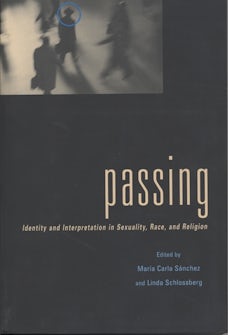
  • Passing: Identity and Interpretation in Sexuality, Race, and Religion

    New York University Press
    August 2001
    283 pages
    5 illustrations
    Cloth ISBN: 9780814781227
    Paper ISBN: 9780814781234

    Edited by:

    María C. Sánchez, Associate Professor of English
    University of North Carolina, Greensboro

    Linda Schlossberg, Lecturer on Studies of Women, Gender, and Sexuality
    Harvard University

    Passing

    Passing for what you are not—whether it is mulattos passing as white, Jews passing as Christian, or drag queens passing as women–can be a method of protection or self-defense. But it can also be a uniquely pleasurable experience, one that trades on the erotics of secrecy and revelation. It is precisely passing’s radical playfulness, the way it asks us to reconsider our assumptions and forces our most cherished fantasies of identity to self-destruct, that is centrally addressed in Passing: Identity and Interpretation in Sexuality, Race, and Religion.

    Identity in Western culture is largely structured around visibility, whether in the service of science (Victorian physiognomy), psychoanalysis (Lacan’s mirror stage), or philosophy (the Panopticon). As such, it is charged with anxieties regarding classification and social demarcation. Passing wreaks havoc with accepted systems of social recognition and cultural intelligibility, blurring the carefully-marked lines of race, gender, and class.

    Bringing together theories of passing across a host of disciplines—from critical race theory and lesbian and gay studies, to literary theory and religious studies—Passing complicates our current understanding of the visual and categories of identity.

    Contributors: Michael Bronski, Karen McCarthy Brown, Bradley Epps, Judith Halberstam, Peter Hitchcock, Daniel Itzkovitz, Patrick O’Malley, Miriam Peskowitz, María C. Sánchez, Linda Schlossberg, and Sharon Ullman.

  • Fantasies of Identification: Disability, Gender, Race

    New York University Press
    April 2014
    273 pages
    12 halftones
    Cloth ISBN: 9781479812981
    Paper ISBN: 9781479859498

    Ellen Samuels, Associate Professor of Gender and Women’s Studies and English
    University of Wisconsin, Madison

    In the mid-nineteenth-century United States, as it became increasingly difficult to distinguish between bodies understood as black, white, or Indian; able-bodied or disabled; and male or female, intense efforts emerged to define these identities as biologically distinct and scientifically verifiable in a literally marked body. Combining literary analysis, legal history, and visual culture, Ellen Samuels traces the evolution of the “fantasy of identification”—the powerful belief that embodied social identities are fixed, verifiable, and visible through modern science. From birthmarks and fingerprints to blood quantum and DNA, she examines how this fantasy has circulated between cultural representations, law, science, and policy to become one of the most powerfully institutionalized ideologies of modern society.

    Yet, as Samuels demonstrates, in every case, the fantasy distorts its claimed scientific basis, substituting subjective language for claimed objective fact. From its early emergence in discourses about disability fakery and fugitive slaves in the nineteenth century to its most recent manifestation in the question of sex testing at the 2012 Olympic Games, Fantasies of Identification explores the roots of modern understandings of bodily identity.

    Table of Contents

    • Acknowledgments
    • Introduction: The Crisis of Identification
    • Part I Fantasies of Fakery
      • 1. Ellen Craft’s Masquerade
      • 2. Confidence in the Nineteenth Century
      • 3. The Disability Con Onscreen
    • Part II Fantasies of Marking
    • Part III Fantasies of Measurement
      • 6. Proving Disability
      • 7. Revising Blood Quantum
      • 8. Realms of Biocertification
      • 9. DNA and the Readable Self
    • Conclusion: Future Identifications
    • Notes
    • Bibliography
    • Index
  • ‘True Detective’ Helmer Cary Fukunaga Teams With John Legend For Pulitzer Winner ‘The Black Count’

    Deadline Hollywood
    2014-04-28

    Dominic Patten

    EXCLUSIVE: On fire since the success of HBO‘s True Detective this year, director Cary Fukunaga has lined up his next project I’ve learned. Teaming with John Legend and his Get Lifted Film Co. partner Mike Jackson, Fukunaga will adapt and helm a big-screen version of The Black Count: Glory, Revolution, Betrayal, And The Real Count of Monte Cristo for Sony. Get Lifted have optioned the Pulitzer-winning 2012 biography written by Tom Reiss that chronicles the life and adventures of French Revolution-era General Thomas-Alexandre Dumas…

    Read the entire article here.

  • The Tax Sleuth Who Took Down a Drug Lord

    The New York Times
    2015-12-25

    Nathaniel Popper, Wall Street Reporter


    Gary Alford, a special agent with the I.R.S., pored over old blog posts and chat room logs that led, eventually, to Dread Pirate Roberts. Cole Wilson for The New York Times

    Gary L. Alford was running on adrenaline when he arrived for work on a Monday in June 2013, at the Drug Enforcement Administration office in the Chelsea neighborhood of Manhattan. A tax investigator, he had spent much of the weekend in the living room of his New Jersey townhouse, scrolling through arcane chat rooms and old blog posts, reading on well after his fiancée had gone to sleep.

    The work had given Mr. Alford what he believed was the answer to a mystery that had confounded investigators for nearly two years: the identity of the mastermind behind the online drug bazaar known as Silk Road — a criminal known only by his screen name, Dread Pirate Roberts.

    When Mr. Alford showed up for work that Monday, he had a real name and a location. He assumed the news would be greeted with excitement. Instead, he says, he got the brushoff.

    He recalls asking the prosecutor on the case, out of frustration, “What about what I said is not compelling?”

    Mr. Alford, a young special agent with the Internal Revenue Service assigned to work with the D.E.A., isn’t the first person to feel unappreciated at the office. In his case, though, the information he had was crucial to solving one of the most vexing criminal cases of the last few years. While Silk Road by mid-2013 had grown into a juggernaut, selling $300,000 in heroin and other illegal goods each day, federal agents hadn’t been able to figure out the most basic detail: the identity of the person running the site…

    …But Mr. Alford also detected the sort of organizational frictions that have hindered communication between law enforcement agencies in the past. Within the I.R.S., Mr. Alford had heard tales of his agency being ignored and overshadowed by more prominent organizations like the F.B.I. The story that resonated with Mr. Alford most strongly was that of the tax agent Frank J. Wilson, who brought down the gangster Al Capone, but who was forgotten in the movie versions of the investigation, which tended to focus on Eliot Ness, the flashier Bureau of Prohibition agent.

    “They don’t write movies about Frank Wilson building the tax case,” Mr. Alford said in an interview at the I.R.S.’s Manhattan headquarters. “That’s just how it is.”

    Mr. Alford grew up in the Marlboro public housing projects of Brooklyn in the 1980s, a short, half-black, half-Filipino kid in a tough neighborhood. His father, a math teacher, would cite the power of the subject to teach his son how to prevail over difficulties. “If you get the right answer, the teacher can’t tell you anything,” Mr. Alford remembers his father saying. That attitude led Mr. Alford to study accounting at Baruch College and then to the I.R.S., where his skeptical, lone-wolf approach worked well…

    Read the entire article here.