• Native lawyer takes on tribes that kick members out

    The Seattle Times
    2015-12-19

    Nina Shapiro, Seattle Times staff reporter

    Seattle lawyer Gabriel Galanda, a longtime defender of Native American rights, is fighting what he calls an ‘epidemic’ of tribal disenrollment.
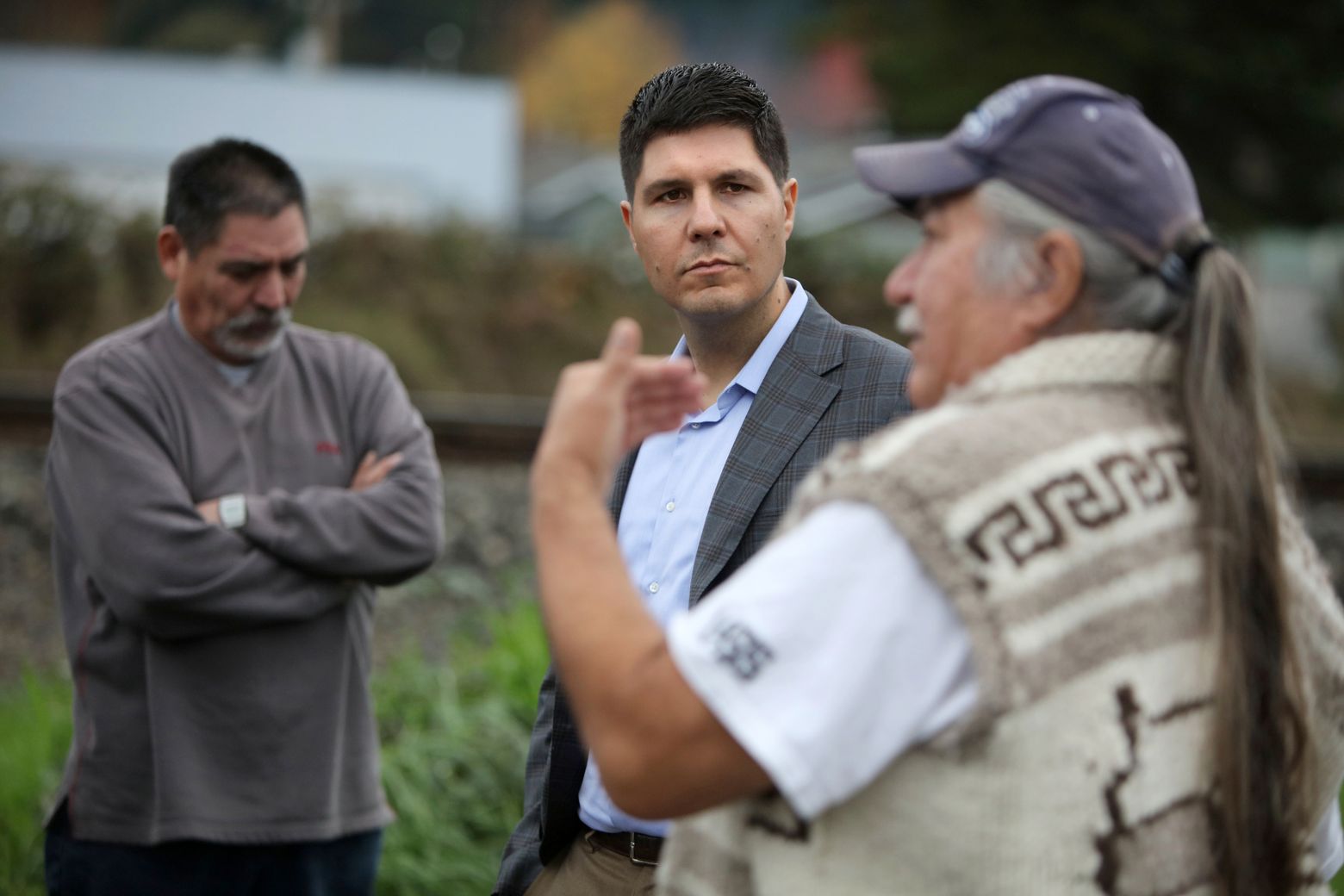

    Native American lawyer Gabriel Galanda, center, listens to Nooksack members talk about disenrollment. (Steve Ringman/The Seattle Times)

    DEMING, Whatcom County — In his big gray truck, Gabriel Galanda makes a notable entrance into a Nooksack tribal-housing development of a couple dozen modest homes, set on a winding road about a half-hour east of Bellingham. Many of the residents, members of a sprawling clan who move easily in and out of each other’s homes, appear with platters of fry bread, chicken adobo, baked halibut, salads, cupcakes and pies.

    It’s a feast befitting their biggest defender, one who has made their small tribe of a couple thousand members well-known throughout Indian country, and not in a good way. The Nooksack tribal government for the past three years has been trying to disenroll the clan in this housing development and its extended family — which would strip all 306 of tribal membership.

    And for the past three years, Galanda, a Seattle-based Native American lawyer, has been fighting it. The cause has taken the 39-year-old Galanda on a journey, personal and professional, that taps into the heart of what it means to be Native American…

    …Galanda’s own ancestors were Native American, Scandinavian, Portuguese and Austrian — a mixed heritage that caused him to question his identity during his formative years.

    But he says he kept remembering his grandma, born on California’s Round Valley Indian Tribes reservation, putting him on her knee and saying, in her smoky, gravelly voice, “You’re Nomlaki and Concow. Don’t ever forget it.”

    “Before I undertook this work,” Galanda says, “I was really caught up in blood quantum.” Now, he says, “I don’t really care.” He has settled instead on an expansive, evolving notion of “belonging” that takes into account lineage without precise blood calculations or federal documents…

    Read the entire article here.

  • “While it seems like blackness gets an unfair share of time, it’s what keeps this whole structure intact,” says [G. Reginald] Daniel. “Everything gets collapsed into the black/white paradigm, no matter what else is going on. Everybody that comes into this country from anywhere else inevitably has to deal with blackness to locate themselves in our social order. That’s a given.”

    Jeremy Gordon, “Multiracial in America: Who gets to be “white”?,” Hopes&Fears, December 15. 2015. http://www.hopesandfears.com/hopes/now/politics/217005-multiracial-in-america.

  • Making Blackness, Making Policy

    Harvard University
    2012
    178 pages

    Peter Geller

    Doctoral Dissertation

    Too often the acknowledgment that race is a social construction ignores exactly how this construction occurs. By illuminating the way in which the category of blackness and black individuals are made, we can better see how race matters in America. Antidiscrimination policy, social science research, and the state’s support of its citizens can all be improved by an accurate and concrete definition of blackness.

    Making Blackness, Making Policy argues that blackness and black people are literally made rather than discovered. The social construction of blackness involves the naming of individuals as black, and the subsequent interaction between this naming and racial projects. The process of naming involves an intersubjective dialogue in which racial self-identification and ascription by others lead to a consensus on an individual’s race. These third parties include an individual’s community, the media, and, crucially, the state. Following Ian Hacking, this process is most properly termed the dynamic nominalism of blackness.

    My dissertation uses analytic philosophy, qualitative and quantitative research, and historical analysis to defend this conception. The dynamic nominalist process is illustrated through the media’s contribution to the making of Barack Obama’s blackness, and the state’s creation and maintenance of racial categories through law, policy, and enumeration.

    I then argue that the state’s dominant role in creating blackness, and the vital role that a black identity plays in millions’ sense of self, requires the United States Government to support a politics of recognition. The state’s antidiscrimination efforts would also improve through the adoption of a dynamic nominalism of blackness. Replacing the Equal Employment Opportunities Commission’s inconsistent and contradictory definitions of race with the dynamic nominalism of blackness would clarify when and how racial discrimination occurs.

    Table of Contents

    • Introduction: Making Blackness Across Disciplines
    • Chapter One: The Dynamic Nominalism of Blackness
    • Chapter Two: Barack Obama and the Making of Black People
    • Chapter Three: The State and the Centrality of Black Identity
    • Chapter Four: Definitions of Race and Antidiscrimination Policy
    • Conclusion: Making Use of Making Blackness
    • Bibliography

    Read the entire dissertation here.

  • The rise of a multiracial identity dovetails with an utopian ideal of a pan-ethnic, post-racial America—one where everyone is a little something. But that post-racial space doesn’t yet exist, with one of the effects being that multiracial people are often pulled between identities. Whether someone identifies more with one race or the other is strongly attributable to their upbringing, their family history, their surroundings, and their physical appearance, making no two multiracial experiences totally alike. It has to do with their public perception, too: Take this one stat from the Pew Research Center, which says 60% of biracial white and black adults say they’re seen as black while only 23% of biracial white and Asian adults say they’re seen as Asian.

    Jeremy Gordon, “Multiracial in America: Who gets to be “white”?,” Hopes&Fears, December 15. 2015. http://www.hopesandfears.com/hopes/now/politics/217005-multiracial-in-america.

  • Multiracial in America: Who gets to be “white”?

    Hopes&Fears
    2015-12-15

    Jeremy Gordon


    The author with his parents, Mary and Dennis Gordon.

    Jeremy Gordon on growing up multiracial, assimilation and “whiteness” in post-Obama America.

    Every Christmas, when the dishes have been cleaned, when the presents are exchanged and the photos snapped, my cousins and I book it out of my aunt’s house in the suburbs for the comfort of the city, where we spend the rest of the night in each other’s company—playing video games, getting drunker, eating a second meal to close the holiday. Last year, we drove to a dim sum restaurant in Chicago’s Argyle neighborhood, which my Chinese family has patronized for my entire life.

    Times had changed, though. We assumed we’d be seated right away, but the restaurant was full. As far as I could remember, it was the first time we’d ever had to wait for a table—and this time, we noticed that most of the diners were white. As we waited for our names to be called, my cousin couldn’t help but gripe. “I can’t believe we’re stuck behind all these white people!” she said. “Can’t they go somewhere else?”

    My cousin is not a facetious woman, so the comment didn’t register as a joke. Nevertheless, her brother and I managed a laugh. It was true—the restaurant was filled with white people, whose grannies had never used Mandarin to order from the sullen teenagers pushing the dim sum carts around. But the complaint was a little awkward because of an incontrovertible fact: My cousins and I are half-white, each of us the offspring of a Chinese woman and a Jewish man…

    We look about half-and-half—not quite white, not quite yellow, definitely a little something. White people might see us as Chinese—or, failing their ability to pinpoint our race, an ever-ambiguous “person of color”—but there are plenty of Chinese who might insist we were white. Joking about “white people” when that might be us—it’s an easy laugh, but ultimately disingenuous. Wondering what to identify as—white, Chinese, or something else—is something I, my cousins, and many multiracial people have struggled with for our whole lives, to no definite conclusion…

    …Multiraciality is a young identity, one that didn’t formally come into existence until the 1980s. G. Reginald Daniel is a sociology professor who’s taught a class on multiracial identity at the University of California, Santa Barbara for nearly three decades, and even he can’t identify its first usage. He points to television shows like Oprah and Sally Jessy Raphael, where panels on multiracial experiences featuring multiracial people were hastily conceived. “The first time I heard the word multiracial used was on The Phil Donahue Show in 1988,” he tells me. “I was pretty shocked because I’d never heard that word before. Prior to that, nobody was talking about this, surely not in public.”..

    Read the entire article here.

  • This poem perfectly captures feelings from a campus protest

    Blavity
    2015-12-26

    Blavity Team

    What’s it like to be conscious of being love[d] and being hated at the same time? This poet [Ariana Brown] eloquently explains her experience at a campus protest.

  • 15 striking findings from 2015

    Pew Research Center
    2015-12-22

    George Gao, Associate Digital Producer

    Every year, we look back at our research to select the most memorable facts that illustrate important trends shaping our world. At Pew Research Center, the topics we analyze range from the specific subjects of video gaming and family caregivers to broader areas like political attitudes, global climate change and religious affiliation.

    It’s a hard task to select just 15, but here are some of our most striking findings of 2015:…

    4. There’s a substantial rise in the share of Americans who say the country needs to continue making changes to give blacks equal rights with whites. In July 2015, six-in-ten (59%) Americans said changes are needed, up from 46% in March 2014. These findings come in a year where racial tensions were high in much of the country, from protests over police shootings to student strikes at universities. Our poll also shows that a racial divide in public opinion persists: Blacks are much more likely than whites to say changes are needed.

    12. Multiracial Americans account for 6.9% of adults, and they are growing at a rate three times as fast as the population as a whole. For much of the nation’s history, America has discussed race in the singular form. But with the rise of interracial couples, combined with a more accepting society, the language of race is changing. More than half of multiracial Americans are proud of their background and feel more open to other cultures. But a majority (55%) also say they have been subjected to slurs or jokes because of their racial background.

    Read the entire article here.

  • Race in Mind: Critical Essays

    University of Notre Dame Press
    2015
    408 pages
    ISBN: 978-0-268-04148-9

    Paul Spickard, Professor of History
    University of California, Santa Barbara

    With contributions by Jeffrey Moniz and Ingrid Dineen-Wimberly

    Race in Mind presents fourteen critical essays on race and mixed race by one of America’s most prolific and influential ethnic studies scholars. Collected in one volume are all of Paul Spickard’s theoretical writings over the past two decades. Ten of the articles have been revised and updated from previous publications. Four appear here for the first time. Spickard’s work embraces three overarching themes: race as biology versus race as something constructed by social and political relationships; race as a phenomenon that exists not just in the United States, but in every part of the world, and even in the relationships between nations; and the question of racial multiplicity.

    These essays analyze how race affects people’s lives and relationships in all settings, from the United States to Great Britain and from Hawaiʻi to Chinese Central Asia. They contemplate the racial positions in various societies of people called Black and people called White, of Asians and Pacific Islanders, and especially of those people whose racial ancestries and identifications are multiple. Here for the first time are Spickard’s trenchant analyses of the creation of race in the South Pacific, of DNA testing for racial ancestry, and of the meaning of multiplicity in the age of Barack Obama.

  • When black is white and vice versa

    The New Tri-State Defender
    Memphis, Tennessee
    2015-12-23

    Brittney Gathen, Special to The New Tri-State Defender


    Dr. Allyson Hobbs signed copies of her book, “A Chosen Exile: AHistory of Racial Passing in American Life,” during an event called “Book Talk” at the National Civil Rights Museum. (Photo: Merritt Gathen)

    Stanford professor and author shines light on racial ‘passing’ at NCRM event.

    Passing” – living as a part of one race despite being born into another – is often full of complexity and consequences, so much so that author and Stanford history professor Dr. Allyson Hobbs calls it a type of “exile.”

    Hobbs, author of “A Chosen Exile: AHistory of Racial Passing in American Life,”examined the topic of racial passing during “Book Talk” at the National Civil Rights Museum last week (Dec. 17). During the event, Hobbs discussed topics such as the negative side of passing and her perception of former Spokane, Washington NAACP president Rachel Dolezal, who, despite being born white, lived as (and still identifies as) a black woman…

    Read the entire article here.

  • White Latinos need to own up to their Whiteness because we just can’t continue to afford this to continue any further. We also need African-Americans to understand that Latin America has over 200 million Afro-descendants and that going to Africa also entails going to Colombia, Brazil, Cuba and Puerto Rico, among other countries. Blackness does not have to solely mean African-American and Whiteness does not have to solely mean Anglo-white.

    Wiliam Garcia, “White Latino Racism on the Rise: It’s Time for a Serious Conversation on Euro-Diasporic Whiteness,” Latino Rebels, December 21, 2015. http://www.latinorebels.com/2015/12/21/white-latino-racism-on-the-rise-its-time-for-a-serious-conversation-on-euro-diasporic-whiteness/.