• Machado de Assis: A Literary Life

    Yale University Press
    2015-05-26
    360 pages
    6 1/8 x 9 1/4
    2 b/w illus.
    ISBN: 9780300180824

    K. David Jackson, Professor of Portuguese and Director of Undergraduate Studies of Portuguese
    Yale University

    Novelist, poet, playwright, and short story writer Joaquim Maria Machado de Assis (1839–1908) is widely regarded as Brazil’s greatest writer, although his work is still too little read outside his native country. In this first comprehensive English-language examination of Machado since Helen Caldwell’s seminal 1970 study, K. David Jackson reveals Machado de Assis as an important world author, one of the inventors of literary modernism whose writings profoundly influenced some of the most celebrated authors of the twentieth century, including José Saramago, Carlos Fuentes, and Donald Barthelme. Jackson introduces a hitherto unknown Machado de Assis to readers, illuminating the remarkable life, work, and legacy of the genius whom Susan Sontag called “the greatest writer ever produced in Latin America” and whom Allen Ginsberg hailed as “another Kafka.” Philip Roth has said of him that “like Beckett, he is ironic about suffering.” And Harold Bloom has remarked of Machado that “he’s funny as hell.”

  • J.R. Reynolds: Say it loud: He’s black and I’m proud

    Battle Creek Enquirer
    Battle Creek, Michigan
    2015-12-07

    J.R. Reynolds, Community Columnist


    J.R. Reynolds

    Until my 2-year-old son is old enough to self-identify racially, I’ve declared him black. I’m raising him African American. Socially and legally. This, despite him being half white. Why? It’s in his best interest. But it’s not without serious, sometimes deadly challenges.

    Being black in America has a bad rap. This, according to media, history books, government policy and even statistics. We’re the collective punching bag of mainstream society.

    It’s open season on black youth. It’s OK to shoot first and ask questions later. We’re guilty until proven innocent. We’re viewed as a physical threat if we raise our voices in anger. Or throw up our hands to surrender. There’s more…

    …So why would a black father like me enthusiastically claim “African American” for his toddler —a moniker that’s historically stigmatized by so many? After all, my son’s mom is white so alternatives exist. Among them: “biracial,” “multiracial” and “other.”…

    Read the entire article here.

  • Metis and the Medicine Line: Creating a Border and Dividing a People

    University of North Carolina Press
    April 2015
    Approx. 352 pages
    6.125 x 9.25
    17 halftones, 3 maps, notes, bibl., index
    Paper: ISBN 978-1-4696-2105-0

    Michel Hogue, Assistant Professor of History
    Carleton University, Ottawa, Ontario, Canadas

    Born of encounters between Indigenous women and Euro-American men in the first decades of the nineteenth century, the Plains Metis people occupied contentious geographic and cultural spaces. Living in a disputed area of the northern Plains inhabited by various Indigenous nations and claimed by both the United States and Great Britain, the Metis emerged as a people with distinctive styles of speech, dress, and religious practice, and occupational identities forged in the intense rivalries of the fur and provisions trade. Michel Hogue explores how, as fur trade societies waned and as state officials looked to establish clear lines separating the United States from Canada and Indians from non-Indians, these communities of mixed Indigenous and European ancestry were profoundly affected by the efforts of nation-states to divide and absorb the North American West.

    Grounded in extensive research in U.S. and Canadian archives, Hogue’s account recenters historical discussions that have typically been confined within national boundaries and illuminates how Plains Indigenous peoples like the Metis were at the center of both the unexpected accommodations and the hidden history of violence that made the “world’s longest undefended border.”

  • Tropics of Haiti: Race and the Literary History of the Haitian Revolution in the Atlantic World, 1789-1865

    Liverpool University Press
    May 2015
    848 pages
    234 x 156mm
    Hardback ISBN: 9781781381847
    Paperback ISBN: 9781781381854

    Marlene L. Daut, Assistant Professor of English and Cultural Studies
    Claremont Graduate University, Claremont, California

    The Haitian Revolution (1791-1804) was an event of monumental world-historical significance, and here, in the first systematic literary history of those events, Haiti’s war of independence is examined through the eyes of its actual and imagined participants, observers, survivors, and cultural descendants. The ‘transatlantic print culture of the Haitian Revolution’ that this literary history shows was created by novelists, poets, dramatists, memoirists, biographers, historians, journalists, and eye-witness observers, revealing enlightenment racial ‘science’ as the primary vehicle through which the Haitian Revolution was interpreted, historicized, memorialized, and fictionalized by nineteenth-century Haitians, Europeans, and U.S. Americans alike.

    Through its author’s contention that the Haitian revolutionary wars were incessantly racialized by four constantly recurring racial tropes—the ‘monstrous hybrid’, the ‘tropical temptress’, the ‘tragic mulatto/a’, and the ‘mulatto legend of history’, Tropics of Haiti shows the ways in which the nineteenth-century tendency to understand Haiti’s revolution in primarily racial terms has affected present day demonizations of Haiti and Haitians. In the end, this new archive of Haitian revolutionary writing, much of which has until now remained unknown to the contemporary reading public, invites us to examine how nineteenth-century attempts to paint Haitian independence as the result of a racial revolution coincides with present-day desires to render insignificant and ‘unthinkable’ the second independent republic of the New World.

    CONTENTS

    • PRELUDE: On “Haitian Exceptionalism”
    • INTRODUCTION: From Enlightenment Literacy to Mulatto/a Vengeance
    • PART ONE: THE MONSTROUS HYBRIDITY OF MULATTO/A VENGEANCE
      • 1. Baron de Vastey, Colonial Discourse, and the Global “Scientific” Sphere
      • 2. Monstrous Testimony and Baron de Vastey in 19th-Century Historical Writing About Haiti
      • 3. Victor Hugo and the Rhetorical Possibilities of Monstrous Hybridity in Revolutionary Fiction
    • PART TWO: TRANSGRESSING THE TROPE OF THE TROPICAL TEMPTRESS
      • 4. Moreau de Saint-Méry’s Daughter and La Mulâtre comme il y a beaucoup de blanches (1803)
      • 5. “Born to Command:” Leonora Sansay and the Paradoxes of Female Resistance in Zelica; the Creole
      • 6. Theresa to the Rescue!: African American Women’s Resistance and the Literary History of the Haitian Revolution
    • PART THREE: THE TROPE OF THE TRAGIC MULATTO/A AND THE HAITIAN REVOLUTION
      • 7. “Sons of White Fathers”: The Tragic Mulatto/a and the Haitian Revolution in Victor Séjour’s “Le Mulâtre”
      • 8. Between the Family and the Nation: Toussaint L’Ouverture and The Interracial Family Romance of the Haitian Revolution
      • 9. Romance and the Republic: Eméric Bergeaud’s Ideal History of the Haitian Revolution
    • PART FOUR: REQUIEM FOR THE “MULATTO LEGEND OF HISTORY”
      • 10. The Color of History: The Transatlantic Abolitionist Movement and William Wells Brown’s “Never-to-be-forgiven-course-of the-mulattoes”
      • 11. Victor Schoelcher, “L’Imagination Jaune,” and the Francophone Geneaology of the “Mulatto Legend of History”
      • 12. “Let us Be Humane after the Victory: Pierre Faubert’s New Humanism
    • CODA : Today’s Haitian Exceptionalism
    • Works Cited
    • Index
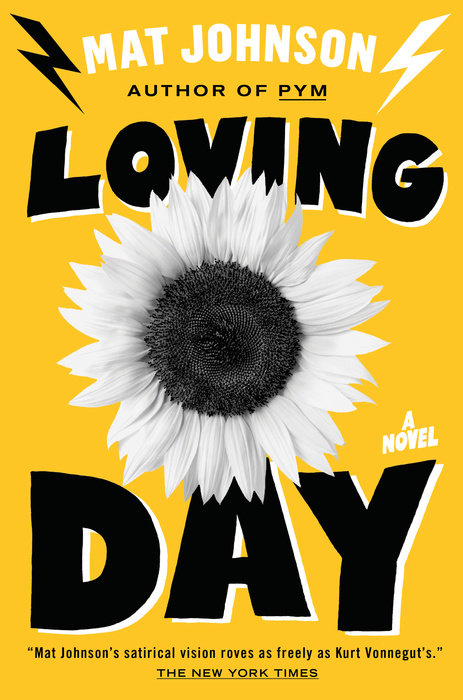
  • Loving Day: A Novel

    Spiegel & Grau
    2015-05-26
    304 Pages
    6-1/8 x 9-1/4
    Hardcover ISBN: 9780812993455
    Ebook ISBN: 9780679645528

    Mat Johnson

    “In the ghetto there is a mansion, and it is my father’s house.”

    Warren Duffy has returned to America for all the worst reasons: His marriage to a beautiful Welsh woman has come apart; his comics shop in Cardiff has failed; and his Irish American father has died, bequeathing to Warren his last possession, a roofless, half-renovated mansion in the heart of black Philadelphia. On his first night in his new home, Warren spies two figures outside in the grass. When he screws up the nerve to confront them, they disappear. The next day he encounters ghosts of a different kind: In the face of a teenage girl he meets at a comics convention he sees the mingled features of his white father and his black mother, both now dead. The girl, Tal, is his daughter, and she’s been raised to think she’s white.

    Spinning from these revelations, Warren sets off to remake his life with a reluctant daughter he’s never known, in a haunted house with a history he knows too well. In their search for a new life, he and Tal struggle with ghosts, fall in with a utopian mixed-race cult, and ignite a riot on Loving Day, the unsung holiday for interracial lovers.

    A frequently hilarious, surprisingly moving story about blacks and whites, fathers and daughters, the living and the dead, Loving Day celebrates the wonders of opposites bound in love.

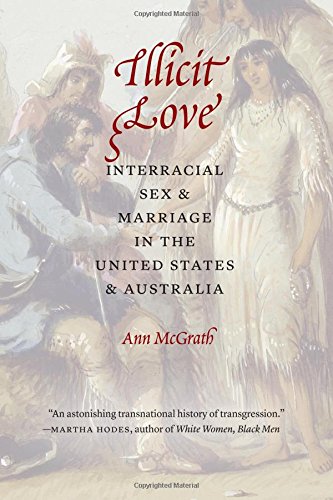
  • Illicit Love: Interracial Sex and Marriage in the United States and Australia

    University of Nebraska Press
    2015-12-01
    616 pages
    Hardcover ISBN: 978-0-8032-3825-1
    Paperback ISBN: 978-1-4962-0384-7

    Ann McGrath, Professor of History, Director of the Australian Centre for Indigenous History
    Australian National University, Canberra, Australian Capital Territory

    Illicit Love is a history of love, sex, and marriage between Indigenous peoples and settler citizens at the heart of two settler colonial nations, the United States and Australia. Award-winning historian Ann McGrath illuminates interracial relationships from the late eighteenth to the early twentieth century through stories of romance, courtship, and marriage between Indigenous peoples and colonizers in times of nation formation.

    The romantic relationships of well-known and ordinary interracial couples provide the backdrop against which McGrath discloses the “marital middle ground” that emerged as a primary threat to European colonial and racial supremacy in the Atlantic and Pacific Worlds from the Age of Revolution to the Progressive Era. These relationships include the controversial courtship between white, Connecticut-born Harriett Gold and southern Cherokee Elias Boudinot; the Australian missionary Ernest Gribble and his efforts to socially segregate the settler and aboriginal population, only to be overcome by his romantic impulses for an aboriginal woman, Jeannie; the irony of Cherokee leader John Ross’s marriage to a white woman, Mary Brian Stapler, despite his opposition to interracial marriages in the Cherokee Nation; and the efforts among ordinary people in the imperial borderlands of both the United States and Australia to circumvent laws barring interracial love, sex, and marriage.

    Illicit Love reveals how marriage itself was used by disparate parties for both empowerment and disempowerment and came to embody the contradictions of imperialism. A tour de force of settler colonial history, McGrath’s study demonstrates vividly how interracial relationships between Indigenous and colonizing peoples were more frequent and threatening to nation-states in the Atlantic and Pacific worlds than historians have previously acknowledged.

  • She Is Cuba: A Genealogy of the Mulata Body

    Oxford University Press
    2015-12-01
    240 Pages
    53 images
    6-1/8 x 9-1/4 inches
    Hardcover ISBN: 9780199968169
    Paperback ISBN: 9780199968176

    Melissa Blanco Borelli, Senior Lecturer in Dance
    Royal Holloway University of London

    • Weaves together historical method, auto-ethnographic, and performative writing
    • Sits at the precipice of scholarly and public interest in Cuban cultural history

    She is Cuba: A Genealogy of the Mulata Body traces the history of the Cuban mulata and her association with hips, sensuality and popular dance. It examines how the mulata choreographs her racialised identity through her hips and enacts an embodied theory called hip(g)nosis. By focusing on her living and dancing body in order to flesh out the process of identity formation, this book makes a claim for how subaltern bodies negotiate a cultural identity that continues to mark their bodies on a daily basis. Combining literary and personal narratives with historical and theoretical accounts of Cuban popular dance history, religiosity and culture, this work investigates the power of embodied exchanges: bodies watching, looking, touching and dancing with one another. It sets up a genealogy of how the representations and venerations of the dancing mulata continue to circulate and participate in the volatile political and social economy of contemporary Cuba.

    Table of Contents

    • Prologue, Entre Familia/Between Family
    • Introduction
    • Chapter 1: Historicizing Hip(g)nosis
    • Interlude 1: Echando Cuentos/Telling Stories
    • Chapter 2: Hip(g)nosis at Work: Rumors, Social Dance and Cuba’s Academias de Baile
    • Interlude 2: A Marriage Proposal
    • Chapter 3: Hip(g)nosis as Pleasure: The Mulata in Film
    • Interlude 3: Lost Baggage
    • Chapter 4: Hip(g)nosis as Brand: Despelote, Tourism and Mulata Citizenship
    • Conclusion or Rear Endings
    • Index
  • They Called Me ‘Coffee with Milk’ as a Kid

    Zócalo Public Square
    2015-11-19


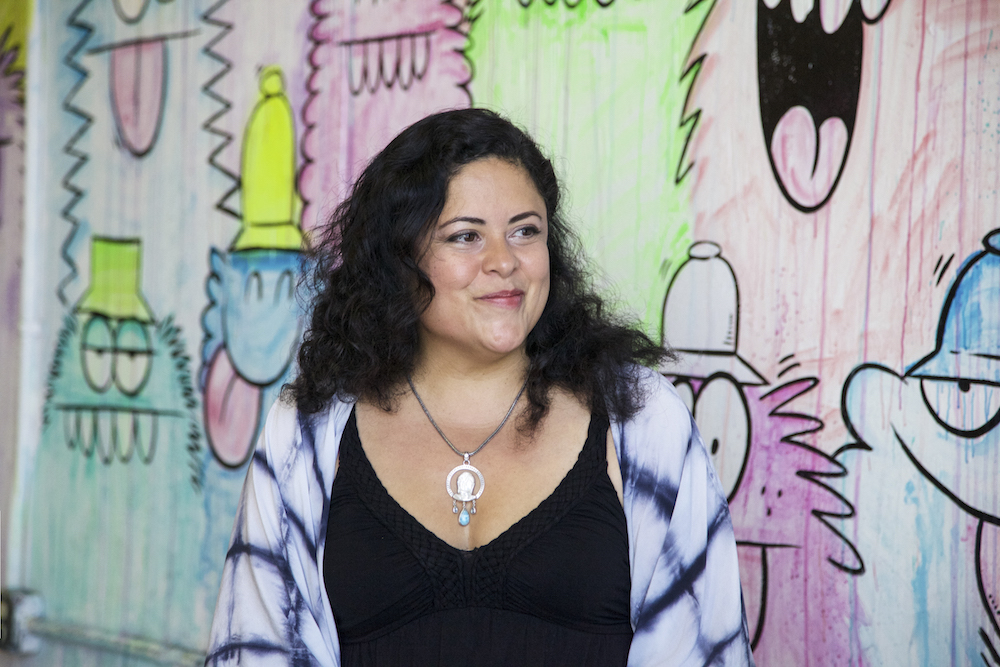
    Maya Soetoro-Ng (Photo by Kenna Reed)

    Peace Educator Maya Soetoro-Ng Wants America to Make Room for Complexity

    Maya Soetoro-Ng is the director of community outreach and global learning for the Matsunaga Institute for Peace and Conflict Resolution at the University of Hawaii at Manoa. For many years, she taught high school classes in social studies and English and undergraduate and graduate courses in multicultural education, social studies methods, and peace education. She is also the half-sister of President Barack Obama. Before participating in a discussion on what Hawaii can teach America about race, she talked about sharing the Nuyorican poets with her students, her pet peeve, and the hardest part of peace to practice…

    Read the interview here.

  • When Louisiana Creoles Arrived in Texas, Were They Black or White?

    Zócalo Public Square
    2015-12-15

    Tyina Steptoe, Assistant Professor of History
    University of Arizona

    Tyina Steptoe’s book, Houston Bound: Culture and Color in a Jim Crow City, was published by the University of California Press in 2015.

    Mixed-Race Migrants Came to Houston for Jobs and Ended Up Challenging Definitions of Race

    Actor Taye Diggs recently raised eyebrows by declaring that he hopes his young son—who has a white mother of Portuguese descent—identifies as “mixed” instead of black. Diggs, who is African-American, also included President Barack Obama in his statement. “Everybody refers to him as the first black president. I’m not saying it’s wrong. I’m just saying that it’s interesting. It would be great if it didn’t matter and that people could call him mixed. We’re still choosing to make that decision, and that’s when I think you get into some dangerous waters.”

    So, who is “black” in America? To answer this question, I think it helps to look at the history of Houston, the city where I grew up and a place that has grappled with the black-white color line in a different way than we’ve conventionally come to understand race in America. A sizable population of people in Houston through the 20th century has identified as “Creole”—and many never really identified as black or white.

    The Creoles who came to live in Houston were descendants of a free, mixed-race population that appeared in colonial Louisiana in the 18th century. The first generation typically had French or Spanish fathers and African mothers. Coerced sexual relationships, complex negotiations, and outright rape led to the creation of this population. Some white men freed their mixed-race offspring, who became known as gens de couleur libre (free people of color). Free people of color formed a separate racial group in colonial Louisiana. Since they were free, they were not lumped into the same category as black slaves. But they also did not have the same legal status as white people. Free people of color, then, were neither white nor black. Following the end of slavery in 1865, they called themselves Creoles of color, a name that future generations continued to use to identify themselves as a group…

    Read the entire article here.

  • Houston Bound: Culture and Color in a Jim Crow City

    University of California Press
    November 2015
    320 pages
    Hardback ISBN: 9780520282575
    Paperback ISBN: 9780520282582

    Tyina Steptoe, Assistant Professor of History
    University of Arizona

    Beginning after World War I and continuing throughout the twentieth century, Houston was transformed from a black-and-white frontier town into one of the most ethnically and racially diverse urban areas in the United States. Houston Bound draws on social and cultural history to show how, despite Anglo attempts to fix racial categories through Jim Crow laws, converging migrations—particularly those of Mexicans and Creoles—complicated ideas of blackness and whiteness and introduced different understandings about race. This migration history is also a story about music and sound, tracing the emergence of Houston’s blues and jazz scenes in the 1920s as well as the hybrid forms of these genres—like zydeco and Tejano soul—that arose when migrants forged shared social space and carved out new communities and politics. Houston’s location on the Gulf Coast, poised between the American South and the West, yields a particularly rich examination of how the histories of colonization, slavery, and segregation produced divergent ways of thinking about race.

    This interdisciplinary book provides both an innovative historiography about migration and immigration in the twentieth century and a critical examination of a city located in the former Confederacy.