• Black Lives in Germany: A Multigenerational Struggle for Acceptance

    The Root
    2016-04-04

    Damaso Reyes


    Damaso Reyes

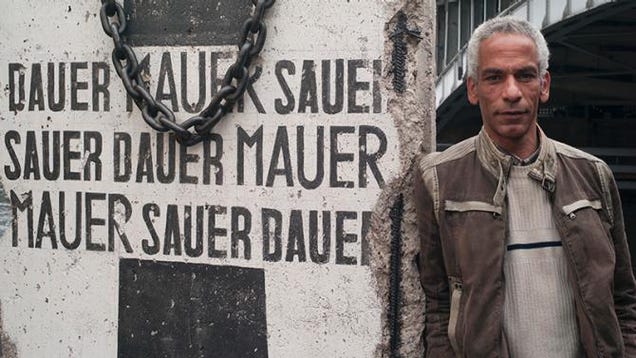
    Biracial Afro-Germans search for their identity in a country where many think that to be German is to be white.

    Who am I? It seems like a simple enough question, but it is one that thousands of Germans of African descent have to ask themselves every day. In a country that defines identity with a great deal of precision, those who fall outside the norm find themselves trapped in a kind of limbo, neither here nor there.

    After World War II, tens of thousands of African-American GIs participated in the occupation of Germany. Many of these young men, barred from combat units by segregation, found homes in supply units. In a country where food was in short supply, not only were these soldiers “exotic,” but they held the keys, if not to the kingdom, then certainly to survival.

    Like many of their fellow white soldiers, black troops made connections with German women. Soon thereafter, children were born, and German society has struggled with what to do with them for the seven decades since. Multigenerational Afro-Germans have struggled to find their place in a society that often doesn’t accept that they belong…

    …For the second postwar generation of Afro-Germans, the struggle for recognition wasn’t any easier. It was this generation of Afro-Germans who came together and created the Initiative of Black People in Germany. Fifty-three-year-old Tahir Della, the son of a black GI and a white mother from Leipzig, is a member of the board of the organization, and he talked about how he thinks other Germans see their fellow citizens of African descent…

    Read the entire article here.

  • Lost kin

    University of Chicago Magazine
    May/June 2015

    Allyson Hobbs, Assistant Professor of History
    Stanford University

    Excerpt from A Chosen Exile: A History of Racial Passing in American Life by Allyson Hobbs, published by Harvard University Press. Copyright © 2014 by Allyson Hobbs. Used by permission. All rights reserved.

    “Going as white” permanently created confusion as some family members disappeared across the color line, creating gaps in family genealogy. One woman explained, “My father’s people, half of them pass for white so naturally I know nothing about hardly any of them.”

    For others, embarrassment and shame prevented an open discussion of family history: “Not much has been disclosed about the Patterson family. It is our guess that there were too many blood mixtures of which the immediate family is not any too proud to relate. … That this family has many skeletons is without a doubt true.” Merthilda C. Duhe wrote that her father used passing as a strategy to create a new life for himself; she knew little about him or his family because he left New Orleans and “deserted the family while they were very young and went over to the white side in Chicago.”

    Others expressed uncertainty about the racial backgrounds of their ancestors. One man questioned his grandfather’s race and explained, “Father was always sensitive about that side of his family.” When asked whether her relatives in Detroit “go for colored or do they go for white,” Mrs. Clemens responded, “I don’t know, and I don’t know what I am. We are 100 per cent American and that is all we can say.” Raymond Brownbow did not know much about his maternal grandmother, a mixed- race house servant who was “described as being very nearly white.” As he explained, “I know very little about her, because it seems that my mother was and is a bit reluctant to discuss her. I remember my mother once telling me that she couldn’t stand the remarks that people would make upon learning of her mother’s mixed blood, and for that reason she refrained from talking much about her.”…

    Read the entire article here.

  • Rebooting beyond the idea of Race

    Mixed Roots Stories
    2016-07-06

    Temu and Elisabeth Diaab

    “Remember how we always wanted to write a children’s book?” Elisabeth asked me one morning over coffee. “Let’s do it now, she said.” Our son had just moved into a college dorm, we were juggling two internet businesses, and even considering having a second child.

    Although, I was born in Los Angeles, California, and Elisabeth, a world away, in Constance, Germany, we were amazed by how similar our experiences were. We were both of mixed racial heritage, our parents were both Muslim and Christian, we had both answered a long list of “interesting” questions regarding our ethnicity. We were drawn together in a very special way…

    Read the entire article here.

  • Commodification of the Black Body, Sexual Objectification and Social Hierarchies during Slavery

    The Earlham Historical Journal: An Undergraduate Journal of Historical Inquiry
    Earlham College, Richmond, Indiana
    Volume VII: Issue II (Spring 2015)
    pages 21-43

    Iman Cooper

    The horror of the institution of slavery during the late eighteenth century was not that it displaced millions of African people from their homes to the US, but rather that it laid the foundation for the commodification and dehumanization of the black body that was culturally, socially, and politically maintained for hundreds of years to come. This essay will first explore the commodification of African captives as the foundation of my analysis, in order to later examine the social and political ramifications of the sexual objectification that was rampant during the slavery era, through the analysis of Harriet Jacob‘s slave narrative. Slavery had long-reaching effects on the conceptualization of the black body, which is later depicted by the emergence of the mulatto class. White slave owners executed their perceived right under the creation of commoditized black bodies to sexually abuse their slaves, producing mixed race (mulatto) children. Social, religious, economic, and political factors allowed the sustained commodification of black bodies to occur. As a result of commodification, black bodies were rendered disciplined subjects; beholden to the will of white men. Simultaneously, white planters‘ wives were socially conditioned to remain publicly silent in the face of their husband‘s betrayal and abuse; hence they often executed their anger on the black slave, further rendering the black body an object to be claimed by others to enact their will upon. Commodification of the black body at the start of the era allowed for the objectification of the black female body to continue throughout slavery, as portrayed by the simultaneous abuse of the masters and the subsequent retribution of the master‘s wives, which were enacted on the black female body…

    Fetishization of the Black Female Slave and Mulatto Children

    Black women were both fetishized and regarded as impure, when seen in contrast to the modesty of white women; therefore at the height of slavery, relationships with slave women were decidedly culturally unacceptable. However, just because these relationships were frowned upon does not mean that men resisted crossing the line of this social taboo; they did. The violation of this boundary by slave-owners was sometimes shamelessly explicit, while other times they attempted to keep their affairs secretive, for fear of both the societal backlash and the anger of their wives. As a result, the mulatto class grew extensively during the slavery era, becoming a visible marker of the extensiveness of this issue in the society. The skin color of these children served as a visible reminder for the wives and the community of their husband‘s infidelity. Masters sometimes took care of their mulatto children and eventually freed them, but more often than not, children either worked on the plantation, or (at their wives‘ insistence) were put up for auction and sold into slavery. As the mistress of the plantation, wives held a degree of power that could either improve the lives of slaves on her plantation, or create further harm and devastating destruction…

    Read the entire article here.

  • Indian, African-Guyanese numbers continue to decline, census finds

    Stabroek News
    Georgetown, Guyana
    2016-07-19

    Staff Writer

    – mixed race, Amerindian populations still growing

    Although the country’s two largest ethnic groups, East Indian and African-Guyanese, continued to decline in their numbers between 2002 and 2012, the drop was offset by continued growth in the mixed race and Amerindian populations, according to the last census.

    However, the 2012 National Population and Housing Census also found that despite the shifts, which include the decline in the East Indian-Guyanese population from 326,277 or 43.4% to 297,493 or 39.8%—a drop of 28,784 or 3.6%—the overall ethnic distribution pattern remained unchanged from the 1980s.

    The Bureau of Statistics yesterday announced the release of two Compendiums that further detail the findings of the four-year-old census, including the ethnic composition of the population…

    Read the entire article here.

  • Crucifying the White Savior (Film)

    Shadow and Act
    2016-06-29

    Andre Seewood

    We no longer have to forgive them, for they know exactly what they are doing.

    The new film by Gary Ross, “The Free State of Jones” is uncontestably a White savior film. Laid bare, “The Free State of Jones” is a simplistically constructed tale of a Confederate army deserter who eventually lives in a polygamous relationship with a Black former slave named Rachel (Gugu Mbatha-Raw) with whom he has a mixed race child and his White wife and their White child. The film’s story is a heroification of the 1862 true story of Newton Knight a real Confederate deserter from Jones County, Mississippi, who ironically didn’t actually “save” anyone, but instead merely prolonged the inevitable suffering of those Blacks and his mixed race progeny who were trapped within the White supremacist power structure of the United States of America.

    The film builds its White savior character not in the broad conflicts between Confederate and Union soldiers, Free Black men and the KKK, but in small scenes of selfless heroism and demonstrative yet intimate “White-man- taking-charge- and-directing- the-actions- of-others” scenes that accumulate over the course of the two-and- a-half- hour film until there is no doubt about who is saving whom in a battle and who desperately needed to be protected from whom in a White supremacist society. Yet “The Free State of Jones” is an oddly racially segregated film that separates its Black token characters from its White fully developed characters, even as they fight (presumably) together to protect their illegal territory. There are certain battle and robbery scenes where no Black token is shown and others where Black tokens fight next to each other but are segregated from their fellow White fighters, revealing that Knight’s Free State was conditional at best. Moreover, the film never manages to convince the skeptical spectator that Knight’s higher ideals of freedom, autonomy, and “Every man is a man” equality were not simply rooted in his adulterous lust for a Black woman’s body.

    However, if we take off the metaphorical rose colored glasses that director Gary Ross has placed in front of the camera, it is not too difficult to see that Newton Knight was merely a Confederate deserter who wanted to have his cake and eat it too- a Black mistress and a White wife – and through the benefit of his White privilege, he was allowed to do so with peculiar impunity until the end of his days…

    Read the entire article here.

  • “Daddy, I wish there weren’t any Black people.”

    Medium
    2016-05-05

    Abe Lateiner

    Taking a deep breath, I respond to my daughter with a wish of my own.

    I’ve begun to see that it’s not about having the “right” answers when kids ask about race. Don’t get me wrong: I think there are better and worse answers to offer. There’s also a lot to be said for having a calm, thoughtful answer in the first place, sending the important signal that it’s fine to talk about race openly.

    At the end of the school day this past fall, I drove to pick up my 5 year-old daughter, Estella, from kindergarten. As we walked down the steps outside, Estella said she felt like walking instead of driving. It was a beautiful day, and so I happily agreed to take a walk around the block and then drive home.

    We were at the tipping point of the New England autumn. Some of the leaves were beginning to turn yellow, and a few were already burning red. We were admiring the colors as Estella skipped along, her little hand in mine, when she said, “Daddy, I wish that we lived in a world where people couldn’t change their skin color.”

    I’ve been intentional about talking race with Estella. As a White father with a multiracial daughter, I don’t have any sort of grand strategy beyond teaching her that race and skin color are only tangentially related. “Black” people don’t have skin that is the color black, “White” people don’t have skin that is the color white, many “Black” people have lighter skin than some “White” people, and so on. So when we talk about racial categories, I’ll often say, “Isn’t it silly that we use those words to describe people? They’re just made up.”

    But I’m also careful to explain that even though race is made up, it gets people hurt, traumatized, and even killed. I’ve told her that the people we call “Black” are more likely to be treated unfairly by the police just because of the way that they look…

    Read the entire article here.

  • Meet Anthony Ocampo, the Professor Who Wrote a Book on Why Latinos and Filipinos are Primos

    Remezcla
    2016-07-12

    Kevin Nadal


    Anthony Ocampo

    As one of the few Filipino American psychology professors in the US, it can get lonely. I am the only Filipino American professor on my campus and one of the few tenured Filipino American professors in New York City (and on the East Coast in general). When I first started writing about Filipino American issues over a decade ago, I found myself constantly fighting with scholars (especially peer reviewers) who argued that I should concentrate on issues affecting the pan-ethnic Asian American community, instead of focusing specifically on Filipino Americans. Whenever I wrote journal articles or essays, I always had to explain who Filipino Americans were – outlining colonial history, phenotypical appearances, and socioeconomic experiences in the US. I relied on interdisciplinary readings because there was so little written about Filipino Americans in social sciences. I turned to Latinx and Black American mentors, who validated my feelings of marginalization within the Asian American community. And I was fortunate to work with one Chinese American mentor who encouraged me to pursue my interests in writing about Filipino American Psychology.

    While there have been several amazing Filipino American scholars who have emerged across multiple disciplines in the past ten years or so, it is still a rarity to see a Filipino American professor — in a tenure or tenure-track position — who studies issues of concern for Filipino American people. In fact, in a study that I conducted with Dr. Dina Maramba in 2010, we found that there were only 113 tenured or tenure-track Filipino American professors in social sciences, education, and humanities in all of the U.S. As a reference point, there are 45 full-time professors in my Psychology Department alone (mostly white) and 415 full-time professors on my campus with 15,000 students. So, to only have a little over 100 Filipino American full-time professors in the US across these disciplines (when there are over 4 million Filipino Americans in the US), is both disproportionate and unfortunate.

    Because of all of this, I was so excited when I first learned about Dr. Anthony Ocampo and his research on deconstructing race for Filipino Americans. Dr. Ocampo is a tenure-track assistant professor of sociology at Cal Poly Pomona. His first book, The Latinos of Asia: How Filipino Americans Break the Rules of Race describes how Filipino Americans’ experiences with race and racism is influenced by social context (e.g., friendships, neighborhoods and communities, or even school environments). His research answers many of the questions that I had when I was first a student trying to understand Filipino American identity- unpacking issues related to Spanish and American colonialism, whether or not Filipinos are “Asian enough”, and whether or not Filipinos should continue to be classified under this pan-Asian umbrella…

    Read the entire article here.

  • FACING FORWARD: A Panel Discussion on Mixed-Race/Ethnic Japanese Americans and Community

    Japanese American Service Committee of Chicago
    4427 N. Clark Street
    Chicago, Illinois 60640
    2016-07-19, 18:30-20:00 CDT (Local Time)

    The Japanese American Service Committee Legacy Center Presents A “Memories of Now” Seminar Series Presentation

    Co-sponsored by the Chicago Japanese American Historical Society (CJAHS) and the Japanese American Citizens League – Chicago Chapter (JACL-Chicago)

    Featured Panelists:

    • Jackie Keiko Denofrio
    • Laura Kina
    • Erik Matsunaga
    • Christine Munteanu

    For more information, click here.

  • Barack Obama and the Rhetoric of Hope by Mark S. Ferrara (review) [Williamson]

    Rhetoric & Public Affairs
    Vollume 18, Number 4, Winter 2015
    pages 748-750

    Jason G. Williamson
    Department of Communication Studies
    University of Georgia

    Barack Obama and the Rhetoric of Hope. By Mark S. Ferrara. Jefferson, NC: McFarland and Company, 2013; pp. 204. $45.00 paper.

    In Barack Obama and the Rhetoric of Hope, Mark S. Ferrara attempts to piece together the historical, intellectual, and literary influences of Barack Obama’s presidential campaign rhetoric, primarily as the “rhetoric of hope” was constructed leading up to the 2008 campaign and employed during that campaign, as well as its reemergence for 2012. Ferrara defines the rhetoric of hope as “deliberately constructed political discourse that envisions social betterment brought about by the force of shared values and culminating in a promise of a ‘more perfect union’ in the future” (11). The utopian idealism that percolates throughout Obama’s campaign discourse is of particular interest to Ferrara, especially as American rhetorical tropes are employed to discursively construct Obama as a “quasi-prophetic” figure who possesses the leadership skills necessary to move the country closer to collective salvation (14–15). Ferrara repeatedly observes the rhetoric of hope relying on a dialectical tension between the ideal and the actual, promising to transform the current status quo into a salvific telos.

    The book is primarily organized into two major sections, with the first half (chapters 1–5) dedicated to locating historical and literary influences of Obama’s rhetoric of hope and the second half (chapters 6–10) investigating the values and characteristics of this rhetoric, concluding with a comparison of Obama’s two presidential campaigns. The opening chapters outline the manner in which utopian tropes derived from Judeo-Christian thought (chapter 1) as well as the European Enlightenment (chapter 2) influence Obama’s rhetoric. In the three chapters that follow, Ferrara continues [End Page 748] pulling on individual threads, such as slave narratives (chapter 3); the presidential traditions of Thomas Jefferson, Abraham Lincoln, and Franklin Roosevelt (chapter 4); and the influence of fiction, music, and popular culture (chapter 5), arguing that these threads, woven together, form Obama’s rhetoric of hope.

    In the second half, Ferrara moves beyond the antecedents of the rhetoric of hope, presenting a reading of Obama’s campaign rhetoric as an amalgam of multiple influences. Chapter 6 analyzes the role of American values in the rhetoric of hope, culminating in Obama’s embodiment of the American Dream, a combination of individual determination and community awareness with a heavy emphasis on “work” as an operative term, a theme that the president continues in his second term, as evident in the most recent State of the Union address. Ferrara approaches Obama’s discourse with an Aristotelian conception of rhetoric and places a heavy emphasis on the deliberate decisions of the rhetor, highlighting Obama’s role as a writing subject constructing his own narrative persona in chapter 7. Ferrara, an assistant professor of English at State University of New York at Oneonta, reads Obama’s autobiographical narratives as an effort in which Obama “casts himself as a prophet of change situated by virtue of his unique American story to usher in a new global order” (135). Ferrara locates Obama within the tradition of political autobiographical works in American history “from John Smith to Benjamin Franklin to Malcolm X,” arguing that Obama intentionally constructs his own story in such a way as to build on American mythologies (125). The climax is perhaps seen in Obama’s 2008 tour of the Middle East and Europe (chapter 8), where his narrative positions Obama as a figure that can unite American ideals with a global, multicultural audience. The final two chapters track the continuation of the 2008 campaign themes in 2011 and 2012, underscoring the claim that “the rhetoric of hope contains a neat circularity that is the product of intentional design” (187). Whether by intent or not, the characteristics of the rhetoric of hope obviously manifest in Obama’s campaigns.

    Throughout, Ferrara’s analysis casts light on many aspects of Obama’s rhetoric that the reader will find intuitive. Although his prose is occasionally too driven by quotations and not enough of the author’s own voice, the text and analysis is accessible for a wide audience. Readers who study presidential rhetoric will immediately note the pronounced absence…