• Rising Sun, “Rising Soul”: Mixed Race Japanese of African Descent

    University of Southern California, University Park Campus
    Los Angeles, California
    Montgomery Ross Fisher Building (MRF)
    Montgomery Ross Fisher Auditorium (340)
    Friday, 2016-02-26, 14:00-17:00 PST (Local Time)

    Rising Soul is a documentary film that explores the question, “What is the impact of Afro-Japanese offspring and their origins as children of Japanese war brides?” At the end of World War II, many Japanese women married American men of African descent and immigrated to the United States. While several stories examine the lives of Japanese war brides who married white Americans, none delve deeply into the history of Japanese war brides who married African Americans, and the journeys of their mixed-race children. Rising Soul explores the transnational juncture of Japanese and African American cultures embodied in the African-descent offspring of Japanese war brides, women that not only faced the challenges of life in the U.S., but who also confronted the adversities of interracial marriages to African Americans – hardships that emanated not only from white society, but also from Japanese including other Japanese war brides married to whites, from African Americans, and from Asian Americans. The documentary seeks to de-mystify Asian and Black identity from a perspective that does not see it as an anomaly or a subset of Hapa or Haafu identity but as something very real, primary, and organic to mixed race. Through interviews, glimpses into cultural phenomena, and historical artifacts, the film illuminates the complexity of that identity, and the betwixt and between and fusion that multiple heritages of color can foster. A panel will feature Rising Soul producer Monique Yamaguchi, screenwriter Velina Hasu Houston; and subjects from the film including Linda Gant, Sumire Gant, Kiyoshi Houston, Curtiss Takada Rooks, and Rika Houston. Excerpts from the film also will be screened.

    For more information and to RSVP, click here. View the flyer here.
  • Let Ohio Vote First

    The New York Times
    2016-02-16

    Emma Roller

    We, as voters and election-obsessed bystanders, made it past the first two contests in this eons-long presidential primary, but seven candidates weren’t so lucky.

    The winnowed-down field has now moved on to the warmer vote-seeking climes of Nevada and South Carolina. Before moving on too, I’d like to consider what this election has now proven: Iowa and New Hampshire’s first-in-the-nation status is not only obsolete, it’s bad for our democratic process.

    Ask people in Iowa or New Hampshire to justify their lock on early voting, and you hear this: “It’s cheap to campaign here.” “We take this job seriously.” “It’s part of our political heritage.” It can turn into a sort of Zen koan: We matter because we’re first, and we’re first because we matter. Inconveniently for them, none of these justifications are good enough.

    That’s why, to help save our democracy, I would like to autocratically declare Ohio as the new first-in-the-nation primary state starting in 2020. It might not be a perfect idea, but it would be a lot better than our system now.

    The main problem with Iowa and New Hampshire is a demographic one. Put simply, they are too white. Both states’ populations are roughly 90 percent white, while the United States population as a whole is 62 percent white. The United States is projected to become a minority-white country in roughly 30 years. This is where Ohio comes in

    Read the entire article here.

  • In an increasingly multiracial America, identity is a fluid thing

    89.3 KPCC: Southern California Public Radio
    Pasadena, California
    2016-02-16

    Leslie Berestein Rojas, Immigration and Emerging Communities Reporter

    If there’s any part of town that’s solidly Latino, it’s where Walter Thompson Hernandez grew up, in Huntington Park.

    The city, on the southeast fringe of Los Angeles, is 97 percent Latino. Thompson-Hernandez was raised there by his mother, an immigrant from Jalisco, in what he describes as a very Mexican household.

    “Quinceaneras, Vicente Fernandez, chilaquiles – those were very prominent fixtures in my upbringing,” said Thompson-Hernandez, now a graduate student researcher at the University of Southern California.

    But he was different: “I saw myself as Mexican, but I stood out. I was always the tallest kid, had the curliest hair, the darkest skin,” he said.

    His father was African-American, born in Oakland. His parents were estranged when he was very young. His mother always told him about his mixed heritage. But it didn’t really hit him until they moved to Palms, on the Westside.

    “When we moved to the Westside, most of my friends were African-American,” Thompson-Hernandez said. “In a way, I sort of longed to identify that part of my heritage. So all my friends were black. I would spend countless hours, sleepovers at their house. So I came into this black identity by experiencing blackness with my friends.”

    In his early twenties, he reconnected with his father and his side of the family. It was around that time that he first hear the term “Blaxican,” for black and Mexican. It resonated – and he ran with it…

    …This evolving dance with race and identity is a familiar theme for Los Angeles actor and playwright Fanshen Cox. She produces a one-woman show called “One Drop of Love,” which she performs around the country. Her father is a Jamaican immigrant. Her mother is Native American and Danish.

    Cox remembers how some black relatives and friends in Washington, D.C. identified her as a child: “In D.C., which is where I was born, I was ‘red bone’ and ‘high yellow.’”

    These terms labeled her as a light-skinned black person – and set her at a distance, closer to white, as she describes it. Then her family moved to liberal Cambridge, Massachusetts

    Read the entire article here.

  • Music does not discriminate | Chi Chi Nwanoku | TEDxEuston

    TEDx Talks
    2016-01-14

    Chi Chi Nwanoku speaks at a 2015 TEDx event in London.

    Chi-Chi Nwanoku MBE is the Founder, Artistic Director of Chineke!, Europe’s first classical orchestra of Black and Ethnic Minority musicians and is also the Principal Double bassist and founder of the Orchestra of the Age of Entertainment. Chi-chi is a professor of Double Bass History Studies at the Royal Academy of Music and was made a Fellow there in 1998.

    Chi-chi gracefully opened the TEDxEuston 2015 stage. She declared we are all born musicians; everyone of us has a heartbeat connected to something. It was a privilege for the audience to hear her personal journey through her early introduction to music and her experiences as a black women in the classical music industry. She narrates how she is fighting the good fight to bring diversity to the classical world and encourages the audience to “Never be afraid of a challenge.”

  • Ordinary Yet Infamous: Hannah Mary Tabbs and the Disembodied Torso

    Not Even Past: “The past is never dead. It’s not even past.” William Faulkner
    2016-02-01

    Kali Nicole Gross, Associate Professor of African and African Diaspora Studies
    University of Texas, Austin

    Adapted from Kali Nicole Gross’s new book: Hannah Mary Tabbs and the Disembodied Torso: A Tale of Race, Sex, and Violence in America (Oxford University Press, 2016).


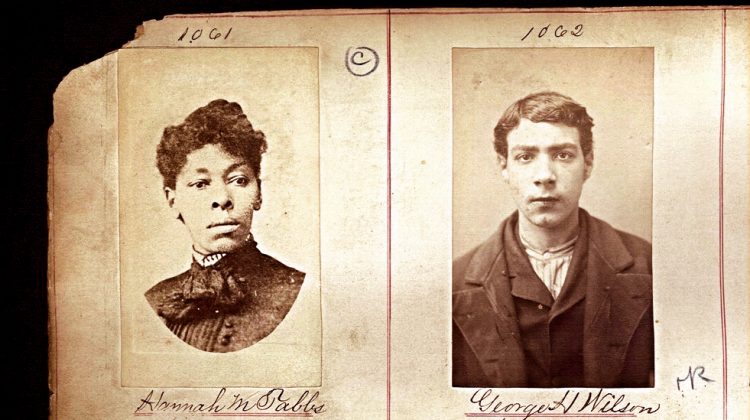
    Rogues’ Gallery Books (1887) Courtesy of the Philadelphia City Archives.

    The discovery of a headless, limbless, racially ambiguous human torso near a pond outside of Philadelphia in 1887, horrified area residents and confounded local authorities. From what they could tell, a brutal homicide had taken place. At a minimum, the victim had been viciously dismembered. Based on the circumstances, it also seemed like the kind of case to go unsolved. Yet in an era lacking sophisticated forensic methods, the investigators from Bucks County and those from Philadelphia managed to identify two suspects: Hannah Mary Tabbs, a black southern migrant, and George Wilson, a young mulatto that Tabbs implicated shortly after her arrest. The ensuing trial would last months, itself something of a record given that most criminal hearings wrapped up in a week or so. The crime and its adjudication also took center stage in presses from Pennsylvania to Illinois to Missouri

    Read the entire article here.

  • How and why did they do it?

    Harriet Beecher Stowe House
    2950 Gilbert Avenue
    Cincinnati, Ohio 45206
    Sunday, 2016-02-28, 13:00 EST (Local Time)

    Between the the 18th and mid-20th centuries, countless African Americans passed as white, leaving behind families and friends, roots and communities.

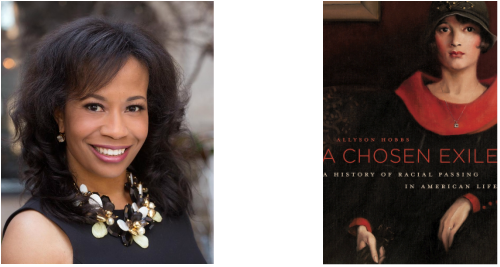
    Allyson Hobbs, Ph.D., Assistant Professor, Department of History, Stanford University, will be at the Harriet Beecher Stowe House Sunday, February 28, at 1 pm to discuss her book A Chosen Exile: A History of Racial Passing in American Life, published Harvard University Press.
    A Chosen Exile was selected as an Editors’ Choice by The New York Times Book Review, The Root, and The San Francisco Chronicle.
    It’s a story of challenges and loss in a country obsessed with racial distinctions.

    Free to the public. Refreshments will be served. Reservations available by e-mail @ friendsharrietbeecherstowe@gmail.com or call 513-751-0651.

  • Soledad O’Brien on #OscarsSoWhite: Why Did It Take So Long to Have This Discussion?

    The Hollywood Reporter
    2016-01-28

    Soledad O’Brien, Founder and CEO
    Starfish Media Group


    Soledad O’Brien
    Getty Images

    In my experience, diversity doesn’t just “happen.” It has to be very intentional. People have to have a genuine desire to make a change.

    It’s hard to tell what’s going to happen this time around. There are some bright signs, including the fledgling efforts of the Academy of Motion Picture Arts and Sciences. And, most importantly, there is an active, honest conversation going on…

    …I was raised by a white dad and black mom for whom dating and marriage were legally impossible in Baltimore in 1958 — so they drove to D.C. to get married, then lived in a fairly hostile environment toward mixed-race couples. That sense of isolation never stopped them, and it’s certainly helped me to deal with some very typical racism in my career: being dismissed as the “affirmative action” hire, being left out of opportunities. I’m not complaining. It’s the way it is and it was up to me to try to excel anyway. And, later, as a reporter I found it interesting to interview people who felt that way and try to understand their perspective. But that doesn’t mean the frustration didn’t build, and in my case, as that of many others, it eventually forces you to speak out. It also encourages you to do what you can to make it better.

    In my case, I now run a production company called Starfish Media Group that strives to tell the untold stories of people of diverse backgrounds….

    Read the entire article here.

  • Hannah Mary Tabbs and the Disembodied Torso: A Tale of Race, Sex, and Violence in America

    Oxford University Press
    2016-02-03
    232 pages
    10 illustrations
    6-1/8 x 9-1/4 inches
    Hardcover ISBN: 9780190241216

    Kali Nicole Gross, Martin Luther King, Jr. Professor of History
    Rutgers, The State University of New Jersey

    • A true crime account that offers a glimpse of the racially volatile world of post-Reconstruction Philadelphia
    • Unearths historical experiences of traditionally marginalized, taboo subjects
    • Combines narrative prose with rigorous historical research

    Shortly after a dismembered torso was discovered by a pond outside Philadelphia in 1887, investigators homed in on two suspects: Hannah Mary Tabbs, a married, working-class, black woman, and George Wilson, a former neighbor whom Tabbs implicated after her arrest.

    As details surrounding the shocking case emerged, both the crime and ensuing trial-which spanned several months-were featured in the national press. The trial brought otherwise taboo subjects such as illicit sex, adultery, and domestic violence in the black community to public attention. At the same time, the mixed race of the victim and one of his assailants exacerbated anxieties over the purity of whiteness in the post-Reconstruction era.

    In Hannah Mary Tabbs and the Disembodied Torso, historian Kali Nicole Gross uses detectives’ notes, trial and prison records, local newspapers, and other archival documents to reconstruct this ghastly whodunit crime in all its scandalous detail. In doing so, she gives the crime context by analyzing it against broader evidence of police treatment of black suspects and violence within the black community.

    A fascinating work of historical recreation, Hannah Mary Tabbs and the Disembodied Torso is sure to captivate anyone interested in true crime, adulterous love triangles gone wrong, and the racially volatile world of post-Reconstruction Philadelphia.

    Table of Contents

    • Prologue
    • Chapter 1: “Handle With Care”
    • Chapter 2: “The Woman Found”
    • Chapter 3: “To Do Him Bodily Harm”
    • Chapter 4: “Wavy Hair and Nearly White Skin”
    • Chapter 5: “Held for Trial”
    • Chapter 6: “The Defense Opens”
    • Epilogue
    • Notes
    • Bibliography
    • Index

  • Chirlane McCray and the Limits of First-Ladyship

    The New York Times Magazine
    2016-02-09

    Rachel Kaadzi Ghansah


    New York City Mayor Bill de Blasio and First Lady Chirlane McCray
    Credit Damon Winter/The New York Times

    What two years in Gracie Mansion have meant for a woman who aspired to be the “voice for the forgotten voices.”

    The first time I had lunch with Chirlane McCray at Gracie Mansion, I was distracted by the wallpaper. This was just about a year after her husband, Bill de Blasio, was sworn in as mayor of New York. In a breathlessly short period, McCray had gone from being a poet, wife and mother, with a job writing ad copy for a neighborhood hospital, to being first lady of New York City with a day-to-day schedule that could consist of everything from reading books to kindergartners in a classroom in East New York to exchanging pleasantries with Catherine, the Duchess of Cambridge.

    Standing near the head of a long, polished dining table, as a young white woman in a chef’s uniform recited the lunch menu, McCray repeated our choices to me and her chief of staff. But my attention kept drifting to the walls, where a Zuber wallpaper from the 1830s depicted a maiden, her complexion a flushed peaches and cream, trapped in an almost-embrace with a pale and severe-looking soldier in a red-and-blue military uniform. Before they moved into Gracie, McCray and de Blasio lived in a vinyl-sided townhouse in Park Slope, Brooklyn, and worked out at the local Y.M.C.A. Shortly after de Blasio became mayor, McCray said she would be a ‘‘voice for the forgotten voices,’’ because, she said, ‘‘black women do not have as many positive images in the media as we should.’’ How did it feel for that woman to regularly dine within this patrician fantasy?…


    New York City Mayor Bill de Blasio and First Lady Chirlane McCray
    Credit Damon Winter/The New York Times

    …What made de Blasio exceptional during his campaign in 2013 was his ability to convincingly articulate what many minority families had never heard a white man say publicly about race. He understood their fears and related to them. He was the one candidate who seemed to know intimately the fatigue that many of them felt after 12 years of Michael Bloomberg’s leadership as mayor. This was in large part because of the woman by his side with the long dreadlocks, tiny nose ring and activist past. Though she had obviously not made de Blasio black, she gave black New Yorkers a sense of representation, a sense that unlike Rudolph W. Giuliani or Bloomberg, her husband did not lack empathy toward their concerns…

    Read the entire article here.

  • Multiracialism in the U.K., on being a mixed-race feminist, and the interplay of African and Afro-Caribbean culture, with Nicola Codner, Ep. 52

    Multiracial Family Man
    2015-02-14

    Alex Barnett, Host

    Nicola Codner, Founder and Creator
    Mixed Race Feminist Blog
    Leeds, Yorkshire, United Kingdom

    Ep. 52: Nicola Codner is a multiracial woman (Black Jamaican, Nigerian and White British), born and living in Leeds, Yorkshire within the UK. She is a counselor, and she feels that her background has given her a love for diversity and the ability to appreciate multiple perspectives. Prior to training as a counselor she worked in academic publishing.

    She is the founder and creator of the Mixed Race Feminist Blog.

    Listen as Nicola speaks with Alex about multiracialism in the UK, about being a mixed-race feminist, and about the interplay of African and Afro-Caribbean culture.

    Listen to the episode (01:03:44) here. Download the episode here.