• Invisible Bridges: Life Along the Chinese-Russian Border

    The New Yorker
    2016-02-09

    Peter Hessler

    In the summer of 2014, Davide Monteleone, an Italian photographer who had lived in Moscow for more than a decade, began to travel to the Russian-Chinese border in search of something that felt real and reliable. “I had been covering the uprising in Ukraine, and then the civil war and the occupation of Crimea,” he told me. “I was disturbed by how hard it was to remain neutral when there was so much press attention. I felt like whatever I did was going to be used for propaganda. So I thought about doing something far away.” After the European Union and the United States levied sanctions against Russia, the country began signing high-profile gas and trade agreements with China. “There were a lot of articles in Russia about this new friendship between Russia and China,” Monteleone said. “So I figured, let’s go and see what’s going on. Is this relationship real?”

    In Moscow, Monteleone had read about a new bridge across the Amur River that the Russians were supposedly building at the city of Blagoveshchensk. “But you go there and there is no bridge,” he said. “People in Moscow knew about this bridge, but the people in this place didn’t even know they were planning to build it.” In the regions around the phantom bridge, he noticed other things that were also missing. “On the Russian side, there’s no agriculture,” he said. “It’s forest and that’s it. You ask the Russians why they don’t grow anything, and they say, ‘The weather is not very good; you can’t grow anything.’ And then you cross to the Chinese side, and there are plantations everywhere! It’s only two hundred metres, so the climate must be the same.”…

    …Over the past two centuries, there have been periodic tensions between Russia and China, including some serious border conflicts, and historically Russia has usually held the upper hand. But nowadays, at the personal level, Monteleone notices a different dynamic. “In a remote place like this, the Russians just wait for something that is going to happen, while the Chinese try to do something,” he said. This disparity seemed to shape the interpersonal dynamics of many Russian-Chinese couples that Monteleone met on his travels. In Blagoveshchensk, he spent time with a Chinese businesswoman who runs a small empire of Russian hotels and restaurants. Back in her hometown of Harbin, she has a husband and a child, but across the border she has acquired a kind of modern-day concubine—a Russian husband, along with another child. “I suspected that the Russian husband—it’s also for practical reasons,” Monteleone said. “Chinese cannot open companies in Russia if they don’t have a Russian partner.” He found it fascinating to watch them interact: “She was saying, ‘Go and get the car!’ ‘Bring me there!’ ‘Call this person!’ He was a husband, but at the same time he was an employee. She was speaking Russian, but in a strange accent.”

    That was one of the few mixed couples that Monteleone encountered in which a Chinese woman was paired with a Russian man. “The combination is usually Chinese men and Russian women,” he said. This may be a result of simple demographics: in Russia, there are only eighty-seven men to every hundred women, whereas in China there are a hundred and six men to every hundred women. But, in Monteleone’s view, it’s also a convergence of different social and economic forces. “It’s because men die much sooner in these parts of Russia,” he said bluntly. “In this kind of remote region, there’s no jobs, no activities, no way to spend time, so the men just drink.” He continued, “And Russian women here seem to be much more responsible than men. I’m sorry to say it, but they’re the ones taking care of things.” On the southern side of the border, he noticed that language schools are full of young Russian women who seem dedicated to acquiring Mandarin, and perhaps a Chinese husband…

    Read the entire article here.

  • Bill Clinton downplays Obama: ‘We’re all mixed-race people’

    The New York Post
    2016-02-14

    Aaron Short

    Bill Clinton still wants to be known as America’s “first black president.”

    The former president downplayed President Obama’s historic presidency, telling a Memphis crowd Friday everyone has some African ancestry.

    “Unless your ancestors, every one of you, are 100 percent, 100 percent from sub-Saharan Africa, we are all mixed-race people,” he said, according to reports…

    Read the entire article here.

  • An Interview with Poet and Room Poetry Coordinator Chelene Knight

    Room: Literature, Art, and Feminism Since 1975
    Issue 37.4: Claiming Space (2015)

    Interview with Bonnie Nish

    Chelene Knight was born in Vancouver and is a graduate of The Writer’s Studio at SFU. She has been published in Sassafras Literary Magazine, Room, emerge 2013 and Raven Chronicles and is the Poetry Coordinator at Room. Braided Skin, her first book (Mother Tongue Publishing, March 2015), has given birth to numerous writing projects, including a work in progress, Dear Current Occupant. Her work is deeply rooted in her experiences of mixed ethnicity. Her mother is African-American, and her father and his family were victims of the Asian expulsion in Uganda during the 70s, when President Idi Amin led a campaign of “de-Indianization,” resulting in the “ethnic cleansing” of the country’s Indian minority. Chelene is currently pursuing her BA in English at SFU.

    Her first book Braided Skin is forthcoming with Mother Tongue Publishing in spring 2015. Her launch will take place Wednesday April 8th, 2015 from 7-9:30 pm as a part of Twisted Poets Literary Salon run by Pandora’s Collective.

    ROOM: First of all Congratulations on your new book Braided Skin (Mother Tongue Publishing). Would you like to tell us something about your new book?

    CK: Thank you! Braided Skin is a mix of many things…

    Read the entire interview here.

  • “End the Autocracy of Color”: African Americans and Global Visions of Freedom

    Imperial & Global Forum (blog of the Centre for Imperial and Global History at the History Department, University of Exeter)
    2016-02-15

    Keisha N. Blain, Assistant Professor of History
    University of Iowa


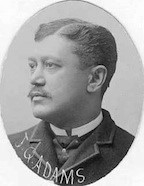
    John Q. Adams

    Historically, black men and women in the United States frequently linked national and geopolitical concerns. Recognizing that the condition of black people in the United States was “but a local phase of a world problem,” black activists articulated global visions of freedom and employed a range of strategies intent on shaping foreign policies and influencing world events.

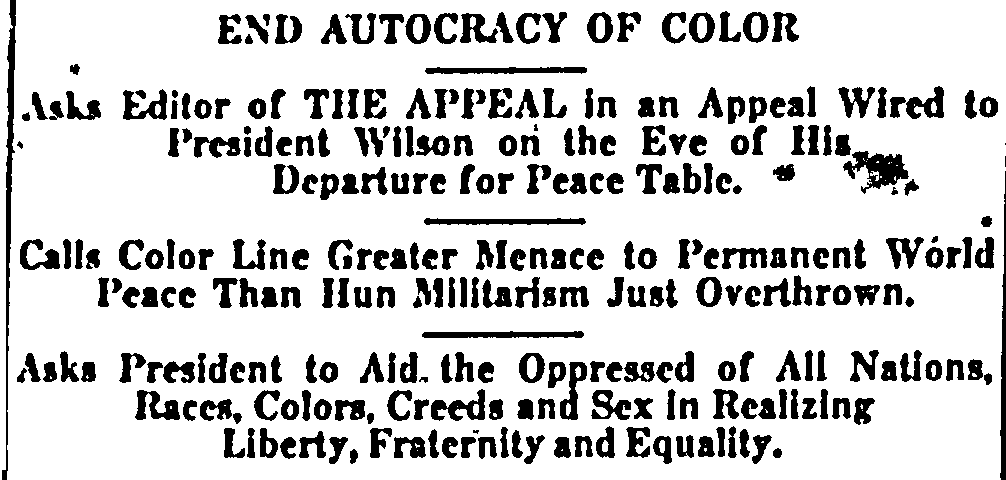
    During the early twentieth century, John Q. Adams, an African American journalist, called on people of African descent to link their experiences and concerns with those of people of color in other parts of the globe. Born in Louisville, Kentucky in 1848, Adams moved to St. Paul, Minnesota in 1886, where he became associate editor, and subsequent owner, of the Appeal newspaper. The paper’s debut coincided with key historical developments of the period including the hardening of U.S. Jim Crow segregation laws, the rising tide of anti-immigration sentiment, and the rapid growth of American imperial expansion overseas…


    John Q. Adams, “End Autocracy of Color,” The Appeal, 4 January 1919

    Read the entire article here.

  • Black History Month 2016: Three-star General, Lt. General Nadja West

    Black German Cultural Society
    2016-02-05

    Congratulations!!!

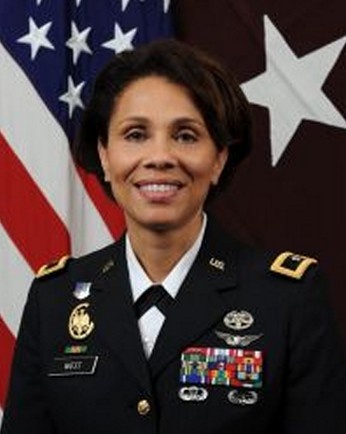
    Lt. Gen. Nadja West has been appointed as the Army’s 44th Surgeon General. With this appointment comes a promotion to lieutenant general, which makes West the Army’s first black female 3-star general as well as the highest ranking female of any race to graduate from West Point.

    West started as a child in Germany five decades ago. She came into the world a mischlingskinder or “brown baby”—one of many children borne of liaisons between African American servicemen and German women. Orphaned as a baby, she was adopted at nine months by Oscar and Mabel Grammer. Oscar Grammer worked as a chief warrant officer in the U.S. Army. Mabel Grammer was a civil rights activist and journalist who, at one point, wrote for the Afro American Newspapers. Together the couple adopted 12 children; West was the youngest.

    On Tuesday, February 9 (2016), Lt. Gen Nadja West will be honored in an official ceremony…

    Read the entire article here.

  • Braided Skin, Poems

    Mother Tongue Publishing
    2015-03-15
    96 pages
    8″ x 6″
    Paperback ISBN: 978-1-896949-50-5

    Chelene Knight

    Braided Skin is the vibrant telling of experiences of mixed ethnicity, urban childhood, poverty and youthful dreams through various voices. Knight writes a confident rhythm of poetry, prose and erasure by using the recurring image of braiding–a different metaphor than “mixing,” our default when speaking the language of race. In the title poem “Braided Skin,” this terminology shifts, to entwining and crossing, holding together but always displaying the promise or threat of unravelling. This is just as all tellings of family, history and relationships must be–“Skin that carries stories of missing middles.” When speaking about race, Knight raises the question, then drops it, and the image becomes other objects, then abstraction, and memory–finally becoming something “she breathes in” actively.

  • Arcade Fire Exploited Haiti, and Almost No One Noticed

    The Atlantic
    2013-11-12

    Hayden Higgins


    Arcade Fire / JF Lalonde

    The band has a deep, sincere relationship with the Caribbean nation. But even so, Reflektor’s marketing campaign has perpetuated stereotypes.

    Months before Arcade Fire’s new album came out, I learned of its existence when social media pointed me to a website with some chalked, black and white patterns spelling out “Reflektor.” The designs seemed strange and foreign, and I was intrigued about what the music might sound like—not because I knew what the accompanying imagery meant, but precisely because I didn’t.

    This, of course, was the intended effect. It turns out those designs were inspired by Haitian veve graffiti, used in syncretistic Vodoun practices to summon the Loa (angels or spirits, messengers to the deity). But presented out of context, to the typically unknowing fan like me, they connoted something else: mystery, exoticness, esotericism.

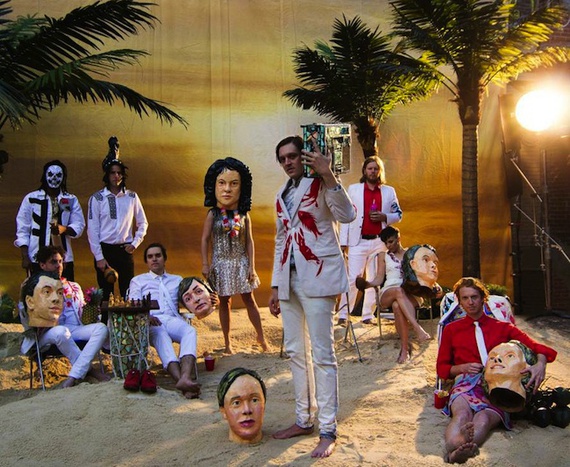
    Reflektor itself—now released and at the top of the charts—and the rest of its marketing campaign went all-in on the Haitian tropes. During some promotional concerts the band donned Kanaval masks, coopting a symbol that holds multifaceted, complex meaning for Haitians during Carnival but that was reduced to flat shorthand for “party!” during a raucous SNL appearance. The music evokes similar stereotypes. In the song “Flashbulb Eyes,” glimmering marimbas will, for many listeners, conjure a specific idealization of the Caribbean (where Haiti is located), while singer Win Butler wails about cameras stealing souls. The band’s music used to feel interesting by virtue of its heart-on-sleeve confrontation with mortality; now, it borrows its edginess by leaning on preconceptions about a foreign region….

    …This demonstrates that peoples’ stereotypes and assumptions operate independent of the appropriators’ own knowledge, however deep, of the culture they’re taking from. In this case, that knowledge is substantial. The band has a longstanding relationship with Haiti, starting with member Régine Chassagne’s ancestry (her parents fled the nation during the Duvalier horrors). They have been dedicated supporters of Partners in Health, which works to eradicate disease in Haiti. As Darville points out, though, audiences generally lack this context, and the onus is on the artist to recognize that fact…

    Read the entire article here.

  • Maj. Gen. Nadja West confirmed as 44th Army Surgeon General

    www.army.mil: The Official Homepage of the United States Army
    2015-12-11

    Maria Tolleson, Media Relations Officer


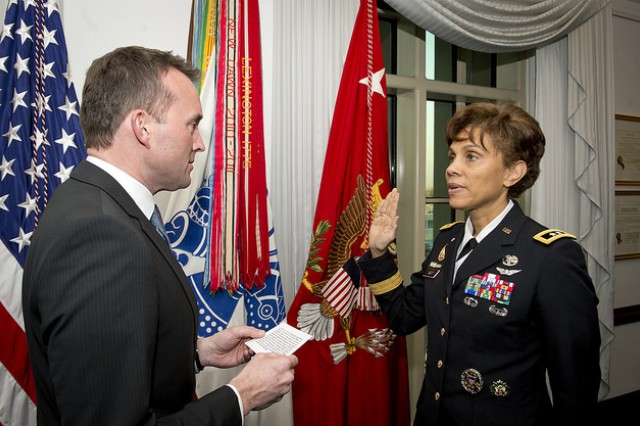
    Maj. Gen. Nadja West is sworn in as 44th Surgeon General of the Army by Acting Secretary of the Army Eric Fanning. West is also Commander of the US Army Medical Command.

    OFFICE OF THE SURGEON GENERAL Falls Church, Va. (Dec. 11, 2015) — The Senate confirmed Thursday Maj. Gen. Nadja West to serve as the new Army Surgeon General and Commanding General, U.S. Army Medical Command (MEDCOM).

    With the appointment as the 44th Surgeon General, West picks up a third star to become the Army’s first black female to hold the rank of lieutenant general.

    She most recently served as the Joint Staff Surgeon at the Pentagon. West’s appointment as Army Surgeon General is effective immediately…

    …With this appointment she becomes the first black Army Surgeon General and the highest ranking female to have graduated from the US Military Academy at West Point

    Read the entire article here.

  • South Bend high school student behind race-based signs speaks out

    WNDU TV 16
    South Bend, Indiana
    2016-02-12

    A local high school student says he’s in trouble after he and two other students posted some controversial signs at Riley High School.

    The signs stated “COLORED ONLY” and “WHITES ONLY,” and they were placed above water fountains throughout the school.

    Shane Williams, who says he’s black, white, and Hispanic, told NewsCenter 16, “I put the signs up to help students to view legal segregation in a different form, for them to experience it themselves…

    Read the entire story here.

  • Passing up the race: Students share stories of racial “passing”

    Polaris Press
    The Ann Richards School For Young Women Leaders
    Austin, Texas
    2016-02-04

    It was one of the first weeks of sixth grade when Lanna Ahlberg found herself at school talking on the phone in Traditional Mandarin with her Taiwanese grandmother.

    Hanging up the phone, Ahlberg found a number of girls staring at her.

    “In sixth grade, a lot of people thought I was Hispanic or white because I have chocolate hair, like it’s not black hair. My eyes aren’t as prominent,” Ahlberg, now in eighth grade, said. “My mom is Taiwanese and my dad is half Swedish.”

    If you’re a person of color who has ever been mistaken for white, you’ve experienced the phenomenon known as “white passing.”

    Simply defined, White passing is when a person of color is perceived as white at any point in their life…

    Read the entire article here.