• Rubén Trejo: Beyond Boundaries / Aztlán y más allá

    University of Washington Press
    Published with Northwest Museum of Arts and Culture
    April 2010
    160 pages
    110 color illus., notes, bibliog., 9 x 10 in
    Paperback ISBN: 9780295990040

    Edited and Introduced by:

    Ben Mitchell, Senior Curator of Art
    Northwest Museum of Arts and Culture, Spokane, Washington

    Essays By:

    Tomás Ybarra-Frausto, Former Professor of Spanish and Portuguese
    Stanford University
    Former Associate Director for Creativity and Culture
    Rockefeller Foundation

    John Keeble, Professor Emeritus
    Eastern Washington University

    “Multiple backgrounds can form such two- and three-dimensional ideas that they take you to the brink of lunacy, but I have used this rich background and ethnic landscape for creating art. As a student at the University of Minnesota, I often wondered what the study of Russian history, Shakespeare, English literature, or Freud . . . had to do with cleaning onions in Hollandale, Minnesota, picking potatoes in Hoople, North Dakota, or visiting relatives in Michoacán. This diversity of ideas can produce a three-headed monster or an artist, and I chose the latter.” –Rubén Trejo

    Rubén Trejo: Beyond Boundaries / Aztlán y más allá is the first comprehensive survey of Trejo’s art and career. It focuses on more than fifty works from 1964 through the present, including pieces from his delightful life-size, puppet-like Clothes for Day of the Dead series; works from the Calzones series – cast bronze underwear and jalapenos – that challenge the Spanish machismo culture; seminal examples of his lifelong exploration of the cruciform image; and much more. The volume includes biographical and interpretive essays, as well as a chronology, list of exhibitions, and bibliography.

    Rubén Trejo (1937-2009) was born in a Chicago, Burlington and Quincy railroad yard in St. Paul, Minnesota, where his father, a mixed Tarascan Indian and Hispanic from Michoacán, Mexico, and his mother, from Ixtlan in the same Mexican province, had found a home for the family in a boxcar while his father worked for the railroad. Trejo became the first in his family to graduate from college, and in 1973 he moved to the Pacific Northwest, where he began a thirty-year association with Eastern Washington University as teacher and artist.

    His isolation from major centers of Chicano culture led him to search for self-identity through his art. Influenced and inspired by such writers and artists as Octavio Paz and Guillermo Gómez-Peña, he explored a dynamic, multidimensional worldview through his sculpture and mixed-media pieces and created a body of work that deftly limns his identity as an artist and a Chicano. Throughout his long teaching career, he worked tirelessly to create opportunities for young Chicanos through tutoring and mentoring.

    Table of Contents

    • Preface by Ben Mitchell
    • In a Garden of Ideas / Ben Mitchell
    • Beyond Boundaries, Aztlán y más allá / Tomás Ybarra-Fraust
    • Plates
    • Trejo’s Perfect Havoc / John Keeble
    • Chronology for Rubén Miguel Trejo
    • Selected Exhibitions
    • Selected Bibliography
    • Patrons
    • About the Authors
  • Mixed Black and White Race and Public Policy

    Hypatia
    Volume 10, Issue 1 (February 1995)
    Pages 120 – 132
    Special Issue: Feminist Ethics and Social Policy, Part 1
    DOI: 10.1111/j.1527-2001.1995.tb01356.x

    Naomi Zack, Professor of Philosophy
    University of Oregon

    The American folk concept of race assumes the factual existence of races. However, biological science does not furnish empirical support for this assumption. Public policy derived from nineteenth century slave-owning patriarchy is the only foundation of the “one-drop rule” for black and white racial inheritance. In principle, Americans who are both black and white have aright to identify themselves racially. In fact, recent demographic changes and multiracial academic scholarship support this right.

    Read or purchase the article here.

  • Crossing Waters, Crossing Worlds: The African Diaspora in Indian Country

    Duke University Press
    2006
    392 pages
    7 illustrations, 1 table

    Edited by:

    Tiya Miles, Professor of American Culture, Afroamerican and African Studies, and Native American Studies
    University of Michigan

    Sharon Patricia Holland, Associate Professor of English; African & African American Studies
    Duke University

    Contributors: Joy Harjo, Tiya Miles, Eugene B. Redmond, Jennifer DeVere Brody, Sharon Patricia Holland, Tiffany M. McKinney, David A. Y. O. Chang, Barbara Krauthamer, Melinda Micco, Celia E. Naylor-Ojurongbe, Deborah E. Kanter, Robert Warrior, Virginia Kennedy, Tamara Buffalo, Wendy S. Walters, Robert Keith Collins, Ku’ualoha Ho’omanawanui, Roberta J. Hill

    Crossing Waters, Crossing Worlds explores the critically neglected intersection of Native and African American cultures. This interdisciplinary collection combines historical studies of the complex relations between blacks and Indians in Native communities with considerations and examples of various forms of cultural expression that have emerged from their intertwined histories. The contributors include scholars of African American and Native American studies, English, history, anthropology, law, and performance studies, as well as fiction writers, poets, and a visual artist.

    Essays range from a close reading of the 1838 memoirs of a black and Native freewoman to an analysis of how Afro-Native intermarriage has impacted the identities and federal government classifications of certain New England Indian tribes. One contributor explores the aftermath of black slavery in the Choctaw and Chickasaw nations, highlighting issues of culture and citizenship. Another scrutinizes the controversy that followed the 1998 selection of a Miss Navajo Nation who had an African American father. A historian examines the status of Afro-Indians in colonial Mexico, and an ethnographer reflects on oral histories gathered from Afro-Choctaws. Crossing Waters, Crossing Worlds includes evocative readings of several of Toni Morrison’s novels, interpretations of plays by African American and First Nations playwrights, an original short story by Roberta J. Hill, and an interview with the Creek poet and musician Joy Harjo. The Native American scholar Robert Warrior develops a theoretical model for comparative work through an analysis of black and Native intellectual production. In his afterword, he reflects on the importance of the critical project advanced by this volume.

    Table of Contents

    • Foreword: “Not Recognized by the Tribe” / Sharon P. Holland
    • Preface: Eating out of the Same Pot? / Tiya Miles
    • Acknowledgments
    • Introduction: Crossing Waters, Crossing Worlds / Tiya Miles and Sharon Patricia Holland
      1. A Harbor of Sense: An Interview with Joy Harjo / Eugene B. Redmond
      2. An/Other Case of New England Underwriting: Negotiating Race and Property in Memoirs of Elleanor Eldridge / Jennifer D. Brody and Sharon P. Holland
      3. Race and Federal Recognition in Native New England / Tiffany M. McKinney
      4. Where Will the Nation Be at Home? Race, Nationalisms, and Emigration Movements in the Creek Nation / David A. Y. O. Chang
      5. In Their “Native Country”: Freedpeople’s Understandings of Culture and Citizenship in the Choctaw and Chickasaw Nations / Barbara Krauthamer
      6. “Blood and Money”: The Case of Seminole Freedmen and Seminole Indians in Oklahoma / Melinda Micco
      7. “Playing Indian”? The Selection of Radmilla Cody as Miss Navajo Nation, 1997-1998 / Celia E. Naylor
      8. “Their Hair was Curly”: Afro-Mexicans in Indian Villages, Central Mexico, 1700-1820 / Deborah E. Kanter
      9. Lone Wolf and DuBois for a New Century: Intersections of Native American and African American Literatures / Robert Warrior
      10. Native Americans, African Americans, and the Space That Is America: Indian Presence in the Fiction of Toni Morrison / Virginia Kennedy
      11. Knowing All of My Names / Tamara Buffalo
      12. After the Death of the Last: Performance as History in Monique Mojica’s Princess Pocahontas and the Blue Spots / Wendy S. Walter
      13. Katimih o Sa Chata Kiyou (Why Am I Not Choctaw)? Race in the Lived Experiences of Two Black Choctaw Mixed-Bloods / Robert Keith Collins
      14. From Ocean to o-Shen: Reggae Rap, and Hip Hop in Hawai’i / Ku’ualoha Ho’omanawanui
      15. Heartbreak / Roberta J. Hill
    • Afterword / Robert Warrior
    • References
    • Contributors
    • Index
  • Becoming Modern Racialized Subjects: Detours through our pasts to produce ourselves anew

    Cultural Studies
    Volume 23, Number 4 (July 2009)
    pages 624-657
    DOI: 10.1080/09502380902950948

    Hazel V. Carby, Charles C. and Dorathea S. Dilley Professor of African American Studies
    Yale University

    This essay is a close engagement with the work of Stuart Hall which has been central to the project of unraveling the complexities of difference, divisions in history, consciousness and humanity, embedded in the geo-political oppositions of colonial center and colonized margin, home and abroad, and metropole and periphery. Hall has exposed the temporal enigma that haunts the relation between colonial and post-colonial subject formation. In response, the essay focuses on the geo-politics rather than the linear temporality of encounters in an examination of the sources of tension, contention and anxiety that arise as racialized subjects are brought into being through narration in examples drawn from The Interesting Narrative of the Life of Olaudah Equiano and post-colonial Caribbean novelists. The essay concludes by positing an alternative narrative for the emergence of the modern racialized state in Britain, one that has its origins in official responses to the presence of black American troops and West Indian civilian and Royal Air Force (RAF) personnel on British soil during World War II, rather than to the Caribbean migrants who arrived on the Empire Windrush in 1948.

    …It was not only black subjects that were policed and disciplined. Black servicemen were dialogically constituted in their blackness in and through their potential and actual encounters with white women who were also to be ‘managed’. Reynolds records the ‘intensive efforts [that] were made to guide the conduct of British women’. For women who were in the armed service ‘military discipline was invoked’ to discourage them from fraternizing with black soldiers and by January 1944 these policies hardened when ‘the Women’s Territorial Auxillary issued an order ‘‘forbidding its members to speak to colored American soldiers except in the presence of a white [person]’’’. These systems of surveillance were not only instituted and regulated by the military they were also enabled and maintained by members of local constabularies who ‘routinely reported women soldiers found in the company of black GIs to their superiors.’ Even civilian women were prosecuted by their local police who evoked ‘a variety of laws’ to take them into custody when they were found ‘in company of black soldiers’ (Reynolds 1996, p. 229).

    White women were counseled by families, friends and authorities alike, against marriage with black men; black American soldiers who wished to marry British women were refused permission to do so by their Commanding Officers and quickly transferred. Black journalist Ormus Davenport, ‘himself a wartime GI, claimed that there had been a ‘‘gentleman’s agreement’’ to prevent mixed marriages’. But ‘in the 8th Air Force Service Command where most of the American Air Force blacks were concentrated, a total ban on such marriages was quite explicit’ (Reynolds 1996, p. 231). The result was disastrous for their offspring…

    Read the entire article here.

  • African Cherokees in Indian Territory: From Chattel to Citizens

    University of North Carolina Press
    July 2008
    376 pages
    5.5 x 8.5, 6 illus., 8 maps
    Cloth ISBN: 978-0-8078-3203-5
    Paper ISBN: 978-0-8078-5883-7

    Celia E. Naylor, Associate Professor of History
    Dartmouth College

    Forcibly removed from their homes in the late 1830s, Cherokee, Creek, Choctaw, and Chickasaw Indians brought their African-descended slaves with them along the Trail of Tears and resettled in Indian Territory, present-day Oklahoma. Celia E. Naylor vividly charts the experiences of enslaved and free African Cherokees from the Trail of Tears to Oklahoma’s entry into the Union in 1907. Carefully extracting the voices of former slaves from interviews and mining a range of sources in Oklahoma, she creates an engaging narrative of the composite lives of African Cherokees. Naylor explores how slaves connected with Indian communities not only through Indian customs—language, clothing, and food—but also through bonds of kinship.

    Examining this intricate and emotionally charged history, Naylor demonstrates that the “red over black” relationship was no more benign than “white over black.” She presents new angles to traditional understandings of slave resistance and counters previous romanticized ideas of slavery in the Cherokee Nation. She also challenges contemporary racial and cultural conceptions of African-descended people in the United States. Naylor reveals how black Cherokee identities evolved reflecting complex notions about race, culture, “blood,” kinship, and nationality. Indeed, Cherokee freedpeople’s struggle for recognition and equal rights that began in the nineteenth century continues even today in Oklahoma.

  • The relationship between the ‘racial’ experiences of the ‘half Japanese’ and Japanese identity/racial discourse: The process of ‘othering’

    2008
    58 pages

    Marcia Yumi Lise

    People of mixed heritage in Japan, often referred to as Hafu, are often subject to ethnic/racial hurdles in Japan. The distinct Japanese racial thinking and the monoethnic myth affect the ways in which Hafus are considered in Japanese society. It is often difficult for Hafus to be considered ‘ordinary’ Japanese regardless of their Japanese upbringing.

    Through a qualitative research methodology, this study sets out to explore and address the issues of ‘othering’ experienced by Hafus in Japan and examine the ways in which Japanese racial thinking affects their position in society and their sense of belonging from the point of view of the Hafus.

    Read the entire thesis here.

  • Our obsession with classification: What are the implications to mixed race studies?

    2009-02-11
    3 pages

    Marcia Yumi Lise

    Whether it is by gender, sex, race, ethnicity, culture, religion, age, or nationality, in contemporary society, we are immensely preoccupied by classifying people into categories. Social scientists collect and produce data to utilise it for analysis. We hold passports or identity cards (of some sort), which specify one’s nationality, gender, name, date of birth, place of birth etc. When taking up employment we are asked to fill in an ethnic monitoring form. What’s interesting is that in England for example the Domesday Survey is said to have started nearly 1,000 years ago (The National Archives). Objectification manifests everywhere in our world now.

    …What does all this mean to the study of mixed race people and identities? When we speak of mixed race people, we are constantly drawing lines between different ethnicities, races, nationalities, heritages, or cultures to allow us to define “mixed race”. Academics have often stated that ‘mixed race’ people challenge existing classifications based on the aforementioned criterias. For instance, a Japanese and British individual instantly confronts conventional racial/national/ethnic/cultural classification. However we adjust to work in line with and make do with existing classification system. Recall how the concept of ‘race’ is ungrounded however. In this light the objectification of people using the criteria of ‘race’ is misleading…

    Read the entire essay here.

  • Rethinking race at the Students of Color Dinner

    University of Buffalo Law Links
    University of Buffalo Law School
    April 2010

    On the day that civil rights icon Benjamin Hooks passed away, UB Law School’s 21st annual Students of Color Dinner took stock of the nation’s state of race relations – and celebrated achievements that transcended race and culture.

    The April 15 dinner, held at the Buffalo Niagara Marriott, featured as keynote speaker UB Law Associate Professor Rick Su, who teaches and writes mostly in the areas of immigration and local government law. His remarks looked at the idea of America as a “post-racial society,” and he began with the news that President Obama, the son of a white mother and a Kenyan father, checked a single box on his 2010 Census form, indicating that he was “black, African-American or Negro.”

    “Our racial history has always been very complicated,” Su said. “What is interesting is the fact that the Census had choosing to identify as mixed race as an option. Until 2000, the option of selecting mixed race was unavailable…

    Read the entire article here.

  • ‘If You Can’t Pronounce My Name, You Can Just Call Me Pride’: Afro-German Activism, Gender and Hip Hop

    Gender & History
    Volume 15 Issue 3 (November 2003)
    Pages 460 – 486
    DOI: 10.1111/j.0953-5233.2003.00316.x

    Fatima El-Tayeb, Assistant Professor of African-American Literature and Culture
    University of California, San Diego

    The history of the black German minority, now estimated at around 500,000, goes back several centuries. It is only since the twentieth century, however, that Germans of African descent have been perceived as a group. This did not lead to their recognition as a national minority, but rather, from the 1910s to the 1960s, they were defined as a collective threat to Germany’s racial and cultural ‘purity’. When a sense of identity emerged among Afro-Germans themselves in the 1980s, the majority population continued to deny the existence of ethnic diversity within German society. At the turn of the twenty-first century, Afro-Germans seemingly suddenly appeared as a new, ‘hip’ minority. This appearance was largely focused on the immense public success of the Hip Hop collective ‘Brothers Keepers’, conceived as an anti-racist, explicitly Afro-German intervention into German debates around national identity and racist violence. This article explains the success of ‘Brothers Keepers’ by contextualising it within the tradition of two decades of Afro-German feminist activism and the transnational Hip Hop movement of European youth of colour.

    Read or purchase the article here.

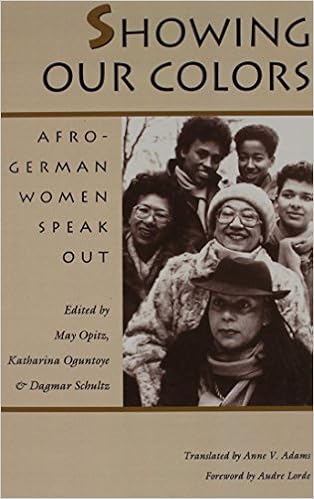
  • Showing Our Colors: Afro-German Women Speak Out

    Orlanda Frauenverlag (German)
    1986
    University of Massachusetts Press (English)
    1992
    ISBN: 0-87023-759-4
    Likely out of print.

    Edited by

    May Opitz [Ayim]
    Katharina Oguntoye
    Dagmar Schultz

    Translated by Anne V. Adams

    Foreword by Audre Lorde