• Spiritualism in Nineteenth-Century New Orleans: The Life and Times of Henry Louis Rey

    University Press of Mississippi
    January 2017
    208 pages
    25 b&w illustrations, 1 map, chronology, bibliography, index
    6 x 9 inches
    Hardcover ISBN-13: 978-1496810083

    Melissa Daggett
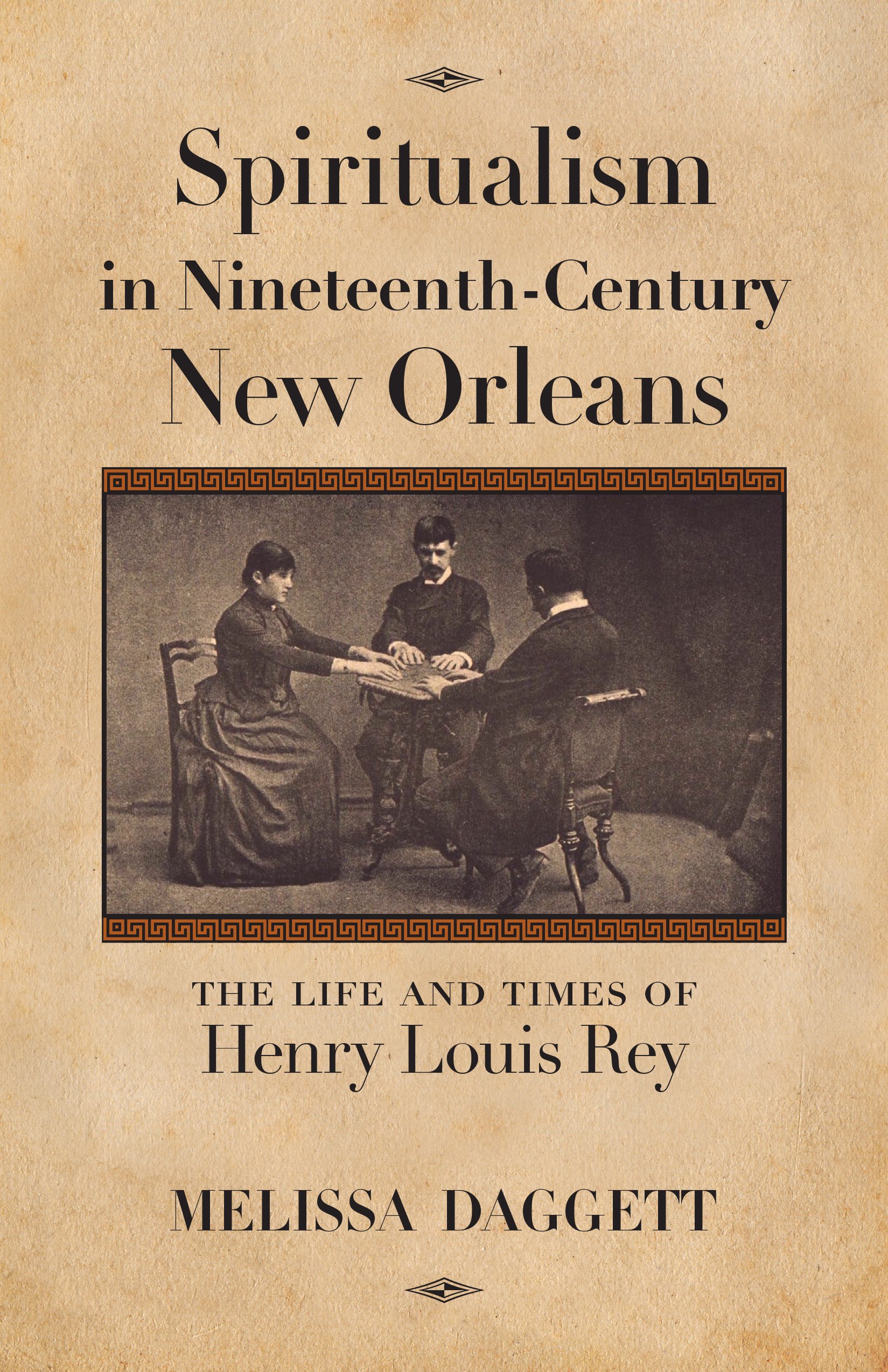
    Modern American Spiritualism blossomed in the 1850s and continued as a viable faith into the 1870s. Because of its diversity and openness to new cultures and religions, New Orleans provided fertile ground to nurture Spiritualism, and many séance circles flourished in the Creole Faubourgs of Tremé and Marigny as well as the American sector of the city. Melissa Daggett focuses on Le Cercle Harmonique, the francophone séance circle of Henry Louis Rey (1831–1894), a Creole of color who was a key civil rights activist, author, and Civil War and Reconstruction leader. His life has so far remained largely in the shadows of New Orleans history, partly due to a language barrier.

    Spiritualism in Nineteenth-Century New Orleans focuses on the turbulent years between the late antebellum period and the end of Reconstruction. Translating and interpreting numerous primary sources and one of the only surviving registers of séance proceedings, Daggett has opened a window into a fascinating life as well as a period of tumult and change. She provides unparalleled insights into the history of the Creoles of color and renders a better understanding of New Orleans’s complex history. The author weaves an intriguing tale of the supernatural, of chaotic post-bellum politics, of transatlantic linkages, and of the personal triumphs and tragedies of Rey as a notable citizen and medium. Wonderful illustrations, reproductions of the original spiritual communications, and photographs, many of which have never before appeared in published form, accompany this study of Rey and his world.

  • And yet, it is shockingly easy for me to locate the information. Instead of showing us the microfiche records that I thought we’d have to comb through, the librarian says it’s easier if we just access their subscription to Ancestry.com, and so leads us past the exhibits to the room with the large wooden desks and logs us in on one of the computer stations. And there, we see that in 1940—the first and most recent census in the list—before my mother was born and when my grandmother was a widow by her first husband, my grandmother and her first five children, ages 13, 10, 8, 6, and 1, are all classified as “C” for “colored.” When we click on the 1930 census, she and her first two children are designated as “Neg”: “negro.”

    Ashlie Kauffman, “Our Secret Family Legacy,” The Rumpus, August 31, 2016. http://therumpus.net/2016/08/our-secret-family-legacy/.

  • “…interracial relationships and interracial marriages are anything but color-blind. Yes, there is love, but that love is tinged and affected by the history of colonialism, skin color hierarchy, White racial privilege, unequal economic opportunity and by racist/sexist imageries that define the politics of sexual desire and acceptability.” —Larry Hajime Shinagawa

    Karen Ye, “Love Sees No Color? Chinese American Intermarriage,” AsAmNews, July 10, 2014. http://www.asamnews.com/2014/07/10/love-sees-no-color-chinese-american-intermarriage/.

  • Our Secret Family Legacy

    The Rumpus: Not the end of the Internet, but you can see it from here.
    2016-08-31

    Ashlie Kauffman, Senior Poetry Editor
    jmww

    Half my life ago, when I was twenty-one and in my first year out of college, my father brought his new girlfriend back home to Baltimore to visit. It had been over four years since I had last seen him, yet after a lifetime as an alcoholic, he was far from pleasant. We met for dinner at the house of a couple in whose basement he’d lived in before leaving town (I more accurately should say before he had to leave town, because of his then illegal activities). His friends and girlfriend doted on me almost parentally even though we’d just met: the wife, in fact, insisted on giving me four rolls of quarters for my laundry—all three of them engaging in the kind of codependency in which they tried to make up for the frequent offensive statements that my father was dishing out.

    The drunker he became, the more personal these statements got, and the more vitriol he loaded into them. He was bragging about things about which anyone else would feel guilty or ashamed, in order to fluff himself up—some things that even now I would never repeat to my mother, for how deeply they pushed the knife. He was enacting the typical bully, typical alcoholic blaming-and-judging behavior: making himself feel better by putting others down. In front of his friends and girlfriend, he criticized my mother for divorcing him and called her, multiple times, “a whore”; then he called her mother—my grandmother—”a nigger.” To prove his point, he slurred, with a knowing tone, as if he were somehow enlightening me, “Your grandmother had nigger lips.”…

    Read the entire article here.

  • On Being a Black Female Math Whiz During the Space Race

    The New York Times
    2016-09-05

    Cara Buckley, Culture Reporter


    Katherine Johnson, left, and Christine Darden, two of the former NASA mathematicians in the book “Hidden Figures.”
    Credit:  Chet Strange for The New York Times

    HAMPTON, Va. — Growing up here in the 1970s, in the shadow of Langley Research Center, where workers helped revolutionize air flight and put Americans on the moon, Margot Lee Shetterly had a pretty fixed idea of what scientists looked like: They were middle class, African-American and worked at NASA, like her dad.

    It would be years before she learned that this was far from the American norm. And that many women in her hometown defied convention, too, by having vibrant, and by most standards, unusual careers.

    Black and female, dozens had worked at the space agency as mathematicians, often under Jim Crow laws, calculating crucial trajectories for rockets while being segregated from their white counterparts. For decades, as the space race made heroes out of lantern-jawed astronauts, the stories of those women went largely untold.

    Four of them are the subjects of Ms. Shetterly’s first book, “Hidden Figures,” a history being released on Tuesday by William Morrow. The book garnered an early burst of attention because its movie version, starring Taraji P. Henson, Octavia Spencer and Janelle Monáe, is scheduled for a year-end release and set for an Oscars run. The movie rights were snapped up weeks after Ms. Shetterly sold her book proposal in 2014, and well before she started writing the book in earnest, a disorientingly fast, if exhilarating, turn…

    Read the entire article here.

  • What is Afro-Latin America?

    African American Intellectual History Society (AAIHS)
    2016-09-04

    Devyn Spence Benson, Assistant Professor of Africana Studies and Latin American
    Davidson College, Davidson, North Carolina

    From Mexico to Brazil and beyond, Africans and people of African descent have fought in wars of independence, forged mixed race national identities, and contributed politically and culturally to the making of the Americas. Even though Latin America imported ten times as many slaves as the United States, only recently have scholars begun to highlight the role blacks and other people of African descent played in Latin American history. This course will explore the experiences of Afro-Latin Americans from slavery to the present, with a particular focus on Haiti, Cuba, Mexico, Brazil, and Colombia. We will also read some of the newest transnational scholarship to understand how conversations about ending racism and building “raceless” nations spread throughout the Americas and influenced the Civil Rights movement in the United States.

    In doing so, the course seeks to answer questions such as: What does it mean to be black in Latin America? Why has racism persisted in Latin America despite political revolutions claiming to eliminate discrimination? How have differing conceptions of “race” and “nation” caused the rise and decline of transnational black alliances between U.S. blacks and Afro-Latin Americans?

    Last Tuesday, I began my eighth year of university teaching, but my first day at my new institution – Davidson College. Feeling both like a newbie (I was still unpacking boxes of books last week) and like an old pro, I dove right into teaching two introductory courses—Afro-Latin America and History of the Caribbean—passing out the course description pasted above. Both of my courses were cross-listed with Africana and Latin American Studies and fell under my purview as the new professor of Afro-Latin America. Mine is a joint position and the first untenured new hire for both Africana and Latin American Studies. I was initially shocked when I saw the advertisement last summer and remain shocked in many ways that both Africana and Latin American Studies at Davidson were interested in hiring an Afro-Latin Americanist as their first faculty position (other than chair) in two relatively young departments…

    Read the entire article here.

  • A look at historical multiracial families through the House of Medici

    OUPblog: Oxford University Press’s Academic Insights for the Thinking World
    2016-09-04

    Catherine Fletcher

    Catherine Fletcher is author of The Black Prince of Florence: The Spectacular Life and Treacherous World of Alessandro de’ Medici.

    The Medici, rulers of Renaissance Florence, are not the most obvious example of a multiracial family. They’ve always been part of the historical canon of “western civilization,” the world of dead white men. Perhaps we should think again. A tradition dating back to the sixteenth century suggests that Alessandro de’ Medici, an illegitimate child of the Florentine banking family who in 1532 became duke of Florence, was the son of an Afro-European woman. Sometimes called Simunetta, she may have been a slave in the household of his grandmother Alfonsina Orsini de’ Medici. The historical sources are elusive, but by pursuing them we can learn much about the history of race.

    It’s easy to get the impression that mixed-race families are a new phenomenon. Pew Research Center reported last year that 6.9% of US adults are multiracial, and that the numbers are growing. In Britain the numbers are also growing, though smaller overall (2%) and one in 10 UK couples is of mixed ethnicity.*

    Historical and archaeological research, however, shows that mixed-race families have been around very much longer…

    Read the entire article here.

  • The Black Prince of Florence: The Spectacular Life and Treacherous World of Alessandro de’ Medici

    Oxford University Press
    2016-09-01
    336 pages
    6-1/8 x 9-1/4 inches
    Hardcover ISBN-13: 9780190612726

    Catherine Fletcher, Historian, Author, AHRC/BBC New Generation Thinker 2015

    • The first-ever biography of Alessandro de’ Medici, arguably the first black head of state
    • Draws on extensive archival research of first-hand sources
    • An accessible and dramatic retelling of Renaissance politics and rivalry

    Ruler of Florence for seven bloody years, 1531 to 1537, Alessandro de’ Medici was arguably the first person of color to serve as a head of state in the Western world. Born out of wedlock to a dark-skinned maid and Lorenzo de’ Medici, he was the last legitimate heir to the line of Lorenzo the Magnificent. When Alessandro’s noble father died of syphilis, the family looked to him. Groomed for power, he carved a path through the backstabbing world of Italian politics in a time when cardinals, popes, and princes vied for wealth and advantage. By the age of nineteen, he was prince of Florence, inheritor of the legacy of the grandest dynasty of the Italian Renaissance.

    Alessandro faced down family rivalry and enormous resistance from Florence’s oligarchs, who called him a womanizer-which he undoubtedly was—and a tyrant. Yet this real-life counterpart to Machiavelli’s Prince kept his grip on power until he was assassinated at the age of 26 during a late-night tryst arranged by his scheming cousins. After his death, his brief but colorful reign was criticized by those who had murdered him in a failed attempt to restore the Florentine republic. For the first time, the true story is told in The Black Prince of Florence.

    Catherine Fletcher tells the riveting tale of Alessandro’s unexpected rise and spectacular fall, unraveling centuries-old mysteries, exposing forgeries, and bringing to life the epic personalities of the Medicis, Borgias, and others as they waged sordid campaigns to rise to the top. Drawing on new research and first-hand sources, this biography of a most intriguing Renaissance figure combines archival scholarship with discussions of race and class that are still relevant today.

    Table of Contents

    • Family tree
    • Glossary of names
    • Timeline
    • Maps
    • A note on money
    • Prologue
    • Book One: The Bastard Son
    • Book Two: The Obedient Nephew
    • Book Three: The Prince Alone
    • Afterword: Alessandro’s Ethnicity
    • Acknowledgements
    • Bibliography
    • Notes
    • Index
  • Sil Lai Abrams Blooms in Blackness

    Los Angeles Review of Books
    2016-08-31

    Brooke Obie

    Sil Lai Abrams, Black Lotus: A Woman’s Search for Racial Identity (New York: Gallery Books, 2016)

    SIL LAI ABRAMS HAD HER SUSPICIONS about her race as a very young child. Her brown skin was much darker and her hair much curlier than her fair-skinned, straight-haired younger sister and brother. When she would walk down the street with her Chinese mother and White father, her White neighbors would stare and whisper.

    “Your skin is brown because you were born in Hawaii,” her father would tell her anytime she asked, assuring her of her legitimacy as his own White child. It became her retort when she was met with “porch monkey” and other racist slurs by children at her majority-White school: “I’m Hawaiian!” she assured them, not Black.

    The same father who raised her in Whiteness would strip her of that safety net of privilege when she was 14 years old. After Sil Lai laughs at racist jokes with her younger sister May Lai, one of which is how to “stop a nigger from jumping on the bed” — par for the course in her Seminole County, Florida, neighborhood — her father came into the room, appearing disgusted, only to say, “I don’t know why you’re laughing, Sil Lai. You’re one.”…

    Read the entire review here.

  • How My White Mother Helped Me Find My Blackness

    The Establishment
    2016-08-31

    Ijeoma Oluo, Editor at Large


    The author (left) with her sister, uncle, brother, and mother

    “Hold still.”

    “Mom, you’re hurting me!”

    “I am not. Hold still or your headwrap won’t look right.”

    “I don’t want to wear the headwrap. It looks weird. Everyone will laugh at me!”

    “What kind of African are you??”

    I looked up at my white mom as she tugged on the gele around my head, and tried very hard not to roll my eyes…

    Read the entire article here.