• Our Diversity Isn’t Looking Very Diverse

    Affinity Magazine
    2016-08-20

    Etienne Rodriguez
    Rutgers, The State University of New Jersey

    Look alive, True Believers, if the rumors are to be believed, then Zendaya is playing the role of Mary Jane Watson in the upcoming Spider-Man movie. This is the latest in a series of black women being cast in traditionally white comic book roles. First it was Candice Patton being cast as Iris West in CW’s The Flash, then Tessa Thompson as Valkyrie in Marvel’s Thor: Ragnarok, followed by Kiersey Clemons being cast in Warner Brother’s The Flash, and now Zendaya. While they’re all great actresses and I can’t wait to see them in action, it’s hard not to notice that only a certain type of black girl is being cast.

    We all want to celebrate the fact that black women are getting more roles, but we need to address the colorism in these casting. Zendaya, Kiersey, Tessa, and Candice are all lightskin black women. These aren’t coincidences; these are products of our society’s devaluing of darkskin black women, especially those that don’t meet Eurocentric beauty standards. These actresses received/continue to receive a lot of hate, doused in racism no doubt, but nothing in comparison to what Leslie Jones went through just last month.

    Leslie is a darkskin black women with Afrocentric features, and the internet sure as hell wanted her to know it. Through comparison to gorillas, various racial slurs, and general bigotry, she was forced to retreat from Twitter and thus interacting with her fans. Women like her are rarely given the chance to shine and when they are, they’re met with harassment and abuse…

    Read the entire article here.

  • My Multiracial Identity Isn’t A Party Trick

    The Establishment
    2016-06-16

    Natasha Diaz

    We sat in a diner at 4 a.m. with a stack of chocolate chip pancakes and chicken fingers between us, the only meal that made sense at that time of night. After a while, the food soaked up enough of the alcohol that we could converse somewhat effectively. He looked up at me and smiled, pancakes drooping from his fork. “Babe,” he said, “the guys and I were talking last night, trying to figure out who had hooked up with the most girls of different races. And I won!”

    I sat stiffly as he listed off different ethnicities, not attaching a name or even an anecdote to any of these women, as if he was running through ROYGBIV for some elementary school test. When he finished, he took another bite of pancakes and added triumphantly, “We thought no one had hooked up with a mixed girl, but then we realized: Natasha! She’s ­… what was that word for you? Mulatto?”

    I took a sip of water, stalling for time to gather my thoughts. I ran through the timeline of our three-week relationship. I was a freshman, newly free from my childhood; he was a senior, well­-liked on campus. Over warm keg beers, he had vowed that he would watch over me. But this wasn’t the first time I had told myself, “He’s just drunk. He means it as a compliment.”

    I had found myself making a lot of mental excuses during my first month of college. I’d been justifying the continual inappropriate jokes, invasive questions, and strange obsession with my lack of melanin: How can you be Black when you’re so… white?…

    Read the entire article here.

  • Celebrating Japan’s multicultural Olympians

    The Japan Times
    2016-08-17

    Naomi Schanen, Staff Writer

    Meet the athletes flying the flag and challenging traditional views of what it is to be Japanese

    Japan and Brazil’s ties go back to the early 20th century, when the first Japanese immigrants arrived as farmers in the South American country. Brazil is home to the largest Japanese community outside Japan — 1.5 million of the country’s 205 million people identify themselves as Japanese-Brazilian, including a handful of members of the Brazilian Olympic team.

    But although the host countries of the current and next Summer Olympics share cultural bonds, compared to Brazil, where nearly half of people consider themselves mixed-race, multiculturalism remains elusive in Japan, where ethnic homogeneity is often held up as something to be proud of.

    Though Japan is home to the second-largest Brazilian community outside of Brazil, only 2 percent of the country’s population was born overseas. Compared to most other developed countries, immigration to Japan is negligible. However, despite having to deal with an aging, shrinking population, the majority of Japanese seem to prefer it this way. In a recent Yomiuri Shimbun poll, only 37 percent said they felt that more non-Japanese should be accepted to fill the gaps in the country’s labor market…

    Read the entire article here.

  • Race And Radicalism In Puerto Rico: An Interview With Carlos Alamo-Pastrana

    African American Intellectual History Society (AAIHS)
    2016-08-02

    Devyn Spence Benson, Assistant Professor of History and African and African American Studies
    Louisiana State University

    This month I interviewed Dr. Carlos Alamo-Pastrana about his new book, Seams of Empire: Race and Radicalism in Puerto Rico and the United States (University Press of Florida, 2016). Tracing cultural and political exchanges between African Americans, U.S. white liberals, and Puerto Ricans, this timely work highlights how activists and politicians in both spaces understood race, empire, and colonialism in the 20th century. Alamo-Pastrana illuminates the potential for fruitful multiracial alliances by uncovering the archive of a sub-group of Puerto Rican independentistas called the Proyecto Piloto. Led by Puerto Rican doctor Ana Livia Cordero, who had been married to Julian Mayfield, this group identified Puerto Rico as a black nation, worked to provide education and social services in poor barrios, and sought links with U.S. black radicals. Seams of Empire is a must read for scholars of transnational and diaspora history as well as anyone trying to build black and brown alliances in today’s antiracist movements.

    Dr. Carlos Alamo-Pastrana is currently Associate Dean of Strategic Planning and Academic Resources at Vassar College where he is also Associate Professor of Sociology and Latin American and Latina/o Studies. His research and teaching interests focus on comparative racial formations, Latino/a Studies, Afro-Latina/o intellectual history, popular culture, and prison studies.

    Seams of Empire follows cultural workers and politicians in Puerto Rico and the United States to tell a story about racism, colonialism, and activism. What led you to focus the book on these exchanges?

    Alamo-Pastrana: That is such a great question because it really gets at the heart of the book. As someone who studies race in the Americas, I have always found the conversations about race in Puerto Rico a bit limiting. These are in many instances reduced to the realm of popular culture especially music, film, etc. Even more, they are framed in very insular ways that really limit the scope of how we should think about race in broader contexts to include different national, racial, and political movements and groups. This is significant because it helps to produce and circulate some of the troubling forms of racial exceptionalism that I discuss in the book. Even I fell into this trap in some of my earlier research projects on Afro-Puerto Rican folk music.

    But, for this book, I felt that I needed to push the analysis beyond the nation-state framework to see the more dynamic ways that people and ideologies travel across different spaces. The book tries to use cultural production and actors in larger global circuits in order to see how race is being (re)configured and used to explain certain political dilemmas…

    …In the Introduction, you make a point of saying that you want Puerto Rican Studies scholars to “banish” la gran familia puertorriqueña as an analytical lens for looking at the island (11). What is the grand Puerto Rican family and what dangers (or challenges) does it present to the type of work you do?

    Alamo-Pastrana: La gran familia puertorriqueña is one of the foundational state myths that asserts that Puerto Rico is somehow a racially heterogeneous (mestizo), inclusive, and equal nation. It is this, the argument goes, that makes Puerto Rico so much more different than its racist colonizer to the North. Well, you don’t have to look around much in Puerto Rico to see how untrue this is…

    Read the entire interview here.

  • Seams of Empire: Race and Radicalism in Puerto Rico and the United States

    University Press of Florida
    2016-05-10
    232 pages
    6×9
    Hardcover ISBN 13: 978-0-8130-6256-3

    Carlos Alamo-Pastrana, Associate Professor of Sociology and Latin American and Latina/o Studies
    Vassar College, Poughkeepsie, New York

    Puerto Rico’s colonial relationship with the United States and its history of intermixture of native, African, and Spanish inhabitants has prompted inconsistent narratives about race and power in the colonial territory. Departing from these accounts, early twentieth-century writers, journalists, and activists scrutinized both Puerto Rico’s and the United States’s institutionalized racism and colonialism in an attempt to spur reform, leaving an archive of oft-overlooked political writings.

    In Seams of Empire, Carlos Alamo-Pastrana uses racial imbrication as a framework for reading this archive of little-known Puerto Rican, African American, and white American radicals and progressives, both on the island and the continental United States. By addressing the concealed power relations responsible for national, gendered, and class differences, this method of textual analysis reveals key symbolic and material connections between marginalized groups in both national spaces and traces the complexity of race, racism, and conflict on the edges of empire.

    Contents

    • List of Figures
    • List of Abbreviations
    • Acknowledgments
    • Introduction
    • 1. The Puerto Rican Blueprint
    • 2. Dispatches from the Colonial Outpost
    • 3. The Living Negro in Latin America
    • 4. The Republic of the Penniless
    • 5. You Are Here to Listen
    • Conclusion
    • Notes
    • Bibliography
    • Index
  • Seattle’s multiracial identity evolves along with census

    The Seattle Times
    2016-08-18

    Gene Balk

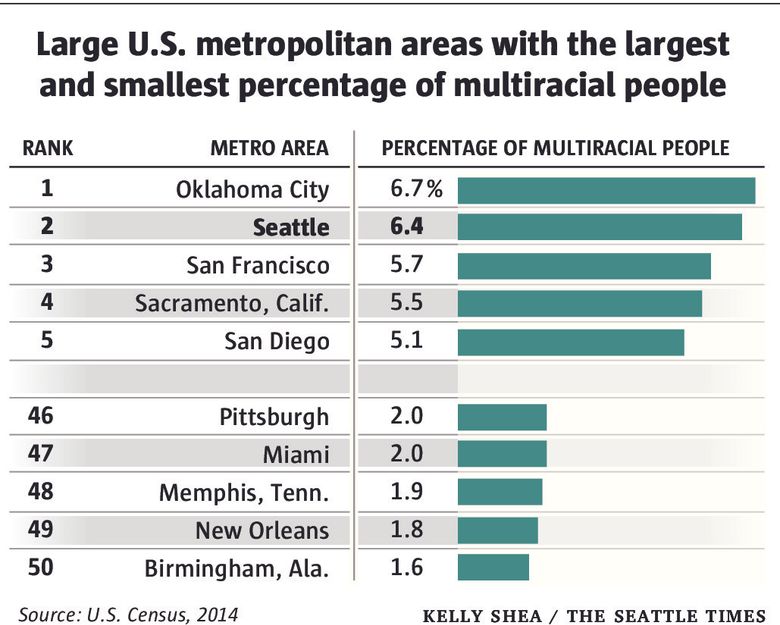
    Now that Americans can select more than one racial category, we rank high nationally in terms of multiracial population and percentage.

    TODAY — WHEN NEARLY 10 million Americans identify as multiracial — it’s strange to think that just a few decades ago, this community was practically invisible.

    That’s because it wasn’t until 2000 that the Census Bureau allowed Americans to choose more than one racial category to describe themselves. Before that, you could pick only one, and people with mixed backgrounds often struggled over the decision about which box to check.

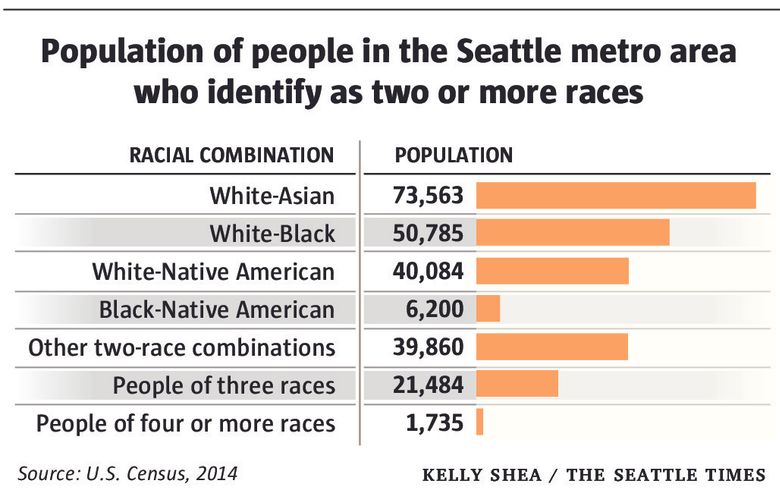
    When the Census Bureau made that change, it had an especially profound impact in Seattle. That’s because even though Seattle ranks only 15th in size among U.S. metropolitan areas, our population of multiracial people — about 233,000 — is the fourth-largest. New York, Los Angeles and San Francisco are the top three, in order…

    Read the entire article here.

  • Richard Pryor’s Daughter Opens Up About The Racism Her Family Faced In Beverly Hills

    The Huffington Post
    2016-08-18

    Lisa Capretto
    The Oprah Winfrey Network

    “I’m a product of this thing that everyone was against.”

    When Rain Pryor was born in 1969, her father, Richard Pryor, had already begun transitioning from a relatively mild joke-telling comedian to a fearless, outspoken comic whose routines doubled as raw social commentary. As Pryor’s comedy was shifting, so was the country, moving toward more progressive values. But, as his daughter Rain points out, blatant racism still affected countless families, including her own.

    Speaking with “Oprah: Where Are They Now?”, the 47-year-old actress opened up about her childhood, setting the scene for what her interracial family faced during that time in their Beverly Hills community.

    “My dad’s Richard Pryor. My mother, Shelley, was a poor Jewish woman,” Rain says. “Imagine, if you will, Beverly Hills in the early ‘70s. Here I am, this mixed-race child [with] my golden skin, my big poufy hair ― because Mom knew nothing about a pressing comb ― [and] my mom’s blond-haired, blue-eyed, looking like Cher, wearing dashikis.”…

    Read the entire article here.

  • Despite the fact that both Rachel [Dolezal] and Vanessa [Beecroft] seem to have found their “true” identities, I am still searching for where “multicultural” fits within the landscape that is race in America. When I was younger, I had moments of weakness where I allowed racist, ignorant, hurtful behavior to occur around me without repercussion. Speaking out, would mean having to explain myself, and then be questioned and teased for “not really being” who I say I am. I struggle with a permanent guilt for the way my appearance allows me to move through the world so much more easily than my family members, and I am grateful for the constant reminder. As much as I am connected to and proud of my Black and Brazilian heritage, an intense awareness of how I am perceived by everyone around me is part of who I am. It has taken 29 years to get here with far more work to be done. And when these white women proclaim themselves to be spiritually Black, it feels like they’re pouring multiple varieties of artisanal salt (available at the aforementioned, gentrified storefronts) on the wound.

    Natasha Diaz, “White People, Stop Saying You’re ‘Black On The Inside’,” The Establishment, August 15, 2016. http://www.theestablishment.co/2016/08/15/white-people-stop-saying-youre-black-on-the-inside/.

  • The Memoir of a White-Passing Activist

    Odyssey
    2016-08-16

    Haley Arthur

    My experiences with being mixed race and trying to use my white privilege to help liberate myself and others.

    “Oh, you’re mixed? Wow, I would never have guessed. Now it all makes sense.”

    Yes, this is something that has been said to me multiple times, and something that I will probably continue to hear for the rest of my life. But the part that bothers me is not the fact that people don’t recognize my indigenous blood upon first glance, but rather that the fact that in the eyes of some people, fighting to gain equal rights for everyone only “makes sense” if I am not a full-blooded white person (which, by the way, is pretty much impossible to come by these days anyway, for all of you white supremacists out there). People say this as if they know that the system benefits white people, and cannot conceive why I, a fellow white person, would ever want to change that. But that in itself is a huge part of the problem. Nothing about racial injustice “makes sense”, least of all the hesitation to fight against it…

    Read the entire article here.