• The reawakening of Afro-Argentine culture

    Global Post
    2009-08-30

    Anil Mundra

    Descendants of slaves are starting to assert their identity but it’s not easy in South America’s whitest country.

    BUENOS AIRES — “Liberty has no color” read the signs held outside a Buenos Aires city courthouse. “Arrested for having the wrong face,” and “Suspected of an excess of pigment,” said others. And more to the point: “Enough racism.”
     
    A black street vendor was allegedly arrested without cause or proper procedure earlier this year, prompting this August hearing of a habeas corpus appeal. But leaders of the Afro-Argentine community say this moment goes beyond any particular man or incident, calling it a watershed case that brings to trial the treatment of blacks in Argentina.
     
    “It’s not about this prosecutor or that police officer, but rather an institutionally racist system,” said Malena Derdoy, the defendant’s lawyer.
     
    Argentina is generally considered the whitest country in South America — 97 percent, by some counts — possibly more ethnically European than immigrant-saturated Europe. There was once a large Afro-Argentine presence but it has faded over the epochs. Now, for the first time in a century and a half, Argentine descendants of African slaves are organizing and going public to assert their identity…

    …At the beginning of the 1800s, black slaves were 30 percent of the population of Buenos Aires, and an absolute majority in some other provinces. The first president of Argentina had African ancestry, and so did the composer of the first tango. Even the word “tango,” like many other words common in the Argentine vocabulary, has an African root; so do many beloved foods, including the national vices of the asado barbecue and dulce de leche.
     
    The abolition of slavery was a slow process that spanned the better part of the 19th century. At the same time, under the government’s explicit and aggressive policy of whitening the race — to replace “barbary” with “civilization,” in the famous phrase of the celebrated president Sarmiento — Afro-Argentines were inundated by European immigration, the largest such influx in the Americas outside of the United States. Blacks had dwindled to only 1.8 percent of Buenos Aires by the 1887 census, after which their category was replaced with more vague terms like “trigueno” — “wheaty.”

    “It’s part of Argentine common sense that there are no blacks, that their entire culture had disappeared toward the end of the 1800s,” said anthropologist Pablo Cirio. “That’s all a lie.”…
     
    …The survey was performed with help from the national census bureau and World Bank funding, at the urging of local Afro-Argentine activists who hoped to have the “Afro-descendant” category re-inserted into the Argentine census in 2010 and count themselves as a distinct segment of the populace after a century missing. Soon afterward, DNA tests of blood samples in several Buenos Aires hospitals bolstered the pilot census’ result with a very similar percentage of genes traceable to Africa. Moreover, a much higher number — about 10 percent — was obtained by testing mitochondrial DNA, which traces maternal ancestry. This is consistent with the historical conjecture that many black men were lost after being sent to the frontlines of 19th-century wars, and Afro-Argentines assimilated into the white population when the
    remaining women mixed with the hordes of European males who had come to Argentina to work…

    Read the entire article here.

  • Rutgers Group Brings Students Together to Explore the Complexities of Being Multiracial

    Focus
    Rutgers University News
    September 2012

    Carrie Stetler

    By 2050, one in five Americans is likely to be multiracial

    It’s a question Joan Gan hears a lot: “What are you?” She instantly knows what it means.

    Her father is Chinese and her mother is Greek, so when people meet her for the first time, they often have trouble identifying her ethnicity.

    Gan, a Rutgers junior who grew up in Parsippany, understands their curiosity, and the questions don’t really bother her. But other aspects of growing up biracial were harder to negotiate.

    “In high school I saw lots of ethnic clubs, and at colleges, too, and I didn’t really know which one to join,” says Gan, an environmental science major. “Even though I’m technically Asian, people don’t consider me one of them and technically I’m white, but people don’t always consider me that, either.”

    During her first year at Rutgers, Gan discovered Fusion: Rutgers Union of Mixed People, which gives her and other students an opportunity to come together and explore the challenges and complexities of being multiracial…

    …Fusion began seven years ago when Rutgers psychology professor Diana Sanchez, who is now the club’s adviser, started researching biracial and multiracial identity.

    “As a way of connection multiracial students and getting participants for my research, I asked a student I knew to start an organization and he did,’’ says Sanchez, an an associate professor in the Department of Psychology, in the School of Arts and Sciences.. “Multiracial people hold a unique view of race; they’ve questioned it in a very different way. If you feel ‘in between’ communities, there is another identity you form that has to do with the merging of both those identities.”

    Phillip Handy, who graduated in 2009, was one of the co-founders of Fusion. He is half European and half African American. “Racial conversations at Rutgers … often viewed race in a very categorical way,” says Handy, who grew up in Howell and now lives in California.“I thought the discussions would be enhanced by a multiracial student group.”…

    Read the entire article here.

  • Mixed-race teen in the middle: who will she choose?

    Tampa Bay Times
    St. Petersburg, Florida
    2012-09-23

    Leonora LaPeter Anton, Times Staff Writer

    Her dark eyes scanned the fluorescent-lit lunchroom, locking onto her friends in the center of the chaos. Her thoughts sprayed in many directions: the upcoming eighth-grade formal, a surprisingly bad grade she recently got on an English paper, her role in the school play.

    She passed a table full of white girls and one of them high-fived her. She passed a table full of white boys and one of them called her name. She arrived at a table full of black girls — the table where she sits almost every day. As she set her notebook down, one of her best girlfriends ignored her and moved to another table.

    Asianna Williams, 14, wanted to ignore the drama. She is a light-skinned mixed-race girl trying to discover who she is in a society that still carves up territory by race. Nowhere was this more evident than in the lunchroom at Thurgood Marshall Fundamental Middle School. Table after table, as far as the eye could see, white faces congregated around one table, black faces around another.

    Asianna’s father is black and her mother is white. Years ago, this might have relegated her to a no-man’s land, not fully welcomed by either blacks or whites. Now, thanks in part to sheer numbers (last year, there were 42 other mixed-race students at Thurgood Marshall), Asianna doesn’t feel ostracism. But she does feel pressure.

    Pressure to choose black kids. Pressure to choose white kids. Like the tables in the lunchroom, nearly everything Asianna does — and she does a lot of things — comes with an overlay of race.

    But what if you were someone who didn’t want to choose?…

    …There have always been people of mixed race in American society. Cultural taboos and prejudice often meant they simply identified themselves as black, or if their skin was sufficiently light-colored, tried to pass as white…

    Read the entire article here.

  • Assimilating Hawai‘i: Racial Science in a Colonial “Laboratory,” 1919-1939

    University of Minnesota
    July 2012
    322 pages

    Christine Leah Manganaro

    A DISSERTATION IN PARTIAL FULFILLMENT OF THE REQUIREMENTS FOR THE DEGREE OF DOCTOR OF PHILOSOPHY

    This dissertation demonstrates how American physical anthropologists and sociologists working in Hawai‘i framed the biological and cultural assimilation of mixed race people and Asian migrants into Americanness as natural rather than ideological, thus naturalizing the islands’ incorporation into the United States as a story about integration rather than colonization. Scientists argued that mixing in this “racial laboratory” improved the quality of the majority non-white population, that migration and colonization were features of a natural historical trajectory of Americanization, and that race relations in the islands were the product of a human ecology that went hand in hand with capitalist development. All of these ideas became the racial common sense that traveled to the continental U.S. and perpetuated American amnesia about empire.

    This project revisits the historiography of the supposed retreat of scientific racism and, by closely examining the methods, actual data, and conclusions of scientists whose work shaped their disciplines, demonstrates how racialist thinking persisted in work that has been characterized as either questioning the race concept, as politically progressive, or both. Taking cues from studies of settler colonialism in Hawai‘i and recent debate about the actuality of a retreat of scientific racism in the United States, this dissertation demonstrates how treating assimilation as a natural process that needed to be better understood, rather than a discursive project of colonial governance, legitimated American power in the islands.

    During a period when scientists and politicians alike were interested in fitness, degeneracy, and the consequences of immigration and miscegenation as part of debates about national progress, scientists viewed Hawai‘i as a laboratory where they could conduct research on heredity and cultural change that was difficult or impossible to do in the continental United States. American social scientists working in Hawai‘i framed the processes they studied, particularly the assimilation of mixed race people and Asian migrants into American culture and identity, as natural rather than ideological. American scientists with sometimes opposing political orientations such as Louis R. Sullivan and L.C. Dunn concluded that, unlike mixed race people generally and especially “mulattoes,” Chinese-Hawaiian “hybrids” were actually improvements on their supposedly pure parents (chapter 1).

    Physical anthropologist Harry Shapiro, in his study of racial plasticity among migrants in a changed environment, developed few concrete findings, but helped establish Hawai‘i as a long-term human research site. Sociologist Romanzo Adams, who was trained at the University of Chicago, produced the history of Hawai‘i as a history of admixture that exaggerated the degree of interracial reproduction and suggested that the territorial population was well on its way to complete biological amalgamation (chapter 3).

    Through a series of interviews with couples in interracial marriages and the collection of student papers about identity and racial prejudice, many of which contradicted Adams’ findings and predictions, graduate researcher Margaret M. Lam recorded the testimony of residents who both resisted certain types of racialization as they also participated in the construction and maintenance of racial boundaries and meanings (chapter 4).

    Finally, sociologist Andrew Lind, framed social inequality and tense race relations in the territory as a product of competition for jobs and housing, a “natural” feature of “human ecology,” rather than a product of intentional labor control and government decisions (chapter 5). This advanced the idea that social conditions in Hawai‘i were a natural product of modernization rather colonization.

    Table of Contents

    • Acknowledgements
    • Introduction
    • Chapter 1: “Biologically Better” Studies and Hybrids: The Persistence of Racialism in Studies of Race Mixing in Territorial Hawai‘i, 1916-1932
    • Chapter 2: A Racial Laboratory for the World: Establishing Studies of Race Mixing, Migration, and Environment in the 1930s
    • Chapter 3: Turning a Colony into a Melting Pot: Romanzo Adams’ Interracial Marriage in Hawaii and the Natural History of Hawai‘i’s Americanization, 1919-1937
    • Chapter 4: Narrating Colonial Racial Formation: Race Consciousness and Identity in the Vernacular, 1928-1936
    • Chapter 5: Defining an “Island Community”: Race Relations as Ecological Succession, 1927-1939
    • Conclusion
    • Bibliography

    Read the entire dissertation here.

  • Poet to discuss biracialism during UHV/ABR Fall Reading Series

    University of Houston-Victoria Newswire
    Victoria, Texas
    2012-09-20

    Born to a Chinese mother and a Norwegian father, award-winning author Paisley Rekdal’s mixed heritage often influences her poetry and essay writing.

    She will share her insights about biracialism on Sept. 27 as the second speaker in the University of Houston-Victoria/American Book Review Fall Reading Series. Rekdal also will give a reading of her poetry.

    The event will begin at noon in the Alcorn Auditorium of UHV University West, 3007 N. Ben Wilson St. It is free and open to the public. Light refreshments will be served.

    “Rekdal’s interesting mix of style and subject matter is a great addition to our reading series,” said Jeffrey Di Leo, ABR editor and publisher, and dean of the UHV School of Arts & Sciences. “As an Asian American, she gives a voice to a part of biracialism that is underrepresented and continues that theme to other subjects that are often overlooked.”

    During the event, Rekdal plans on reading and sharing photographs from her latest book, “Intimate: An American Family Album.” The book is a hybrid photo-text memoir that combines poems, fiction and nonfiction with photography from Edward S. Curtis, a famous photographer of the American West and Native American people.

    The book explores her father’s mixed-race marriage to her mother while paralleling it with stories about Curtis and his Indian guide, Alexander Upshaw. Rekdal found inspiration by looking at photographs from Curtis and imagined his life.

    “It’s a memoir about my family, but it also talks about representation of mixed-race people or how they are not represented,” she said…

    Read the entire article here.

  • Intimate: An American Family Photo Album

    Tupelo Press
    April 2012
    300 pages
    Paperback ISBN: 978-1-932195-96-5
    Clothbound ISBN: 978-1-936797-08-0

    Paisley Rekdal, Distinguished Professor of English
    University of Utah

    Intimate is a hybrid memoir and “photo album” that blends personal essay, historical documentary, and poetry to examine the tense relationship between self, society, and familial legacy in contemporary America. Typographically innovative, Intimate creates parallel streams, narrating the stories of Rekdal’s Norwegian-American father and his mixed-race marriage, the photographer Edward S. Curtis, and Curtis’s murdered Apsaroke guide, Alexander Upshaw. The result is panoramic, a completely original literary encounter with intimacy, identity, family relations, and race.

  • She [Susan Graham of Project RACE] cannot claim to be the voice of racial minorities without acknowledging the ways she (as a white person) benefits from the system that makes multiracial advocacy necessary in the first place. As a biracial person, it is completely unacceptable to me that someone who claims to be an advocate for the multiracial community would openly proclaim that she not only doesn’t believe that white privilege even exists but that it is not a necessary part of the conversation in multiracial advocacy. This is the comment this woman wrote back to me when I challenged her about her position:

    We can easily have a discussion of multiracial advocacy without a conversation on white privilege if some academic and academic librarians would let it go.

    This was part of my response:

    The fact that you can deny white privilege is actually the most incriminating evidence of the fact that you have it. You may be able to dismiss it, but for racial minorities we live with the realities of white privilege every day.

    Alyssa Bacon-Liu, “The Privilege of Denial,” All Things Beautiful, September 19, 2012. http://www.allthingsbeautifulblog.com/2012/09/the-privilege-of-denial.html

  • In the end, although Project RACE’s political advocacy facilitated other multiracial groups’ participation in the OMB discussions for the 2000 census, [Susan] Graham was eventually shut out of the process. Her position as a white woman campaigning for multiracial interests proved to be unappealing to too many, and her uncompromising stance distanced her from more flexible multiracial groups. The political alliances she made and her unwillingness to sympathize with monoracial civil rights groups’ concerns lost her the support both of monoracial people of color and multiracial activists. Graham’s passion and loyalty to the original racial designation voted upon by her constituents served her well in the public sphere, but her continual reliance on white privileged forms of advocacy and expression were her political undoing. Although Project RACE remains one of the more active inter- or multiracial organizations in the U.S. (many dissipated after the 2000 census victory), it also still remains connected to a white privileged perspective and racially unreflexive forms of advocacy.

    Alicia Doo Castagno, “‘Founding Mothers’: White Mothers of Biracial Children in the Multiracial Movement (1979-2000),” (Undergraduate Honors Thesis, Wesleyan University, 2012), 98.

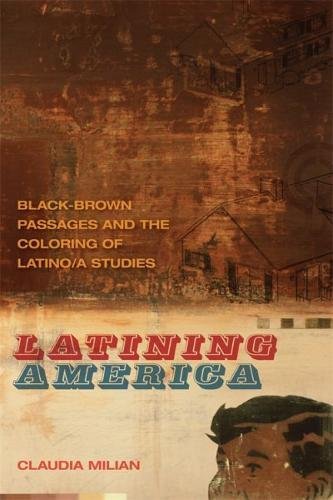
  • Latining America: Black-Brown Passages and the Coloring of Latino/a Studies

    University of Georgia Press
    2013-02-01
    288 pages
    5 b&w photos
    Trim size: 6 x 9
    Cloth ISBN: 978-0-8203-4435-5
    Paper ISBN: 978-0-8203-4436-2
    Ebook ISBN: 978-0-8203-4479-9

    Claudia Milian, Associate Professor of Spanish & Latin American Studies
    Duke University

    With Latining America, Claudia Milian proposes that the economies of blackness, brownness, and dark brownness summon a new grammar for Latino/a studies that she names “Latinities.” Milian’s innovative study argues that this ensnared economy of meaning startles the typical reading practices deployed for brown Latino/a embodiment.

    Latining America keeps company with and challenges existent models of Latinidad, demanding a distinct paradigm that puts into question what is understood as Latino and Latina today. Milian conceptually considers how underexplored “Latin” participants—the southern, the black, the dark brown, the Central American—have ushered in a new world of “Latined” signification from the 1920s to the present.

    Examining not who but what constitutes the Latino and Latina, Milian’s new critical Latinities disentangle the brown logic that marks “Latino/a” subjects. She expands on and deepens insights in transamerican discourses, narratives of passing, popular culture, and contemporary art. This daring and original project uncovers previously ignored and unremarked upon cultural connections and global crossings whereby African Americans and Latinos traverse and reconfigure their racialized classifications.

  • The demand for multiracial identity for the children of interracial marriage, however, may be explained in terms of a desire for status as long as we live in a society in which there is still a clear racial hierarchy. The demand that multiracial children be recognized as partly white did not come from blacks.  Nor is it surprising that Susan Graham, a major advocate for the multiracial category on the United States Census found an ally in Newt Gingrich, who opined that such a category might “‘be an important step toward transcending racial division.’” The enthusiasm for such alternative classifications leads skeptics to believe that this system of reclassification and the rhetoric of transcendence will make it easy to ignore the reality and the structure of racism.

    Deborah W. Post, “Cultural Inversion and the One-Drop Rule: An Essay on Biology, Racial Classification, and the Rhetoric of Racial Transcendence,” Albany Law Review, Volume 72, Issue 4 (2009):925-926.