• Racially Mixed People, DDC Table 5 Ethnic and National Groups, and MARC 21 Bibliographic Format Field 083 

    Cataloging & Classification Quarterly
    Volume 47, Issue 7 (October 2009)
    pages 657 – 670
    DOI: 10.1080/01639370903112005

    Julianne Beall
    Library of Congress, Washington, DC

    This article explores ways that notation in Table 5 Ethnic and National Groups of the Dewey Decimal Classification (DDC) system can be used to extend subject access to works about racially mixed people beyond that provided by the rules for constructing standard DDC numbers. The proposed approach makes use of the new 083 field (Additional Dewey Decimal Classification Number) in the MARC Bibliographic Format and techniques developed for DeweyBrowser beta v2.0 by OCLC Research, especially tag clouds.

    Read or purchase the article here.

  • The Flemish Bastard and the Former Indians: Métis and Identity in Seventeenth-Century New York

    The American Indian Quarterly
    Volume 34, Number 1 (Winter 2010)
    pages 83-108
    E-ISSN: 1534-1828 Print ISSN: 0095-182X
    DOI: 10.1353/aiq.0.0087

    Tom Arne Midtrød, Professor of History
    University of Iowa

    In 1709 the English Board of Trade recommended the settlement of three thousand Palatine migrants on the Hudson and Mohawk rivers in New York. The officials expressed confidence that these colonists would not only produce naval stores for the fleet but also intermarry with the Indians “as the French do” and lay the foundation for an expanding fur trade. They knew well that French Canadians had long mingled with Indians and produced children of mixed ancestry, or métis. What they perhaps did not know was that New York had long had métis of its own.

    Compared to Canada, New York never had a large métis population, and some historians have commented upon the social distance between Dutch and Indians. Nevertheless, intimacy resulting in métis children does not seem to have been uncommon in this colony. Dutch observers charged Indians with lack of sexual restraint, and liaisons between Dutch men and Native women sometimes worried the authorities. In 1638 the Dutch council prohibited adultery with blacks and Indians and at least occasionally took legal action. Manor lord and patroon Kiliaen van Rensselaer warned his nephew Arent van Curler and forbade his tenants from sleeping with Indian females. Sexual promiscuity with Indian women was among the charges levied against provincial secretary Cornelis van Tiehnoven by his political enemies in the 1640s. Prosecutions of colonists impregnating Indian women are known from the early English period.

    Native people probably thought these relations should involve a degree of reciprocity and mutual obligation. Historians have stressed that many Native peoples saw marriage and other intimate relations as means of incorporating outsiders, and an early Dutch observer alluded to the existence of this practice among Native traders in New Netherland…

    Read or purchase the article here.

  • Near Black: White-to-Black Passing in American Culture

    University of Massachusetts Press
    November 2008
    224 pages
    paper ISBN 978-1-55849-675-0; cloth ISBN 978-1-55849-674-3

    Baz Dreisinger, Associate Professor of English
    John Jay College of Criminal Justice, City University of New York
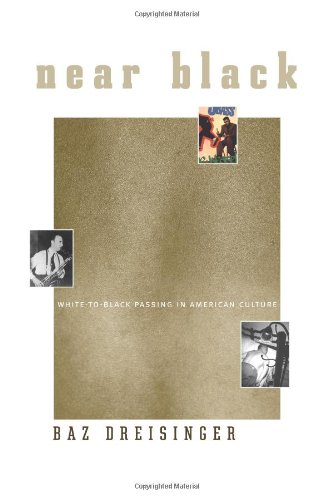
    A provocative look at the shifting contours of racial identity in America

    In the United States, the notion of racial “passing” is usually associated with blacks and other minorities who seek to present themselves as part of the white majority. Yet as Baz Dreisinger demonstrates in this fascinating study, another form of this phenomenon also occurs, if less frequently, in American culture: cases in which legally white individuals are imagined, by themselves or by others, as passing for black.

    In Near Black, Dreisinger explores the oft-ignored history of what she calls “reverse racial passing” by looking at a broad spectrum of short stories, novels, films, autobiographies, and pop-culture discourse that depict whites passing for black. The protagonists of these narratives, she shows, span centuries and cross contexts, from slavery to civil rights, jazz to rock to hip-hop. Tracing their role from the 1830s to the present day, Dreisinger argues that central to the enterprise of reverse passing are ideas about proximity. Because “blackness,” so to speak, is imagined as transmittable, proximity to blackness is invested with the power to turn whites black: those who are literally “near black” become metaphorically “near black.” While this concept first arose during Reconstruction in the context of white anxieties about miscegenation, it was revised by later white passers for whom proximity to blackness became an authenticating badge.

    As Dreisinger shows, some white-to-black passers pass via self-identification. Jazz musician Mezz Mezzrow, for example, claimed that living among blacks and playing jazz had literally darkened his skin. Others are taken for black by a given community for a period of time. This was the experience of Jewish critic Waldo Frank during his travels with Jean Toomer, as well as that of disc jockey Hoss Allen, master of R&B slang at Nashville’s famed WLAC radio. For journalists John Howard Griffin and Grace Halsell, passing was a deliberate and fleeting experiment, while for Mark Twain’s fictional white slave in Pudd’nhead Wilson, it is a near-permanent and accidental occurrence.

    Whether understood as a function of proximity or behavior, skin color or cultural heritage, self-definition or the perception of others, what all these variants of “reverse passing” demonstrate, according to Dreisinger, is that the lines defining racial identity in American culture are not only blurred but subject to change.

  • Questions for Benjamin Todd Jealous: Race Matters

    The New York Times
    2009-07-30

    Deborah Solomon

    As the new head of the National Association for the Advancement of Colored People, can you tell us how your organization plans to respond to the case of Henry Louis Gates Jr., the Harvard professor who was recently arrested for disorderly conduct at his own home — charges that have since been dropped — after he reportedly chewed out a cop who suspected him of burglary?
    Our local volunteers are already engaged with the Cambridge Police Department, as we are with police departments across this country. The next step is passing the End Racial Profiling Act in Congress. Racial profiling is a constant drumbeat in this country. It’s a form of humiliation that strikes like lightning on a daily basis, and that is part of what Professor Gates was responding to. It’s hard to be in your house, told you’re a burglary suspect and then when you are no longer a suspect, told you are the problem…

    …As the son of a white father and a black mother, do you refer to yourself as black?
    Yes, without qualification…

    Read the entire article here.

  • Obama Census Choice: African-American

    The Huffington Post
    2010-04-02

    Mark S. Smith

    WASHINGTON — He may be the world’s foremost mixed-race leader, but when it came to the official government head count, President Barack Obama gave only one answer to the question about his ethnic background: African-American.

    The White House confirmed on Friday that Obama did not check multiple boxes on his U.S. Census form, or choose the option that allows him to elaborate on his racial heritage. He ticked the box that says “Black, African Am., or Negro.”…

    …Obama the community activist and then politician always self-identified as African-American, and he now wears the mantle of America’s first black president with pride…

    Read the entire article here.

  • Who are the ‘Mixed’ ethnic group?

    Office for National Statistics [United Kingdom]
    May 2006

    Ben Bradford

    Introduction

    The last fifty years have seen the emergence of some new, predominantly British-born, ethnic minorities. These are the children of inter-ethnic partnerships, primarily partnerships between people from the White British group and people from ethnic minority groups. They include the children of White and Black Caribbean parents, White and Asian parents and White and Black African parents, as well as a multitude of other Mixed identities.

    The majority of people who have a Mixed ethnic identity have a White parent and were born in Britain. One of the key issues of interest about the Mixed ethnic groups concerns the extent to which they are more similar to the White group, or to the ethnic minority groups, from which they are drawn. For example, whether young people from the Mixed White and Black Caribbean group experience the relatively low unemployment of their White peers, or the much higher unemployment of their Black Caribbean peers.

    This article profiles the four Mixed ethnic groups identified in the 2001 Census. These groups are necessarily abstractions from the multitude of actual Mixed ethnicities which exist in Britain today. The three specific groups identified in the Census—Mixed White and Black Caribbean, Mixed White and Black African and Mixed White and Asian—were designed to allow the greatest number of people possible to easily identify themselves. Those who did not identify with one of these Mixed ethnicities could use a write-in space to provide their own description of their ethnicity.

    We look at the size of the groups, their demographic and socio-economic characteristics and we consider how they compare with other ethnic groups. This article is intended to complement similar analysis of the ‘Other’ ethnic groups already published by ONS. Together this work provides an overview of the characteristics of these less well known ethnicities.

    Table of contents

    Introduction
    Executive Summary
    1. The introduction of Mixed ethnic group categories on the Census
    2. Who are the Mixed ethnic groups?
    3. The size of the Mixed ethnic populations in England and Wales
    4. Age profile of the Mixed ethnic groups
    5. Country of Birth
    6. Religion
    7. Region of residence
    8. Socio-economic occupational class
    9. Economic Activity
    10. Unemployment
    11. Educational Attainment
    References

    Read the entire article here.

  • Measurement Uncertainty in Racial and Ethnic Identification Among Adolescents of Mixed Ancestry: A Latent Variable Approach

    Structural Equation Modeling: A Multidisciplinary Journal
    Volume 17, Issue 1 (January 2010)
    pages 110 – 133
    DOI: 10.1080/10705510903439094

    Allison J. Tracy
    Wellesley Centers for Women

    Sumru Erkut
    Wellesley Centers for Women

    Michelle V. Porche
    Wellesley Centers for Women

    Jo Kim
    Wellesley Centers for Women

    Linda Charmaraman
    Wellesley Centers for Women

    Jennifer M. Grossman
    Wellesley Centers for Women

    Ineke Ceder
    Wellesley Centers for Women

    Heidie Vázquez Garca
    Wellesley Centers for Women

    In this article, we operationalize identification of mixed racial and ethnic ancestry among adolescents as a latent variable to (a) account for measurement uncertainty, and (b) compare alternative wording formats for racial and ethnic self-categorization in surveys. Two latent variable models were fit to multiple mixed-ancestry indicator data from 1,738 adolescents in New England. The first, a mixture factor model, accounts for the zero-inflated mixture distribution underlying mixed-ancestry identification. Alternatively, a latent class model allows classification distinction between relatively ambiguous versus unambiguous mixed-ancestry responses. Comparison of individual indicators reveals that the Census 2000 survey version estimates higher prevalence of mixed ancestry but is less sensitive to relative certainty of identification than are alternate survey versions (i.e., offering a “mixed” check box option, allowing a written response). Ease of coding and missing data are also considered in discussing the relative merit of individual mixed-ancestry indicators among adolescents.

    Read or purchase the article here.

  • “… But … But I am Brown.” The Ascribed Categories of Identity: Children and Young People of Mixed Parentage

    Child Care in Practice
    Volume 13, Issue 2 (April 2007)
    pages 83 – 94
    DOI: 10.1080/13575270701201169

    Annabel Goodyer, Principal Lecturer in Social Work
    London South Bank University

    Toyin Okitikpi

    This paper explores the concept of the categorisation of social groups by looking at the issue of ascribed categories of identity for children and young people of mixed parentage. Our exploration of the knowledge-base in this area reveals that children and young people have clearly expressed views about their racial identity and that these views are broadly consistent across research studies. In essence, children and young people’s expressed views are that they are not mixed-race, black or white, but are in fact brown. The emerging sociology of childhood and the government’s current child participation agenda emphasise the centrality of children and young peoples’ perspectives on the provision of services that seek to support them. Through this perception, which places children and young people’s own understandings of their racial identity at the forefront of the analysis, we added fresh understandings to the existing data concerning ascribed categories of identity for children and young people of mixed parentage.

    Read or purchase the article here.

  • Who Counts & Who’s Counting? 38th Annual Conference National Association for Ethnic Studies Conference

    National Association for Ethnic Studies, Inc.
    2010-04-08 through 2010-04-10
    L’Enfant Plaza Hotel
    Washington, D.C.

    Dr. Larry Shinagawa, NAES 2010 Conference Chair

    Our theme of “Who Counts and Who’s Counting” signals the importance of Washington, D.C. as a physical, cultural, and social nexus for policy decisions that will shape the 21st Century. With the 2010 Census signaling the dramatic changes that are affecting all ethnic and racial communities in the United States, who is doing the counting and how we construct the discourse and policies of who counts will be central to the future of all residents of the United States and will shape global relations around the world. We hope you will participate in this important dialogue; welcome to NAES 2010 in Washington, D.C.!

    A paritial tenative program is below (All times are local EDT):

    Session II – Thursday 10:30 – 10:45
    Whiteness studies
    Heidi Cooper, Emily Drew, Zaid Mahir

    Racial classifications and stereotypes
    Jamelia Bastien, Bonazzo Claude, Jacco van Sterkenburg

    Session III – Thursday 13:30 – 14:45
    Black identities
    Janet Awokoya, Anne Brubaker, Yanyi Djamba, Mizaba Abedi

    Defining Race
    Tiffany King, Arturo Nunez, Maisha Wester

    Session IV – Thursday 15:00 – 16:15
    Beyond the binary of race
    Kaysha Corinealdi, José Luis Morín, Jodie Roure

    Session IX – Saturday 09:00 – 10:15
    European Identities
    Daniel Carawan, Jon Keljik, Elizabeth Onasch, Samantha Pockele

    The race in “mixed” race? Reiterations of power and identity
    Sue-Je Gage, Rainier Spencer, Nicole Truesdell

  • 3 Questions: Melissa Nobles on the U.S. Census

    MIT News
    Massachusetts Institute of Technology
    2010-04-01

    Melissa Nobles, Arthur and Ruth Sloan Professor of Political Science
    Massachusetts Institute of Technology

    As America’s decennial headcount gets under way, an MIT political scientist discusses the history of race and ethnicity in the U.S. Census

    April 1 marks National Census Day, the official date of this year’s U.S. Census. To help put the census in context, MIT News spoke with Associate Professor of Political Science Melissa Nobles, whose teaching and research interests span the comparative study of racial and ethnic politics, and issues of retrospective justice. Her book, “Shades of Citizenship: Race and the Census in Modern Politics” (Stanford University Press, 2000), examined the political origins and consequences of racial categorization in demographic censuses in the United States and Brazil.

    Q. You’ve noted in your book that the initial impetus for census-taking was political, and yet the earliest censuses also included racial categories. Why are race and ethnicity included in the U.S. Census?

    A. Census-taking in the U.S. is as old as the Republic. The U.S. Constitution mandates that an “actual enumeration” be conducted every 10 years to allow for representational apportionment. The initial impetus for census taking was political. Yet the earliest censuses also included racial categories. The inclusion of these categories offers important insights into the centrality of racial and ethnic identifications in American political, economic and social life. This centrality continues to this day…

    …The 1850 census first introduced the category “mulatto,” at the behest of a southern physician, in order to gather data about the presumed deleterious effects of “racial mixture.” Post-Civil War censuses, which continued to include the “mulatto” category, reflected the enduring preoccupation with “racial mixing.”..

    Read the entire article here.