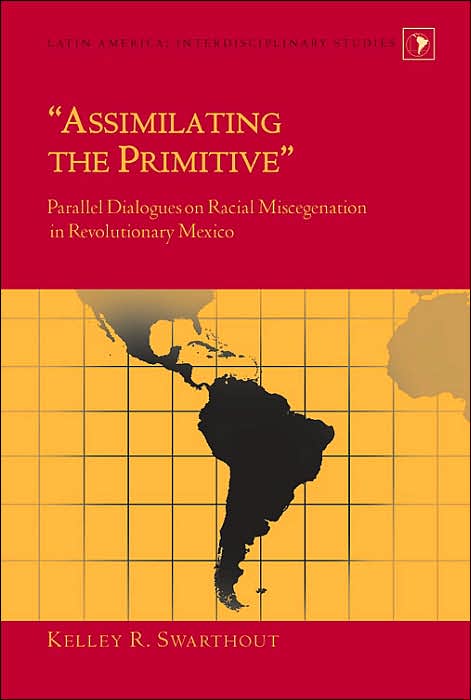
• “Assimilating the Primitive”: Parallel Dialogues on Racial Miscegenation in Revolutionary Mexico

    Peter Lang Publishing Group
    2004
    179 pages, 4 tables
    Hardback ISBN: 978-0-8204-6322-3

    Kelley R. Swarthout, Visiting Assistant Professor of Spanish
    Colgate University, New York

    This book examines the Mexican nationalist rhetoric that promoted race mixing as a cultural ideal, placing it within its broader contemporary polemic between vitalist and scientific thought. Part of its analysis compares the attitudes of anthropologist Manuel Gamio and educator José Vasconcelos with those of the European primitivist D. H. Lawrence, and concludes that although Gamio and Vasconcelos made lasting contributions to the construction of popular notions of mexicanidad, their paradigms were fatally flawed because they followed European prescriptions for the development of national identity. This ultimately reinforced the belief that indigenous cultural expression must be assimilated into the dominant mestizo culture in order for Mexico to progress. Consequently, these thinkers were unsuccessful in resolving the cultural dilemma Mexico suffered in the years immediately following the Revolution.

    Table of Contents

    • List of Tables
    • Acknowledgments
    • Chapter 1: Theory
      • Primitive as a Western Construct
      • Science, Race, and the Nation
      • The Vitalist Opposition to Science
    • Chapter 2: The History
      • Mestizaje: Mexico’s National Myth
      • The Emergence of Racial Hybridity
      • Envisioning a Mestizo Middle Class
      • The Birth of Mexican Cultural Nationalism
    • Chapter 3: The Dialogue
      • Scientificism vs. Vitalism in Revolutionary Mexico
      • Manuel Gamio and Scientific Indigenism
      • Jose Vasconcelos and the Spiritual Renovation of Mexican Culture
      • D.H. Lawrence’s American Journey: A Pilgrimage to the “Indian Source”
    • Epilogue: Toward a Postmodern Mexican Identity
    • Bibliography
    • Index
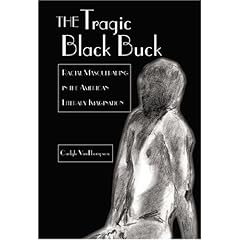
  • The Tragic Black Buck: Racial Masquerading in the American Literary Imagination

    Peter Lang Publishing Group
    2004
    198 pages
    ISBN: 978-0-8204-6206-6

    Carlyle Van Thompson, Acting Dean, School of Liberal Arts and Education
    Medgar Evers College, the City University of New York

    The Tragic Black Buck examines the phenomenon, often paradoxical, of black males passing for white in American literature. Focusing on the first third of the twentieth century, this book argues that black individuals successfully assuming a white identity represent a paradox, in that passing for white exemplifies a challenge to the hegemonic philosophy of biological white supremacy, while denying blackness. Issues of race, gender, skin color, class, and law are examined in the literature of passing, involving the historical, theoretical, and literary tropes of miscegenation, mimicry, and masquerade. The narratives examined in The Tragic Black Buck are Charles Waddell Chesnutt‘s The House Behind the Cedars, James Weldon Johnson‘s The Autobiography of an Ex-Coloured Man, F. Scott Fitzgerald‘s The Great Gatsby, and William Faulkner‘s Light in August.

  • Census and Consensus? A Historical Examination of the US Census Racial Terminology Used for American Residents of African Ancestry

    Peter Lang Publishing Group
    2005-07-31
    232 pages
    20.6 x 14.7 x 1.5 cm
    US-ISBN: 978-0-8204-7667-4

    Iman Makeba Laversuch, Lecturer
    University of Cologne, Germany

    Colored, Black, Negro, Mulatto, Quadroon, Octoroon, African American. This book provides an in-depth analysis of the language policies governing the selection and application of the racial classifiers used by the United States Census for American residents of African ancestry over the past 200 years. The historical linguistic investigation is supplemented by a corpus of letters sent by the American public concerning not only the government’s controversial policies of racial designation, but also its methods of racial classification. Detailed demographic information about the evolving multicultural diversity of the US society is provided, along with a critical political discussion of the ways in which these sociological developments may effect the ways Americans define themselves.

    Table of Contents

    • An Interdisciplinary Survey of Past Research on Racial Labeling
    • Miscegenation”: The Historical Confound to the US Census System of Racial Classification for US Residents of African Ancestry
    • Strategies for Determining the Racial Classification of American Residents with African Ancestry
    • The Historical Inventory of Racial Ethnonyms
    • A Diachronic Analysis of the Individual Racial Ethnonyms from 1790 to 2000
    • A Diachronic Analysis of the System of Racial Labels
    • Identity Politics, Language Planning, and the US Census: The Costs and Benefits of Change.
  • The Monochrome Society: Americanness and the unsung agreement across racial lines

    Policy Review
    Hoover Institution
    Stanford University
    Feburary & March 2001

    Amitai Etzioni

    Various demographers and other social scientists have been predicting for years that the end of the white majority in the United States is near, and that there will be a majority of minorities. cnn broadcast a special program on the forthcoming majority of people of color in America. President Clinton called attention to this shift in an address at the University of California, San Diego on a renewed national dialogue about race relations. His argument was that such a dialogue is especially needed as a preparation for the forthcoming end of the white majority, to occur somewhere in the middle of the next century. In his 2000 state of the union address, Clinton claimed that “within 10 years there will be no majority race in our largest state, California. In a little more than 50 years, there will be no majority race in America. In a more interconnected world, this diversity can be our greatest strength.” White House staffer Sylvia Mathews provided the figures as 53 percent white and 47 percent a mixture of other ethnic groups by 2050. Pointing to such figures, Clinton asked rhetorically if we should not act now to avoid America’s division into “separate, unequal and isolated” camps.

    Some have reacted to the expected demise of the white majority with alarm or distress. In The Disuniting of America (1992) Arthur Schlesinger Jr. decries the “cult of ethnicity” that has undermined the concept of Americans as “one people.” He writes, “Watching ethnic conflict tear one nation after another apart, one cannot look with complacency at proposals to divide the United States into distinct and immutable ethnic and racial communities, each taught to cherish its own apartness from the rest.” He also criticizes the “diversity” agenda and multiculturalism, arguing that “the United States has to set a monocultural example in a world rent by savage ethnic conflict; the United States must demonstrate ‘how a highly differentiated society holds itself together.’”

    …Race as social construction

    Many social scientists call into question the very category of race drawn on by those who foresee increasing racial diversity. Alain Corcos, author of several books on genetics, race, and racism, notes that “race is a slippery word,” one that is understood in varying manners at various times, one without a single definition we may readily grasp. He writes in The Myth of Human Races (1984):

    Race is a slippery word because it is a biological term, but we use it every day as a social term. . . . Social, political, and religious views are added to what are seen as biological differences… Race also has been equated with national origin… with religion . . . with language.

    The diversity of characteristics by which race is and has been defined points to its unsatisfactory quality as a tool for categorizing human beings. Both anthropological and genetic definitions of race prove inadequate, because while each describes divisions among the human population, each fails to provide reliable criteria for making such divisions. As Corcos notes, they “are vague. They do not tell us how large divisions between populations must be in order to label them races, nor do they tell us how many there are.” Importantly, “ [t]hese things are, of course, all matters of choice for the classifier.”…

    …Intermarriage

    Last but not least, the figures used by those who project a majority of minorities or the end of a white majority are misleading. These figures are based on a simplistic projection of past trends. How simplistic these projections often are can be quickly gleaned from the Census projection that the number of Native Americans will grow from 2,433,000 in 2000, or approximately 1 percent of the total population, to 4,405,000, or approximately 1 percent of the total population by the year 2050, and to 6,442,000, or approximately 1 percent of the total population by the year 2100. That is, 100 years and no change.

    This tendency to depict the future as a continuation of the past is particularly misleading because it ignores the rapidly rising category of racially mixed Americans, the result of a rising number of cross-racial marriages and a rejection of monoracial categories by some others, especially Hispanic Americans…

    …The merits of a new category

    Dropping the whole social construction of race does not seem in the cards, even if the most far-reaching arguments against affirmative action and for a “color-blind” society win the day. However, there are strong sociological reasons to favor the inclusion of a multiracial category in the 2010 Census.

    Introducing a multiracial category has the potential to soften racial lines that now divide America by rendering them more like economic differences and less like caste lines. Sociologists have long observed that a major reason the United States experiences relatively few confrontations along class lines is that Americans believe they can move from one economic stratum to another. (For instance, workers become foremen, and foremen become small businessmen, who are considered middle class.) Moreover, there are no sharp class demarcation lines as in Britain; in America many workers consider themselves middle class, dress up to go to work, and hide their tools and lunches in briefcases, while middle class super-liberal professors join labor unions. A major reason confrontations in America occur more often along racial lines is that color lines currently seem rigidly unchangeable.

    If the new category is allowed, if more and more Americans choose this category in future decades, as there is every reason to expect given the high rates of intermarriage and a desire by millions of Americans to avoid being racially boxed in, the result may be a society in which differences are blurred…

    Read the entire article here.
  • In multiracial America, the census puts us in a box

    Washington Post
    2010-03-21

    Susan Straight, Professor of Creative Writing
    University of California, Riverside

    I received the census form in the mail last week, and I was ready. A vaguely admonitory letter from the Census Bureau had arrived the week before, urging me to fill out the form because the results would be used to “help each community get its fair share of government funds for highways, schools, health facilities, and many other programs you and your neighbors need.” It ended with a warning: “Without a complete, accurate census, your community may not receive its fair share.”

    That’s a lot of fairness and sharing and community going on. But as my three daughters and I talked about the form — and in particular its racial and ethnic categories — we started wondering: How does the census really define our community, and how would that affect whatever our fair share would be?

    The first time I got to check a census box for a child, it was 1990. I had an 8-month-old daughter with curly, brown-black hair, cinnamon-dark eyes and almond-colored skin. Her father is a mix of African, Irish and Native American; I am white; and since we could check only one box, the only option available for her was “Other,” as if she were from a different planet…

    Read the entire article here.

    Susan Straight’s new novel, “Take One Candle, Light a Room,” about a mixed-race family, will be published in October.

  • How to really be accurate on ‘race’ on the Census

    The American Thinker
    2010-03-17

    James Lewis

    Not many people like to fill in the “race” category on the Census, because we know perfectly well that it comes from the Left, which has found another way to slice and dice the American people, to set us against each other, and to empower the Left. Which happens to be exactly what the National Socialists did under you-know-who. You had to carry papers identifying your race, and your parents’ and grandparents’ race. Under slavery and segregation the Dixiecrat South did the same thing. But the main point, of course, was to separate the blacks and the whites…

    …But Mr. Science has an answer. If we’re going to play race games let’s do it scientifically. For example, if you’re black that’s meaningless unless you specify Bantu, Hutu/Tutsi, San, or any number of other lineages within Africa. Africa has the biggest human variety in the world.  Obama looks totally different from the rest of the Black Caucus; it’s because he is. He belongs to a different biological lineage. He’s not a Bantu. But most American blacks are mixed-race, of course, like Obama himself.

    Likewise, if you’re pure Irish, your race is Gaelic. If you’re Irish-English, you’re Gaelic-Caucasian or something close to that. If you look blond, you’re likely to be a Northern European. If you’re Jewish but you look like a Russian, you are Semitic-Nordic-Slavic. If you’re Jewish and you look like a Spaniard, you’re Semitic-Hispanic. If you’re Jewish from Yemen, you’re probably Semitic-Arabic. If you’re a pure cohen, you’re Semitic back some 3,000 years, especially if you have heritable diseases like Tay-Sachs. But of course going earlier than that, there are plenty of generations back to the human population bottleneck in North Africa, where humans were reduced to some 5,000 individuals. That’s the shared founding population for all of us. (And everybody was Black at that time.)…

    Read the entire article here.

  • Count Yourself In California: The Census on Multiracial ID’s

    Spot.Us
    2010-03-18

    Denise L. Poon

    When she fills out her 2010 Census form this week, Mei-Ling Malone is looking forward to answering Question #9 ― “the race question.” She’s adamant about documenting her multiracial background. 

    Malone, who studied multiracial politics at UC [University of California] Irvine and is now pursuing a doctorate at UCLA, has an African American father and a Taiwanese mother. For Malone, 26, this is her first opportunity to respond to a Census and possibly provide a different answer to the race question than what her parents may have noted for her 10 years ago.

    President Obama is called our first black president, yet his mother was white,” she said. “For a majority of people who are black and multiracial, we are physically viewed as black, and treated, or discriminated as such. I’m glad that when I indicate I’m multiracial, I’m also counted as black.”…

    …The actual data collection process works as follows: The Census Bureau first takes responses from 2010 Census forms and scans and captures the answers. Then, this information is turned into electronic text. For Question #9, an “auto coder” ― a computer program that classifies and tabulates write-in information ― then tabulates the data into different multiracial combinations of the initial race groups.

    The five major race categories, as defined by the OMB, plus the “Some Other Race” category, can be put together in 57 possible unique combinations of two, three, four, five or six races. When this information is added to data of the six single-race groups, the Census Bureau will have 63 different tabulated categories…

    “For those who may think that the option to identify with more than one race is trivial, they are mistaken,” said Christopher Parker, a professor of political science at the University of Washington. “Marking more than one box can affect both the enforcement of civil rights and inform the political behavior of those who choose more than one racial category with which to identify.”…

    Read the entire article here.

  • The age of Obama: The changing place of minorities in British and American society

    Manchester University Press
    2010-04-01
    192 pages
    234x156mm
    Hardback ISBN: 9780719082771; Paperback ISBN: 9780719082788

    Tom Clark, Columnist
    The Guardian

    Robert D. Putnam, and Isabel Malkin Professor of Public Policy
    Harvard University

    Edward Fieldhouse, Professor of Social and Political Science and Director of the Institute for Social Change
    University of Manchester, United Kingdom

    Drawing on collaborative research from a distinguished team at Harvard and Manchester universities, The age of Obama asks how two very different societies are responding to the tide of diversity that is being felt around the rich world. Guardian journalist Tom Clark, Robert D. Putnam – best-selling author of Bowling Alone – and Manchester’s Edward Fieldhouse offer a wonderfully readable account. Like Bowling alone, The age of Obama mixes social scientific rigor with accessible charts and lively arguments. It will be enjoyed by politics, sociology and geography students, as well as by anyone else with an interest in ethnic relations.

    Injustice, it turns out, still blights the lives of many UK and US minorities – particularly African Americans. And there are signs the new diversity strains community life. Yet in both countries, public opinion is running irreversibly in favour of tolerance. That augurs well for the future – and suggests a British Obama cannot be ruled out.

    Table of Contents

    Summary
    1. Introduction: the diversity revolution 
    2. Two concepts in two countries: race and migration
    3. Home truths: how minorities live
    4. The rickety ladder of opportunity: minorities and work
    5. Mosaic or cracked vase? Diversity and community life
    6. Distorting mirrors: media framing and political debate
    7. Tidal generation: politics and deeper currents of public opinion
    8. Concluding thoughts: making a success of the revolution
    Bibliography
    Index

  • Homelands and Indigenous Identities in a Multiracial Era

    Social Science Research
    Article In Press, Accepment Manuscript
    Online: 2010-02-17

    Carolyn A. Liebler, Assistant Professor
    Department of Sociology and Minnesota Population Center
    University of Minnesota

    Although multiple race responses are now allowed on federal censuses and surveys, most interracially married single-race parents report a single race for their children. It is well-established that the social context of these racial identification decisions affects their outcome. This research focuses instead on the physical context. It is argued that homelands – physical places with cultural meaning – are an important component of the intergenerational transfer of a single-race identity in indigenous mixed-race families. To test potential explanations for the relationship between homelands and indigenous identities, this research focuses on families in which an interracially married American Indian lives with a spouse and child and was included in the Census 2000 5% Public Use Microdata Sample. Logistic regression reveals a strong effect of living in an American Indian homeland on the child’s chances of being reported as single-race American Indian. This effect remains even after accounting for strong ties to American Indians and other groups, family and area poverty levels, geographic isolation, and the racial composition of the area. The intergenerational transmission of strong identities continues in this multiracial era (as it has for centuries) in the context of culturally meaningful physical places.

    Read or purchase the article here.

  • Beyond Black and White: A film by Nisma Zaman

    Women Make Movies
    1994
    28 minutes
    Color, 16mm/DVD
    Order No. W99431

    Beyond Black and White is a personal exploration of the filmmaker’s bicultural heritage (Caucasian and Asian/Begali) in which she relates her experiences to those of five other women from various biracial backgrounds. In lively interviews and group discussions these women reveal how they have been influenced by images of women in American media, how racism has affected them, and how their families and environments have shaped their racial identities. Their experiences are placed within the context of history, including miscegenation laws and governmental racial classifications. Beyond Black and White is a remarkable celebration of diversity in American society.