• Sociology Noir: Studies at the University of Chicago in Loneliness, Marginality and Deviance, 1915–1935

    McFarland Publishers
    2007
    196 pages
    7 photos, bibliography, index
    softcover ISBN: 978-0-7864-2990-5

    Roger A. Salerno, Professor of Sociology
    Pace University, New York

    Between 1915 and 1935 the University of Chicago was the center for the production of innovative sociological research that unearthed the marginalized existence of unconventional Americans. Referred to as the Chicago school monographs by social historians, these works brought acclaim to the country’s premiere graduate program in sociology. Working at the shadowy margins of the city, these Chicago school scholars dramatically examined the lives of delinquents, prostitutes, gangsters, and homeless men. Their work harmonized with narratives of proletarian and pulp fiction and the serialized newspaper accounts of urban vice and deviance. This book offers a survey of some of these key monographs such as The Unadjusted Girl, The Hobo, The Jack-Roller and The Taxi Dance Hall.

  • Place, scale and the racial claims made for multiracial children in the 1990 US Census

    Ethnic and Racial Studies
    Volume 32, Issue 3 (March 2009)
    pages 522 – 547

    Steven R. Holloway, Professor of Geography
    University of Georgia

    Richard Wright, Orvil E. Dryfoos Professor of Geography and Public Affairs and Geography Department Chair
    Dartmouth College

    Mark Ellis, Professor of Geography
    University of Washington, Seattle

    Margaret East, PhD., Independent Scholar
    Lexington, Virginia

    Multiracial children embody ambiguities inherent in racial categorization and expose fictions of discrete races. Nevertheless, parents of multiracial children were asked for the 1990 US Census to report a single race for their offspring. Using confidential 1990 Census micro-data, we investigate the choices parents made for the three most common racially mixed household types (Asian-white, black-white and Latino-white) in twelve large metropolitan areas. We find that context affects the reporting of children’s racial identity. We examine these effects with models that incorporate three spatial scales: households, neighbourhoods and metropolitan areas. Model estimates reveal that racial claims made by parents of Latino- and Asian-white (but not black-white) children varied significantly across metropolitan area. A neighbourhood’s proportion white increased the probability that parents reported their children as white, while a neighbourhood’s racial diversity increased the probability that black-white parents claimed a non-white race (black or ‘other’) for their children.

    Read or purchase the article here.

  • “Remarkable” Mixed-Race Family in 20th Century Is Subject of Book Discussion [with Book Signing by the Author]

    James Madison Building
    Dining Room A, Sixth Floor, J
    101 Independence Aveune, SE
    Washington, DC
    2010-03-03, 12:30 EST (Local Time)
    Webcast Time: 00:59:24

    Adele Logan Alexander, Professor of History
    George Washington University

    Parallel Worlds” Focuses on “the Enduring (In)significance of Melanin”

    When William Henry Hunt married Ida Alexander Gibbs in the spring of 1904, their wedding was a glittering Washington social event that joined an Oberlin-educated diplomat’s daughter and a Wall Street veteran who could trace his lineage to Jamestown. Their union took place in a world of refinement and privilege, but both William and Ida had mixed-race backgrounds, and their country therefore placed severe restrictions on their lives because, at that time, “one drop of colored blood” classified anyone as a Negro…

    Adele Logan Alexander has written a fascinating account of this couple in “Parallel Worlds: The Remarkable Gibbs-Hunts and the Enduring (In)significance of Melanin” (University of Virginia Press, 2010). Alexander will discuss and sign her book on Wednesday, March 3, at 12:30 p.m. in Dining Room A, sixth floor, James Madison Building, 101 Independence Ave. S.E. The event, part of the Books and Beyond author series of the Center for the Book, is free and open to the public; no tickets are required…

    ..The Center for the Book was established by Congress in 1977 “to use the resources and prestige of the Library of Congress to promote books, reading, literacy and libraries.” With its many educational programs that reach readers of all ages, through its support of the National Book Festival and through its dynamic state centers in the 50 states, the District of Columbia and the U.S. Virgin Islands, the Center for the Book has developed a nationwide network of organizational partners dedicated to promoting the wonders and benefits of reading. The Center also oversees the new Read.gov website, with its exclusive “Exquisite Corpse Adventure” serialized story.

    View the entire webcast here.

    Listen to National Public Radio‘s Michel Martin interview Adele Logan Alexander about the book on Tell Me More (on  2010-02-10) here.

  • Race and the “One Drop Rule” in the Post-Reconstruction South

    Renegade South: Histories of Unconventional Southerners
    2009-03-17

    Victoria E. Bynum, Emeritus Professor of History
    Texas State University, San Marcos

    Many people, perhaps most, think of “race” as an objective reality. Historically, however, racial categorization has been unstable, contradictory, and arbitrary. Consider the term “passing.” Most of us immediately picture a light-skinned person who is “hiding” their African ancestry. Many would go further and accuse that person of denying their “real” racial identity. Yet few people would accuse a dark-skinned person who has an Anglo ancestor of trying to pass for “black,” and thereby denying their “true” Anglo roots!

    So why is a white person with an African ancestor presumed to be “really” black? In fact, in this day of DNA testing, it’s become increasingly clear that many more white-identified people have a “drop” or two of African ancestry than most ever imagined. Are lots of white folks (or are they black?) “passing,” then, without even knowing it?..

    Read the entire article here.

  • The Sorcery of Color: Identity, Race, and Gender in Brazil

    Temple University Press
    November 2006
    336 pages
    6×9
    6 tables
    Paper EAN: 978-1-59213-351-2; ISBN: 1-59213-351-7
    Cloth EAN: 978-1-59213-350-5; ISBN: 1-59213-350-9
    Electronic Book EAN: 978-1-59213-352-9

    Elisa Larkin Nascimento, Director
    IPEAFRO Afro-Brazilian Studies and Research Institute, Rio de Janeiro, Brazil

    Originally published in 2003 in Portuguese, The Sorcery of Color argues that there are longstanding and deeply-rooted relationships between racial and gender inequalities in Brazil. In this pioneering book, Elisa Larkin Nascimento examines the social and cultural movements that have attempted, since the early twentieth century, to challenge and eradicate these conjoined inequalities.

    The book’s title describes the social sleight-of-hand that disguises the realities of Brazilian racial inequity. According to Nascimento, anyone who speaks of racism—or merely refers to another person as black—traditionally is seen as racist. The only acceptably non-racist attitude is silence. At the same time, Afro-Brazilian culture and history have been so overshadowed by the idea of a general “Brazilian identity” that to call attention to them is also to risk being labeled racist.

    Incorporating leading international scholarship on Pan Africanism and Afrocentric philosophy with the writing of Brazilian scholars, Nascimento presents a compelling feminist argument against the prevailing policy that denies the importance of race in favor of a purposefully vague concept of ethnicity confused with color.

    Table of Contents

    • Acknowledgments
    • List of Tables
    • List of Abbreviations
    • Introduction to the English Edition
    • Preface – Kabengele Munanga
    • Introduction
    • 1. Identity, Race, and Gender
    • 2. Brazil and the Making of “Virtual Whiteness”
    • 3. Constructing and Desconstructing the “Crazy Creole”
    • 4. Another History: Afro-Brazilian Agency (São Paulo and Rio de Janeiro, 1914-1960)
    • 5. The Black Experimental Theater: Plots, Texts, and Actors
    • Glossary of Brazilian Words
    • Bibliographical References

    …The second obstacle to the discussion of race in Brazil is resistance to the idea that African populations in different parts of the world share a common experience. The presumption is that blacks in Brazil are in a unique situation determined solely by the circumstances of their society and have little or nothing in common with black populations in other parts of the world. Critics have frequently accused the black social movement in Brazil of attempting to import foreign standards and raising a problem that has never existed before. On the other hand, the concerns of the black movement often revolve around issues specific to Brazil rather than racism as a world phenomenon.

    But racist domination is worldwide in scope. It derives from the historical imposition of Western hegemony over non-Western peoples and its essence is expressed in the ideology of white supremacy. The standard of whiteness affects the identity constructs of all dominated peoples, making the issue of identity crucial, but oftentimes, it is expressed in specific local terms. In Brazil, the sorcery of color transforms mixed-race identity into a permanent search for the simulation of whiteness…

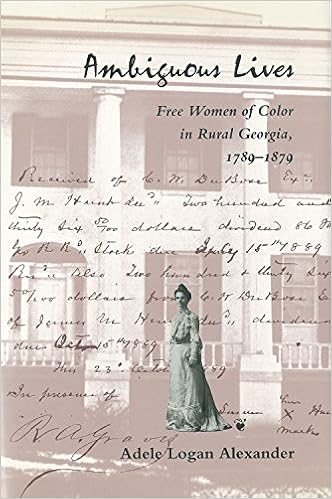
  • Ambiguous Lives: Free Women of Color in Rural Georgia, 1789-1879

    University of Arkansas Press
    1992
    304 pages
    ISBN Cloth: 1-55728-214-5
    ISBN Paper: 1-55728-215-3
    Out of Print

    Adele Logan Alexander, Professor of History
    George Washington University, Washington, D.C.

    1992 Winner, Gustavus Myers award as one of the year’s outstanding books promoting racial understanding.

    Historians have produced scores of studies on white men, extraordinary white women, and even the often anonymous mass of enslaved Black people in the United States. But in this innovative work, Adele Logan Alexander chronicles there heretofore undocumented dilemmas of one of nineteenth-century America’s most marginalized groups—free women of color in the rural South.

    Ambiguous Lives focuses on the women of Alexander’s own family as representative of this subcaste of the African-American community. Their forbears, in fact, included Africans, Native Americans, and whites. Neither black nor white, affluent nor impoverished, enslaved nor truly free, these women of color lived and died in a shadowy realm situated somewhere between the legal, social, and economic extremes of empowered whites and subjugated blacks. Yet, as Alexander persuasively argues, these lives are worthy of attention precisely because of these ambiguities—because the intricacies, gradations, and subtleties of their anomalous experience became part of the tangled skein of American history and exemplify our country’s endless diversity, complexity, and self-contradictions.

    Written as a “reclamation” of a long-ignored substratum of our society, Ambiguous Lives is more than the story of one family—it is a well-researched and fascinating profile of America, its race and gender relations, and its complex cultural weave.

  • Kilombismo, Virtual Whiteness, and the Sorcery of Color

    Journal of Black Studies
    Volume 34, Number 6 (2004)
    pages 861-880
    DOI: 10.1177/0021934704264009

    Elisa Larkin Nascimento
    Afro-Brazilian Studies and Research Institute

    This article explores the legacy and current presence of racism in Brazil, particularly their unique expression in the juxtaposition of the miscegenation ideology of nonracism with the living legacy of Lombrosian criminology. The author proposes the Sorcery of Color as a metaphor for the Brazilian standard of race relations, which transforms a perverse system of racial domination into a pretense of antiracist ideals and establishes what the author describes as the category of virtual whiteness, a fulcrum of identity intrinsically intermeshed with issues of gender and patriarchy. The groundings of Afrocentric thought can be found in the writings and actions of African Brazilian intellectuals of the 20th century, and its most articulated expression is the thesis of Kilombismo, developed by Abdias do Nascimento in the context of his work in Pan-African affairs in the 1970s and 1980s.

    Read or purchase the article here.

  • A conversation with Victoria E. Bynum, author of The Long Shadow of the Civil War: Southern Dissent and Its Legacies

    University of North Carolina Press
    April 2010

    Victoria E. Bynum, author of The Long Shadow of the Civil War: Southern Dissent and Its Legacies, discusses three Unionist strongholds in the South,

    Q: There seems no end to books about the American Civil War. What does The Long Shadow of the Civil War offer that is new?

    A: Although Civil War books about the home front are not new, this is a new sort of home front study that focuses on three communities from three different states. Rather than close with the war and Reconstruction, The Long Shadow of the Civil War follows individual Unionists and multiracial families into the New South era and, in some cases, into the twentieth century. This historical sweep allows the reader to understand the ongoing effects of the war at its most personal levels…

    …Q: Newt Knight, the controversial “captain” of the Knight Company, is a polarizing figure who even today evokes heated arguments among readers. Why is this so, and how did it affect your historical treatment of him?

    A: As long as we continue to debate the causes, meanings, and effects of the Civil War, Newt Knight’s motives and character will also be debated. We know that he defied Confederate authority during the war, supported Republican Reconstruction afterward, and openly crossed the color line to found a mixed-race community. To neo-Confederates, such facts make Newt a scoundrel and a traitor to his country and his race. To neo-abolitionists, he is a backwoods Mississippi hero who defended his nation and struggled to uplift the black race. My response to such powerful and emotional narratives is to examine critically not only the documentary evidence, but also the mountain of published opinions about Newt Knight that have too often functioned as “evidence” for both sides of the debate.

    Q: Newt Knight, his white wife Serena, and former family slave, Rachel, were the founding parents of a multiracial community. What sort of a community was it in terms of racial identity? How did members of the community identify themselves racially, as opposed to how the larger white society defined them?

    A: As segregation took hold in New South Mississippi (1880-1900), the descendants of Newt, Serena, and Rachel were increasingly defined by white society as black, i.e. as “Negroes,” despite being of European, African, and Native American ancestry. Before the Civil Rights Movement of the 1950s, however, few of these descendants identified themselves as “black.” Depending on their physical appearance, including skin shade and hair texture, descendants of Newt and Rachel variously defined themselves as white, Indian, or colored. Whereas white society applied a “one drop rule” that grouped together all people of African ancestry, these descendants self-identified in ways that reflected their multiracial heritage.

    There is no direct evidence of how Newt, Serena, or Rachel racially identified their multiracial descendants. Descendant Yvonne Bivins, the most thorough Knight researcher, was told by her elders that Newt Knight actively encouraged his descendants to identify as white. All that is certain — but nonetheless remarkable — is that they economically supported, nurtured, and lived openly among both white and multiracial kinfolk all their lives.

    Q: By crossing the color line, Newt Knight deviated from the norm by acknowledging and supporting his multiracial descendants. What may we deduce from those facts about his political views on race relations in the era of segregation?

    A: Since we don’t know that Newt Knight identified his multiracial descendants as “black,” we can’t deduce from his intimate relationships with them, or by his efforts to enroll them in a local school (one that he helped create) alongside his white descendants, that he supported equality for all people of African ancestry — that is, for people classed as “Negroes.” Only if we adhere to the “one drop rule” — and assume that Newt Knight did, too — can we conclude that Newt’s protection of his own kinfolk extended to all Americans of African ancestry.

    Newt’s efforts on behalf of freedpeople as a Republican appointee during Reconstruction do not necessarily make him an advocate of black equality, as some historians have argued. There were many Reconstruction Republicans who supported the same basic rights of marriage and military service that Newt upheld for freedpeople, while supporting segregation and opposing black voting rights. We simply don’t know Newt’s political position on these issues…

    Read the entire interview here.

  • The Long Shadow of the Civil War: Southern Dissent and Its Legacies

    University of North Carolina Press
    April 2010
    240 pp.
    6.125 x 9.25, 9 illus.
    1 map, notes, bibl., index
    Cloth ISBN: 978-0-8078-3381-0
    Large Print ISBN: 978-0-8078-7909-2

    Victoria E. Bynum, Emeritus Professor of History
    Texas State University, San Marcos

    In The Long Shadow of the Civil War, Victoria Bynum relates uncommon narratives about common Southern folks who fought not with the Confederacy, but against it. Focusing on regions in three Southern states–North Carolina, Mississippi, and TexasBynum introduces Unionist supporters, guerrilla soldiers, defiant women, socialists, populists, free blacks, and large interracial kin groups that belie stereotypes of the South and of Southerners as uniformly supportive of the Confederate cause.

    Examining regions within the South where the inner civil wars of deadly physical conflict and intense political debate continued well into the era of Reconstruction and beyond, Bynum explores three central questions. How prevalent was support for the Union among ordinary Southerners during the Civil War? How did Southern Unionists and freed people experience both the Union’s victory and the emancipation of slaves during and after Reconstruction? And what were the legacies of the Civil War–and Reconstruction–for relations among classes and races and between the sexes, both then and now?

    Centered on the concepts of place, family, and community, Bynum’s insightful and carefully documented work effectively counters the idea of a unified South caught in the grip of the Lost Cause.

    Visit Dr. Bynum’s blog Renegade South here.

  • Husband And Wife Duo Paved The Way For Blacks In Diplomacy [Interview with Adele Logan Alexander]

    Tell Me More
    National Public Radio
    2010-02-10

    Michel Martin, Host of Tell Me More

    with

    Adele Logan Alexander, Professor of History
    George Washington University

    Tell Me More continues its Black History Month series with a conversation with Adele Logan Alexander. Alexander is professor of history at George Washington University and a member of the National Council on the Humanities. She’s also author of “Parallel Worlds,” a new book that details the lives of married couple William Henry Hunt and Ida Gibbs Hunt. William Henry Hunt was the first African-American to have a complete career in U.S. diplomacy; Ida Gibbs Hunt was an intellectual on world issues.

    …MARTIN: And I have to ask you a question, which might be a delicate one for some people, which is these were both very light-skinned people.

    Prof. ALEXANDER: Yes.

    MARTIN: And, you know, this is an issue which has kind of newly surfaced because of, you know, Senate Majority Leader Harry Reid’s comments about Senator Obama, or rather President Obama’s complexion. But I do want to ask whether these two people moved in the world as African-Americans, or were they seen as white? Were they passing?

    Prof. ALEXANDER: I am convinced, and many other sources that I quote in this book are convinced that one of the reasons he lasted so long with the State Department was that they really weren’t quite 100 percent sure. But one of the tricky points with this comes when what do you do when people simply assume in a world where you don’t think in the middle of France, where certainly the local people didn’t run into African-Americans all of that time – here is this sophisticated man, here is this consul who likes to do sporting things and ride horses and eat fine food and wine. He is not part of their image of what a black man is supposed to be. And, of course, in France a lot of the things that black people were pictured as had to do with their colonial visions, and they didn’t fit this picture…

     Listen to the interview and/or read the transcript here.