• White Teeth: A Novel

    Vintage an imprint of Random House
    2001-06-12
    464 pages
    ISBN: 978-0-375-70386-7 (0-375-70386-1)

    Zadie Smith

    On New Year’s morning, 1975, Archie Jones sits in his car on a London road and waits for the exhaust fumes to fill his Cavalier Musketeer station wagon. Archie–working-class, ordinary, a failed marriage under his belt–is calling it quits, the deciding factor being the flip of a 20-pence coin. When the owner of a nearby halal butcher shop (annoyed that Archie’s car is blocking his delivery area) comes out and bangs on the window, he gives Archie another chance at life and sets in motion this richly imagined, uproariously funny novel.

    Epic and intimate, hilarious and poignant, White Teeth is the story of two North London families–one headed by Archie, the other by Archie’s best friend, a Muslim Bengali named Samad Iqbal. Pals since they served together in World War II, Archie and Samad are a decidedly unlikely pair. Plodding Archie is typical in every way until he marries Clara, a beautiful, toothless Jamaican woman half his age, and the couple have a daughter named Irie (the Jamaican word for “no problem”). Samad–devoutly Muslim, hopelessly “foreign”–weds the feisty and always suspicious Alsana in a prearranged union. They have twin sons named Millat and Magid, one a pot-smoking punk-cum-militant Muslim and the other an insufferable science nerd. The riotous and tortured histories of the Joneses and the Iqbals are fundamentally intertwined, capturing an empire’s worth of cultural identity, history, and hope.

    Zadie Smith’s dazzling first novel plays out its bounding, vibrant course in a Jamaican hair salon in North London, an Indian restaurant in Leicester Square, an Irish poolroom turned immigrant café, a liberal public school, a sleek science institute. A winning debut in every respect, White Teeth marks the arrival of a wondrously talented writer who takes on the big themes–faith, race, gender, history, and culture–and triumphs.

  • Unnatural Selections: Eugenics in American Modernism and the Harlem Renaissance

    University of North Carolina Press
    April 2004
    288 pages
    6.125 x 9.25, 19 illus., 2 charts, notes, bibl., index
    Cloth ISBN: 978-0-8078-2868-7
    Paper ISBN: 978-0-8078-5531-7

    Daylanne K. English, Associate Professor of English & Chair
    Macalester College

    Challenging conventional constructions of the Harlem Renaissance and American modernism, Daylanne English links writers from both movements to debates about eugenics in the Progressive Era. She argues that, in the 1920s, the form and content of writings by figures as disparate as W. E. B. Du Bois, T. S. Eliot, Gertrude Stein, and Nella Larsen were shaped by anxieties regarding immigration, migration, and intraracial breeding.

    English’s interdisciplinary approach brings together the work of those canonical writers with relatively neglected literary, social scientific, and visual texts. She examines antilynching plays by Angelina Weld Grimké as well as the provocative writings of white female eugenics field workers. English also analyzes the Crisis magazine as a family album filtering uplift through eugenics by means of photographic documentation of an ever-improving black race.

    English suggests that current scholarship often misreads early-twentieth-century visual, literary, and political culture by applying contemporary social and moral standards to the past. Du Bois, she argues, was actually more of a eugenicist than Eliot. Through such reconfiguration of the modern period, English creates an allegory for the American present: because eugenics was, in its time, widely accepted as a reasonable, progressive ideology, we need to consider the long-term implications of contemporary genetic engineering, fertility enhancement and control, and legislation promoting or discouraging family growth.

  • Righteous Propagation: African Americans and the Politics of Racial Destiny after Reconstruction

    University of North Carolina Press
    December 2004
    416 pages
    6.125 x 9.25, 22 illus., notes, bibl., index
    Cloth ISBN: 978-0-8078-2902-8
    Paper ISBN  978-0-8078-5567-6

    Michele Mitchell, Associate Professor of History
    New York University

    Between 1877 and 1930–years rife with tensions over citizenship, suffrage, immigration, and “the Negro problem”–African American activists promoted an array of strategies for progress and power built around “racial destiny,” the idea that black Americans formed a collective whose future existence would be determined by the actions of its members. In Righteous Propagation, Michele Mitchell examines the reproductive implications of racial destiny, demonstrating how it forcefully linked particular visions of gender, conduct, and sexuality to collective well-being.

    Mitchell argues that while African Americans did not agree on specific ways to bolster their collective prospects, ideas about racial destiny and progress generally shifted from outward-looking remedies such as emigration to inward-focused debates about intraracial relationships, thereby politicizing the most private aspects of black life and spurring race activists to calcify gender roles, monitor intraracial sexual practices, and promote moral purity. Examining the ideas of well-known elite reformers such as Mary Church Terrell and W. E. B. DuBois, as well as unknown members of the working and aspiring classes, such as James Dubose and Josie Briggs Hall, Mitchell reinterprets black protest and politics and recasts the way we think about black sexuality and progress after Reconstruction.

    Read the prologue here.

    Table of Contents

    • Acknowledgments
    • Notes on Usage and Terminology
    • Prologue. To Better Our Condition One Way or Another: African Americans and the Concept of Racial Destiny
    • 1. A Great, Grand & All Important Question: African American Emigration to Liberia
    • 2. A Black Man’s Burden: Imperialism and Racial Manhood
    • 3. The Strongest, Most Intimate Hope of the Race: Sexuality, Reproduction, and Afro-American Vitality
    • 4. The Righteous Propagation of the Nation: Conduct, Conflict and Sexuality
    • 5. Making the Home Life Measure Up: Environment, Class and The Healthy Race Household
    • 6. The Colored Doll Is a Live One: Material Culture, Black Consciousness, and Cultivation of Interracial Desire
    • 7. A Burden of Responsibility: Gender, “Miscegenation,” and Race Type
    • 8. What a Pure, Healthy, Unified Race Can Accomplish: Collection Reproduction and the Sexual Politics of Black Nationalism
    • Epilogue. The Crossroads of Destiny
    • Notes
    • Bibliography
    • Index
  • A Reappraisal of the Constitutionality of Miscegenation Statutes

    Cornell Law Quarterly
    Volume 42, Issue 2 (Winter 1957)
    pages 208-222

    Andrew D. Weinberger, LL.B., D. HUM, Member of the New York Bar, New York City & Visiting Professor of Law
    Nationzal University of Mexico

    Today [in 1957], 21 States of the Union by statute forbid marriages on racial grounds. These statutes are neither uniform in the racial groups against whom the ban is applicable, nor in defining membership in the various ethnic groups. Thus, while in Utah white-Mongolian marriages are illegal and void, in North Carolina they are permitted. In Arkansas, where white-Negro marriages are void, a Negro is defined as “any person who has in his or her veins any Negro blood whatever.” In Florida, one ceases to be a Negro when he has less than “one-eighth of . . . African or Negro blood”; and in Oklahoma, anyone not of “African descent” is miraculously transmuted into a member of the white race.

    The racial groups affected by such statutes include Mongolians, Malays, Hindus, Chinese, Japanese, Ethiopians, American Indians, Cherokees, Mestizos, Halfbreeds, and “the brown race.” The sole racial group (other than white persons) affected by all twenty-one statutes is the Negro…

    Read the entire article here.

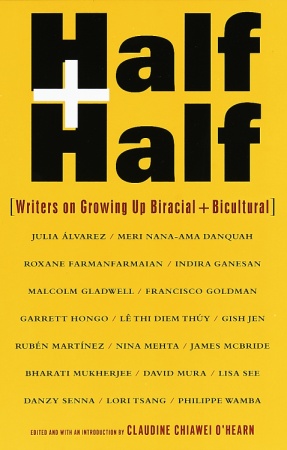
  • Half + Half: Writers on Growing Up Biracial and Bicultural

    Pantheon an imprint of Random House
    1998-06-09
    288 pages
    ISBN: 978-0-375-70011-8 (0-375-70011-0)

    Edited by Claudine C. O’Hearn

    As we approach the twenty-first century, biracialism and biculturalism are becoming increasingly common.  Skin color and place of birth are no longer reliable signifiers of one’s identity or origin.  Simple questions like What are you? and Where are you from? aren’t answered—they are discussed.  These eighteen essays, joined by a shared sense of duality, address the difficulties of not fitting into and the benefits of being part of two worlds.  Through the lens of personal experience, they offer a broader spectrum of meaning for race and culture.  And in the process, they map a new ethnic terrain that transcends racial and cultural division.

    Table of Contents

    • Introduction by Claudine Chiawei O’Hearn
    • LOST IN PLACE by Garrett Hongo
    • THE MULATTO MILLENNIUM by Danzy Senna
    • THE DOUBLE HELIX by Roxane Farmanfarmaian
    • CALIFORNIA PALMS by le thi diem thuy
    • MORO LIKE ME by Francisco Goldman
    • THE ROAD FROM BALLYGUNGE by Bharati Mukherjee
    • REFLECTIONS ON MY DAUGHTER by David Mura
    • LIFE AS AN ALIEN by Meri Nana-Ama Danquah
    • LOST IN THE MIDDLE by Malcolm Gladwell
    • THE FUNERAL BANQUET by Lisa See
    • A WHITE WOMAN OF COLOR by Julia Alvarez
    • A MIDDLE PASSAGE by Philippe Wamba
    • FOOD AND THE IMMIGRANT by Indira Ganesan
    • WHAT COLOR IS JESUS? by James McBride
    • POSTCARDS FROM “HOME” by Lori Tsang
    • FROM HERE TO POLAND by Nina Mehta
    • TECHNICOLOR by Ruben Martinez
    • AN ETHNIC  TRUMP by Gish Jen
    • About the Authors
  • Legal Transplants: Slavery and the Civil Law in Louisiana

    University of Southern California Legal Studies Working Paper Series
    Working Paper 32
    May 2009
    37 pages

    Ariela J. Gross, Professor of Law and History
    University of Southern California Law School

    Can Louisiana tell us something about civil law vs. common law regimes of slavery? What can the Louisiana experience tell us about a civil law jurisdiction “transplanted” in a common-law country? Louisiana is unique among American states in having been governed first by France, then by Spain, before becoming a U.S. territory and state in the nineteenth century. Unlike other slave states, it operated under a civil code, first the Digest of 1808, and then the Code of 1825. With regard to the regulation of slaves, these codes also incorporated a “Black Code,” first adopted in 1806, which owed a great deal to both French and Spanish law. Comparisons of Louisiana with other slave states tend to emphasize the uniqueness of New Orleans’ three-tier caste system, with a significant population of gens de couleur libre (free people of color), and the ameliorative influence of Spanish law. This reflects more general assumptions about comparative race and slavery in the Americas, based on the work of Frank Tannenbaum and other historians of an earlier generation, who drew sharp contrasts between slavery in British and Spanish America. How does the comparison shift if we turn our attention away from slave codes, where Tannenbaum focused, to the “law in action”? At the local level, one can see the way slaves took advantage of the gap between rules and enforcement, and to fathom racial meanings at the level of day-to-day interactions rather than comparisions of formal rules. This essay surveys three areas of law involving slaves – manumission, racial identity, and “redhibition” (breach of warranty) – to compare Louisiana to other jurisdictions, and particularly to its common-law neighbors.

    …The first major slave codes in the North American colonies date to 1680-82. They draw numerous distinctions on the basis of race rather than status, including laws against carrying arms and against leaving the owner’s plantations without a certificate. A penalty of thirty lashes met “any Negro” who “lift up his hand against any Christian.” In 1691, English women were fined for having a bastard child with a negro. In 1705, all mulatto children were made servants to the age of 31 in Virginia; Maryland and North Carolina adopted the same rule within the next several decades.

    By the time the U.S. became a republic, only those of African descent were slaves, and all whites were free. Yet there were a significant number of individuals and entire communities of mixed ancestry with ambiguous racial identity along the Eastern seaboard. In the southeast, Indian tribes both absorbed runaway slaves and, in the late eighteenth century, adopted African slavery. In addition to the 12,000 people designated in the Census as “free people of color” in Virginia, there were 8000 in Maryland in 1790, 5000 in North Carolina, 1800 in South Carolina, and 400 in Georgia…

    Read the entire paper here.

  • “The Caucasian Cloak”: Mexican Americans and the Politics of Whiteness in the Twentieth-Century Southwest

    The Georgetown Law Journal
    Volume 95, Issue 2
    Pages 337-392

    Ariela J. Gross, Professor of Law and History
    University of Southern California Law School

    The history of Mexican Americans and Jim Crow in the Southwest suggests the danger of allowing state actors or private entities to discriminate on the basis of language or cultural practice. Race in the Southwest was produced through the practices of Jim Crow, which were not based explicitly on race, but rather on language and culture inextricably tied to race. This Article looks at three sets of encounters between Mexican Americans and the state in mid-twentieth-century Texas and California—trials involving miscegenation, school desegregation, and jury exclusion—to see the way in which state actors used Mexican Americans’ nominal white identity under the law to create and protect Jim Crow practices. First, it argues that whiteness operated primarily as a “Caucasian cloak” to obscure the practices of Jim Crow and to make them appear benign, whether in the jury or school context. If Mexican Americans were white, then they were represented so long as whites were represented. Second, it demonstrates that Mexican-American civil rights leaders as well as ordinary individuals in the courtroom did not simply identify as white; some showed a more complex understanding of “Mexican” as a mestizo race, and others pointed to the idea of race as a status produced by racist practice. Mexicans were nonwhite if they were treated as nonwhite under Jim Crow. Finally, it argues that, at least in twentieth-century Texas and California, cultural discrimination was racial discrimination, and that continuing discrimination on the basis of language ability and other cultural attributes should be scrutinized carefully under antidiscrimination law…

    Table of Contents

    INTRODUCTION
    MEXICAN-AMERICAN WHITENESS BEFORE 1930
    A. THE NINETEENTH CENTURY
    B. WHITE BY TREATY—IN RE RODRIGUEZ
    C. SEX ACROSS RACIAL BORDERS: POPULAR AND LEGAL IDEAS OF THE “MEXICAN RACE”

    II. THE POLITICS OF WHITENESS IN THE 1930S AND 1940S
    A. JIM CROW IN THE SOUTHWEST
    B. MEXICAN-AMERICAN ORGANIZATIONS AND POLITICS

    III. LITIGATING MEXICAN-AMERICAN WHITENESS
    A. THE 1930S SCHOOL AND JURY CASES
    B. THE 1940S SCHOOL AND JURY CASES

    IV. AFTER HERNANDEZ V. TEXAS: LIFTING THE CAUCASIAN CLOAK
    A. FROM HERNANDEZ V. TEXAS TO CISNEROS
    B. LA RAZA COSMICA

    CONCLUSION

    Read the entire article here.

  • Grad student explores questions of race through digital technology

    News & Events
    York Univeristy, Toronto, Ontario
    2010-01-28

    The technology to turn oneself into a mixed-race avatar might be confined to movies, but Brian Banton plays with racial manipulations of himself online, wrote the Toronto Star (online) Jan. 27 [2010] in a story that included five photos of him.

    As a York graduate student, he explores questions of racial hybridity as related to corporate design. Much of the work is obscurely theoretical, Banton says. “But I also want to be playful. (Mixed race) is a serious issue but I don’t want to be heavy-handed.”..

    Read the entire article here.

  • Multiracial Matrix: The Role of Race Ideology in the Enforcement of Anti-Discrimination Laws, a United States – Latin America Comparison

    Cornell Law Review
    Volume 87, Number 5 (July 2002)
    Cornell University Law School

    Tanya Katerí Hernández, Professor of Law
    Fordham University

    This Article examines the role of race ideology in the enforcement of antidiscrimination laws.  Professor Hernández demonstrates the ways in which the U.S. race ideology is slowly starting to resemble the race ideology of much of Latin America.  The evolving U.S. race ideology is a multiracial matrix made up of four precepts: (1) racial mixture and diverse racial demography will resolve racial problems; (2) fluid racial classification schemes are an indicator of racial progress and the colorblind abolition of racial classifications an indicator of absolute racial harmony; (3) racism is solely a phenomenon of aberrant racist individuals; and (4) focusing on race is itself racist.  Because the multiracial matrix parallels much Latin American race discourse, Professor Hernández conducts a comparative analysis between U.S. and Latin American anti-discrimination law enforcement practices.  Professor Hernández concludes that the new race ideology bolsters the maintenance of race hierarchy in a racially diverse population.  Consequently, an uncritical embrace of the new race ideology will hinder the enforcement of antidiscrimination law in the United States.  Professor Hernández proposes that a greater focus on racism as a global issue that treats race as a political identity formation will assist in the recognition of the civil rights dangers of a multiracial matrix.

    Read the entire article here.

  • African Americans and National Identities in Central America

    Rina Cáceres, Professor of Diaspora Studies Program at the Centro de Investigationes Historicas de America Central
    Universidad de Costa Rica

    Lowell Gudmundson, Professor of Latin American Studies and History
    Mount Holyoke University

    Mauricio Meléndez

    An interdisciplinary, multinational research program to reconceptualize and document, both visually and textually, the history of people of African descent in Central America.

    Supported by the National Endowment for the Humanities Collaborative Research Program, Mount Holyoke College and The Center for Central American Historical Research at the Universidad de Costa Rica.

    Our collaborative research project seeks to reassess the historical presence and contributions of peoples of African descent to the national histories and identities constructed in Central America over the past two centuries. In choosing a color for the cosmic race, modern nationalist thinkers in the region systematically emphasized the European and Indigenous origins of its peoples, in terms of both historical fact and group agency. Thus they radically discounted not only the importance, role, and presence of any African heritage but also as the centrality of racial or ethnic conflict within the historical experience of non-indigenous sectors of society…

    Visit the project website here.