• 2010 African American Studies Symposium

    University of Texas at San Antonio
    2010-04-16

    The 3rd annual African American Studies Symposium is a one-day conference Friday, April 16, 2010, at the University of Texas at San Antonio. This year, the theme is ‘Politics and Black Popular Culture.’ We especially encourage papers on language, music, hair, art, film, Black popular literature, celebrities (e.g., Oprah, Tiger Woods, Wanda Sikes), technology, border crossing, health, post-race/mixed-race identities, and political races (e.g., Texas Governor’s race, Houston Mayoral race, 2008 Presidential election). Each talk is allotted 20 minutes per session with an additional 30 minutes for discussion of the panel’s papers.

    Pre-registration required, but no registration fee.

  • The Myth of the Human Races

    Michigan State University Press
    December 1997
    210 pages
    6.00″ x 9.00″
    Notes, bibliography, index
    Cloth ISBN 10: 0-87013-439-6; ISBN 13: 978-0-87013-439-5

    Alain F. Corcos, Professor Emeritus of Botany
    Michigan State University

    The idea that human races exist is a socially constructed myth that has no grounding in science. Regardless of skin, hair, or eye color, stature or physiognomy, we are all of one species. Nonetheless, scientists, social scientists, and pseudo-scientists have, for three centuries, tried vainly to prove that distinctive and separate “races” of humanity exist. These protagonists of race theory have based their flawed research on one or more of five specious assumptions:

    • humanity can be classified into groups using identifiable physical characteristics
    • human characteristics are transmitted “through the blood,”
    • distinct human physical characteristics are inherited together,
    • physical features can be linked to human behavior,
    • human groups or “races” are by their very nature unequal and, therefore, they can be ranked in order of intellectual, moral, and cultural superiority.

    The Myth of Human Races systematically dispels these fallacies and unravels the web of flawed research that has been woven to demonstrate the superiority of one group of people over another.

  • Q&A With Researchers: Associate Professor Manying Ip

    asia:nz online
    Asia New Zealand Foundation

    Associate Professor Manying Ip
    Asia:NZ Trustee; Associate Professor of Chinese, School of Asian Studies, University of Auckland

    Manying Ip came to New Zealand in 1974 from Hong Kong where her family lived for five generations. With her strong classical Chinese education at home and colonial English education at shool, she grew up sharply aware of the challenges of being cross-cultural.

    Her interest in Maori-Chinese interactions started from the mid 1980s when she conducted extensive qualitative interviews among the pioneering Chinese families, which grew ever stronger with the immigration and ethnic identity debates

    Manying is Associate Professor in Asian Studies at The University of Auckland and the author of several critically acclaimed books on Chinese in New Zealand. These include: Aliens At My Table: Asians as New Zealanders See Them (Penguin, 2005), Unfolding Identity, Evolving Identity: The Chinese in New Zealand (Auckland University Press, 2003) as well as numerous journal articles and book chapters on issues pertaining to recent Asian immigrants. Dr Ip’s most recent book Being Maori-Chinese: Mixed Identities (Auckland University Press, 2008) uses extensive interviews with seven different families of mixed Chinese-Maori descent to explore both historical and contemporary relations between Maori and Chinese, a subject which has not been given serious extended study before. Her edited volume The Dragon and The Taniwha: Maori and Chinese in New Zealand will be published in April 2009, investigating the complex social fabric of New Zealand and offering a nuanced study of ancient and contemporary shared identities amongst two significant ethnic minority groups.

    Dr Ip is a respected advocate for Chinese communities living in New Zealand. She was awarded a Suffrage Centennial Medal in 1993 and was made an Officer of the New Zealand Order of Merit in 1996.  In 2004 she co-directed New Faces Old Fears, a television documentary exploring racism, multiculturalism and social cohesion in New Zealand. In late 2008, she was elected a Fellow of the New Zealand Academy of Humanities (FNZAH) in recognition of her distinction in research and the advancement of the humanities.

    1. Your most recent publication Being Maori–Chinese: Mixed Identities explores the historical and contemporary significance of the relationship between Maori and Chinese New Zealanders.  How did you become interested in this topic and what were some of the most interesting findings?

    Ever since I started conducting oral interviews on the early days of Chinese New Zealanders, I heard my interviewees mentioning their relationship with Maori people: as co-workers in the market gardens, as neighbours  and workmates. Quite often they mentioned the existence of mixed Maori-Chinese families because early Chinese men came to New Zealand as bachelors and many of them formed relationships with Maori women…

    Read the entire interview here.

  • Drawing Battle Lines

    Sarah Lawrence College Magazine
    Spring 2003: Who Are You

    Catherine McKinley[-Davis] was one of only a few thousand African-American and biracial children adopted by white couples in the late 1960s and early 1970s. Throughout her childhood and adolescence, her consciousness grew as she did. Her very identity—composed both of the whiteness and blackness mixed in her genes, and of the whiteness of her adoptive parents—began to tear her apart, and she eventually embarked on a quest to find her birth parents and move toward self-acceptance. In this excerpt from “The Book of Sarahs”, her new memoir, McKinley pinpoints a crucial moment: that time when her home became the field on which the combats of race, of identity, of being the outsider, began to be fought in earnest.

    With my parents’ move to Vermont, it seemed as though a very final, pronounced line had been drawn between us. It was different from the boundaries I had drawn in the past, acting against the surety that they would still be standing right there no matter how firm I drew and redrew the battle lines.

    In Attleboro, those lines were drawn like this: In our house, I built a haven for myself, constructing my bedroom the way I thought it would have been if I had grown up in a Black family. My shelves were filled with Black books, replacing the artifacts of a former self—the dolls from my grandmother’s travels, the complete Laura Ingalls Wilder boxed library, the collections of Scottish verse, the Peterson’s guides to wildflowers and the seashore. I stowed them in the crawl space under the eaves of the house and moved my mother’s copies of The Black Child: A Parent’s Guide, the SNCC freedom movement songbooks, Amiri Baraka’s The Dutchman and The Slave, the row of James Baldwin paperbacks, and Stokely Carmichael and James Hamilton’s Black Power out from between the Rachel Carson and Thoreau and Henry Beston books, the trail guides, and my father’s engineering manuals in the den. I covered my walls with clippings from Essence and Ebony and turned up the dial on the “civil rights station” (read: Black radio, aired only on late night and Sunday slots, picked up from the Boston airways) to let everyone know who was living there. And I put a ban on my room. My father, who was my ally, if only for his silence and quiet amusement at my lobbies against the family, was the only one allowed in, and only so that he could tend the African violets he grew on shelves he built into my bedroom windows. I liked the flowers; they were African, despite how suspicious they seemed to me, sitting in the living room of every old white lady in town…

    Read the entire article here.

  • Mestizaje Upside-Down: Aesthetic Politics in Modern Bolivia

    University of Pittsburgh Press
    May 2004
    240 pages
    6 x 9
    ISBN: 9780822942276

    Javier C. Sanjinés, Associate Professor of Latin American Literature and Cultural Studies
    University of Michigan

    Mestizaje refers to the process of cultural, ethnic, and racial mixture that is part of cultural identity in Latin America. Through a careful study of fiction, political essays, and visual art, this book defines the meaning of mestizaje in the context of the emergence of a modern national and artistic identity in late-19th- and early 20th-century Bolivia.

  • A Letter to My Father: Growing up Filipina and American

    University of Oklahoma Press
    2008
    184 pages
    5.5″ x 8.5″ x 0″
    8 b&w illustrations, 2 maps
    Cloth ISBN: 978-0-8061-3909-8

    Helen Madamba Mossman

    Going from the jungles of the wartime Philippines to the schoolyards of northwestern Oklahoma is no easy transition. For one twelve-year-old girl, it meant distance not only across the globe but also within her own family.

    Born to a Filipino father and an American mother, Helen Madamba experienced terrifying circumstances at a young age. During World War II, her father, Jorge, fought as an American soldier in his native Philippines, and his family camped in jungles and slept in caves for more than two years to evade capture by the Japanese. But once the family relocated to Woodward, Oklahoma, young Helen faced a different kind of struggle.

    Here Mossman tells of her efforts to repudiate her Asian roots so she could fit into American mainstream culture—and her later efforts to come to terms with her identity during the tumultuous 1960s. As she recounts her father’s wartime exploits and gains an appreciation of his life, she learns to rejoice in her biracial and multicultural heritage.

    Written with the skill of a gifted storyteller and graced with photos that capture both of Helen’s worlds, A Letter to My Father is a poignant story that will resonate with anyone familiar with the struggle to reconcile past and present identities.

  • Being Māori-Chinese: Mixed Identities (Book Review)

    Sites: a journal of social anthropology and cultural studies
    University of Otago, New Zealand
    Volume 5, Number 2 (2008)
    pages 180-182

    Kate Bagnall

    Being Māori-Chinese: Mixed Identities, Manying Ip, Auckland University Press, Auckland, 2008, 255pp. ISBN 978-1-86940-399-7

    Manying Ip makes it clear from the outset that Being Māori-Chinese: Mixed Identities is a very personal book. It begins with an explanation of her own inspiration for the project – the emergence of tantalising snippets about Māori-Chinese families that kept popping up in her wider research on New Zealand Chinese – and her own process of locating subjects and conducting interviews. Ip tells of being warned by a ‘well-meaning elder’ from Te Wānangao-Raukawa about the difficulties she would encounter in her project, due to the sensitivity of the subject matter and the reticence that Māori-Chinese as a group would have towards sharing in-depth information with her. ‘Are you sure you wish to pursue this study on Māori-Chinese relations? I don’t think people will tell you much’, he said.

    The publication of Being Māori-Chinese is, then, an acknowledgement of Ip’s reputation as a researcher and community advocate. It is only through mutual trust that she has been given access to the personal stories of the seven Māori-Chinese families whose experiences make up the heart of the book.  Each chapter focuses on a particular family and presents an intimate journey into the family culture and individual identities of family members. The book is further testament to the courage and generosity of her subjects, who shared memories and thoughts on many aspects of their lives. Their generosity is particularly moving because, as Ip states, ‘those memories involve a struggle against social discrimination and, in many cases, family disapproval’…

    Family stories, such as those told in Being Māori-Chinese, are at the core of the growing body of Australasian scholarship that explores mixed race lives, families and communities. Such stories counter the assumptions of previous generations that interracial encounters were either unthinkable due to race prejudice or occurred under unsavoury conditions that were detrimental to one or both parties. Ip is to be commended for encouraging the Māori-Chinese families included in the book to share their experiences, and also for carefully structuring each chapter so that her voice takes a secondary place to those of family members themselves. As she notes in her Introduction, the book explores lives that ‘have been largely overlooked in the formal historical and sociological discourse of New Zealand’. This book is an important step in inserting Māori-Chinese into the story of New Zealand’s past, present and future…

    Read the entire review here.

  • Santiago de Guatemala, 1541-1773: City, Caste, and the Colonial Experience

    University of Oklahoma Press
    1997
    368 pages
    9.09″ x 6.02″ x 0.83″
    14 illus, 6 maps, 1 figure
    Paperback ISBN: 978-0-8061-2911-2; ISBN(10): 0-8061-2911-5

    Christopher H. Lutz

    Santiago de Guatemala was the colonial capital and most important urban center of Spanish Central America from its establishment in 1541 until the earthquakes of 1773. Christopher H. Lutz traces the demographic and social history of the city during this period, focusing on the rise of groups of mixed descent. During these two centuries the city evolved from a segmented society of Indians, Spaniards, and African slaves to an increasingly mixed population as the formerly all-Indian barrios became home to a large intermediate group of ladinos. The history of the evolution of a multiethnic society in Santiago also sheds light on the present-day struggle of Guatemalan ladinos and Indians and the problems that continue to divide the country today.

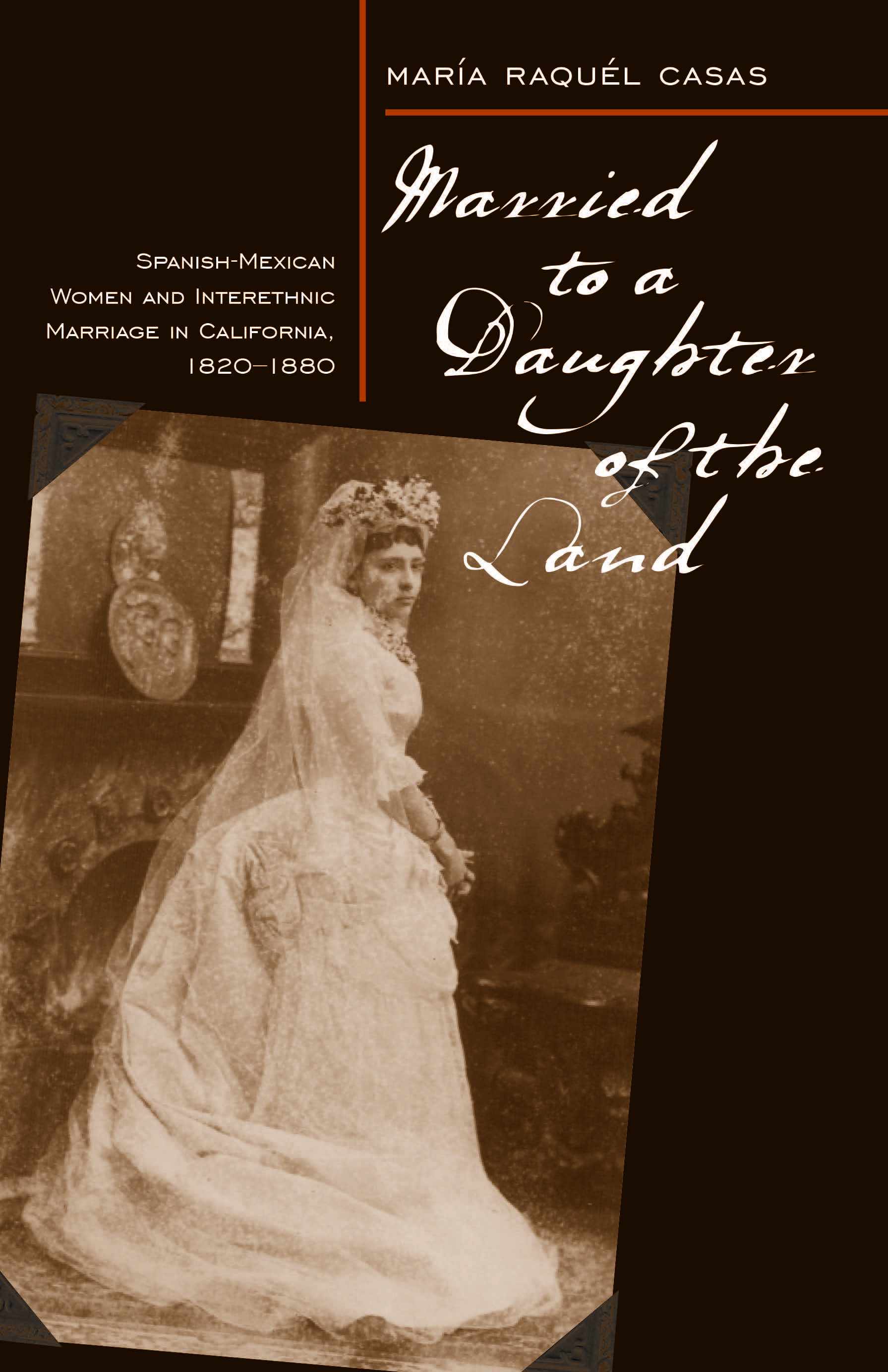
  • Married to a Daughter of the Land: Spanish-Mexican Women and Interethnic Marriage in California, 1820-1880

    University of Nevada Press
    2007
    Hardcover ISBN: 978-0-87417-697-1
    Hardcover Pages: 272
    Paperback ISBN: 978-0-87417-778-7
    Paperback Pages: 280

    María Raquél Casas, Associate Professor of History
    University of Nevada, Las Vegas

    The surprising truth about intermarriage in 19th-Century California

    Until recently, most studies of the colonial period of the American West have focused on the activities and agency of men. Now, historian María Raquél Casas examines the role of Spanish-Mexican women in the development of California. She finds that, far from being pawns in a male-dominated society, Californianas of all classes were often active and determined creators of their own destinies, finding ways to choose their mates, to leave unsatisfactory marriages, and to maintain themselves economically. Using a wide range of sources in English and Spanish, Casas unveils a picture of women’s lives in these critical decades of California’s history. She shows how many Spanish-Mexican women negotiated the precarious boundaries of gender and race to choose Euro-American husbands, and what this intermarriage meant to the individuals involved and to the larger multiracial society evolving from California’s rich Hispanic and Indian past. Casas’s discussion ranges from California’s burgeoning economy to the intimacies of private households and ethnically mixed families.  Here we discover the actions of real women of all classes as they shaped their own identities. Married to a Daughter of the Land is a significant and fascinating contribution to the history of women in the American West and to our understanding of the complex role of gender, race, and class in the Borderlands of the Southwest.

  • Black, White, Other: Racial categories are cultural constructs masquerading as biology

    Natural History Magazine
    December 1994
    pp. 32–35

    Jonathan Marks, Associate Professor of Anthropology
    University of North Carolina, Charlotte

    While reading the Sunday edition of the New York Times one morning last February, my attention was drawn by an editorial inconsistency. The article I was reading was written by attorney Lani Guinier (Guinier, you may remember, had been President Clinton’s nominee to head the civil rights division at the Department of Justice in 1993. Her name was hastily withdrawn amid a blast of criticism over her views on political representation of minorities.) What had distracted me from the main point of the story was a photo caption that described Guinier as being “half-black.” In the text of the article, Guinier had described herself simply as “black”

    How can a person be black and half black at the same time? In algebraic terms, this would seem to describe a situation where x = 1/2 x, to which the only solution is x = 0.

    The inconsistency in the Times was trivial, but revealing. It encapsulated a longstanding problem in our use of racial categories—namely, a confusion between biological and cultural heredity. When Guinier is described as “half-black,” that is a statement of biological ancestry, for one of her two parents is black. And when Guinier describes herself as black, she is using a cultural category, according to which one can either be black or white, but not both.

    Race—as the term is commonly used—is inherited, although not in a strictly biological fashion. It is passed down according to a system of folk heredity, an all-or-nothing system that is different front the quantifiable heredity of biology. But the incompatibility of the two notions of race is sometimes starkly evident—as when the state decides that racial differences are so important that interracial marriages must be regulated or outlawed entirely. Miscegenation laws in this country (which stayed on the books in many states through the 1960s) obliged the legal system to define who belonged in what category. The resulting formula stated that anyone with one-eighth or more black ancestry was a “negro.” (A similar formula, defining Jews, was promulgated by the Germans in the Nuremberg Laws of the 1930s.).

    Applying such formulas led to the biological absurdity that having one black great-grandparent was sufficient to define a person as black, but having seven white great grandparents was insufficient to define a person as white. Here, race and biology are demonstrably at odds. And the problem is not semantic but conceptual, for race is presented as a category of nature…

    …Unlike graduated biological distinctions, culturally constructed categories are ultrasharp. One can be French or German, but not both; Tutsi or Hutu, but not both; Jew or Catholic, but nor both; Bosnian Muslim or Serb, but not both; black or white, but not both. Traditionally, people of “mixed race” have been obliged to choose one and thereby identity themselves unambiguously to census takers and administrative bookkeepers—a practice that is now being widely called into question

    Read the entire article here.