• Whiteness as Stigma: Essentialist Identity Work by Mixed-Race Women

    Symbolic Interaction
    Volume 22, Number 3 (1999)
    Pages 187–212
    DOI 10.1525/si.1999.22.3.187

    Debbie Storrs, Professor of Sociology
    University of Idaho

    Historically, in both the social sciences and the general public, racial mixing has been stigmatized. This stigmatization was fueled by whites’ desire to protect their racial privileges as well as the belief that hybridization between “pure” and superior white racial stocks and inferior non-white stocks produces an inferior being. While this view has been challenged within the social sciences, the general public’s sentiment toward racial mixing remains consistently negative. The low interracial marriage rate, particularly among blacks and whites, points to the lack of popular acceptance of racial mixing. This article reveals an unusual and creative reversal of the racial mixing problem by historically stigmatized mixed-race women. The women in this study reject dominant patterns of stigma by reassigning stigma to their European ancestry. Given this reversal, women articulate and embrace non-white identities. This article explains the reversal of the racial mixing problem as well as the identity work of women as they particulate the meaning of race and racial belonging within dominant racial logic. The identification of macro constraints and the illustration of individual agency in the negotiation of identity extends the symbolic interactionist perspective on identity formation.

    I didn’t like my skin color, I really didn’t. I’m much too light. I don’t tan… All my brothers and sisters have more color to their skin. I just want pigment? I’m just tired of looking white… I just wish I were darker because I’m so pale. I am very pale
    (Jamie, a mixed-race young woman)

    For many, the statement above is counterintuitive, perhaps even amusing or bewildering, because of the historical tendency in the United States to stigmatize people of color based on the assumption that whiteness is not only normative but desirable, beautiful, and generally superior to non-whiteness. Using Goffman’s (1963) term, non-white identities are “stigmatized” by the dominant members of society. Jamie’s wish for pigment challenges the somatization of non-whiteness and the long held conception of whiteness. Through an analysis of mixed-race women’s narratives, this research reveals how women…

  • “What are You?”: Explaining Identity as a Goal of the Multiracial Hapa Movement

    Social Problems
    Volume 56, Number 4 (November 2009)
    Pages 722–745
    DOI 10.1525/sp.2009.56.4.722

    Mary Bernstein, Associate Professor of Sociology
    University of Connecticut

    Marcie De la Cruz
    Empirical Education Inc.

    This article uses the Hapa movement as a case study in order to provide a framework for understanding identity as a goal of social movements and to expand on a theoretical understanding of multiracial social movements. In contrast to current understandings of identity-based movements, this article argues that the Hapa movement seeks simultaneously to deconstruct traditional notions of (mono)racial identities and to secure recognition for a multiracial “Hapa” identity. Movements that have identity as a goal are motivated by activists’ understandings of how categories are constituted and how those categories, codes, and ways of thinking serve as axes of regulation and domination. The Hapa movement simultaneously challenges (mono)racial categories at both the institutional level through targeting the state and at the micro level through challenging the quotidian enactment of race and promulgating a Hapa identity. Activism by mixed-race individuals and organizations constitutes an important challenge to power that has significant implications for racial categorization and classification in contemporary American society.

  • An interview with Henry Wiencek: Slaves and Slavery in George Washington’s World

    Common-Place: Common Reading
    Volume 6, Number 4
    July 2006


    William Costin (c. 1780-1842), the Washingtons’ mixed-race grandson/nephew. He was the son of Ann Dandridge, enslaved half sister of Martha Washington, and Jacky Custis, Martha’s son. Courtesy of the Library of Congress, Prints and Photographs Division.

    Henry Wiencek is the author of the acclaimed “An Imperfect God: George Washington, His Slaves, and the Creation of America” (2003), winner of the Los Angeles Times Book Prize in history and the Best Book of 2003 award from the Society for Historians of the Early American Republic. He has also written The Hairstons: An American Family in Black and White (1999), which received the 1999 National Book Critics Circle Award. In the spirit of rereading, this issue’s Common Reading asks Wiencek to talk about his work on Washington and slavery and to reflect on some of the ways it revises received wisdom about the American past.
     
    Common-place: It seems clear from “Imperfect God” that you learned a great deal from genealogists. For historians working inside the academy, this might seem striking. How was it that you came to be interested in genealogy as a way of addressing larger historical questions about race and slavery?

    Henry Wiencek: When I researched my previous book, The Hairstons: An American Family in Black and White, I could not avoid genealogy and genealogists. That book focused on one extended family with a black side, a white side, and family genealogists on every side trying to reconstruct a lost/hidden past. In several instances I came across documents indicating hidden or forgotten blood ties between the whites and blacks. You can’t avoid finding that kind of information if you’re studying plantation families. It happened everywhere and the evidence is thick on the ground—wills, gifts of land, odd emancipations, payments for education, favored treatment for particular people. I had so many of these stories from Hairston documents and oral history that I couldn’t put them all into the book. And after the book came out more people called or wrote to me about other instances. The other part of this is you have to be careful in evaluating this information—not everything is at it seems.

    When you encounter evidence of kinship between owners and slaves you have, first of all, learned something new about the complexity of their world, and next you are confronted with the question: did knowledge of his or her kinship to slaves influence the actions of an owner? Martha Washington‘s first father-in-law, John Custis, all but acknowledged his mixed-race son, freed him, and gave him a very generous bequest. In contrast, Martha held her own half sister in slavery. The existence of this half sister, Ann Dandridge, was one of the great shocks of my research, and I discovered her only because genealogists had written to Mount Vernon about Dandridge and their letters were in the files. I pursued the leads in that correspondence and came up with additional evidence. So through the work of genealogists I came up with information that completely changed our view of what slavery was like at Mount Vernon…

    …As to “genealogy as a way of addressing larger historical questions about race and slavery”—genealogy teaches us that many white colonial families had mixed-race kin. It would be fascinating to consult Virginia‘s African American genealogists and see how many of them can trace their families back to leading white families such as the Carters, Lees, Byrds, Randolphs, et al. (Right now I can say “yes” to three of those names—I don’t know about the Byrds, but they’re related to the Custises, so I guess they’d be a “yes” too.) That would give us a sense of how closely entwined these leading families were with slaves. Reading the accounts of the very peculiar, very intense relationship between Landon Carter and his slave Nassau, I have wondered if they were half brothers. My point is that, in public statements, the white male leadership of colonial Virginia reviled miscegenation, and we have come to believe that they were genuinely revolted by race mixing. Then how could these same men so avidly practice it? If they were disgusted by mixed-race people, how could the masters and mistresses of the era staff their houses with mulattoes? Wouldn’t you expect mulattoes to be shunned, exiled? Jefferson is a prime example. He spoke forcefully against racial mixing, but his entire household staff consisted of mulatto and all-but-white slaves, many of whom were his relatives. My thinking is that, to some degree, this eighteenth-century racial-purity talk was smokescreen and rationalization for outsiders. It’s an extremely complex issue….

    Read the entire interview here.

  • An Imperfect God: George Washington, His Slaves, and the Creation of America

    Farrar, Straus and Giroux an imprint of Macmillan
    2003
    416 pages
    5 1/2 x 8 1/4 inches
    16 Pages of Black-and-White Illustrations/Map/Notes/Index
    Paperback ISBN: 978-0-374-52951-2, ISBN10: 0-374-52951-5

    Henry Wiencek

    L.A. Times Book Prize – Winner, History

    A major new biography of Washington, and the first to explore his engagement with American slavery

    When George Washington wrote his will, he made the startling decision to set his slaves free; earlier he had said that holding slaves was his “only unavoidable subject of regret.” In this groundbreaking work, Henry Wiencek explores the founding father’s engagement with slavery at every stage of his life–as a Virginia planter, soldier, politician, president and statesman.

    Washington was born and raised among blacks and mixed-race people; he and his wife had blood ties to the slave community. Yet as a young man he bought and sold slaves without scruple, even raffled off children to collect debts (an incident ignored by earlier biographers). Then, on the Revolutionary battlefields where he commanded both black and white troops, Washington’s attitudes began to change. He and the other framers enshrined slavery in the Constitution, but, Wiencek shows, even before he became president Washington had begun to see the system’s evil.

    Wiencek’s revelatory narrative, based on a meticulous examination of private papers, court records, and the voluminous Washington archives, documents for the first time the moral transformation culminating in Washington’s determination to emancipate his slaves. He acted too late to keep the new republic from perpetuating slavery, but his repentance was genuine. And it was perhaps related to the possibility–as the oral history of Mount Vernon‘s slave descendants has long asserted–that a slave named West Ford was the son of George and a woman named Venus; Wiencek has new evidence that this could indeed have been true.

    George Washington’s heroic stature as Father of Our Country is not diminished in this superb, nuanced portrait: now we see Washington in full as a man of his time and ahead of his time.

  • Biracial Self-Identification: Impact on Trait Anxiety, Social Anxiety, and Depression

    Identity
    Volume 7, Issue 2
    May 2007
    pages 103 – 114
    DOI: 10.1080/15283480701326018
     
    Victoria H. Coleman
    Department of Psychology, American University, Washington, D.C.

    M. M. Carter
    Department of Psychology, American University, Washington, D.C.

    Sixty-one Biracial participants were assessed on measures of depression, trait anxiety, and social anxiety to ascertain if their racial identity choice impacted their scores on these psychological measures. Societal pressure to identify as monoracial was also measured to determine if the various racial identity groups perceived these pressures differently and if these pressures were related to the reported quality of psychological functioning. Results indicated that a validated Biracial identity may serve as a protective factor for anxiety and depressive symptoms, whereas Biracial individuals who consider their race to be meaningless or fluid based on situational factors reported significantly higher levels of depression and trait anxiety symptoms than other Biracial individuals. The latter group also reported the least pressure from family to identify as monoracial. Societal pressure from peers to identify as monoracial was found to predict social anxiety and fear of negative evaluation among all Biracial participants

    Read or purchase the article here.

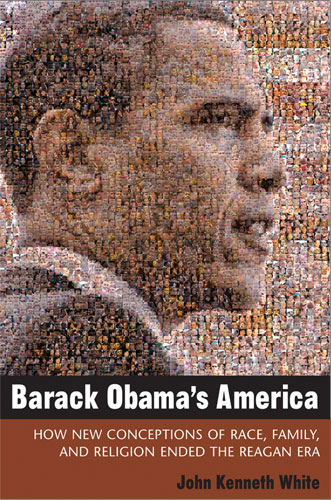
  • Barack Obama’s America: How New Conceptions of Race, Family, and Religion Ended the Reagan Era

    The University of Michgan Press
    2009
    320 pages
    6 x 9
    Cloth ISBN: 978-0-472-11450-4
    Paper ISBN: 978-0-472-03391-1
    Ebook Formats ISBN: 978-0-472-02179-6

    John Kenneth White, Professor of Politics
    Catholic University of America, Washington, D.C

    Research and reflections on the American demographic shift that led to the election of President Barack Obama

    The election of Barack Obama to the presidency marks a conclusive end to the Reagan era, writes John Kenneth White in Barack Obama’s America. Reagan symbolized a 1950s and 1960s America, largely white and suburban, with married couples and kids at home, who attended church more often than not.

    Obama’s election marks a new era, the author writes. Whites will be a minority by 2042. Marriage is at an all-time low. Cohabitation has increased from a half-million couples in 1960 to more than 5 million in 2000 to even more this year. Gay marriages and civil unions are redefining what it means to be a family. And organized religions are suffering, even as Americans continue to think of themselves as a religious people. Obama’s inauguration was a defining moment in the political destiny of this country, based largely on demographic shifts, as described in Barack Obama’s America.

    Read the Q&A with the University of Michigan Press and John Kenneth White here.

    University of Michigan Press: Was Barack Obama’s election a reflection of change in American attitudes, or more a change in the type of people who make up the country?

    John Kenneth White: …The America of the 1950s through the 1980s has come to an end. Whites will be a minority of all Americans by the middle of the twenty-first century. Hispanics will be nearly a third of the population by 2030. The face of America is turning from white into some form of beige or bronze. Even how we define race is an open question. For much of American history, race was categorized into two categories: black or white. Mixed race was frowned upon and degrading terms such as “quadroon” were invented. Now there are more mixed racial marriages than ever before and the children from those marriages are not easily categorized….

  • Brown Skinned White Girls: class, culture and the construction of white identity in suburban communities

    Gender, Place & Culture
    Volume 3, Issue 2
    July 1996
    pages 205 – 224
    DOI: 10.1080/09663699650021891

    France Winddance Twine, Professor of Sociology
    University of California, Santa Barbara

    Feminist scholars theorizing about whiteness and white identity have not examined the pivotal role that middle-class material privilege, residential segregation and US consumer culture play in the social construction of a racialized cultural identity among the African-descent daughters of Asian-American and European-American mothers. There is a dearth of empirical research by feminist scholars which interrogates the shifts in a racialized gender identity which follow from the interaction between class status, ideological communities and residentially segregated communities. The nascent body of social science scholarship on white identity has assumed that a ‘white’ identity is available only to individuals of exclusively European ancestry. This paper provides a specific case-study of African-descent girls, who have been culturally constructed as ‘white’ girls prior to puberty, only to later construct a non-white ‘black’ or ‘biracial’ identity after moving to a different residential, cultural and ideological community-the Berkeley campus of the University of California. Drawing upon transcripts from 16 taped interviews with African-descent university students, who were attending the University of California at Berkeley, this paper delineates the specific cultural conditions under which a racially neutral or ‘white’ identity is acquired, constructed, and then reconstructed by a segment of the African-descent community, the daughters of Asian and European-American women in economically privileged households in suburban communities. 

    Read or purchase the article here.

  • The Ethics of Identity

    Princeton University Press
    2004
    384 pages
    6 x 9
    Hardback ISBN: 9780691120362
    Paper ISBN: 978-1-4008-2619
    e-Book ISBN: 978-1-4008-2619-3

    Kwame Anthony Appiah, Laurance S. Rockefeller University Professor of Philosophy and the Center for Human Values
    Princeton University

    • A New York Times Editors’ Choice
    • One of Amazon.com’s Best Nonfiction Books of 2005
    • Winner of the 2005 Award for Excellence in Professional/Scholarly Publishing in Philosophy, Association of American Publishers
    • Honorable Mention for the 2005 Gustavus Myers Outstanding Book Award, Gustavus Myers Center for the Study of Bigotry and Human Rights

    Race, ethnicity, nationality, religion, gender, sexuality: in the past couple of decades, a great deal of attention has been paid to such collective identities. They clamor for recognition and respect, sometimes at the expense of other things we value. But to what extent do “identities” constrain our freedom, our ability to make an individual life, and to what extent do they enable our individuality? In this beautifully written work, renowned philosopher and African Studies scholar Kwame Anthony Appiah draws on thinkers through the ages and across the globe to explore such questions.

    The Ethics of Identity takes seriously both the claims of individuality–the task of making a life—and the claims of identity, these large and often abstract social categories through which we define ourselves.

    What sort of life one should lead is a subject that has preoccupied moral and political thinkers from Aristotle to Mill. Here, Appiah develops an account of ethics, in just this venerable sense–but an account that connects moral obligations with collective allegiances, our individuality with our identities. As he observes, the question who we are has always been linked to the question what we are.

    Adopting a broadly interdisciplinary perspective, Appiah takes aim at the clichés and received ideas amid which talk of identity so often founders. Is “culture” a good? For that matter, does the concept of culture really explain anything? Is diversity of value in itself? Are moral obligations the only kind there are? Has the rhetoric of “human rights” been overstretched? In the end, Appiah’s arguments make it harder to think of the world as divided between the West and the Rest; between locals and cosmopolitans; between Us and Them. The result is a new vision of liberal humanism–one that can accommodate the vagaries and variety that make us human.

    Table of Contents

    • PREFACE
    • Chapter One: The Ethics of Individuality
      • THE GREAT EXPERIMENT—LIBERTY AND INDIVIDUALITY—PLANS OF LIFE–THE SOUL OF THE SERVITOR—SOCIAL CHOICES—INVENTION AND AUTHENTICITY—THE SOCIAL SCRIPTORIUM—ETHICS IN IDENTITY—INDIVIDUALITY AND THE STATE—THE COMMON PURSUIT
    • Chapter Two: Autonomy and Its Critics
      • WHAT AUTONOMY DEMANDS—AUTONOMY AS INTOLERANCE—AUTONOMY AGONISTES—THE TWO STANDPOINTS—AGENCY AND THE INTERESTS OF THEORY
    • Chapter Three: The Demands of Identity
      • LEARNING HOW TO CURSE—THE STRUCTURE OF SOCIAL IDENTITIES—MILLET MULTICULTURALISM—AUTONOMISM, PLURALISM, NEUTRALISM—A FIRST AMENDMENT EXAMPLE: THE ACCOMMODATIONIST PROGRAM—NEUTRALITY RECONSIDERED—THE LANGUAGE OF RECOGNITION—THE MEDUSA SYNDROME—LIMITS AND PARAMETERS
    • Chapter Four: The Trouble with Culture
      • MAKING UP THE DIFFERENCE—IS CULTURE A GOOD?—THE PRESERVATIONIST ETHIC—NEGATION AS AFFIRMATION— THE DIVERSITY PRINCIPLE
    • Chapter Five: Soul Making
      • SOULS AND THE STATE—THE SELF-MANAGEMENT CARD—RATIONAL WELL-BEING—IRRATIONAL IDENTITIES—SOUL MAKING AND STEREOTYPES—EDUCATED SOULS—CONFLICTS OVER IDENTITY CLAIMS
    • Chapter Six: Rooted Cosmopolitanism
      • A WORLDWIDE WEB–RUTHLESS COSMOPOLITANS–ETHICAL PARTIALITY–TWO CONCEPTS OF OBLIGATION–COSMOPOLITAN PATRIOTISM–CONFRONTATION AND CONVERSATION–RIVALROUS GOODS, RIVALROUS GODS–TRAVELING TALES–GLOBALIZING HUMAN RIGHTS–COSMOPOLITAN CONVERSATION
    • ACKNOWLEDGMENTS
    • NOTES
    • INDEX
  •  Mixed Race in the United States

    Simpson Center for The Humanities at the University of Washington
    Dates (Local Time: 19:30 PST): 2010-01-06, 2010-01-20, 2010-02-03, 2010-02-17, and 2010-03-03
    Location: Kane Hall 220

    Is it coincidence that the first nonwhite president of the United States comes from a multiracial background? Or was his election, in fact, partially due to his mixed-race background and the idea that it somehow resonated with all Americans, regardless of race? In the twenty-first century United States, mixed-race people, from the chief executive to the family next door, seem to be everywhere. In the past twenty-five years, the period since the decriminalization of interracial marriage, the births of monoracial babies have increased 15%, while multiracial births have increased a dramatic 260%.  But what do these numbers imply?  Has racialized inequality changed with the surging numbers of multiracial Americans?  This course will interrogate what it means to understand mixed-race identity in America, and what representations and histories of U.S. multiracialism can illustrate about changing notions of race, power, and privilege in the United States.

    Ralina L. Joseph is Assistant Professor in the Department of Communication and an adjunct assistant professor in the departments of American Ethnic Studies and Women Studies at the University of Washington.  She recently completed a book manuscript, Beyond the Binaries?: Reading Mixed-Race Blackness in the New Millennium, and is currently at work on her second book project, Speaking Back: How Black Women Resist Post-Identity Culture. Joseph teaches about issues of race, gender, sexuality, and the media, and is a 2009 recipient of a Woodrow Wilson Career Enhancement Fellowship and a Ford Foundation Postdoctoral Fellowship.

    The Wednesday University provides Puget Sound residents with an intellectually stimulating way to continue their education in the humanities.

    Each year, the Wednesday University offers three courses taught by distinguished faculty at the University of Washington. These courses, which meet on Wednesday evenings, are open to anyone—from high school students to senior citizens. Please join us and become a part of one of Seattle’s liveliest intellectual and cultural communities.

    The Wednesday University is a collaborative program sponsored by Seattle Arts & Lectures, the Simpson Center for the Humanities, and the Henry Art Gallery. All classes are held at the Henry Art Gallery Auditorium at the University of Washington from 7:30-9 pm.

    Course Fee: $80 each or $210 for all three courses. To register, please visit the Seattle Arts & Lectures website or call 206.621.2230 ext. 10.

    All course locations are on the University of Washington campus.  The Fall and Winter courses will be in Kane Hall. The Spring course will be in Brechemin Hall in the Music Building.  All courses begin at 19:30 PST (Local Time).

    To register for the lecture, click here.

  • Racial ambiguity among the Brazilian population

    Ethnic and Racial Studies
    Volume 25, Issue 3 (May 2002)
    pages 415-441
    DOI: 10.1080/01419870252932133

    Edward E. Telles, Professor of Sociology
    Princeton University

    I investigate the extent to which interviewers and respondents in a 1995 national survey consistently classify race in Brazil, overall and in particular contexts. Overall, classification as white, brown or black is consistent 79 per cent of the time. However, persons at the light end of the colour continuum tend to be consistently classified, whereas ambiguity is greater for those at the darker end. Based on statistical estimation, the findings also reveal that consistency varies from 20 to 100 per cent depending on one’s education, age, sex and local racial composition. Inconsistencies are in the direction of both ”whitening” and ”darkening”, depending on whether the reference is interviewer or respondent. For example, interviewers ”whitened” the classification of higher educated persons who self-identified as brown, especially in mostly non-white regions. Finally, I discuss the role of the Brazilian state in constructing race and the implications of these findings for survey research and comparative analysis.

    Read the entire article here.