• Negotiating Social Contexts: Identities of Biracial College Women

    Information Age Publishing
    2007
    79 pages
    Paperback ISBN: 978-1-59311-596-8
    eBook ISBN: 9781607527107

    Edited by:

    Andra M. Basu, Dean of Adult and Professional Studies
    Albright College, Reading, Pennsylvania
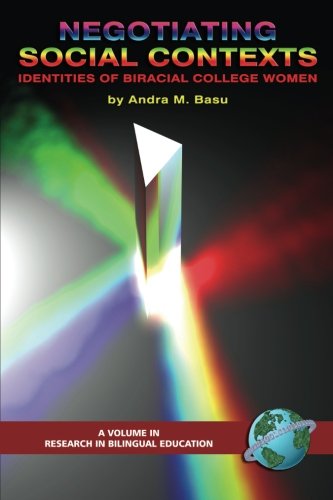
    This book examines the identification choices of a group of biracial college women and explores how these identifications relate to their choices and constructions of different social contexts. It is a qualitative study that draws on recent psychological literature, as well as personal interviews and focus groups with a group of biracial college women. The book includes 1) a review of the relevant literature concerning biracial individuals, 2) a discussion of some of the unique issues facing researchers who work with biracial populations, and 3) an indepth examination of the relationship between identity and different social contexts for a group of biracial women. The book addresses issues critical to educators, counselors, policy makers and researchers who work with biracial students, as well as biracial individuals and their families. For example, it shows how, for this group of biracial college women, identity choices did influence their choices and constructions of social contexts, particularly at the school that they all attended. Yet while identification choices did influence their perceptions about their social contexts, other factors such as social barriers also influenced them. Family members played a role in their identification choices as well, but siblings were found to be more influential than parents. In addition, the book demonstrates how educators and biracial mentors had a significant impact on this particular group of biracial women. The implications of these findings for parents, educators and future researchers are considered, as the number of biracial individuals living in the United States continues to grow.

  • Working with Multiracial Students: Critical Perspectives on Research and Practice

    Information Age Publishing
    2006
    Paperback: 1-59311-250-5
    Hardcover: 1-59311-127-4

    Edited By:

    Kendra R. Wallace
    University of Maryland, Baltimore County

    Working with Mixed Heritage Students offers a collection of writings that bridges the social science and educational literature related to mixed heritage identity development and schooling in diverse contexts. As such, it is the first book of its kind to provide a direct focus on multiracial/ethnic identity and formal education in the United States based on the scholarship of educational researchers. The two common threads linking the chapters are: the flexible, yet situated nature of ethnic and racial identities among mixed heritage students; and the importance of theorizing social contexts when interpreting and representing identity, community, and belonging. In addition to exploring general themes of identity development, Working with Mixed Heritage Students addresses theoretical and methodological issues in conducting research on topics related to mixed heritage students, as well as implications for teacher preparation and educational practice. Ultimately, the authors brought together in this volume share a focus on recently mixed heritage students of first, or second, or third generation multiracial and multiethnic descent. This diversity of perspectives on such a complex topic creates a tension within the book, one that naturally emerges through interdisciplinary collaboration. But it is hoped that this tension is just one of many that will lead to further reflection, dialogue, and action by researchers and educators working with like populations.

  • Counseling Multiracial Families

    SAGE Publications
    1999
    208 pages
    Paperback ISBN: 9780761915911
    Hardcover ISBN: 9780761915904

    Bea Wehrly, Professor Emeritus of Counselor Education
    Western Illinois University

    Kelley R. Kenney, Professor of Counseling & Human Services
    Kutztown University, Kutztown, Pennsylvania
    Multicultural Education and Consulting, Sinking Spring, Pennsylvania

    Mark Kenney, Adjunct Professor
    Kutztown University, Kutztown, Pennsylvania
    Multicultural Education and Consulting, Sinking Spring, Pennsylvania

    Multiracial families (families in which one member of the family has a different racial heritage than the other member(s) of the family) comprise a rapidly growing U.S. population. Counseling Multiracial Families addresses this population that has been neglected in the counseling literature. In the first chapter, readers are given a comprehensive history of racial mixing in the United States special needs and issues of multiracial families as well as special strengths of multiracial families are addressed. Challenges of interracially married couples are explored as are the social and cultural issues related to parenting and child rearing of multiracial children in today’s society. The results of biracial identity development research are translated into counseling practice with the children, adolescents, and adults in multiracial families.

    Table of Contents

    • Historical Overview
    • Multiracial Individuals, Interracial Couples and Families
    • Interracial Marriage
    • Current Conditions and Challenges
    • Multiracial Individuals
    • Issues across the Lifespan
    • Other Multiracial Families
    • Intervention and Treatment of Multiracial Individuals, Couples and Families
    • Case Studies
  • Phillip Handy examines how children form racial identities in multiracial families

    Research Highlights
    Rutgers University
    2009-04-22

    The election of America’s first mixed-race president has created new interest in what it’s like to grow up as a multiracial child. A Rutgers senior majoring in sociology and psychology has already received input from about 930 multiracial people from across the country to help provide some answers.

    Phillip Handy, who grew up in Howell and has a white mother and an African-American father, was actually pondering the phenomenon before the presidential campaign ever began. In 2006, he helped form an organization called Fusion, the Rutgers Union of Mixed People, aimed at uniting people who identify with, or are interested in, the multiracial experience. A year ago, Handy was included in a New York Times article and video about mixed race.

    Handy’s early interest in the field has now blossomed into academic research, which he will discuss in a panel presentation at the Aresty Undergraduate Research Symposium called Race and Gender in the Family: A Mixed-Race Perspective.

    Handy’s work explores how the strength of the relationship between a multiracial child and his or her parent of the same gender impacts racial identity and awareness. He hypothesizes that the children closer to the same-gender parent will gravitate toward that parent’s characteristics. In addition, he predicts that this effect will be more prominent in families where gender roles are more clearly defined…

    Read the entire article here.

  • …These emerging beliefs provided the legal community with a framework within which to justify increasingly rigid separation between blacks and whites and increasingly stringent definitions of blackness. One clear example may be found in Judge Thomas M. Norwood‘s remarks in 1907, entitled “Address on the Negro,” in which he reflected upon his experiences dealing with black defendants over the years. After detailing the inferiority of the black race, Norwood explained to his audience that miscegenation was a horrible threat to the nation. Even though the law forbade interracial sex, having legal prohibitions on the books was not sufficient to curb the evil: “illicit miscegenation thrives and the proof stalks abroad in breeches and petticoats along our streets and highways.” This proof was the mixed-race issue of such unions.

    Norwood’s beliefs about black inferiority did not permit him to blame “pure” blacks for the increases in racial mixing. He placed the blame squarely on white men, who made and enforced the laws against miscegenation and prevented black men from crossing the color line, while simultaneously “wallow[ing] with dusky Diana with impunity.” This practice by white men, in Norwood’s view, was particularly damaging to white women. Women married to men who engaged in interracial sex would bear the shame of knowing that their children had black half siblings. Their white daughters would flinch at having to acknowledge a black child’s salute of them as sisters.

    While Norwood saw “full-blooded Negroes” as childlike, easily led, humble, and nonthreatening, he believed that mulattoes, due to the admixture of whiteness, were a genuine threat both in their prominence and in their attitudes. He argued that all prominent black persons in the United States had white or Native American ancestry to thank for their abilities and that all were hostile to whites. His solution to this problem, which would have been unconstitutional even under the prevailing racist standards, was to “Draw a dead line between the races. Tell the Negro, when he crosses it the penalty is death. Tell the white man, when he crosses it the penitentiary is there.” …

    Julie Novkov, “Racial Constructions: The Legal Regulation of Miscegenation in Alabama, 1890–1934,” Law and History Review Summer 2002.

  • Racial Formation in the New Millennium

    Routledge
     2008-03-01
    256 pages
    Trim Size: 6 x 9
    Hardback ISBN: 978-0-415-95025-1

    Michael Omi, Associate Professor of Ethnic Studies
    University of California, Berkeley

    Howard Winant, Professor of Sociology
    University of California, Santa Barbara

    First published in 1986, and then again in 1994, Omi and Winant’s Racial Formation in the United States is considered a classic text on race and ethnicity. Racial Formation in the New Millennium builds upon the ideas set forth in Omi and Winant’s classic text – providing a sophisticated and up-to-date overview of race and ethnicity in the United States. In this volume, they include current issues and controversies related to racism, race/class/gender interrelationships, modern life and racial politics.

  • Racial Formation in the United States: From the 1960s to the 1990s, 2nd Edition

    Routledge
    Publication Date: 1994-03-22
    240 pages
    Trim Size: 6 x 9
    Paperback ISBN: 978-0-415-90864-1

    Michael Omi, Associate Professor of Ethnic Studies
    University of California, Berkeley

    Howard Winant, Professor of Sociology
    University of California, Santa Barbara

    First published in 1986, Racial Formation in the United States is now considered a classic in the literature on race and ethnicity. This second edition builds upon and updates Omi and Winant’s groundbreaking research. In addition to a preface to the new edition, the book provides a more detailed account of the theory of racial formation processes. It includes material on the historical development of race, the question of racism, race-class-gender interrelationships, and everyday life. A final chapter updates the developments in American racial politics up to the present, focusing on such key events as the 1992 Presidential election, the Los Angeles riots, and the Clinton administration’s racial politics and policies.

  • A Reader on Race, Civil Rights, and American Law: A Multiracial Approach

    Carolina Academic Press
    2001
    864 pages
    ISBN-10: 0-89089-735-2
    ISBN: 978-0-89089-735-5
    LCCN: 2001092052

    Timothy Davis, W. and Ruth H. Turnage Professor of Law
    Wake Forest University

    Kevin R. Johnson, Dean and Mabie-Apallas Professor of Public Interest Law and Chicana/o Studies
    University of California, Davis

    George A. Martinez, Professor of Law
    Southern Methodist University, Dedman School of Law

    This anthology offers a range of legal and related literature analyzing the major issues of race and civil rights in the modern United States. Unlike previous works, which have tended to focus on the relationship between Caucasians and African Americans, this anthology considers race and civil rights issues from a wide range of minority perspectives — African American, Asian American, Latino, and Native American.

    The debate over race issues is examined in numerous contexts, including the role of race in laws affecting education, housing, employment, voting rights, immigration, and the administration of criminal justice. In this anthology, editors Davis, Johnson, and Martinez explore broader themes such as the history of racial subordination of African Americans, Native Americans, Asian Americans and Latinos; affirmative action; hate speech; and the subordination of women of color. In setting the stage for an examination of race in these diverse contexts, the anthology’s first selections explore the concept of race.

    The anthology is geared toward, but not limited to, law school classes focusing on civil rights and race relations. The selections are of such a nature that the anthology should also appeal to anyone interested in foundational readings in this area. Each chapter begins with an introduction that strives to provide a framework from which the reader can analyze the current debates over issues of race in the United States.

    View the table of contents here.

  • How Did You Get to Be Mexican? A White/Brown Man’s Search for Identity

    Temple University Press
    1999
    264 pages
    6×9
    EAN: 978-1-56639-651-6
    ISBN: 1-56639-651-4

    Kevin R. Johnson, Dean and Mabie-Apallas Professor of Public Interest Law and Chicana/o Studies
    University of California, Davis

    This compelling account of racial identity takes a close look at the question “Who is a Latino?” and determines where persons of mixed Anglo-Latino heritage fit into the racial dynamics of the United States. The son of a Mexican-American mother and an Anglo father, Kevin Johnson has spent his life in the borderlands between racial identities. In this insightful book, he uses his experiences as a mixed Latino-Anglo to examine issues of diversity, assimilation, race relations, and affirmative action in contemporary United States.

    Read the introduction here.

    Table of Contents

    Preface
    1. Introduction
    2. A “Latino” Law Student? Law 4 Sale at Harvard Law School
    3. My Mother: One Assimilation Story
    4. My Father: Planting the Seeds of a Racial Consciousness
    5. Growing Up White?
    6. College: Beginning to Recognize Racial Complexities
    A Family Gallery
    7. A Corporate Lawyer: Happily Avoiding the Issue
    8. A Latino Law Professor
    9. My Family/Mi Familia
    10. Lessons for Latino Assimilation
    11. What Does It All Mean for Race Relations in the United States?
    Notes
    Bibliography
    Index

  • I-Dentity: The Biracial Woman as a Bridge In Third-Wave Feminism

    Erica Jackson
    Fall 1993

    This is by no means intended to be an exhaustive discussion of the biracial experience in America, which is in no way monolithic.  In fact, it is inspired by the belief that race (whether singular or plural)  is an outdated concept and so it alone does not determine self-image, and if it does, not necessarily in the ways we stereotype each other, nor to the degree of signifigence generally attached to it in the mass media. 

    Toward that end, this paper will suspend disbelief in the concept of race, in order to explore the dimensions and constructions of race.  If nothing else, I hope it raises questions about the assumptions we  carry with us.  A biracial person is first and foremost a person, with all the shared and unique qualities of any other.

    Assumptions about the biracial become self-fulfilling prophecies. Like all assumptions (regarding women, or blacks, for example), they limit the possibilities of both the person making them and the person about whom they are made, and in their ability to connect.  While mixed race people are a natural link between the races of which they are a part, images of them have  instead been used for divisive purposes.

    This is especially disturbing as it applies to relationships among and between white, biracial and black women.  Rather than connecting on the basis of interests or other shared experience, the relationship between blacks and biracials is often predicated upon the latter’s partial denial of heritage.  This illustrates a basic problem in race relations.  By viewing race as a fundamental identification, it becomes defined in very narrow terms and experiences, alienating blacks both from non-blacks with whom they might share profound experiences and from other black/part black biracial individuals whose experience is very different from their own.
     
    Theories aside, the author questions the ability of one so tied to the issue as herself to be objective.  Are my assertions and reflections simply based on the idealism with which I judge events?  Could I be reinventing my experience to accommodate my beliefs?  Am I nit-picking or merely whining about realities I should simply accept?  Perhaps objectivity is overrated and empiricism does not always apply.  After all, if we don’t tell our own stories, who will tell them for us?  So far, no one…

    Read the entire article here.