• Sugar & Slate

    Planet Books
    January 2002
    192 pages
    ISBN-10: 0954088107
    ISBN-13: 978-0954088101
    8.1 x 5.8 x 0.6 inches

    Charlotte Williams, Professor of Social Work
    Royal Melbourne Institute of Technology, Melbourne, Australia

    Arts Council of Wales Book of the Year, 2003

    A mixed-race young woman, the daughter of a white Welsh-speaking mother and black father from Guyana, grows up in a small town on the coast of north Wales. From there she travels to Africa, the Caribbean and finally back to Wales. What begins as a journey becomes a fascinating confrontation with herself and with the idea of Wales and Welshness.

    Sugar and Slate is a remarkable personal memoir that speaks to the wider experience of mixed-race Britons, characterised by its constant pull of to-ing and fro-ing, movement and dislocation, going away and coming back with always a sense of being ‘half home’. It is a story of Welshness and a story of Wales but above all a story for those of us who look over our shoulder across the sea to some other place.

  • The Attitudes Toward Multiracial Children Scale

    Journal of Black Psychology
    2001
    Vol. 27, No. 1
    pages 86-99
    DOI: 10.1177/0095798401027001005

    Charmain F. Jackman
    University of Southern Mississippi

    William G. Wagner, Professor
    University of Southern Mississippi

    J. T. Johnson
    University of Southern Mississippi

    The Attitudes Toward Multiracial Children Scale (AMCS) was developed to measure adults’ attitudes concerning the psychosocial development of multiracial children. Two separate studies were conducted to evaluate the items devised for the scale. In the first study, an initial version of the AMCS was administered to 250 college students from racially/ethnically diverse backgrounds. Results revealed that scores on the 43-item scale were internally consistent (Cronbach’s alpha = .92) and that four factors (i.e., Multiracial Identity, Multiracial Heritage, General Adjustment, and Social Relationships) could be identified. The AMCS was then revised and administered to a group of 187 participants. Again, factor analysis yielded a four-factor solution (i.e., Psychosocial Adjustment, Self-Esteem, Multiracial Identity, and Multiracial Heritage). The internal consistency for scores on the resulting 23-item scale was good (Cronbach’s alpha = .87) and 3-week test-retest reliability (n = 15) was .77.

  • Beyond Black: Biracial Identity in America (Book Review)

    Pychiatric Services
    May 2003
    Volume 54
    Page 751
    Published by The American Psychiatric Association

    Maureen Slade, R.N., M.S., Director of Psychiatry
    Northwestern Memorial Hospital, Chicago

    Brendan Slade-Smith
    Illinois Wesleyan University, Bloomington

    Beyond Black: Biracial Identity in America
    by Kerry Ann Rockquemore and David L. Brunsma; Thousand Oaks, California, Sage Publications, 2002, 178 pages.

    Who is black today, and who will be black tomorrow? Kerry Ann Rockquemore and David L. Brunsma, two sociologists, decided to initiate a research project to study this complicated and highly controversial question, in part to provide sorely needed empirical data to facilitate informed discussions on multiracialism. The authors also hope that their book can be used as a resource to guide decisions about the inclusion of a multiracial category in the 2010 census. Rockquemore and Brunsma chose to focus specifically on individuals who have one black and one white parent.

    Beyond Black: Biracial Identity in America is composed of six chapters and is easy reading, while at the same time being intellectually stimulating and challenging. The first chapter lays the groundwork for explaining why it is necessary to study biracial identity formation in a scholarly fashion. This chapter includes a straightforward discussion of the role of slavery, the “one-drop” rule, miscegenation, the Jim Crow laws, and the civil rights era in the rigid categorization of blacks as a racial category in the United States. However, the most fascinating discussion is the identification and in-depth discussion of possible biracial identities…

    Read the entire article here.

  • African Mexicans and the Discourse on Modern Nation

    University Press of America
    June 2004
    136 pages
    Paper ISBN: 0-7618-2858-3 / 978-0-7618-2858-7

    Marco Polo Hernández Cuevas, Asssociate Professor of Spanish
    North Carolina Central University

    In African Mexicans and the Discourse on Modern Nation, author Marco Polo Hernández-Cuevas explores how the Africaness of Mexican mestizaje was erased from the national memory and identity and how national African ethnic contributions were plagiarized by the criollo elite in modern Mexico. The book cites the concept of a Caucasian standard of beauty prevalent in narrative, film, and popular culture in the period between 1920 and 1968, which the author dubs as the “cultural phase of the Mexican Revolution.”

    The author also delves into how criollo elite disenfranchised non-white Mexicans as a whole by institutionalizing a Eurocentric myth whereby Mexicans learned to negate part of their ethnic makeup. During this time period, wherever African Mexicans, visibly black or not, are mentioned, they appear as “mestizo,” many of them oblivious of their African heritage, and others part of a willing movement toward becoming “white.” This analysis adopts as a critical foundation Richard Jackson’s ideas about black phobia and the white aesthetic, as well as James Snead’s coding of blacks.

    Table of Contents

    • Foreword
    • Preface
    • Acknowledgments
    • Introduction
    • The Revolution and Invisibility: African Mexicans and the Ideology of Mestizaje in La raza cósmica
    • The Erased Africaness of Mexican Icons
    • La vida inútil de Pito Pérez: Tracking the African Contribution to the Mexican Picaresque Sense of Humor
    • Angelitos negros, a Film from the “Golden Age” of Mexican Cinema: Coding Visibly Black Mestizos By and Through a Far-Reaching Medium
    • Modern National Discourse and La muerte de Artemio Cruz: The Illusory “Death” of African Mexican Lineage
    • Conclusion
    • Bibliography
    • Index
  • Winnefred and Agnes: The Story of Two Women

    Independent Publishing Group
    September 2002
    288 pages, Cloth, 5 1/2 x 8 1/2
    6 B/W Photos, 1 Chart, 1 Map
    ISBN: 9780795701139 (0795701136)

    Agnes Lottering

    This is a rare, possibly the first, first-person account of being part of the group of mixed-race families who came into existence at Ngome in the province of KwaZulu-Natal when, in the late 19th century, well-to-do British and Irish traders took Zulu wives and adopted Zulu cultural practices, including polygamy. The author recounts her life and that of her mother in this true account of a Zululand family whose lives were touched in equal measure by tribal belief and Christianity, healing herbs, magical birds, and the tokeloshe, a mischievous creature surrounded by myth and sexual innuendo. It is also a tale of betrayal, grand passion, bewitchment, abuse, and the triumph of love. Part love story and family saga, part social history, it is above all a uniquely South African tale.

    Agnes Lottering was born in Ngome Forest in 1937. Due to financial and other constraints, she never completed her schooling. Yet she is a gifted storyteller, telling her tale with freshness and authenticity. She lives in Durban, South Africa.

  • “The New Kubla Khan: Mixed Race Multi-Nationalism”

    Paper presented at the annual meeting of the American Studies Association
    2009-05-24

    Michele Elam, Martin Luther King, Jr. Centennial Professor of English, Professor, Director of African & African American Studies
    Stanford University

    This paper examines how, and to what ends, people of the “mixed race experience” are being discursively contextualized as posterchildren of the “post-race,” “post-nation” era. As early as 1996, Stanley Crouch was proclaiming that “race is over;” since then, others also have rung race’s death knell: Holland Cotter in a 2001 New York Times piece, for example, has claimed that the time for “ethno-racial identity” is past, that we are now witnessing the coming of “postblack or postethnic art” that represents what Anthony Appiah recently called a “New Cosmopolitanism.” This presentation argues that “mixed race” has emerged in the context of these “post-race” cultural discourses, discourses which suggest, as Belize in Tony Kushner’s Angels in America puts it, that “race, taste and history” are “finally overcome.” Hybridity for many represents “life after race”(Naomi Zack), a step “beyond race” (Dinesh D’Sousa), a gesture “against race”(Paul Gilroy), the “new racial order” (G. Reginald Daniel), a “new frontier”(Maria Root) advanced by a “new people” (Jon Michael Spencer) who are ushering in a new world beyond race, identity, and nation. My presentation examines this problematic representation of mixed race people as post-nation vanguards in both mainstream media and in the field of pop-culture, and the send-up of the idea that “mixed race” people constitute a new nation-beyond-nationalism in Danzy Senna’s novel, Symptomatic (2005).

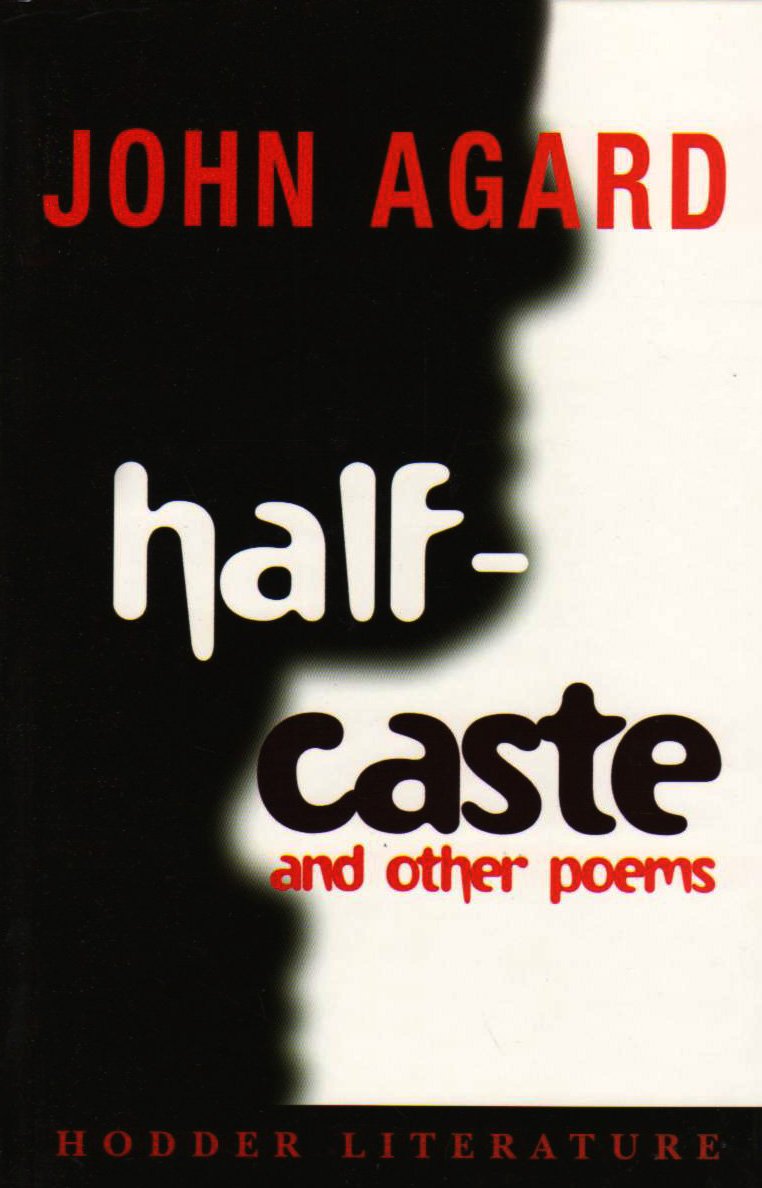
  • Half-Caste and Other Poems

    Hodder Literature
    2005-09-15
    Paperback: 80 pages
    19.4 x 12.2 x 0.8 cm
    ISBN-10: 0340893893
    ISBN-13: 978-0340893890

    John Agard

    Half-Caste’, the title poem of this collection, is one of the set poems for GCSE English for AQA A, the largest spec with 375,000 candidates. But its influence and presence extends well beyond the ‘AQA’ schools, making John Agard one of the most popular, well-known and respected poet-performers on the schools circuit.

    Through his 45 poems, John Agard explores a wide variety of themes: racial harmony, tension and diversity; war and religion; society, patriotism and politics; as well as more personal ideas on relationships, love and attraction. This is all delivered with a range and depth in terms of content, language, poetic form and technique that will engage and motivate KS3 and KS4 pupils while developing their understanding. An ideal collection to sit at the heart of a scheme of work on cross-cultural themes.

    Table of Contents

    And All Was Good
    My Move Your Move
    Union Jack and Union Jill
    Half-caste [Read here.]
    Rainbow
    Tongue
    A Word
    Message From Your Mobile
    Right-On Mr Left
    Smoke-loving Girl Blues
    Angels For Neighbours
    Flag
    A Vampire’s Priorities
    A Hello From Cello
    The Hurt Boy and The Birds
    Boomerang
    That Mouth
    Behold My Pen
    Punctuating The Silence
    Poetry Jump-Up
    Follow That Steel Pan
    Coal’s Son and Diamond’s Daughter
    A Date With Spring
    volte For Your Local Shadow
    Twins
    Quest
    Clouds
    The Ozone Liar
    Cowtalk
    Who’ll Sve Dying Man?
    For the Record
    One Question From A Bullet
    A Hand On A Forehead
    Not Arms
    Checking Out Me History
    Toussaint L’Overture Acknowledges Wordsworth’s Sonnet ‘To Toussaint L’Overture’
    Windrush Child
    Crybaby Prime Minister
    Skin
    A Social Skeleton
    The Giant With A Taste For Mongrel Blood
    Behind The Menu
    Salt
    Coal
    Marriage of Opposites
    Notes

  • Between Camps: Nations, Cultures and the Allure of Race (Also published in the United States by Harvard University Press as Against Race: Imagining Political Culture beyond the Color Line)

    Routledge
    2004-08-26
    424 pages
    Trim Size: 234X156
    Paperback ISBN: 978-0-415-34365-7

    Paul Gilroy, Anthony Giddens Professorship in Social Theory
    The London School of Economics and Political Science


    In this provocative book, now reissued with a new introduction, Paul Gilroy contends that race-thinking has distorted the finest promises of modern democracy.  He compels us to see that fascism was the principal political innovation of the twentieth century – and that its power to seduce did not die in a bunker in Berlin.

    Between Camps addresses questions such as:

    Gilroy examines the ways in which media and commodity culture have become pre-eminent in our lives in the years since the 1960s and especially in the 1980s with the rise of hip-hop and other militancies. With this trend, he contends, much that was valuable about black culture has been sacrificed in the service of corporate interests and new forms of cultural expression tied to visual technologies. He argues that the triumph of the image spells death to politics and reduces people to mere symbols.

    At its heart, Between Camps is a Utopian project calling for the renunciation of race. Gilroy champions a new humanism, global and cosmopolitan, and he offers a new political language and a new moral vision for what was once called ‘anti-racism’.

  • Hey Mum, What’s a Half-Caste?

    Independent Publishing Group
    April 2010
    316 pages, Trade Paper, 5.75 x 8.25
    35 B/W Photos
    ISBN: 9781921248030 (1921248033)

    Lorraine McGee-Sippel

    Compelling and honest, this memoir recounts the diffuse effects of a governmental policy that required the author’s adoptive parents to be informed of her Afro-American ancestry. Chronicling her personal search for cultural identity, this account also delves into indigenous studies, Australian history, and psychology. This remarkable story is simultaneously universal and deeply personal and will educate and inspire readers.

    Lorraine McGee-Sippel is a descendent of the Yorta Yorta people from the Murray-Goulburn region on the Victorian-NSW border. She is a contributor to numerous anthologies and publications, and in 2008 she received the Inaugural Yabun Elder of the Year Award for her contribution to reconciliation and community work.

  • Lara

    Bloodaxe Books
    2009
    192 pages
    Paperback ISBN: 1 85224 831 9

    Bernardine Evaristo

    Lara is a powerful semi-autobiographical novel-in-verse based on Bernardine Evaristo’s own childhood and family history. The eponymous Lara is a mixed-race girl raised in Woolwich, a white suburb of London, during the 60s and 70s. Her father, Taiwo, is Nigerian, and her mother, Ellen, is white British. They marry in the 1950s, in spite of fierce opposition from Ellen’s family, and quickly produce eight children in ten years. Lara is their fourth child and we follow her journey from restricted childhood to conflicted early adulthood, and then from London to Nigeria to Brazil as she seeks to understand herself and her ancestry.

    The novel travels back over 150 years, seven generations and three continents of Lara’s ancestry. It is the story of Irish Catholics leaving generations of rural hardship behind and ascending to a rigid middle class in England; of German immigrants escaping poverty and seeking to build a new life in 19th century London; and of proud Yorubas enslaved in Brazil, free in colonial Nigeria and hopeful in post-war London. Lara explores the lives of those who leave one country in search of a better life elsewhere, but who end up struggling to be accepted even as they lay the foundations for their children and future generations.

    This is a new edition of Bernardine Evaristo’s first novel Lara, rewritten and expanded by a third since its first publication in 1997.