• The Loving opinion treated race as a monolithic and meaningful category, even though the realities of the case itself subverted this account. The litigation arose in Caroline County, Virginia, a place called the “passing capital of America” because so many light-skinned blacks were mistaken for whites. In addition, the Jeters made clear that “Richard [wasn’t] the first white person in our family,” suggesting that Mildred’s own racial background was complex.

    Rachel F. Moran, “Loving and the Legacy of Unintended Consequences,” (Wisconsin Law Review, Issue 2, 2007), 241-281. https://www.researchgate.net/publication/265218010_Loving_and_the_Legacy_of_Unintended_Consequences.

  • The Identity Development of Biracial Children and Society’s Impact Thereon

    Workshop by Francis Wardle
    1989-03-04
    18 pages

    Francis Wardle

    This document is taken from a workshop presentation focusing on the identity development of biracial children. The confusion of the academic community concerning this topic is emphasized. Three main aspects are examined: (1) “What is the identity process of any child?”; (2) “What is society?”; and (3) “How does society impact the developmental process?”. The identity process is outlined as beginning at birth, when the infant first develops trust and bonds with his or her parent or caregiver. The developmental levels of infancy, young children from birth to five years of age, and adolescence are highlighted. A question and answer section is included in which the author responds to questions dealing with lack of acceptance of interracial marriages and relationships; biracial children’s identity, development, and attitudes; teachers who are uncomfortable with teaching biracial children; and other children’s reactions to biracial children.

    Read the entire paper here.

  • Barack Obama’s Improbable Election and the Question of Race and Racism in Contemporary America

    Journal of Black Studies
    January 2010
    Volume 40, No. 3

    Guest Editor
    Pamela D. Reed, Assistant Professor of English Composition and Africana Literature
    Virginia State University

    The Journal of Black Studies has now issued two special issues on President Barack Hussein Obama. “The Barack Obama Phenomenon” (Mazama, 2007) examines the historic candidacy of the then Illinois Senator. The present issue explores Obama’s nascent presidency and matters of race and racism, both in the run-up to and in the wake of his landmark victory.

    Try as one might, it is not possible to minimize the centrality of race in all areas of American life, even now. Indeed, since the inception of the American republic, built on the backs of enslaved Africans, race and color have been the ultimate determinants of socioeconomic status. For over four centuries, dating from around the mid-15th century, millions of Africans were forcibly transported across the Atlantic Ocean, and scores of them were brought to the United States, where their forced labor provided the engine for the American capitalist machine…

    …Whatever the case, W. E. B. Du Bois’s prescient statement (1903) regarding the problem of the color line in the 20th century is no less true today—even as we head into the second decade of the 21st century. Be that as it may, Barack Hussein Obama is the 44th President of these United States. As a result, scholars will undoubtedly dissect his election and his presidency for the foreseeable future. We begin that process herein.

    Table of Conents

    • Pamela D. ReedIntroduction: Barack Obama’s Improbable Election and the Question of Race and Racism in Contemporary America. pp. 373-379.
    • Philip S. S. HowardTurning Out the Center: Racial Politics and African Agency in the Obama Era. 380-394.
    • Christopher J. MetzlerBarack Obama’s Faustian Bargain and the Fight for America’s Racial Soul. pp. 395-410.
    • Martell Teasley and David IkardBarack Obama and the Politics of Race: The Myth of Postracism in America. pp. 411-425.
    • Thomas EdgeSouthern Strategy 2.0: Conservatives, White Voters, and the Election of Barack Obama. pp. 426-444.
    • Felix Germain “Presidents of Color,” Globalization, and Social Inequality. pp. 445-461.
    • Pearl K. Ford, Tekla A. Johnson, and Angie Maxwell“Yes We Can” or “Yes We Did”?: Prospective and Retrospective Change in the Obama Presidency. pp. 462-483.
    • David MasteySlumming and/as Self-Making in Barack Obama’s Dreams From My Father. pp. 484-501.

     
    Read the entire introduction here.

  • …Finally, Rhinelander teaches us about the limited spaces that are available in society for recognizing families that are multiracial. Like many multiracial families, Alice’s family, the Joneses, existed within an American landscape that had no recognized place for them and their lives. Just like the one-drop rule was applied to individuals, it was applied to the Jones family during and after the Rhinelander saga. In other words, Elizabeth Jones’s legal and social classification as a white individual became “implicated by [the] brownness” of her family members, and the reality of her family’s existence as one that lived between two worlds, one white and one black, was erased. It had no place in 1920s New York society, and it placed them nowhere within the spectrum of American families. Today, this sense of family as defined by race persists. The lesson is so clear that even young children understand it. Just ask my husband, who is white and who is often asked as he drops off or picks up our children, who are racially mixed, black and white children, “why he does not match.” Or ask my daughter, who even at the age four, understood that there was no place for her family, often declaring that she wanted to paint her daddy “brown like Davey’s dad.” As Heidi Durrow has explained about the continuing “spaceless-ness” of interracial families in our society, “[w]hen race acts as the primary kinship identifier, the reality of [the multiracial] family dissolves.” It is important that we continue to explore and study cases like Rhinelander case, which serve as stark reminder of this dissolving multiracial family, and our need to create spaces for it…

    Angela Onwuachi-Willig,  “A Beautiful Lie: Exploring Rhinelander v. Rhinelander as a Formative Lesson on Race, Identity, Marriage, and Family,” California Law Review, Volume 95, 2007, University of Iowa Legal Studies Research Paper No. 07-27.

  • I now see fluid identity as a strength. I like being able to move in and out of different communities, being able to express the cultural characteristics of my surroundings without much thought. Perhaps the best example of this came a few years ago while I was in line at Disneyland with a few friends. The women ahead of us were exchange students from Japan. We talked for the forty-five minutes or so it took to get on the roller coaster, and when we got off the ride, my friends commented on how I “became Japanese” as I talked with the students. “Your sentence structure changed. You bowed your head a lot. It was like you became a different person. Do you always do that around Japanese people?” Their questions truly caught me off guard, not because I felt insecure in who they perceived me to be, but because I really hadn’t noticed I did that. Fluid identity is just as it sounds: the ability to identify in a way that takes into account the cultural currents and adjust accordingly. The issues it raises permeate all aspects of who I am.

    Amiko Matsumoto, “Fluid…: Identity In the Making,” The Vermont Connection Journal, (July 29, 2002).

  • Fluid…: Identity in the Making

    The Vermont Connection Journal
    The University of Vermont
    2002-07-29

    Amiko Matsumoto

    I get the “what are you” question a lot. I usually get a warning that the question is coming: a tilt of the head, a squint of the eyes, a puzzled look as the wheels turn in my questioner’s head. She or he will try to figure out where I fit, what possible combination or part of the world looks like me. And when the search of the database ends without a satisfactory answer, my questioner will ask, “What are you?”

    For a long time, I didn’t like this question because I didn’t have a neatly packaged answer. “My dad is sansei, a third generation Japanese American, and my mom’s ancestry goes back three generations to France and Switzerland,” I’d respond. Sometimes that answer would be satisfactory, but most often, it was not. “But what are YOU?” or “But you don’t look THAT Japanese” or even “Wow, your English is really good”—that’s what would usually follow.

    When it did, I would feel like I had done something wrong, that I had failed, and that I should do more to explain myself. I wanted to be understood so badly that I sometimes tried to deny part of who I was in order to more successfully fit into someone’s perception of who I should be. But a few years ago, all of that changed. It wasn’t an overnight decision for me, but rather a process that was the result of many conversations, confrontations, and tears. At some point during my time in Burlington, I became comfortable with my biracial identity. More than comfortable, I became proud…

    …I now see fluid identity as a strength. I like being able to move in and out of different communities, being able to express the cultural characteristics of my surroundings without much thought. Perhaps the best example of this came a few years ago while I was in line at Disneyland with a few friends. The women ahead of us were exchange students from Japan. We talked for the forty-five minutes or so it took to get on the roller coaster, and when we got off the ride, my friends commented on how I “became Japanese” as I talked with the students. “Your sentence structure changed. You bowed your head a lot. It was like you became a different person. Do you always do that around Japanese people?” Their questions truly caught me off guard, not because I felt insecure in who they perceived me to be, but because I really hadn’t noticed I did that. Fluid identity is just as it sounds: the ability to identify in a way that takes into account the cultural currents and adjust accordingly. The issues it raises permeate all aspects of who I am…

    Read the entire article here.
  • Mixed Race… Mixed Up?

    Presentation at the Canadian Critical Race Conference 2003

    Charito Gailling

    Mee Lain Ling

    Our workshop will explore “mixed race experience” by referring to our own experiences as mixed race women. We are particularly interested in fostering discussion that critically examines racial binaries of whiteness vs non-whiteness and how mixed race voices are negotiated and made invisible. Using exercises, discussion and group work, we will invite participants to consider how re-presentations of power and privilege are present in popular and academic discourses on this topic. We hope to challenge participants to become aware of their own specific “lenses” and think through intersections of identity, racialization, gender, etc. which can be highlighted through the experience of being a mixed race person.

    View the presentation here.

  • Proposed Session: Multiracial/ethnic families

    XVII ISA World Congress of Sociology
    Sociology on the Move
    International Sociological Association
    2010-07-11 through 2010-07-17
    Gothenburg, Sweden

    Programme Coordinators

    Rudy R. Seward, Professor, Director of Graduate Studies, and Associate Chair of Sociology
    University of North Texas, USA

    Ria Smit, Associate Professor of Sociology
    University of Johannesburg, South Africa

    Organizers:

    Cynthia M. Cready, Associate Professor of Sociology
    University of North Texas, USA

    George Yancey, Associate Professor of Sociology
    University of North Texas, USA

    Empirical and theoretical papers that address any aspect of multiracial/ethnic families are invited for this session. Possible topics include: attitudes toward racial/ethnic dating and intermarriage and multiracial/ethnic families; trends in racial/ethnic dating and intermarriage; individual- and community-level effects on racial/ethnic dating and intermarriage; the impact of racial/ethnic dating and intermarriage on other aspects of individual and community life; representations of multiracial/ethnic families in the media; interracial/ethnic adoption; socialization in multiracial/ethnic families; racial/ethnic identity of children from multiracial/ethnic families; identity issues among adults in multiracial/ethnic families; developmental outcomes of children from multiracial/ethnic families; theoretical and methodological approaches and challenges to the study of multiracial/ethnic families; and the interaction of social policy and multiracial/ethnic families.

    For more information, click here.

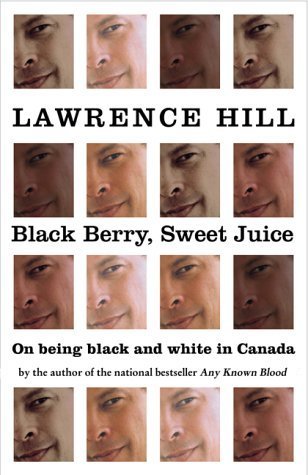
  • Black Berry, Sweet Juice: On Being Black and White in Canada

    Harper Collins Canada
    September 2001
    256 pages
    Paperback ISBN: 9780006385080; ISBN10: 0006385087

    Lawrence Hill

    Lawrence Hill’s remarkable novel, Any Known Blood, a multi-generational story about a Canadian man of mixed race, was met with critical acclaim and it marked the emergence of a powerful new voice in Canadian writing. Now Hill, himself a child of a black father and white mother, brings us Black Berry, Sweet Juice, Hill: On Being Black and White in Canada, a provocative and unprecedented look at a timely and engrossing topic.

    In Black Berry, Sweet Juice, Hill movingly reveals his struggle to understand his own personal and racial identity. Raised by human rights activist parents in a predominantly white Ontario suburb, he is imbued with lingering memories and offers a unique perspective. In a satirical yet serious tone, Hill describes the ambiguity involved in searching for his identity – an especially complex and difficult journey in a country that prefers to see him as neither black nor white.

    Interspersed with slices of his personal experiences, fascinating family history and the experiences of thirty-six other Canadians of mixed race interviewed for this book, Black Berry, Sweet Juice also examines contemporary racial issues in Canadian society. Hill explores the terms used to describe children of mixed race, the unrelenting hostility towards mix-race couples and the real meaning of the black Canadian experience. It arrives at a critical time when, in the highly publicized and controversial case of Elijah Van de Perre, the son of a white mother and black father [Theodore “Blue” Edwards] in British Columbia, the Supreme Court of Canada has just granted custody to Elijah’s mother, Kimberly Van de Perre.

    A reflective, sensitive and often humourous book, Black Berry, Sweet Juice is a thought provoking discourse on the current status of race relations in Canada and it’s a fascinating and important read for us all.

  • Any Known Blood

    Harper Collins Canada
    2001-09-20
    528 pages
    Paperback ISBN: 9780006391760; ISBN10: 0006391761

    Lawrence Hill

    Langston Cane V is 38, divorced and working as a government speechwriter, until he’s fired for sabotaging the minister’s speech. It seems the perfect time for Langston, the eldest son of a white mother and prominent black father, to embark on a quest to discover his family’s past—and his own sense of self.

    Any Known Blood follows five generations of an African-Canadian-American family in a compelling story that slips effortlessly from the slave trade of 19th-century Virginia to the modern, predominantly white suburbs of Oakville, Ontario—once a final stop on the Underground Railroad. Elegant and sensuous, wry and witty, it is an engrossing tale about one man’s attempt to find himself through unearthing and giving voice to those who came before him.