• The Inheritability of Identity: Children’s Understanding of the Cultural Biology of Race

    Child Development
    Volume 66 Issue 5 (October 1995)
    Pages 1418 – 1437
    DOI: 10.1111/j.1467-8624.1995.tb00943.x

    Lawrence A. Hirschfeld, Professor, Anthropology & Psychology
    Eugene Lang College, The New School for Liberal Arts

    4 experiments explored adult and grade school children’s beliefs about inheritability of identity, particularly the “one-drop rule” that defines children of mixed-race parents as belonging to the racial category of the minority parent. In Study 1, 8- and 12-year-olds (N=32) and adults (N=43) were asked the category membership of mixed-race children and the degree to which they resembled each parent. Study 2 investigated whether the same-aged children (N=36) and adults (N=18) expected mixed-race children to have white, black, or intermediate features. Study 3 explored children’s (N=46) expectations about the inheritability of the same properties in animals. Older children, like adults, were found to believe that mixed-race children have black racial features. Adults additionally believe that such children inherit the categorical identity of the minority parent. Study 4 repeated the same tasks with black and white children (N=39) attending an integrated school. Unlike children attending a predominantly white school, children in the integrated school (regardless of race) expect mixed-race children to have intermediate racial features.

  • A New Look at an Old Notion: Lawrence Hirchfeld Discusses Race in Society

    Michigan Today
    University of Michigan
    June 1996

    John Woodford

    Talk of race is everywhere and incessant in America, the din of discourse emanating from all ranks and stations, all age groups, all creeds, all parts of the political spectrum and all manner of news and cultural media.

    Is race real or is it imagined? If it’s real, is it real in a biological sense, a social sense, or both? If imaginary, how did the idea arise?

    Lawrence A. Hirschfeld, U-M associate professor of anthropology and psychology, tackles all of these questions in a book published this spring by the MIT Press: Race in the Making: Cognition, Culture and the Child’s Construction of Human Kinds. The book emerged from Hirschfeld’s studies in the United States and Europe of children’s thinking about race. It will interest not only anthropologists, psychologists, philosophers, historians, political scientists and social workers, but parents and teachers as well. Professor Hirschfeld discussed some of his conclusions with Michigan Today’s John Woodford.

    MT: What is race?

    LH: It is important to begin by talking about what race is not. Regardless of what our senses seem to tell us, race is not a biologically coherent story about human variation simply because the races we recognize and name are not biologically coherent populations. There is as much genetic variation within racial groups as there is between them. Now this does not mean that race is not real psychologically or sociologically. It is obvious that race is real in both these senses. People believe in races and they use this belief to organize important dimensions of social, economic, and political life. But this does not make race a real thing biologically

    Read the entire article here.

  • Nobody’s Son: Notes from an American Life

    University of Arizona Press
    1998
    188 pages
    5.0 x 8.0
    Paper ISBN: 978-0-8165-2270-5

    Luis Alberto Urrea

    Here’s a story about a family that comes from Tijuana and settles into the ‘hood, hoping for the American Dream.

    …I’m not saying it’s our story. I’m not saying it isn’t. It might be yours. “How do you tell a story that cannot be told?” writes Luis Alberto Urrea in this potent memoir of a childhood divided. Born in Tijuana to a Mexican father and an Anglo mother from Staten Island, Urrea moved to San Diego when he was three. His childhood was a mix of opposites, a clash of cultures and languages. In prose that seethes with energy and crackles with dark humor, Urrea tells a story that is both troubling and wildly entertaining. Urrea endured violence and fear in the black and Mexican barrio of his youth. But the true battlefield was inside his home, where his parents waged daily war over their son’s ethnicity. “You are not a Mexican!” his mother once screamed at him. “Why can’t you be called Louis instead of Luis?” He suffers disease and abuse and he learns brutal lessons about machismo. But there are gentler moments as well: a simple interlude with his father, sitting on the back of a bakery truck; witnessing the ultimate gesture of tenderness between the godparents who taught him the magical power of love. “I am nobody’s son. I am everybody’s brother,” writes Urrea. His story is unique, but it is not unlike thousands of other stories being played out across the United States, stories of other Americans who have waged war—both in the political arena and in their own homes—to claim their own personal and cultural identity. It is a story of what it means to belong to a nation that is sometimes painfully multicultural, where even the language both separates and unites us. Brutally honest and deeply moving, Nobody’s Son is a testament to the borders that divide us all.

    Read an excerpt here.

  • Feminist Readings of Native American Literature: Coming to Voice

    University of Arizona Press
    1998
    181 pages
    6.0 x 9.0
    Paper ISBN: 978-0-8165-1633-9

    Kathleen M. Donovan, Professor and Department Head of English
    South Dakota State University, Brookings

    Who in a society can speak, and under what circumstances? These questions are at the heart of both Native American literature and feminist literary and cultural theory. Despite the recent explosion of publication in each of these fields, almost nothing has been written to date that explores the links between the two. With Feminist Readings of Native American Literature, Kathleen Donovan takes an important first step in examining how studies in these two fields inform and influence one another. Focusing on the works of N. Scott Momaday, Joy Harjo, Paula Gunn Allen, and others, Donovan analyzes the texts of these well-known writers, weaving a supporting web of feminist criticism throughout. With careful and gracefully offered insights, the book explores the reciprocally illuminating nature of culture and gender issues. The author demonstrates how Canadian women of mixed-blood ancestry achieve a voice through autobiographies and autobiographical novels. Using a framework of feminist reader response theory, she considers an underlying misogyny in the writings of N. Scott Momaday. And in examining commonalities between specific cultures, she discusses how two women of color, Paula Gunn Allen and Toni Morrison, explore representations of femaleness in their respective cultures. By synthesizing a broad spectrum of critical writing that overlaps women’s voices and Native American literature, Donovan expands on the frame of dialogue within feminist literary and cultural theory. Drawing on the related fields of ethnography, ethnopoetics, ecofeminism, and post-colonialism, Feminist Readings of Native American Literature offers the first systematic study of the intersection between two dynamic arenas in literary studies today.

    Read an excerpt here.

  • Earthquake Weather

    University of Arizona Press
    1996
    87 pages
    5.5 x 8.5
    Paper ISBN: 978-0-8165-1630-8

    Janice Gould

    It’s unmistakable, that strangely calm air and sky that signals big change ahead: earthquake weather. These are familiar signs to Janice Gould, a poet, a lesbian, and a mixed-blood California Indian of Koyangk’auwi Maidu descent. Her sense of isolation is intense, her search for identity is relentless, and her words can take one’s breath away. Sometimes accepting, sometimes full of anger, Gould’s work is rare, filtered through the feelings, thoughts, and experiences of a lesbian of Indian heritage. Over and over again, she speaks as an outsider looking in at the lives of others–through a doorway, out of a car window, or from the shambles of a broken relationship. Showing a steady courage in the midst of this alienation, her words are also stark testimony to the struggle of an individual caught in social and emotional contexts defined by others. In Earthquake Weather, as in an evolving friendship, Gould opens herself to the reader in stages. “I did not know how lonely I was / till we began to talk,” she writes in an opening section, setting the introspective tone of what’s to come. She begins with a focus on those universal truths that both bind us and isolate us from each other: the pain of loss, the finality of death, our longing to see beneath the surface of things. Next, the poet turns to her growing-up years during the Vietnam War and the civil rights movement. She describes a family in turmoil and an Indian heritage that, oddly, was one of the factors that made her feel most disconnected from other people. And she writes poignantly about her increasing alienation from prescribed sexual roles. “What’s wrong with me? / Where do I belong? Why / am I here? Why can’t I / hold on?” Finally, as in a trusting friendship, Gould offers the reader vivid word portraits of relationships in her life–women she has loved and who have loved her. Erotic and deeply personal, these poems serve as both a reconciliation and affirmation of her individuality. “Yet would you deny / that between women desire exists / that in our friendship a delicate / and erotic strand of fire unites us?” The poems in this book, says critic Toby Langen, are most powerful for their “courageous drawing on experience and feelings.” They will speak to many general readers as well as anyone interested in questions of gender and identity, including students of literature, lesbian/women’s studies, social/cultural studies, or American Indian studies.

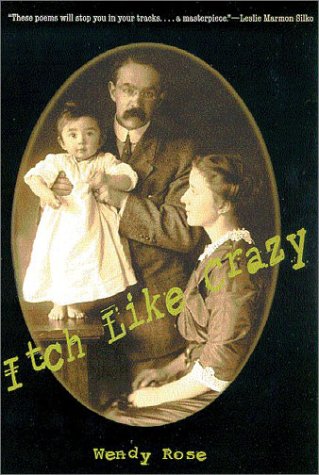
  • Itch Like Crazy

    University of Arizona Press
    2002
    121 pages
    6.0 x 9.0
    Paper ISBN: 978-0-8165-2177-7

    Wendy Rose

    Among Native American writers of mixed-blood heritage, few have expressed their concerns with personal identity with as much passion as Wendy Rose. A mainstay among American Indian poets whose work addresses these issues, she is a writer with whom readers of diverse ethnic backgrounds have consistently identified. In her latest work, Rose returns to these major motifs while exploring a new dimension: using poetry as a tool to delve into the buried secrets of family history—and all of American history as well. Confronting questions of personal history that itch like crazy—the irritations that drive human existence—she acknowledges and pays tribute to her Indian and European ancestors without hiding her anger with American society. Rose’s poems are strong political and social statements that have a distinctly narrative flavor. Here are Europeans who first set foot on America’s shores while Taíno Indians greeted them as if they were visiting neighbors; Hopi and Miwok “Clan Mothers, grand-daughters, all those the missionaries erased”; and European forebears who as settlers pushed their way relentlessly west. Through her vivid imagery, she speaks to and for these ancestors with a sense of loss and an itching caused by the biases provoked by ethnic chauvinism. Itch Like Crazy is a finely crafted literary work that is also a manifesto addressing contacts and conflicts in the history of Indian-white relations. By presenting another view of U.S. history and its impact on the Native Americans who are her ancestors, it offers a new appreciation of the issue of “tribal identity” that too often faces Native peoples of the Americas—and is too often misunderstood by Euro-American society.

    Read an excerpt here.

  • `For Venus smiles not in a house of tears’: Interethnic relations in European cinema

    European Journal of Cultural Studies
    2003
    Vol. 6, No. 1
    pages 55-74
    DOI: 10.1177/1367549403006001470

    Anneke Smelik
    University of Nijmegen

    In the 1990s, several European filmmakers addressed the Romeo and Juliet motif of `impossible love’ in the context of multiculturalism. A heterosexual love affair between people of different ethnic backgrounds allows filmmakers to address issues of racism and deconstruct racial stereotypes. In the films discussed in this article, the tragic love affairs point to the unwillingness of European countries to become pluralistic and multiethnic societies. Some films have attempted to represent interethnic love relations more hopefully, celebrating happy endings of mixed race couples. The success of such films may indicate that the genre of comedy has won over the tragedy of the Romeo and Juliet topos in cinematic representations of interethnic love relations. Perhaps European cinema is ready to embrace constructions of European identity as hybrid, diverse and multiple.

  • Cue Lazarus

    University of Arizona Press
    2001
    76 pages
    6.0 x 9.0
    Paper ISBN: 978-0-8165-2074-9

    Carl Marcum

    A ’77 Pinto. Two boys “a few months from their driver’s license.” And in the back seat, a ghost of the present observing this scene refracted by memory.  In this collection of poetry by Carl Marcum, a young man traces his rise to consciousness, his coming of age in the Southwest as a medio, an individual of mixed race. Displaying his Hispanic heritage as fact, emblem, and music in his poems, Marcum balances hip humor with larger themes of loss and reinvention to paint a work of seriousness and imagination, wrestling sense from the giddy rush of experience. The lead poem, “Cue Lazarus,” conveys the sense of loss that permeates the collection, revisiting time the author spent with a friend he now knows will die. It sets the tone for the explorations to follow as the poet haunts his past: death, traumatic experience, the uneasiness that comes from being unable to forestall tragedy, all combine to create a sense of paradox, that he who endures becomes a ghost compelled to haunt his own life. As poetry becomes a subtle game of language, experience is refigured as an array of possibilities; Marcum finds meaning and epiphany through close observation as he revels in images of constant motion and sustained search. Here is a suite in celebration of Chevys (“That Camaro ran nearly on machismo alone”) and a prayer for breakfast (“I’d like to renounce the salt and pepper shakers / of this life. But the eggs are here / twelve lines into this poem / and getting cold”). He dreams of himself as Pancho Villa, “my poetry at the end of a pistol,” and invokes the spirits of poets past, “beggars on the media of Limbo, holding shabby signs: WILL WORK FOR TRUTH.” Ultimately, Cue Lazarus is about resurrection—of the spirit, of a life, of an identity. It marks the emergence of a vital new voice that, in baring his soul, reveals lessons as old as time.

    Read an excerpt here.

  • ‘After all, I am partly Māori, partly Dalmatian, but first of all I am a New Zealander’

    Ethnography
    Volume 6, Number 4 (December 2005)
    pages 517-542
    DOI: 10.1177/1466138105062477

    Senka Božić-Vrbančić
    The University of Auckland, New Zealand

    This article explores the complexity of the processes of identity construction for ‘mixed-race’ individuals in New Zealand. It focuses on two life stories told by Māori-Croatian women in order to analyse how individuals of Māori-Croatian background constitute their own identity within the heterogeneous discursive practices (race, ethnicity, gender, class, nation) that have operated in New Zealand from colonial times to the bicultural New Zealand of the present. Experience of the hybridization of identity is placed within a framework of power relationships and the varieties of social struggles which help to constitute it from below.

    Read or purchase the article here.