• (Re)constructing multiracial blackness: women’s activism, difference and collective identity in Britain

    Ethnic and Racial Studies
    Volume 24, Issue 1 (January 2001)
    pages 29-49
    DOI: 10.1080/014198701750052488

    Julia Sudbury, Professor and Department Head of Ethnic Studies
    Mills College, Oakland, California

    This article analyses the (re)construction of black identity as a multiracial signifier shared by African, Asian and Caribbean women in Britain, from the framework of recent social movement theory. The collective identity approach calls attention to naming as a strategic element of collective action, but has overlooked the experiences of black women at the intersection of multiple systems of oppression. A focus on the process of constructing black womanhood allows us to move beyond static and unidimensional notions of identity to question how and why gendered racialized boundaries are created and maintained. I argue that multiracial blackness should be viewed as an oppositional identity, strategically invoked by black women activists in order to mobilize collective action. Drawing on everyday theorizing by black women, the article examines the shift from the policing of authenticity claims, to a more open and fluid collectivity, and suggests that explicit interrogations of identity are a prerequisite for effective and sustainable alliances between diverse movement participants…

    …For African Caribbean women, the ‘pure and narrow defnition’ of blackness (see Faith above) was personified through the figure of the ‘conscious’ or ‘I-tal’ black woman. The ‘I-tal’ woman was a direct refutation of hegemonic constructions of beauty and thus established an alternative ideal of womanhood. She was assumed to have dark skin, unprocessed hair and African phenotype features. In seeking to revalorize these denigrated characteristics, black women activists reified a rigid conceptualization of distinct ‘races’.  One unintentional outcome of this approach is the marginalization of mixed race women (Ifekwunigwe 1997). Exclusionary notions of belonging and community were therefore inherent in women’s oppositional constructions of beauty.

    Similar processes characterized a whole array of characteristics and behaviours as black or non-black. A prime area of contestation was that of sexual relationships. Few of the interviewees appeared to view ‘mixed’ relationships as a valid family structure. It was assumed that women who were politically aware would engage in black on black relationships. Accordingly, women who had a white partner were held in suspicion. For example where a woman brought a picture of her new fiancé to a centre, she was at first surrounded by excited women. On seeing the photograph of a white man, the crowds quickly dissipated and women subsequently ignored her…

    Read the entire article here.

  • Interracial Intimacy: The Regulation of Race and Romance

    The University of Chicago Press
    2001
    232 pages
    6 x 9
    Paper ISBN: 9780226536637

    Rachel F. Moran, Michael J. Connell Distinguished Professor of Law
    University of California, Los Angeles

    As late as the 1960s, states could legally punish minorities who either had sex with or married persons outside of their racial groups. In this first comprehensive study of the legal regulation of interracial relationships, Rachel Moran grapples with the consequences of that history, candidly confronting its profound effects on not only conceptions of race and identity, but on ideas about sex, marriage, and family.

    Table of Contents

    • Preface
    • 1. Insights from Interracial Intimacy
    • 2. Antimiscegenation Laws and the Enforcement of Racial Boundaries
    • 3. Subverting Racial Boundaries: Identity, Ambiguity, and Interracial Intimacy
    • 4. Antimiscegenation Laws and Norms of Sexual and Marital Propriety
    • 5. Judicial Review of Antimiscegenation Laws: The Long Road to Loving
    • 6. Race and Romanticism: The Persistence of Racial Endogamy after Loving
    • 7. Race and the Family: The Best Interest of the Child in Interracial Custody and Adoption Disputes
    • 8. Race and Identity: The New Multiracialism
    • 9. The Lessons of Interracial Intimacy
    • Notes
    • Index
  • Interracial Intimacy and the Potential for Social Change

    Berkeley Women’s Law Journal
    University of California, Berkeley Public Law and Legal Theory Research Paper Series
    2002
    pp. 153-164

    Stephanie M. Wildman, Professor of Law and Director of Center for Social Justice and Public Service
    Santa Clara University School of Law

    Moran, Rachel F.  (2001).  Interracial Intimacy: The Regulation of Race and Romance. Chicago: University of Chicago Press.
    271 pp.

    In her review essay Interracial Intimacy and the Potential for Social Change, Stephanie Wildman examines Interracial Intimacy: The Regulation of Race and Romance by Rachel F. Moran. Moran’s book investigates the so-called private landscape of race in the context of interracial intimacy. Moran urges the connection between our personal, private views of race and racial issues and the policy decisions society makes in the public realm. Moran explores historic antimiscegenation laws and their role in establishing societal norms and customs, the significance of race in daily life, the legal decisions leading to Loving v. Virginia, and the role of race in custody and adoption decisions. Wildman observes that interracial gay and lesbian relationships represent another area usually viewed as private, yet which implicates the societal landscape. Recognition of the public aspect of personal choice is a necessary element in the fight against bias and the movement toward social change.

    Read the entire review/essay here.

  • Race Law Stories

    Foundation Press
    2008
    624 pages
    ISBN-13: 9781599410012

    Edited by

    Rachel F. Moran, Michael J. Connell Distinguished Professor of Law
    University of California, Los Angeles

    Devon Wayne Carbado, Professor of Law
    University of California, Los Angeles

    Race Law Stories brings to life well-known and not-so-well known legal opinions—hidden gems—that address slavery, Native American conquest, Chinese exclusion, Jim Crow, Japanese American internment, immigration, affirmative action, voting rights and employment discrimination. Each story goes beyond legal opinions to explore the historical context of the cases and the worlds of the ordinary people and larger-than-life personalities who drove the litigation process. The book’s multiracial and interdisciplinary approach makes it useful for courses on race and the law and Critical Race Theory both inside and outside the law school as well as for undergraduate and graduate courses in ethnic studies. Each story illuminates the role that the law has played in both creating and combating racial inequality. Race Law Cases, an edited collection of the cases discussed in the Race Law Stories, will be available as a supplement in 2008.

    View the Table of Contents here.
    Read the introduction here.

  • Kip And Alice Rhinelander Social Error

    New York Daily News
    1999-05-02 07:10Z

    Jay Maeder, Daily News Staff Writer

    From Germany to the New World came the Rhinelanders in the year 1696, and here they settled New Rochelle and begat. They were quite meticulous about it. For 200 years, naught but the proudest blood streamed through the veins of old Philip Jacob Rhinelander’s descendants as they amassed a real estate fortune second only to that of the Astors and assumed positions of importance at the most rarefied levels of New York and Newport society.

    There was a bit of clucking late in the 19th century when young Philip R. Rhinelander married a Kip. Still, the Kips were only slightly less distinguished. It was not as if young Rhinelander had married, for example, a Vanderbilt. The Vanderbilts were nothing but Staten Island farmers.

    In the year 1924, the last of the line was Philip’s son, 21-year-old Leonard Kip Rhinelander, and he was something of a disappointment, a graceless and awkward lad who was in and out of sanitariums for treatment of assorted nervousnesses and who was regarded as perhaps a little feeble. For all that, he still belonged to the Sons of the Revolution and the Society of Colonial Wars and the Society of the War of 1812 and the Riding Club and the Badminton Club, and he was heir to $100 million, and accordingly he was one of high society’s most eligible bachelors, fluttered at by the fairest of debutante flowers and even by a few hopeful widows. He was, after all, a Rhinelander.

    But Kip’s heart belonged to pretty Alice Jones, a nursemaid and laundress, daughter of a New Rochelle busman, and on Oct. 14, 1924, he married his Cinderella in a civil ceremony so quiet that word did not get out into New York and Newport for several more weeks. Whereupon there erupted high society’s most shocking public scandal in generations.

    For the bride’s father, English-born George Jones, was the son of a West Indian, and thus did West Indian blood stream through his own veins as well, and thus, too, did it stream through his daughter’s.

    Or, to put it another way, Alice Jones was a colored girl…

    Read the entire article here.

  • Asian Americans: From Racial Category to Multiple Identities

    Alta Mira Press
    April 1998
    116 pages
    Cloth: 2 0-7619-9172-7 / 978-0-7619-9172-4 
    Paper: 2 0-7619-9173-5 / 978-0-7619-9173-1 

    Juanita Tamayo Lott

    Does race matter? Having witnessed the civil rights movement and changes in immigration laws, we continue to ask ourselves this complex question. In the United States, racial status and identity has historically been defined by the White majority. Asian Americans: From Racial Category to Multiple Identities shows that race continues to be a major organizing principle in the US.  Using census data on “Blacks,” “White Ethnics,” and “Nonblack Minorities,” Lott deconstructs widely accepted majority/minority classifications to reveal the multiplicity of identities surrounding each group.

    Table of Contents

    • About the Author
    • Acknowledgment
    • Dedication
    • What Are You
    • Chapter One Race: A Major Organizing Principle
    • Chapter Two Directive 15 Origins
    • Chapter Three Continuing Utility of Directive 15
    • Chapter Four Asian Americans: A Racial Category
    • Chapter Five Asian Americans: A Multiplicity of Identities
    • Bibliography
    • Index
  • Racial Constructions: The Legal Regulation of Miscegenation in Alabama, 1890–1934

    Law and History Review
    Volume 20, Number 2 (Summer 2002)
    DOI: 10.2307/744035

    Julie Novkov, Associate Professor of Political Science and Women’s Studies
    State University of New York, Albany

    For over one hundred years–from the post–Civil War era to the post–Civil Rights era–the state of Alabama maintained a legal and social commitment to keeping blacks and whites from engaging in long-term sexual relationships with each other. Recent studies addressing the laws that barred miscegenation have shown that investigating governmental reactions to intimate interracial connections reveals much about the interplay between legal and social definitions of race as well as about the development of whiteness as a proxy for superior social, political, and legal status. As scholarly interest in whiteness as an ideological category has grown, historians have sought the roots of modern conceptions of whiteness as an oppositional category to blackness in legal, social, and economic relations in the southern United States during the era of Jim Crow.

    Prosecutions for miscegenation were an important component in the process of defining race and entrenching white supremacy.  Interracial sexual relationships challenged the boundaries between white and non-white in the most fundamental way by subverting the model of the white family and often by threatening to produce or producing mixed-race children. In most southern states, even before the rise of the so-called “Redeemer” governments and the establishment of Jim Crow, lawmakers in the new postbellum legislatures moved quickly to bar specifically marriages between blacks and whites. By doing so, they sent a signal that even if the national government were intent upon imposing civil and political equality, so-called social equality would not result from emancipation or constitutional reform. The struggle against miscegenation was at bottom a struggle to establish and maintain whiteness as a separate and impermeable racial category that all observers could easily identify. While individuals whose race could not easily be determined threatened this system, the greater threat was the establishment of the miscegenic family. A black man with a white wife, as well as a white man with a black wife, not only had the potential to produce racially ambiguous children but also undermined white supremacy, and thus whiteness itself, by openly melding black and white into the most fundamental unit of society, the family.

    Thus, keeping black and white separate required preventing individuals from being able to challenge the boundary between them. In order to do so, however, understandings of what constituted blackness and whiteness had to be in place. Prior to the Civil War, these had rested largely in social context and interaction; whiteness was intimately connected to performance and its constitution depended upon an individual’s ability to do the things that whites characteristically did. While free blacks posed a problem for this schema, their existence did not challenge the fundamental nature of the system in place, which became increasingly stringent and rigid as sectional conflict increased. In the wake of the Civil War, both whiteness and blackness had to be renegotiated and reconstructed, since slavery was no longer a yardstick. Some legislators and legal actors turned to science both to define blackness and whiteness and to understand their significance for public policy. Defining “race” was always in the background of the prohibition against miscegenation, but during the period when genetic understandings of race were most popular, the question of defining blackness was central in Alabama.

    Because of the wealth of data, studying Alabama’s regulation of miscegenation is particularly helpful in understanding the generation and shifting of ideological conceptions of race. Other Southern and Western states were also grappling with these questions, as evinced by appellate decisions regarding convictions for miscegenation, but Alabama’s appellate courts were particularly engaged with these questions. They produced thirty-eight opinions concerning miscegenation–more reported decisions on the appellate level than any other state–between the end of the Civil War and the U.S. Supreme Court’s invalidation of such statutes in 1967. The number of individuals charged with violating a statute and convicted of violations is a significant measure of the law’s importance. But reviewing appellate litigation reveals more about the questions that were settled and in flux at particular historical moments.  Charles Robinson speculates that Alabama had significantly more cases than any other state both because of its large black population from the postbellum era to the present and because Alabama’s prohibitionary law was more broadly framed than comparable laws in neighboring states; a legal climate in which appeals were sometimes successful probably also contributed to the frequency of litigation.  Because of the large number of appellate cases, more information is available about the development of legal and social questions regarding miscegenation in Alabama than anywhere else.

    This article focuses on a subset of these cases, analyzing the development of racial definitions in the law through the interplay between changing scientific understandings of race and legal actors’ manipulations of these understandings. In the 1890s and early 1900s, appeals of convictions for miscegenation raised evidentiary questions that set the stage for a struggle over proving race in the courts that began in 1918 and continued into the 1930s. In the appellate cases, the focused contention over racial definitions partially resulted from and coincided with the growing presence of eugenic theories about race in public and legal discourse. The science of eugenics captured the popular imagination shortly after the turn of the century and provided a new framework for arguing in terms of scientific expertise that non-whites were inherently and irremediably inferior to whites. This shift toward eugenic explanations of race and racial definition paralleled and partially initiated a shift from evidentiary concerns in the courts to a direct confrontation with questions about racial definition. The new focus on genetic framings of race, however, had an ironic result: criminal defendants convicted of miscegenation were able, often successfully, to challenge their convictions on the ground that the state had not adequately proven that they were black. This temporarily undermined the state’s efforts to maintain whiteness as a separate and impenetrable category.

    As background to this argument, the article first addresses the evolution of the prohibition of miscegenation and the scope of appellate litigation that it generated. It then explains the evidentiary battles of the turn of the century and outlines the rise of eugenic theories and their impact on the law. With this legal, social, and scientific context established, the article turns to the question of how defense attorneys were able to exploit genetic framings of racial definitions for their clients convicted of miscegenation…

    Read the entire article here.

  • The McDonald Furman Papers, 1889-1903

    USCS Newsletter
    University of South Carolina Society
    Spring 1997

    Terry Lipscomb

    McDonald Furman, a descendant of Richard Furman, was a history enthusiast with a taste for anthropology. Regarded as an eccentric by contemporary South Carolinians, he was held in high regard by the Smithsonian Institution Bureau of Ethnology. His research on South Carolina blacks and Indians fascinated the noted ethnologists Albert Gatschet and James A. Mooney.

    Today, Furman’s work is not easily accessible. He never published a book or even a lengthy article, and said that his aim was “every now & then, to write short and pointed articles about some historical subject.” Most of these appeared in the Sumter Watchman and Southron, The State, and the News and Courier, and they are now scattered through microfilmed newspapers and clippings in archival collections.

    Furman’s papers are one of the South Caroliniana Library’s oldest accessions. Included in the original accession of 424 manuscripts are his diary (1878-1903) and drafts of his articles. Two boxes of letters about publication of the state’s colonial records and McCrady’s history of the Revolution reflect Furman’s life-long interest in South Carolina history and politics. They include letters from William A. Courtenay and Edward McCrady.

    Recently, the library added 133 Furman letters and clippings relating to his fascination with the Sumter County “Redbones” or “Old Issues.” He wrote many letters and articles trying to track down the history of these strange people who lived in Privateer Township near Furman’s plantation. As he explained to his readers, “They are a mixed race and have never been slaves. They are supposed to be descendants of Indians and negroes, but nothing is definitely known of their origin.”…

     Read the entire article here.

  • How Race Is Made: Slavery, Segregation, and the Senses

    University of North Carolina Press
    2006
    208 pages
    6.125 x 9.25
    7 illus., notes, index
    Paper ISBN: 978-0-8078-5925-4

    Mark M. Smith, Carolina Distinguished Professor of History
    University of South Carolina

    2007 Choice Outstanding Academic Title

    For at least two centuries, argues Mark Smith, white southerners used all of their senses–not just their eyes–to construct racial difference and define race. His provocative analysis, extending from the colonial period to the mid-twentieth century, shows how whites of all classes used the artificial binary of “black” and “white” to justify slavery and erect the political, legal, and social structure of segregation.

    Based on painstaking research, How Race Is Made is a highly original, always frank, and often disturbing book. After enslaved Africans were initially brought to America, the offspring of black and white sexual relationships (consensual and forced) complicated the purely visual sense of racial typing. As mixed-race people became more and more common and as antebellum race-based slavery and then postbellum racial segregation became central to southern society, white southerners asserted that they could rely on their other senses–touch, smell, sound, and taste–to identify who was “white” and who was not. Sensory racial stereotypes were invented and irrational, but at every turn, Smith shows, these constructions of race, immune to logic, signified difference and perpetuated inequality.

    Smith argues that the history of southern race relations and the construction of racial difference on which that history is built cannot be understood fully on the basis of sight alone. In order to come to terms with the South’s past and present, Smith says, we must explore the sensory dynamics underpinning the deeply emotional construction of race. How Race Is Made takes a bold step toward that understanding.

    Table of Contents

    Introduction: Making Sense of Race
    1. Learning to Make Sense
    2. Fooling Senses, Calming Crisis
    3. Senses Reconstructed, Nonsense Redeemed
    4. Finding Homer Plessy, Fixing Race
    5. The Black Mind of the South
    6. The Brown Concertina
    Notes
    Acknowledgement
    Index

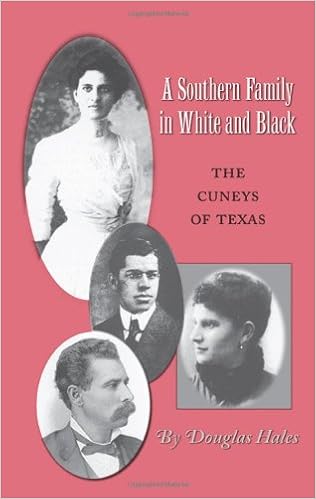
  • A Southern Family in White and Black: The Cuneys of Texas

    Texas A&M University Press
    2002-12-06
    192 pages
    6.125 x 9.25
    4 b&w photos.
    ISBN 13: 978-1-58544-200-3

    Douglas Hales, Professor of History
    Temple College, Temple, Texas

    The complex issues of race and politics in nineteenth-century Texas may be nowhere more dramatically embodied than in three generations of the family of Norris Wright Cuney, mulatto labor and political leader. Douglas Hales explores the birthright Cuney received from his white plantation-owner father, Philip Cuney, and the way his heritage played out in the life of his daughter Maud Cuney-Hare. This intergenerational study casts light on the experience of race in the South before Emancipation, after Reconstruction, and in the diaspora that eventually led cultural leaders of African American heritage into the cities of the North.

    Most Texas history books name Norris Wright Cuney as one of the most influential African American politicians in nineteenth-century Texas, but they tell little about him beyond his elected positions. In The Cuneys, Douglas Hales not only fills in the details of Cuney’s life and contributions but places him in the context of his family’s generations.

    A politically active plantation owner and slaveholder in Austin County, Philip Cuney participated in the annexation of Texas to the United States and supported the role of slavery and cotton in the developing economy of the new state. Wealthy and powerful, he fathered eight slave children whom he later freed and saw educated. Hales explores how and why Cuney differed from other planters of his time and place.

    He then turns to the better-known Norris Wright Cuney to study how the black elite worked for political and economic opportunity in the reactionary period that followed Reconstruction in the South. Cuney led the Texas Republican Party in those turbulent years and, through his position as collection of customs at Galveston, distributed federal patronage to both white and black Texans. As the most powerful African American in Texas, and arguably in the entire South, Cuney became the focal point of white hostility, from both Democrats and members of the “Lily White” faction of his own party. His effective leadership won not only continued office for him but also a position of power within the Republican Party for Texas blacks at a time when the party of Lincoln repudiated African Americans in many other Southern states. From his position on the Galveston City Council, Cuney worked tirelessly for African American education and challenged the domination of white labor within the growing unions.

    Norris Wright Cuney’s daughter, Maud, who was graced with a prestigious education, pursued a successful career in the arts as a concert pianist, musicologist, and playwright. A friend of W. E. B. Du Bois, she became actively involved in the racial uplift movement of the early twentieth century. Hales illuminates her role in the intellectual and political “awakening” of black America that culminated in the Harlem Renaissance of the 1920s. He adroitly explores her decision against “passing” as white and her commitment to uplift.

    Through these three members of a single mixed-race family, Douglas Hales gives insight into the issues, challenges, and strengths of individuals. His work adds an important chapter to the history of Texas and of African Americans more broadly.