• Almighty God Created the Races: Christianity, Interracial Marriage, and American Law

    University of North Carolina Press
    December 2009
    288 pages
    6.125 x 9.25, notes, bibl., index
    Cloth ISBN: 978-0-8078-3318-6
    Paper ISBN: 978-1-4696-0727-6

    Fay Botham, Adjunct Professor of Religious Studies
    University of Iowa

    In this fascinating cultural history of interracial marriage and its legal regulation in the United States, Fay Botham argues that religion–specifically, Protestant and Catholic beliefs about marriage and race–had a significant effect on legal decisions concerning miscegenation and marriage in the century following the Civil War.

    Botham argues that divergent Catholic and Protestant theologies of marriage and race, reinforced by regional differences between the West and the South, shaped the two pivotal cases that frame this volume, the 1948 California Supreme Court case of Perez v. Lippold (which successfully challenged California’s antimiscegenation statutes on the grounds of religious freedom) and the 1967 U.S. Supreme Court case Loving v. Virginia (which declared legal bans on interracial marriage unconstitutional). Botham contends that the white southern Protestant notion that God “dispersed” the races, as opposed to the American Catholic emphasis on human unity and common origins, points to ways that religion influenced the course of litigation and illuminates the religious bases for Christian racist and antiracist movements.

  • Visible Identities: Race, Gender, and the Self

    Oxford University Press
    2006
    344 pages
    6-1/8 x 9-1/4
    ISBN13: 978-0-19-513735-4
    ISBN10: 0-19-513735-3

    Linda Martín Alcoff, Professor of Philosophy
    Hunter College/CUNY Graduate Center

    Winner of the 2009 Frantz Fanon Prize

    In the heated debates over identity politics, few theorists have looked carefully at the conceptualizations of identity assumed by all sides. Visible Identities fills this gap. Drawing on both philosophical sources as well as theories and empirical studies in the social sciences, Martin Alcoff makes a strong case that identities are not like special interests, nor are they doomed to oppositional politics, nor do they inevitably lead to conformism, essentialism, or reductive approaches to judging others. Identities are historical formations and their political implications are open to interpretation. But identities such as race and gender also have a powerful visual and material aspect that eliminativists and social constructionists often underestimate.

    Visible Identities offers a careful analysis of the political and philosophical worries about identity and argues that these worries are neither supported by the empirical data nor grounded in realistic understandings of what identities are. Martin Alcoff develops a more realistic characterization of identity in general through combining phenomenological approaches to embodiment with hermeneutic concepts of the interpretive horizon. Besides addressing the general contours of social identity, Martin Alcoff develops an account of the material infrastructure of gendered identity, compares and contrasts gender identities with racialized ones, and explores the experiential aspects of racial subjectivity for both whites and non-whites. In several chapters she looks specifically at Latino identity as well, including its relationship to concepts of race, the specific forms of anti-Latino racism, and the politics of mestizo or hybrid identity.

    Table of Contents

    • Part One: Identities Real and Imagined
      • Introduction: Identity and Visibility.
      • 1. The Pathologizing of Identity.
      • 2. The Political Critique.
      • 3. The Philosophical Critique.
      • 4. Real Identities.
    • Part Two: Gender Identity and Gender Differences
      • 5. The Identity Crisis in Feminist Theory.
      • 6. The Metaphysics of Gender and Sexual Difference.
    • Part Three: Racialized Identities and Racist Subjects
      • 7. A Phenomenology of Racial Embodiment.
      • 8. Racism and Visible Race.
      • 9. The Whiteness Question.
    • Part Four: Latino/a Particularity
      • 10. Latinos and the Categories of Race.
      • 11. Latinos, Asian Americans, and the Black-White Binary.
      • 12. On Being Mixed.
    • Conclusion.
    • Notes.
    • Bibliography.
    • Index.
  • Race, Hybridity, and Miscegenation

    Thoemme Continuum
    2005-06-30
    657 pages
    ISBN: 1843711044
    EAN/ISBN13: 9781843711049

    Edited by:

    Robert Bernasconi, Edwin Erle Sparks Professor of Philosophy
    Pennsylvania State University

    Kristie Dotson, Assistant Professor of Philosophy
    Michigan State University

    Volumes 1 and 2 of this 3 volume set collect the major contributions to the scientific debate on the unity of the human race in the 1850s, focusing particularly on the idea of hybridity. Volume 3 republishes the major contributions to the political debate on miscegenation.

    This set brings together very rare primary sources of two central debates in the USA from the second half of the 19th century and early 20th century. Many of the essays in all three volumes have not been republished since their original publication and are extraordinarily hard to find. Volumes 1 and 2 collect the major contributions to the scientific debate on the unity of the human race in the 1850s focusing particularly on the idea of hybridity, which since Ray and Buffon had been central to species definition. The main book-length contributions to the debate were recently republished in “American Theories of Polygenesis” (Thoemmes Press, 2002). However, alongside these books and feeding off them are passionate debates which helped to define scientific racism for that time, not only in the US, but also Europe, because to a certain extent Europeans were willing to defer to American observers for their knowledge of Africans and particularly the effects of racism. Volume 3 republishes the major contributions to the political debate on miscegenation.The term “miscegenation” was coined in the anonymous text “Miscegenation: The Theory of the Blending of the Races, Applied to the American White Man and Negro”, now attributed to David Croly. Some of the works included are overtly racist in highly objectionable ways and serve to document a context that is too often ignored. A particular feature of this volume is the inclusion of works by African-American authors. Some of the authors and texts included have been forgotten, but even the better-known texts can be properly understood now they are restored to their context. The debates about hybridity and miscegenation are not only of deep historical significance, they are also of interest in the light of the contemporary rehabilitation of the idea of hybridity in the work of Homi Bhabha, as well as the current interest in the idea of “mixed race”.  The set comes with two separate introductions by editor Robert Bernasconi. These substantial essays (5,000-10,000 words each) record the history of the debates including reference to works not here republished, brief biographical information on the authors included, and insights into the larger intellectual and political context.

  • The Idea Of Race

    Hackett Publishing Company
    2000
    256 pages
    Cloth ISBN: 0-87220-459-6, ISBN-13: 978-0-87220-459-1
    Paper ISBN: 0-87220-458-8, ISBN-13: 978-0-87220-458-4

    Edited by

    Robert Bernasconi, Edwin Erle Sparks Professor of Philosophy
    Pennsylvania State University

    Tommy L. Lott, Professor of Philosophy
    San José State University

    A survey of the historical development of the idea of race, this anthology offers pre-twentieth century theories about the concept of race, classic twentieth century sources reiterating and contesting ideas of race as scientific, and several philosophically relevant essays that discuss the issues presented. A general Introduction gives an overview of the readings. Headnotes introduce each selection. Includes suggested further readings.

    Table of Contents
    Introduction

    The Classification of Races

    1. Francois Bernier, “A new division of earth, according to the different species or races of men who inhabit it”
    2. Francois-Marie Voltaire, “Of the Different Races of Men,” from The Philosophy of History
    3. Immanuel Kant, “Of the Different Human Races”
    4. Johann Gottfried von Herder, Ideas on the Philosophy of the History of Humankind
    5. Johann Friedrich Blumenbach, On the Natural Variety of Mankind
    6. G. W. F. Hegel, “Anthropology,” from The Encyclopedia of Philosophical Science

    Science and Eugenics

    1. Arthur de Gobineau, The Inequality of Human Races
    2. Charles Darwin, “On the Races of Man,” from The Descent of Man
    3. Francis Galton, “Eugenics: Its Definition, Scope and Aims”

    Heredity and Culture

    1. Franz Boas, “Instability of Human Types”
    2. Alain Locke, “The Concept of Race as applied to Social Culture”
    3. Ashley Montagu, “The Concept of Race in the Human Species in the Light of Genetics”

    Race and Political Ideology

    1. W. E. B. Du Bois, The Conservation of Races
    2. Anthony Appiah, “The Uncompleted Argument: Du Bois and the Illusion of Race”
    3. Leopold Senghor, “What is Negritude?”

    Racial Identity

    1. Linda Alcoff, “Mestizo Identity”
    2. Michael Hanchard, “Black Cinderella? Race and the Public Sphere in Brazil”
    3. Michael Omi and Howard Winant, Racial Formation in the United States.
  • Bessie Head: Thunder Behind Her Ears – Her Life and Writings

    Boydell & Brewer
    1995-01-01
    320 pages
    23.4 x 15.6 cm
    Paperback ISBN 13: 9780852555354

    Gillian Stead Eilersen

    This biography details the life of Bessie Head – a life which echoes so many of the aspects of the distressing history of South Africa in the last half century. She was born in an asylum to a mother who was considered mad because her father was black. Despite the disadvantages of being both a person of mixed race and a woman, she made her way in South Africa as a journalist. Her exile in rural Botswana was in marked contrast to the intensely urban backgrounds of most other South African writers. Her fierce determination to take root was reflected in her first novel Where Rain Clouds Gather. But she was kept a refugee for 15 years before she was granted citizenship of Botswana. Her most frightening novel, A Question of Power vividly captures the shifting dislocations of schizophrenia.

  • Dr. Rainier Spencer Guest on Mixed Chicks Chat

    Mixed Chicks Chat (The only live weekly show about being racially and culturally mixed.  Also, founders of the Mixed Roots Film & Literary Festival)
    Website: TalkShoe™ (Keywords: Mixed Chicks)
    Episode: #131 – Dr. Rainier Spencer
    Wednesday, 2009-12-09  22:00Z

    Rainier Spencer, Director and Professor of Afro-American Studies; Professor of Interdisciplinary Studies
    University of Nevada, Las Vegas

    Rainier Spencer is professor and director of Afro-American Studies at the University of Nevada at Las Vegas. He has published Spurious Issues: Race and Multiracial Identity Politics in the United States (Westview, 1999) and Challenging Multiracial Identity (Lynne Rienner, 2006), as well as numerous book chapters and journal articles on multiracial identity.  Based on a philosophical platform of racial skepticism, his work focuses on the uses of biological race and hypodescent by the American Multiracial Identity Movement, arguing that the movement supports rather than deconstructs biological race.

    Listen to the episode here. Download the episode here.

  • Why Are People Different?: Multiracial Families in Picture Books and the Dialogue of Difference

    The Lion and the Unicorn
    Volume 25, Number 3
    September 2001
    pp. 412-426
    E-ISSN: 1080-6563
    Print ISSN: 0147-2593
    DOI: 10.1353/uni.2001.0037

    Karen Sands-O’Connor

    The issue of race has often been contentious in children’s literature, from controversies over Twain’s Adventures of Huckleberry Finn, to Bannerman’s Little Black Sambo, to Keats’s The Snowy Day, to Herron’s Nappy Hair. How race is portrayed and who portrays it have been crucial for many critics. Violet J. Harris suggests this preoccupation with cultural authenticity, as she terms it, centers on “individual books and their portrayals of people of color, as well as the representation of specific aspects of their cultures such as values, customs, and family relationships” (40-41). Francis Wardle counters, “presenting the Black race and cultural group as a single, unified, world-wide entity is not only inaccurate, but denies the tremendous richness of economic, cultural, linguistic, national, political, social and religious diversity that exists in the world-wide Black community” (“Mixed-Race Unions” 200). This insistence on cultural authenticity poses even more problems when more than one culture is portrayed within a family, and it is perhaps for this reason that little has been written on the multiracial family as portrayed in literature.

    Even when the multiracial family is alluded to in criticism, the reference is rarely followed up. For example, Pat Pinsent comments in her chapter on “Race and Ethnic Identity” that “today there are few communities with any claim to be racially ‘pure’; in modern society there has been a considerable amount of intermarriage which has blurred any such distinctions even further” (91)…

  • The Chevalier de Saint-Georges: Virtuoso of the Sword and the Bow

    Pendragon Press
    March 2006
    566 pages
    ISBN: 9781576471098

    Gabriel Banat
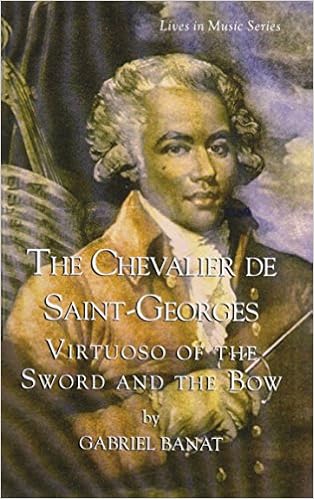
    The Chevalier de Saint-Georges, born Joseph Bologne, was the son of an African slave and a French plantation owner on the island of Guadeloupe. The story of his improbable rise in French society, his life as a famous fencer, celebrated violinist-composer and conductor, and later commander of a colored regiment in the French Revolution, should, on the facts alone, gladden the heart of the most passionate romance novelist. Yet, the information disseminated about this illustre inconnu is found in an extravagant nineteenth-century novel, which contains more fiction than fact. Unfortunately, many of the author’s flights of fancy have found their way into serious works about Saint-Georges. Gabriel Banat has set about systematically dispelling the confusion, for the real story is easily as fascinating as any flight of fancy. Gabriel Banat has been a professional violinist all his life; recitalist and member of the New York Philharmonic, he has systematically scoured the violin repertory for interesting and even unknown music. He came across the works of St. Georges and was fascinated by the freshness and charm of these 18th-century compositions. Eventually, he edited a critical edition of all the violin music and, inevitably, began a systematic investigation into the life of this intriguing and multifaceted individual, utilizing archives of the French Land Army, official clippings and untapped personal diaries of St. Georges’ contemporaries. Banat is the author of an authoritative monograph on St. Georges in the Black Music Research Journal.

    Gabriel Banat has been a professional violinist all his life: recitalist and member of the New York Philharmonic, he has systematically scoured the violin repertory for interesting and even unknown music. He is the author of an authoritative monograph on St. Georges in the Black Music Research Journal.

    Table of Contents

    List of Illustrations ix
    Acknowledgments xii
    Preface xiv
    Necrology xviii
    Chapter 1 The Island 1
    Chapter 2 Joseph 5
    Chapter 3 The Trial 12
    Chapter 4 A Fugitive Family 22
    Chapter 5 The Bologne Plantation 27
    Chapter 6 People ¿of Color¿ 37
    Chapter 7 Return to France 40
    Chapter 8 Paris 46
    Chapter 9 The Prodigy 54
    Chapter 10 Too Many Blacks 67
    Chapter 11 The Chevalier de Saint-Georges 76
    Chapter 12 A Young Man About Town 90
    Chapter 13 Virtuoso 97
    Chapter 14 Gossec 113
    Chapter 15 The New Bow 119
    Chapter 16 Composions- Quartets and Concertos 125
    Chapter 17 Gluck and Marie Antoinette 140
    Chapter 18 Concertos andSymphonie Concertantes 159
    Chapter 19 TheOpéra Affair 177
    Chapter 20 Ernestine 193
    Chapter 21 Mme. de Montesson
    Chapter 22 Mme. de Montalembert
    Chapter 23 L¿Amant Anonyme
    Chapter 24 Le Concert des Amateurs
    Chapter 25 The Grand Orient of France
    Chapter 26 Le Concert Olympique
    Chapter 27 Le Palais-Royal
    Chapter 28 London
    Chapter 29 The Gathering Storm
    Chapter 30 The Bastille
    Chapter 31 Revolution
    Chapter 32 An Orléans Conspiracy?
    Chapter 33 Return to London
    Chapter 34 Lille
    Chapter 35 The National Guard
    Chapter 36 La Légion Saint-Georges
    Chapter 37 Regicide
    Chapter 38 The Great Terror
    Chapter 39 Too Many Colonels
    Chapter 40 Paris 1795
    Chapter 41 Saint Domingue
    Chapter 42 Coda-Finale
    Epilogue
    Epitaphs for those who survived Saint-Georges 456
    Appendix: Dramatis Personae
    Works List
    Discography
    List of Documents
    Bibliography
    Index

    List of Illustrations

    Fig. 1.1 Map of Guadeloupe xix
    Fig. 2.1 View of Basse-Terre, ca. 1750 7
    Fig. 2.2 ¿Squares¿ of sugar cane, Bailiff 9
    Fig. 5.1 Plantation with view on La Suffrière 30
    Fig. 7.1 Custom Records of Passengers arriving in Bordeaux, Aug. 2, 1753 41
    Fig. 7.2 Port of Bordeaux, 1753 42
    Fig. 8.1 Mme. de Pompadour 49
    Fig. 8.2 49 rue St. André des Arts today 52
    Fig. 10.1 The Saint-Georges Guard 70
    Fig. 11.1 Equestrian statue of Louis XV 79
    Fig. 11.2 Chamber music at a musical salon 88
    Fig. 12.1 ¿Winter¿ from Les quatre saisons 94
    Fig. 12.2 The Italian style of fencing 95
    Fig. 13.1 One of Les vingt-quatre violons du Roi 99
    Fig. 13.2 Leopold Mozart and his two children 107
    Fig. 13.3 English Tea in the Salon of the Four Mirrors 108
    Fig. 13.4 Portrait of Saint-Georges at 22 111
    Fig. 14.1 François Joseph Gossec 114
    Fig. 14.2 L¿Hôtel de Soubise 115
    Fig. 15.1 Leopold Mozart, 1756 121
    Fig. 15.2 The evolution of the bow 122
    Fig. 16.1 Title page of Saint-Georges¿ second set of quartets 130
    Fig. 17.1 Maria Antoinette at her spinet in Vienna 145
    Fig. 17.2 Christoph Willibald Gluck 147
    Fig. 17.3 Marie Antoinette in 1777, Versailles 151
    Fig. 18.1 George Polgreen Bridgetower 168
    Fig. 19.1 La petit loge at the Opéra in the Palais-Royal 179
    Fig. 19.2 Mlle.La Guimard in Le Navigateur 185
    Fig. 19.3 Papillon de la Ferté 189
    Fig. 20.1 Choderlos de Laclos 195
    Fig. 20.2 Théatre Italien in 1777 198
    Fig. 21.1 Mme. de Genlis 206
    Fig. 21.2 Mme. de Montesson 208
    Fig. 21.3 The Duke of Orléans and his son 210
    Fig. 23.1 Title page of L¿Amant Anonyme 238
    Fig. 24.1 Title page of the D¿Ogny catalogue 246
    Fig. 24.2 Saint-Georges¿ quartets listed in the D¿Ogny catalogue 247
    Fig. 25.1 Philippe, Duke of Chartres with his family 253
    Fig. 26.1 Masonic initiation ceremony 260
    Fig. 26.2 The Palais-Royal before its reconstruction 262
    Fig. 27.1 ¿Prinny,¿ George, Prince of Wales 277
    Fig. 27.2 Philippe, Duke of Orléans 278
    Fig. 28.1 Henry Angelo 284
    Fig. 28.2 Le Chevalier D¿Éon in his uniform 288
    Fig. 28.3 Mlle. La Chevalière D¿Éon in 1783 288
    Fig. 28.4 Cartoon of St. George and D¿Éon 293
    Fig. 28.5 Fencing match at Carlton House 297
    Fig. 29.1 Burning of the Opera House, 1781 307
    Fig. 29.2 Palais-Royal after reconstruction 308
    Fig. 30.1 Mme. de Genlis as ¿Governor¿ of Philippe¿s children 315
    Fig. 30.2 Giovanni Baptista Viotti 317
    Fig. 30.3 Louis XVI inaugerating the opening session of the Estates-General 320
    Fig. 30.4 Desmoulins haranguing the people 324
    Fig. 30.5 Fall of the Bastille
    Fig. 31.1 Mrs. Grace Dalrymple Elliott 327
    Fig. 32.1 March of the Paris Poissardes, 1789 334
    Fig. 32.2 Cartoon of Lafayette kicking Philippe 340
    Fig. 33.1 Mr. Angelo¿s Fencing Academy 342
    Fig. 34.1 Session at the Jacobin Club, Paris, 1792 363
    Fig. 35.1 General Dillon¿s body being burned in Lille 368
    Fig. 36.1 Hussar of the Légion St. Georges 374
    Fig. 36.2 The battle of Jemappes, 1792 378
    Fig. 36.3 Trooper of the 13th regiment of the Chasseurs à cheval, 1793 383
    Fig. 37.1 Execution of Louis XVI, 1793 386
    Fig. 37.2 Bust of General Dumouriez 388
    Fig. 37.3 Arrest of the Commissioners and the Minister of War by Dumourez 397
    Fig. 38.1 General Thomas Alexandre Dumas 403
    Fig. 38.2 Danton on his way to the guillotine 409
    Fig. 38.3 The Feast of the Supreme Being 410
    Fig. 38.4 ¿The Last Tumbrel¿ 411
    Fig. 40.1 Invasion of the Assembly by the Sans-Culottes 428
    Fig. 40.2 Post-Thermadorian manners, 1795 432
    Fig. 40.3 Theresa Tallien ¿Our Lady of Thermador¿
    Fig. 41.1 Toussaint Louverture, c.1800 444
    Fig. 41.2 Map of Saint-Domingue 445

  • Stanford profs examine mixed race in U.S. society

    The Dartmouth
    Victoria Boggiano, The Dartmouth Staff
    2008-04-18

    In 2000, the U.S. Census gave Americans the chance to identify themselves by more than one race for the first time. Almost seven million people — over 80 percent of whom were under 25 — checked more than one box, Stanford University professors Harry and Michele Elam told a crowded auditorium in Haldeman Hall on Thursday. A new global “mixed-race movement” has begun, they said in their lecture, titled “The High Stakes of Mixed Race: Post-Race, Post-Apartheid Performances in the U.S. and South Africa.”

    The couple’s research stems from studies they have conducted to analyze theatrical performances in the United States and South Africa. Claiming that performance is a “transformative force for institutional and social change,” the Elams examined a variety of plays from these two countries. The research provided the couple with insight into the effect of the worldwide “mixed-race movement” on race politics and cultural identities, Harry said.

    “We’re arguing that analyzing mixed race as a type of social performance can help us make sense of some of these new cultural dynamics,” he said…

    …In the United States, the “mixed-race movement” is comprised of an uneasy coalition of “interracial couples, transracial adoptees and a new generation of mixed-race-identified youth,” the Elams said…

    Read the entire article here.

  • Inexacting Whiteness: Blanqueamiento as a Gender-Specific Trope in the Nineteenth Century

    Cuban Studies
    Volume 36, 2005
    pages 105-128
    E-ISSN: 1548-2464
    Print ISSN: 0361-4441
    DOI: 10.1353/cub.2005.0033

    Gema R. Guevara, Associate Professor, Languages & Literature and Associate Professor, Spanish Section
    University of Utah

    In Cuba, race, nation, and popular music were inextricably linked to the earliest formulations of a national identity. This article examines how the racialized discourse of blanqueamiento, or whitening, became part of a nineteenth-century literary narrative in which the casi blanca mulata, nearly white mulatta, was seen as a vehicle for whitening black Cubans. However, as the novels of Cirilo Villaverde and Ramón Meza reveal, the mulata’s inability to produce entirely white children established the ultimate unattainability of whiteness by nonwhites. This article analyzes the fluidity of these racial constructs and demonstrates that, while these literary texts advocated the lightening of the nation’s complexion over time, they also mapped the progressive “darkening” of Cuban music as popular culture continued to borrow from black music.

    Read the entire article here.