• Crossing the Line: Racial Passing in Twentieth-Century U.S. Literature and Culture

    Duke University Press
    July 2000
    272 pages
    12 b&w photographs
    Cloth ISBN: 0-8223-2479-2, ISBN13: 978-0-8223-2479-9
    Paperback ISBN: 0-8223-2515-2, ISBN13: 978-0-8223-2515-4

    Gayle Wald, Professor of English
    George Washington University

    As W. E. B. DuBois famously prophesied in The Souls of Black Folk, the fiction of the color line has been of urgent concern in defining a certain twentieth-century U.S. racial “order.” Yet the very arbitrariness of this line also gives rise to opportunities for racial “passing,” a practice through which subjects appropriate the terms of racial discourse. To erode race’s authority, Gayle Wald argues, we must understand how race defines and yet fails to represent identity. She thus uses cultural narratives of passing to illuminate both the contradictions of race and the deployment of such contradictions for a variety of needs, interests, and desires.

    Wald begins her reading of twentieth-century passing narratives by analyzing works by African American writers James Weldon Johnson, Jessie Fauset, and Nella Larsen, showing how they use the “passing plot” to explore the negotiation of identity, agency, and freedom within the context of their protagonists’ restricted choices. She then examines the 1946 autobiography Really the Blues, which details the transformation of Milton Mesirow, middle-class son of Russian-Jewish immigrants, into Mezz Mezzrow, jazz musician and self-described “voluntary Negro.” Turning to the 1949 films Pinky and Lost Boundaries, which imagine African American citizenship within class-specific protocols of race and gender, she interrogates the complicated representation of racial passing in a visual medium. Her investigation of “post-passing” testimonials in postwar African American magazines, which strove to foster black consumerism while constructing “positive” images of black achievement and affluence in the postwar years, focuses on neglected texts within the archives of black popular culture. Finally, after a look at liberal contradictions of John Howard Griffin’s 1961 auto-ethnography Black Like Me, Wald concludes with an epilogue that considers the idea of passing in the context of the recent discourse of “color blindness.”

    Wald’s analysis of the moral, political, and theoretical dimensions of racial passing makes Crossing the Line important reading as we approach the twenty-first century. Her engaging and dynamic book will be of particular interest to scholars of American studies, African American studies, cultural studies, and literary criticism.

    Table of Contents

    • Preface
    • Acknowledgments
    • Introduction: Race, Passing, and Cultural Representation
    • 1. Home Again: Racial Negotiations in Modernist African American Passing Narratives
    • 2. Mezz Mezzrow and the Voluntary Negro Blues
    • 3. Boundaries Lost and Found: Racial Passing and Cinematic Representation, circa 1949
    • 4. “I’m Through with Passing”: Postpassing Narratives in Black Popular Literary Culture
    • 5. “A Most Disagreeable Mirror”: Reflections on White Identity in Black Like Me
    • Epilogue: Passing, “Color Blindness,” and Contemporary Discourses of Race and Identity
    • Notes
    • Bibliography
    • Index
  • Sex, Segregation, and the Sacred after Brown

    The Journal of American History
    Volume 91, Number 1 (June 2004)
    pages 119-144
    DOI: 10.2307/3659617

    Jane Dailey, Associate Professor of American History
    University of Chicago, Chicago, Illinois

    The religious history of the civil rights movement is strangely one-sided. “God was on our side,” the activists have said, and scholars have tended to agree. But the opponents of civil rights also used religion in their cause. Jane Dailey argues that historians have underestimated the role of religion in supporting segregation as well as in dismantling it. Viewing the civil rights movement as a contest over Christian orthodoxy helps explain the arguments made by both sides and the strategic actions they took. Dailey examines the connections among antimiscegenation anxiety, politics, and religion to reveal how deeply interwoven Christian theology was in the segregation ideology that supported the discriminatory world of Jim Crow.

    …This article explores how religion served as a vessel for one particular language crucial to racial segregation in the South: the language of miscegenation. It was through sex that racial segregation in the South moved from being a local social practice to a part of the divine plan for the world. It was thus through sex that segregation assumed, for the believing Christian, cosmological significance. Focusing on the theological arguments wielded by segregation’s champions reveals how deeply interwoven Christian theology was in the segregationist ideology that supported the discriminatory world of Jim Crow. It also demonstrates that religion played a central role in articulating not only the challenge that the civil rights movement offered Jim Crow but the resistance to that challenge…

    …Although rebutted at the time and later, Ariel’s argument remained current through the middle of the twentieth century, buttressed along the way by such widely read books as Charles Carroll’s The Negro a Beast (1900) and The Tempter of Eve (1902), both of which considered miscegenation the greatest of sins. Denounced for its acceptance of separate creations, The Negro a Beast was nonetheless enormously influential. Recalling the door-to-door sales campaign that brought the book to the notice of whites across the South, a historian of religion lamented in 1909 that “during the opening years of the twentieth century it has become the Scripture of tens of thousands of poor whites, and its doctrine is maintained with an appalling stubbornness and persistence.” In this tradition, miscegenation—or, more commonly, amalgamation or mongrelization—was the original sin, the root of all corruption in humankind.

    The expulsion from Paradise did not solve the problem of miscegenation. By the time of Noah race mixing was so prevalent that, in the words of one civil rights–era pamphleteer, “God destroyed ‘all flesh’ in that part of the world for that one sin. Only Noah was ‘perfect in his generation’ … so God saved him and his family to rebuild the Adamic Race.” That perfection did not last long, however; according to some traditions, the cursed son of Ham, already doomed to a life of servitude, mixed his blood with “pre-Adamite negroes” in the Land of Nod. Again and again God’s wrath is aroused by the sin of miscegenation, and the people feel the awful weight of his punishment: Sodom and Gomorrah were destroyed for this sin, as was the Tower of Babel, where, in a failed effort to protect racial purity, God dispersed the peoples across the globe. King Solomon, “reputed to be the wisest of men, with a kingdom of matchless splendor and wealth was ruined as a direct result of his marrying women of many different races,” and the “physical mixing of races” that occurred between the Israelites and the Egyptians who accompanied Moses into the wilderness “resulted in social and spiritual weakness,” leading God to sentence the Exodus generation to die before reaching the Promised Land. For evidence that the God of Noah remained as adamantly opposed to racial mixing as ever, white southern believers could look back a mere fifteen years to the Holocaust. The liquidation of six million people was caused, D. B. Red explained in his pamphlet Race Mixing a Religious Fraud (c. 1959), by the sexual “mingling” of the Jews, who suffered what Red represents as God’s final solution to the miscegenation problem: “Totally destroy the people involved.” Here, surely, was proof that segregation was “divine law, enacted for the defense of society and civilization…

    Read the entire article here.

  • The Age of Jim Crow

    W. W. Norton & Company
    October 2008
    434 pages
    5.4 × 8.2 in
    Paperback ISBN 978-0-393-92758-0

    Jane Dailey, Associate Professor of American History
    University of Chicago

    America’s racial history has been marked by both hard-won progress and sudden reversals of fortune.

    In The Age of Jim Crow, Jane Dailey introduces readers to a fascinating collection of documents on race and segregation in America that were created between the end of the Civil War and the emergence of the Civil Rights Movement a century later.  Organized around two themes, Dailey highlights the role of law in creating, maintaining, and — ultimately — helping to undo segregation.   She also traces the effects of interracial sex and marriage as they shaped the era of Jim CrowThe Age of Jim Crow focuses throughout on sexuality and gender politics as they play out across the legal, social and economic, political, and cultural arenas.

    View the Table of Contents here.

  • Between Totem And Taboo: Black Man, White Woman in Francographic Literature

    University of Exeter Press
    2001
    292 pages
    Hardback ISBN: 9780859896498
    BIC Code: 1HFD, 2ADF, 3JF, 3JH, 3JJ

    Roger Little

    Between Totem and Taboo picks its way judiciously through a minefield of prejudice, myth and stereotypes.  It is the first book to explore the literary representation by authors black and white, male and female, of interracial relations between France and her former territories in West Africa through the special nexus of the white woman and the black man.

    Presented as a text-based chronological exploration of the relationship from 1740 to the present day, it reveals how racism distorted such relations for a quarter of a millennium.  It will fascinate anyone seriously interested in Black studies, Women’s studies and Postcolonial studies, who will find in it not only many unknown or unconsidered texts but a new angle of approach to their research.  All quotations are in French and English.

    Roger Little was Professor of French (1776) at Trinity College Dublin until his retirement in 1998. He has an outstanding record of scholarship in French and francophone writing, with particular interests in sub-Saharan Africa and the Caribbean. His academic work has mainly concentrated on modern French poetry and the representation of Blacks in Francographic literature. He has edited several volumes of Textes littéraires for University of Exeter Press. The French government has conferred upon him the rank of Chevalier de l’Ordre National du Mérite and he has been awarded the Prix de l’Académie française: médaille de vermeil du rayonnement de la langue française.

    Table of Contents

    • Acknowledgements
    • Some Key Dates
    • Introduction: Between Totem and Taboo
    • 1. Eighteenth-century Enwhitenment
    • 2. From Taboo to Totem
    • 3. Traditions and Transitions
    • 4. Opposite genders, Opposite Agendas
    • 5. The French Empire Writes Back
    • 6. Struggles for Independence
    • 7. The Freedom to Choose
    • 8. Liberty and Licence
    • 9. Full Circle
    • Conclusion: Beyond Difference and Indifference
    • Notes
    • Select Bibliography
    • Index
  • Race and Reality: What Everyone Should Know about Our Cultural Diversity

    Prometheus Books
    2009-12-22
    336 pages
    Paperback ISBN: 978-1-59102-767-6

    Guy P. Harrison

    The concept of race has had a powerful impact on history and continues to shape the world today in profound ways. Most people derive their attitudes about race from their family, culture, and education. Very few, however, are aware that there are vast differences between the popular notions of race and the scientific view of human diversity. Yet even among scientists, who understand the current evidence, there is great controversy regarding the definition of the term race or even the usefulness of thinking in terms of race at all.

    Drawing on research from diverse sources and interviews with key scientists, award-winning journalist Guy P. Harrison surveys the current state of a volatile, important, and confusing subject. Harrison’s thorough approach explores all sides of the issue, including such questions as these:

    • If analysis of the human genome reveals that all human beings are 99.9% alike, how meaningful are racial differences?
    • Is the concept of race merely a cultural invention?
    • If race distinctions are at least partially based in biological reality, how do we decide the number of races? Are there just three or maybe 3 million?
    • What do studies of racial attitudes reveal? Are we all, in one way or another, racists?
    • How does race correlate with environmental and geographical differences?
    • Are race-based drugs a good idea?
    • How does race influence intelligence, athletic ability, and love interests?

    Harrison delves into these and many more intriguing, controversial, and important questions in this enlightening book. After reading Race and Reality, you will never think about race in the same way again.

    Guy P. Harrison (Grand Cayman, Cayman Islands) is the author of the highly acclaimed 50 Reasons People Give for Believing in a God and Race and Reality: What Everyone Should Know about Our Biological Diversity. He has won several international awards for his writing, including the World Health Organization‘s award for health reporting and the Commonwealth Media Award for Excellence in Journalism.

  • What Answer?

    Prometheus Books
    Originally Published in 1868
    316 pages
    Paperback ISBN: 978-1-59102-050-9

    Anna E. Dickinson

    With an Introduction by

    J. Matthew Gallman, Professor of History
    University of Florida

    This first and only novel by Anna E. Dickinson, a well-known 19th-century orator, abolitionist, and advocate of racial equality and women’s rights, attracted tremendous interest when it first appeared in the fall of 1868, and was enthusiastically endorsed by Harriet Beecher Stowe. Set in the midst of the Civil War, this controversial work of fiction traces the tragic history of an interracial marriage, which is doomed to disaster by the intolerance of a northern society that refuses to accept racial equality. The central love story provoked strong reactions from supporters and critics alike. Dickinson’s friends praised the power of her tale and the poignancy of the lovers’ fate, while some critics voiced disgust at the very notion of miscegenation. To portray such a relationship only three years after the Civil War was to many an act of remarkable audacity.

    Though the work will never be praised as a masterful literary creation, its themes of racial tension and justice have given it enduring value. Also lending the story interest are Dickinson’s impassioned descriptions of two infamous historical incidents – the terrible New York City Draft Riots of July 1863 and the storming of Fort Wagner by black troops of the famed 54th Massachusetts regiment. Even more important is the glimpse she provides into the conflicted attitudes of average white Northern citizens toward blacks just after the War. A scene on a Philadelphia streetcar depicting the mixed reactions of the passengers to a confrontation between a drunken white bigot and a wounded black soldier seems to forecast the Rosa Parks bus incident and the beginnings of the Civil Rights movement almost one hundred years later.

    With an interesting and informative introduction by J. Matthew Gallman, this new edition of a unique work long out of print will be welcome in courses on African American and American history.

  • Bayou Folk

    Prometheus Books
    Originally Published by Houghton Mifflin in 1894
    Pages: 286
    Paperback ISBN: 1-57392-975-1

    Kate Chopin

    The author who today is probably best known for her novel The Awakening initially established her literary reputation with short stories about life in rural Louisiana during the late nineteenth century. Born Katherine O’Flaherty in St. Louis, Missouri, she later married Oscar Chopin, a Creole cotton trader and commission merchant, and lived in and around New Orleans for more than a decade until her husband’s death. During these years, while raising six children on a Southern plantation, Chopin became acquainted with Creoles, Cajuns, and newly freed blacks. After her husband’s death she returned to St. Louis and began writing, drawing from her recent experience in Louisiana to create her fiction.

    The stories collected in Bayou Folk present remarkably vivid snapshots of daily life in a now vanished world. Many of them highlight the relations between blacks and whites in a society where the rules of engagement still reflected the entrenched patterns of slavery some two decades after the Civil War. As she was ahead of her time regarding women’s rights in The Awakening, where she depicted a woman unafraid to throw off traditional restraints, Chopin was also farsighted about race relations in Bayou Folk. Perhaps the story Désirée’s Baby about the birth of a mixed-race baby to two ‘white’ parents best expresses the uneasy relationship between blacks and whites in the old South, and the moral outrage of its strict codes against miscegenation.

    Chopin’s gifts for capturing the dialects of the region and for telling a compelling story in memorable vignettes provide the reader with a richly rewarding experience.

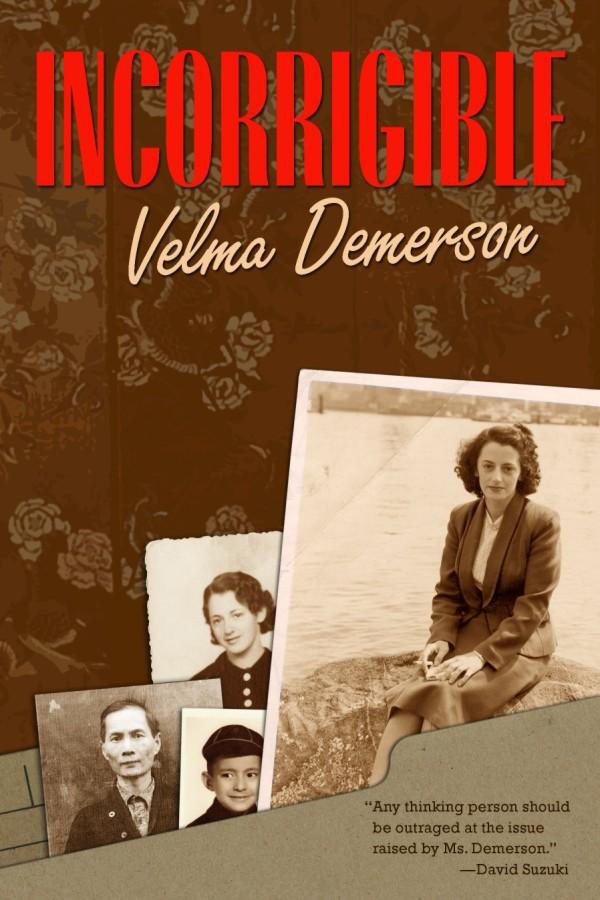
  • Incorrigible

    Wilfrid Laurier University Press
    December 2004
    184 pages
    ISBN13: 978-0-88920-444-7

    Velma Demerson

    On a May morning in 1939, eighteen-year-old Velma Demerson and her lover were having breakfast when two police officers arrived to take her away. Her crime was loving a Chinese man, a “crime” that was compounded by her pregnancy and subsequent mixed-race child. Sentenced to a home for wayward girls, Demerson was then transferred (along with forty-six other girls) to Toronto’s Mercer Reformatory for Females. The girls were locked in their cells for twelve hours a day and required to work in the on-site laundry and factory. They also endured suspect medical examinations. When Demerson was finally released after ten months’ incarceration weeks of solitary confinement, abusive medical treatments, and the state’s apprehension of her child, her marriage to her lover resulted in the loss of her citizenship status.

    This is the story of how Demerson, and so many other girls, were treated as criminals or mentally defective individuals, even though their worst crime might have been only their choice of lover. Incorrigible is a survivor’s narrative. In a period that saw the rise of psychiatry, legislation against interracial marriage, and a populist movement that believed in eradicating disease and sin by improving the purity of Anglo-Saxon stock, Velma Demerson, like many young women, found herself confronted by powerful social forces. This is a history of some of those who fell through the cracks of the criminal code, told in a powerful first-person voice.

    Velma Demerson is a widow, and mother of three children—the first child, the son of her interracial marriage, died at age twenty-six. She has worked throughout her life in a variety of positions, mostly as a secretary for governments (provincial and federal) and lawyers. She is self-educated. This is her first book.

    Read an excerpt here.

  • The Obama Issue

    Journal of Visual Culture
    August 2009
    Volume 8, No. 2
    Online ISSN: 1741-2994
    Print ISSN: 1470-4129

    The August 2009 edition of Journal of Visual Culture is focused on president Barack Obama.

    Table of Contents

    Marquard Smith and JVC Editorial Group
    Questionnaire on Barack Obama
    pp. 123-124

    W.J.T. Mitchell
    Obama as Icon
    pp. 125-129

    Shawn Michelle Smith
    Obama’s Whiteness
    pp. 129-133

    Dora Apel
    Just Joking? Chimps, Obama and Racial Stereotype
    pp. 134-142  

    Raimi Gbadamosi
    I Believe In Miracles
    pp. 142-150 

    Rajagopalan Radhakrishnan
    Recognizing Obama: Image and Beyond?
    pp. 150-154

    Toby Miller
    My Green Crush
    pp. 154-158

    Jacqueline Bobo
    Impact of Grassroots Activism
    pp. 158-160

    Julian Myers, Dominic Willsdon, Mary Elizabeth Yarbrough, and Lauren Berlant
    What Happened in Vegas
    pp. 161-167

    Lauren Berlant
    Dear journal of visual culture
    pp. 166-167

    Marita Sturken
    The New Aesthetics of Patriotism
    pp. 168-172

    Lisa Cartwright and Stephen Mandiberg
    Obama and Shepard Fairey: The Copy and Political Iconography in the Age of the Demake
    pp. 172-176  

    John Armitage and Joy Garnett
    Radicalizing Refamiliarization
    pp. 176-183

    Victor Margolin
    Obama Sightings
    pp. 183-189  

    Joanna Zylinska
    You Killed Barack Obama, 2008
    pp. 190

    Gayatri Chakravorty Spivak
    The Modern Prince . . . ‘to come’?
    pp. 191-193  

    Anna Everett
    The Afrogeek-in-Chief: Obama and our New Media Ecology
    pp. 193-196  

    Julian Stallabrass
    Obama on Flickr
    pp. 196-201  

    Ellis Cashmore
    Perpetual Evocations
    pp. 202-206  

    John Carlos Rowe
    Visualizing Barack Obama
    pp. 207-211 

    Robert Harvey
    Other Obamas
    pp. 211-219

    Curtis Marez
    Obama’s BlackBerry, or This Is Not a Technology of Destruction
    pp. 219-223

    Cynthia A. Young
    From ‘Keep on Pushing’ to ‘Only in America’: Racial Symbolism and the Obama Campaign
    pp. 223-227

    Nicholas Mirzoeff
    An End to the American Civil War?
    pp. 228-233

  • Intermarriage across Race and Ethnicity among Immigrants: E Pluribus Unions

    LFB Scholarly Publishing
    November 2008
    228 pages
    5.5 X 8.5 / viii
    Hardcover ISBN-13: 978-1-59332-294-6

    Charlie V. Morgan, Assistant Professor of Sociology
    Brigham Young University

    Morgan examines the relationship between assimilation and intermarriage. In studying mixed relationships, he finds that ethnicity, in the form of language and religion, is more important than race. Males and females were more likely to find themselves in coethnic relationships as they imagined the role that extended family would play. They talked about parental prejudices, language, religion, and other cultural clashes as major factors. There were many females, however, who did not follow this pattern because of perceptions of patriarchy. They avoided coethnic relationships because they wanted a partner who would think of them as an equal.