• Genealogy as Social Memory: Making the Public Personal

    The 7th Annual Committee on Historical Studies, Sociology Department and International Labor Working Class History Journal Joint Conference
    History Matters: Spaces of Violences, Spaces of Memory
    New School for Social Research
    2004-04-23 through 2004-04-24

    Karla Hackstaff, Associate Professor of Sociology
    Northern Arizona University

    “Race, like nature and sex, is replete with all the rituals of guilt and innocence in the stories of nation, family, and species. Race, like nature, is about roots, pollution, and origins. An inherently dubious notion, race, like sex, is about the purity of lineage; the legitimacy of passage; and the drama of inheritance of bodies, property, and stories”
    (Haraway 1995, p. 213).

    In May 2002, the Thomas Jefferson Foundation which runs Monticello and is comprised of the descendants of Thomas and Martha Jefferson voted to deny membership and associated burial rights to the descendants of Sally Hemings—a slave who appears to have had children by Thomas Jefferson (San Francisco Chronicle, May 12, 2002, p. D4).  This decision was somewhat surprising because in 1998 genetic tests appeared to confirm what Hemings’ relatives had claimed through oral history for years—that at least one, if not all, of Sally Hemings’ children had descended from Thomas Jefferson. Still, the white descendants concluded that the historical and scientific evidence was “insufficient.”…

    …First, within sociology there is a large and growing literature on the formation of racial/ethnic identities, relations, and the accompanying constructions of inequalities (e.g. Azoulay 1997; Brah and Coombes 2000; Collins 2000; DaCosta 2000; Haraway 1995; Nagel 1994; Omi and Winant 1994; Pedraza and Rumbaut 1996; Song 2001; Waters 1990; Worchel 1999). Given that race, ethnicity, and nationality organize many genealogical associations, clearly, race and ethnicity are constructed in the process of doing genealogy. Although ‘race’ as a biological construction has been widely rejected, it is no less real for being a social construction. As many scholars have shown, racialethnic constructions must be sustained, and are neither invariant nor universal.  Ethnoracial identities are sustained through various practices, policies, and institutions—including families.  Because interracial relations have been taboo, we still assume and to a large degree produce families that appear monoracial (DaCosta 2000). Intermarriage has grown substantially in recent decades—there were ten times as many couples categorized as interracial in 1990 as had been the case in 1960; still, in 1990 interracial marriages were just three percent of all marriages in the United Stated (DaCosta 2000, p. 9-10). By 2000, six percent of marriage households were interracial (Simmons and O’Connell 2003).  The practices of adoption agencies and sperm banks often, if not always, produce monoracial families as well. In short, ethnoracial identities continue to be crucial to family constructions…

    Read the entire paper here.

  • Light in August in Light of Foucault: Reexamining the Biracial Experience

    Arizona Quarterly: A Journal of American Literature, Culture, and Theory
    Volume 64, Number 4, Winter 2008
    pages 49-68
    E-ISSN: 1558-9595
    Print ISSN: 0004-1610
    DOI: 10.1353/arq.0.0020

    Bethany L. Lam

    Comparatively little current criticism of Foucauldian racial theory exists, primarily because [Michel] Foucault never formulated a full-blown racial theory. Some critics, such as Robert J.C. Young and Ann Laura Stoler, have successfully used Foucauldian principles to inform their views of race studies. Foucault himself said little directly pertaining to race studies, admits Young: “Foucault had a lot to say about power, but he was curiously circumspect about the ways in which it has operated in the arenas of race and colonialism. His virtual silence on these issues is striking” (57).  This silence does not deter Young and a few other critics from extrapolating Foucauldian thought into various areas of race studies. Young focuses his discussion on racism; he evaluates Foucauldian influence on colonial studies, particularly on Edward Said’s Orientalism, before applying Foucauldian commentary on ethnology, power, and sexuality to a theory of racism. Like Young, Ann Laura Stoler relies heavily on Foucault’s History of Sexuality in her applications of Foucault to colonial studies. Stoler has authored two of the more extensive explorations of Foucauldian thought as it pertains to race studies, Race and the Education of Desire: Foucault’s History of Sexuality and the Colonial Order of Things and Carnal Knowledge and Imperial Power: Race and the Intimate in Colonial Rule.  Both of these works deal with race primarily in the context of sexuality in colonialism, neglecting the larger picture of Foucault and racial identity.

    One element that has been noticeably lacking in the theory thus far is a thorough application of Foucault to the study of multiracialism. But Foucault has much insight to offer in explaining the attitudes of society towards the multiracial, the attitudes of the multiracial towards himself, and the resulting interaction between society and individual. The viability and value of these explanations become evident when applied to literary characters and their social (albeit fictional) contexts. Foucault deepens our understanding of the multiracial in society, showing not just how the individual and society affect each other, but—more importantly—why they view and treat each other as they do; merging his theory with literary criticism sheds new light on the tensions between multiracial characters, such as Faulkner’s Joe Christmas, and their societies, moving our explanations beyond mere “identity confusion” to the underlying causes of the confusion.

    Before applying Foucault directly to Faulkner, let us spend several moments tracing the outlines of a Foucauldian theory of multiracialism. To understand society’s perception of multiracialism, we must begin with the racial hierarchy, one of the many ways by which society orders subjects. In order to do this effectively, we should first look at Foucauldian thought regarding power, knowledge, and discourse. Foucault describes discourse as “an instrument and an effect of power, but also a hindrance, a stumbling-block, a point of resistance and a starting point for an opposing strategy. Discourse transmits and produces power; it reinforces it, but also undermines and exposes it, renders it fragile and makes it possible to thwart it” (History 101). “It is in discourse,” he states, “that power and knowledge are joined together” (100). Discourse is both product and producer of power, the place where power and knowledge intersect.

    In a Foucauldian paradigm, one might view race as a visual discourse. Its power emanates first of all from the prevalence and potency of race-based societal stereotypes. These racial stereotypes act as self-ful-filling prophecies, continually producing and reproducing themselves. The stereotypes lead to a second source of power in the discourse of race: the race-based ordering of society. These stereotypes and ordering feed off the knowledge aspect of racial discourse, knowledge based both on visual perception of skin color and the expectations created by the stereotypes themselves. Society uses its knowledge to assign a place in the racial hierarchy to each person. Race, then, becomes an indicator of societal expectation for a person, to which that person more or less conforms.

    Multiracialism problematizes this visual discourse through its nonconformity, both to the visual code and to traditional racial categories. A mixed-race individual is the result of an ancestral transgression of the racial order, a transgression either of the parents or of a more…

    Read or purchase the entire article here.

  • Undoing Empire: Race and Nation in the Mulatto Caribbean

    University of Minnesota Press
    2003
    336 pages, 27 halftones
    5 7/8 x 9
    Paper ISBN: 0-8166-3574-9
    Paper ISBN-13: 978-0-8166-3574-0
    Cloth ISBN: 0-8166-3573-0
    Cloth ISBN-13: 978-0-8166-3573-3

    José F. Buscaglia-Salgado, Professor and Chair of Cultures, Societies and Global Studies
    Northeastern University, Boston, Massachusetts

    A revelatory account that places mulatto experience at the center of Caribbean history.

    This ambitious book brings to light the story of what José F. Buscaglia-Salgado terms mulataje-the ways Caribbean aesthetics offer the possibility of the ultimate erasure of racial difference. Undoing Empire gives a broad panorama stretching from the complex politics of medieval Iberian societies to the beginning of direct U.S. hegemony in the Caribbean at the end of the nineteenth century.

    Buscaglia-Salgado begins with an examination of Washington Irving‘s “American Columbiad” as an act of historical and territorial plundering. He then traces the roots of mulatto society to the pre-1492 Iberian world, not only finding a connection between the Moors of “Old Spain” and the morenos-the blacks and mulattos of the New World-but also offering a profound critique of creole and imperial discourses. Buscaglia-Salgado reads the pursuit and contestation of what he terms the European Ideal in colonial texts, architecture, and paintings; then identifies the mulatto movement of “undoing” the Ideal in the wars that shook the nineteenth-century Caribbean from Haiti to Cuba, arguing that certain projects of national liberation have moved contrary to the historical claims to freedom in the mulatto world.

  • Ellen Craft: A New American Opera

    8th Annual New York City International Fringe Festival
    2004-08-13 through 2004-08-29

    Lyrics by Sherry Boone
    Music: Sean Jeremy Palmer
    Book: Sherry Boone and Sean Jeremy Palmer

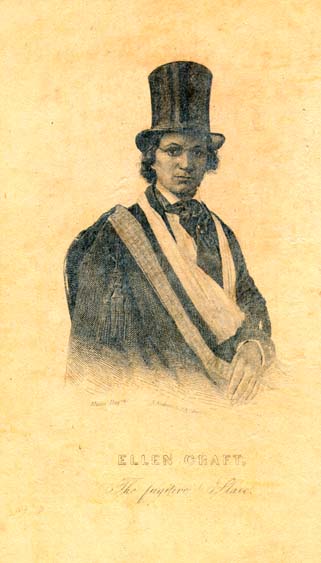
    Ellen Craft: A New American Opera is based on true events of a half -white, half-black womans harrowing escape from slavery disguised as a white man. Ellen‘s fiery story of revenge, love, forgiveness and redemption was recognized as Best Ensemble Performance at the 2004 New York International Fringe Festival. Ellen Craft will be performed on both the Music Theatre and Operatic Stages of the world.

  • Running a Thousand Miles for Freedom or The Escape of William and Ellen Craft from Slavery

    Louisiana State University Press
    Originally Published: 1860
    Published by LSU Press: 1999
    120 pages
    Trim: 6 x 9
    Illustrations: 5 halftones
    ISBN-13: 978-0-8071-2320-1 Paper

    William Craft

    With a Foreword and Biographical Essay by

    Richard J. M. Blackett,  Andrew Jackson Professor of History
    Vanderbilt University

    Husband and wife William and Ellen Craft’s [her mother was a slave and her father was her mother’s owner.] break from slavery in 1848 was perhaps the most extraordinary in American history. Numerous newspaper reports in the United States and abroad told of how the two—fair-skinned Ellen disguised as a white slave master and William posing as her servant—negotiated heart-pounding brushes with discovery while fleeing Macon, Georgia, for Philadelphia and eventually Boston. No account, though, conveyed the ingenuity, daring, good fortune, and love that characterized their flight for freedom better than the couple’s own version, published in 1860, a remarkable authorial accomplishment only twelve years beyond illiteracy. Now their stirring first-person narrative and Richard Blackett’s excellent interpretive pieces are brought together in one volume to tell the complete story of the Crafts.


    Ellen Craft

    Summary by Monique Pierce of Documenting The South:

    Published in 1860, shortly before the start of the Civil War, Running a Thousand Miles for Freedom is the narrative of William and Ellen Craft‘s escape from slavery. Both were born and grew up in Georgia, and they lived in Macon prior to their escape. In December 1848 they devised a plan in which Ellen Craft, who was very light- skinned, would dress as a man and pretend to be a rheumatic seeking better treatment in Philadelphia. William was to accompany her and act as her slave. Relying exclusively on means of public transportation, including trains and steamers, they made their way to Savannah, then to Charleston, Wilmington, North Carolina, Washington, D.C., Baltimore, and Philadelphia, where they arrived on Christmas Day. They then relocated to Boston and sailed for England after the Fugitive Slave Law enabled slave hunters to pursue them even in free states. At the time this work was published, they were living in England with their sons. The narrative includes many anecdotes about slavery and freedom for Blacks and discusses how they were treated in both the South and the North.

    Read the entire book in HTML format here.  You may also obtain it here.

  • Multiracial America: A Resource Guide on the History and Literature of Interracial Issues

    The Scarecrow Press, Inc.
    March 2005
    264 pages
    Paper ISBN: 0-8108-5199-7; ISBN-13: 978-0-8108-5199-3

    Edited by

    Karen Downing, Foundation and Grants Librarian
    Hatcher Graduate Library, University of Michigan

    Darlene Nichols, Psychology Librarian and Coordinator of Instruction
    Hatcher Graduate Library, University of Michigan

    Kelly Webster, Associate Librarian
    Hatcher Graduate Library, University of Michigan

    Multiracial America addresses a growing interest in interracial people and relationships in America. Over the past decade, there have been numerous books and articles written on interracial issues. Despite the rampant growth in publishing, locating these often-scattered and inaccessible materials remains a challenge. This resource guide provides easy access to the available literature. Topical chapters on the most often researched themes are included, such as core historical literature, books for children and young adults, hot-button issues (passing, identification, appearance, fitting in, and blood quantification), interracial dating and marriage, families, adoption, and issues pertaining to race and queer sexuality. Each chapter includes a brief discussion of the literature on the topic, including historical context and comments on the breadth and depth of the available literature, and followed by annotations of books, popular and scholarly journals, magazines, and newspaper articles, videos/films, and websites. Other useful sections include a chapter on the depiction of interracial relationships in film, teaching an interracial issues course, and how to search for materials given changing terminology and classification issues. Indexes by race and non-print media are included.

    Table of contents

    • Acknowledgments
    • Introduction
    1. Accessing the Literature by Karen Downing
    2. Teaching an Interracial Issues Course by David Schoem
    3. Hot Button Issues by Karen Downing and Kelly Webster
    4. Core Historical Literature by Chuck Ransom
    5. The Politics of Being Interracial by Karen Downing
    6. Interracial Dating and Marriage by Alysse Jordan
    7. Interracial Families by Renoir Gaither
    8. Transracial Adoption by Darlene Nichols
    9. Books for Children and Young Adults by Darlene Nichols
    10. Multiracial Identity Development by Kelly Webster
    11. The Intersection of Race and Queer Sexuality by Joseph Diaz
    12. Representations of Interracial Relationships and Multiracial Identity on the American Screen by Helen Look and Martin Knott
    • Appendix I. Subject Heading/Descriptor Vocabularly to Assist in Searching by Karen Downing
    • Appendix II. Definitions of Terms Used in Interracial Literature by Karen Downing
    • Appendix III. Sociology 412 — Ethnic Identity and Intergroup Relations Syllabus by David Schoem
    • Appendix IV. OMB Directive 15
    • Appendix V. Resources by Race
    • Index
    • About the Contributors
  • Reading the Dougla Body: Mixed-race, Post-race, and Other Narratives of What it Means to be Mixed in Trinidad

    Latin American and Caribbean Ethnic Studies
    Volume 3, Issue 1 (March 2008)
    pages 1-31
    DOI: 10.1080/17442220701865820

    Sarah England, Associate Professor of Anthropology
    Soka University of America, Aliso Viejo, California

    In recent years there has been a great deal of scholarship addressing the ‘mixed-race’ question in the Americas. Much of this literature is concerned with documenting the experiences of mixed-race peoples and exploring how their existence alters racial ideologies and racial formations in their respective societies. This essay contributes to that literature through an analysis of the experience of mixed-race peoples in Trinidad and Tobago. Through interviews with people of Indo-Trinidadian and Afro-Trinidadian parentage (douglas) I show how the dougla experience both challenges traditional ways that race is understood ontologically, and is shaped by those same ideologies. I further examine the place that douglas see themselves as occupying in a society where racial mixing is both heralded as the essence of the national character and seen as threatening to the traditional division between Indo-Trinidadians and Afro-Trinidadians.

    Read or purchase the article here.

  • Multiracial Identity in the Post-Civil Rights Era

    Social Identities
    Volume 11, Issue 5 (September 2005)
    pages 531-549
    DOI: 10.1080/13504630500408164

    Gino Michael Pellegrini, Adjunct Assistant Professor of English
    Pierce College, Woodland Hills, California

    This article, which utilizes personal experience as well as other perspectives and theories on race and mixed race, suggests that multiracial identity is a manifestation of recent date that differs from traditional conceptions and descriptions of mixed race that conform to the dichotomous and hierarchical logic of the binary racial system. As delineated in this article, the emergence of multiracial identity is properly understood in the context of the post-civil rights era and has been coextensive with multiculturalism, the proliferation of information technologies, and with the emergence of the multiracial political movement in the 1990s. Further, this article suggests that multiracial identity is also in part a by-product of multicultural American universities of the 1980s and 1990s. That is, multiracial identity has to a certain extent taken shape in reaction to the rigid ethnoracial boundaries and discourses that are imposed on mixed race students in the multicultural academy.

    Read or purchase the article here.

  • Mixed and Multiracial in Trinidad and Honduras: Rethinking Mixed-race Identities in Latin America and the Caribbean

    Ethnic and Racial Studies
    Volume 33, Issue 2 (2010)
    pages 195-213
    DOI: 10.1080/01419870903040169

    Sarah England, Associate Professor of Anthropology
    Department of Social and Behavioral Sciences
    Soka University of America, Aliso Viejo, California

    The purpose of this paper is to explore what it means to be mixed in Latin America and the Caribbean and to ask if mixing in the ‘South’ can always be understood within the so-called racial continuum as opposed to the racial binary of the ‘North’. I do this through a comparison of two potentially mixed-race identities, the afro-indigenous Garifuna of Honduras and peoples of East Indian and African mixture (douglas) in Trinidad. Through this comparison I show that in both Honduras and Trinidad classification of mixed-race peoples can follow the logic of the racial binary or of the racial continuum depending on the historical context and the particular mix. I also discuss the way that mixed-race identities can sometimes be radical critiques of state racial projects of pluralism and at other times they can be the basis of state racial projects meant to obfuscate racial pluralism.

    In his 1967 book, The Two Variants in Caribbean Race Relations, Harry Hoetnik argued thai the main gauge of racism within a society is not so much the degree to which different racial groups are integrated on the level of work and social interaction, but rather the degree to which inter-racial mixing (sexual, reproductive) is accepted and gradations between racial categories are recognized. Based on this premise he set out to characterize the racial systems of the Caribbean, within which he included the United Stales South and Brazil. He argued thai (here are basically three different systems: 1) the North American variant, characterized by a high degree of segmentation between black and white based on strict definitions of whiteness and rules of hypodescent that relegate any mixed people into the non-white…

    Read or purchase the article here.