• Impurity of Blood: Defining Race in Spain, 1870-1930

    Louisiana State University Press
    Published: December 2009
    288 pages
    Trim: 6 x 9
    Illustrations: 1 map
    Cloth ISBN: 13: 978-0-8071-3516-7

    Joshua Goode, Professor of History and Cultural Studies
    Claremont Graduate University, California

    Although Francisco Franco courted the Nazis as allies during the Spanish Civil War in the late 1930s, the Spanish dictator’s racial ideals had little to do with the kind of pure lineage that obsessed the Nazis. Indeed, Franco’s idea of race—that of a National Catholic state as the happy meeting grounds of many different peoples willingly blended together—differed from most European conceptions of race in this period and had its roots in earlier views of Spanish racial identity from the late nineteenth and early twentieth centuries. In Impurity of Blood, Joshua Goode traces the development of racial theories in Spain from 1870 to 1930 in the burgeoning human science of anthropology and in political and social debates, exploring the counterintuitive Spanish proposition that racial mixture rather than racial purity was the bulwark of national strength.

    Goode begins with a history of ethnic thought in Spain in the medieval and early modern era, and then details the formation of racial thought in Spain’s nascent human sciences. He goes on to explore the political, social, and cultural manifestations of racial thought at the dawn of the Franco regime and, finally, discusses its ramifications in Francoist Spain and post–World War II Europe. In the process, he brings together normally segregated historiographies of race in Europe.

    Goode analyzes the findings of Spanish racial theorists working to forge a Spanish racial identity in the late nineteenth and early twentieth centuries, when race and racial sciences were most in vogue across Europe. Spaniards devised their own racial identities using scientifically substantiated racial ideas and confronted head-on the apparent limitations of Spain’s history by considering them as the defining characteristics of la raza española. The task of the Spanish social sciences was to trace the history of racial fusion: to study both the separate elements of the Spanish composition and the factors that had nurtured them. Ultimately, by exploring the development of Spanish racial thought between 1875 and 1930, Goode demonstrates that national identity based on mixture—the inclusion rather than the exclusion of different peoples—did not preclude the establishment of finely wrought and politically charged racial hierarchies.

    Providing a new comprehensive view of racial thought in Spain and its connections to the larger twentieth-century formation of racial thought in the West, Impurity of Blood will enlighten and inform scholars of Spanish and European history, racial theory, historical anthropology, and the history of science.

  • George Henry White: An Even Chance in the Race of Life

    Louisiana State University Press
    2001
    471
    Trim: 6 x 9
    cloth ISBN: 978-0-8071-2586-1

    Benjamin R. Justesen

    Although he was one of the most important African American political leaders during the last decade of the nineteenth century, George Henry White has been one of the least remembered. A North Carolina representative from 1897 to 1901, White was the last man of his race to serve in the Congress during the post-Reconstruction period, and his departure left a void that would go unfilled for nearly thirty years. At once the most acclaimed and reviled symbol of the freed slaves whose cause he heralded, White remains today largely a footnote to history. In this exhaustively researched biography, Benjamin R. Justesen rescues from obscurity the fascinating story of this compelling figure’s life and accomplishments.

    The mixed-race son of a free turpentine farmer, White became a teacher, lawyer, and prosecutor in rural North Carolina. From these modest beginnings he rose in 1896 to become the only black member of the House of Representatives and perhaps the most nationally visible African American politician of his time. White was outspoken in his challenge to racial injustice, but, as Justesen shows, he was no militant racial extremist as antagonistic white democrats charged. His plea was always for simple justice in a nation whose democratic principles he passionately loved. A conservative by philosophy, he was a dedicated Republican to the end. After he retired from Congress, he remained active in the fight against racial discrimination, working with national leaders of both races, from Booker T. Washington to the founders of the NAACP.

    Through judicious use of public documents, White’s speeches, newspapers, letters, and secondary sources, Justesen creates an authoritative and balanced portrait of this complex man and proves him to be a much more effective leader than previously believed.

  • The Louisiana Metoyers

    American Visions
    June, 2000

    Elizabeth Shown Mills

    Gary B. Mills (1944-2002)

    The Metoyer family of Louisiana provides an intriguing ample of the degree to which class, race and economic lines were blurred in early America. The Metoyers were both slaves and masters; in that regard, they were not unique. They were singular in the degree of their success. In the pre-Civil War South, they were, as a family unit, the wealthiest of all free families of color in the nation. After the war, they endured generations of poverty but preserved a rich store of oral history, much of which has been documented at Melrose Plantation in Melrose, La. The Metoyer family has been nationally conspicuous since 1975–the year that Melrose, the last of at least a dozen pillared, two-story “mansion houses” that they built on their plantations, was declared a National Historic Landmark.

    On January 8, 1736, Francoise (a slave belonging to Chevalier Louis Juchereau de St. Denis) and Marie Francoise were married in Natchitoches, La. The only clues indicating the origins of this African couple are the names of four of their children: Dgimby, Choera, Yandon and Coincoin. These names can be attributed to the Ewe linguistic group of the Gold Coast-Dahomey region of Africa. Although Catholic custom required all baptized Christians to bear a saint’s name, popular custom among the French permitted a variety of nicknames, or dits, as the French called them. The custom extended to the slave population as well, and a number of slaves are identified in official records by the African name that French masters permitted them to retain.

    The pronunciation of Coincoin is close to that of Ko-kwe, a name given to all second-born daughters by those who speak the Glidzi dialect of the Ewe language. Marie Therese dite Coincoin, the second daughter born to Francois and Marie Francoise, was baptized at the Natchitoches Post on August 24, 1742. Colonial Louisiana’s Code Noir (Black Laws), which did not permit the separation by sale of a husband and wife or of a child under 14 from its mother, kept the family of Francois and Marie Francoise together as a stable unit until April 18, 1758, when the couple died together in an epidemic that also killed their mistress…

    Read the entire article here.

  • “Of Portuguese Origin”: Litigating Identity and Citizenship among the “Little Races” in Nineteenth-Century America

    Law and History Review
    2007
    Volume 25, Number 3

    Ariela J. Gross, John B. and Alice R. Sharp Professor of Law and History
    University of Southern California

    The history of race in the nineteenth-century United States is often told as a story of black and white in the South, and white and Indian in the West, with little attention to the intersection between black and Indian. This article explores the history of nineteenth-century America’s “little races”—racially ambiguous communities of African, Indian, and European origin up and down the eastern seaboard. These communities came under increasing pressure in the years leading up to the Civil War and in its aftermath to fall on one side or the other of a black-white color line. Drawing on trial records of cases litigating the racial identity of the Melungeons of Tennessee, the Croatans/Lumbee of North Carolina, and the Narragansett of Rhode Island, this article looks at the differing paths these three groups took in the face of Jim Crow: the Melungeons claiming whiteness; the Croatans/Lumbee asserting Indian identity and rejecting association with blacks; the Narragansett asserting Indian identity without rejecting their African origins. Members of these communities found that they could achieve full citizenship in the U.S. polity only to the extent that they abandoned their self-governance and distanced themselves from people of African descent.

    Historians have only begun to tell the histories of “red and black” peoples in the United States, and much of their attention has focused on the “Black Indians” of the Five Civilized Tribes of the Southeastern United States. Yet up and down the eastern seaboard, there were clusters of people who shared African, European, and Indian ancestry, many of whom lived as distinct and separate communities into the nineteenth and even the mid-twentieth centuries, some retaining or struggling to retain Indian identities, others becoming known as “free people of color,” and still others claiming whiteness.

    These “little races,” as they were sometimes known, in many ways gave the lie to the binary statutory regimes of nineteenth-century America. They came under growing pressure from local officials and neighbors as communities became increasingly preoccupied with racial line drawing. But they followed very different paths. By studying these racially ambiguous communities, it is possible to learn more about the relationship among whiteness, blackness, and citizenship in the United States…

    Read the entire article here.

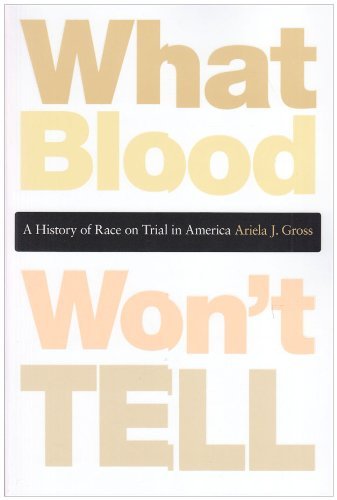
  • What Blood Won’t Tell: A History of Race on Trial in America

    Harvard University Press
    October 2008
    384 Pages
    Hardcover ISBN 13: 978-0-674-03130-2; ISBN 10: 0-674-03130-X
    Paperback ISBN 13: 978-0-674-04798-3; ISBN 10: 0-674-04798-2

    Ariela J. Gross, John B. and Alice R. Sharp Professor of Law and History
    University of Southern California

    • Co-Winner 2009 James Willard Hurst Prize, Law and Society Association
    • Co-Winner 2009 Lillian Smith Book Awards, the Southern Regional Council and the University of Georgia
    • Winner of the 2009 American Political Science Association Award for the Best Book on Race, Ethnicity and Politics

    Is race something we know when we see it? In 1857, Alexina Morrison, a slave in Louisiana, ran away from her master and surrendered herself to the parish jail for protection. Blue-eyed and blond, Morrison successfully convinced white society that she was one of them. When she sued for her freedom, witnesses assured the jury that she was white, and that they would have known if she had a drop of African blood. Morrison’s court trial—and many others over the last 150 years—involved high stakes: freedom, property, and civil rights. And they all turned on the question of racial identity.

    Over the past two centuries, individuals and groups (among them Mexican Americans, Indians, Asian immigrants, and Melungeons) have fought to establish their whiteness in order to lay claim to full citizenship in local courtrooms, administrative and legislative hearings, and the U.S. Supreme Court. Like Morrison’s case, these trials have often turned less on legal definitions of race as percentages of blood or ancestry than on the way people presented themselves to society and demonstrated their moral and civic character.

    Unearthing the legal history of racial identity, Ariela Gross’s book examines the paradoxical and often circular relationship of race and the perceived capacity for citizenship in American society. This book reminds us that the imaginary connection between racial identity and fitness for citizenship remains potent today and continues to impede racial justice and equality.

  • From exclusion and alienation to a ‘multi-racial community’: The image of the métis in New Caledonian literature

    International Journal of Francophone Studies
    ISSN: 13682679
    Volume 8 Issue 3
    December 2005
    DOI: 10.1386/ijfs.8.3.305/1

    Peter Brown 

    In her 2005 New Year’s greetings, Marie-Noëlle Thémereau, the President of the New Caledonian government, expressed her confidence in the future of her multiracial country, echoing the recognition of New Caledonia’s demographic make-up in official discourse since the Noumea Accord (1998). This view of New Caledonian society has not, however, always been so optimistic or encompassing. The island’s mixed population of some 230,000 has given rise over the years to social and political tensions. In this context, representations of Self and Other found in the island’s literature, particularly as they concern the historically highly contentious issue of biological and cultural interaction, provide valuable perspectives on this subject, enabling us to trace the evolution of local attitudes to the question of métissage and acquire a broader vision of the lived experience of the island’s population.

  • ‘Our sea of islands’: migration and métissage in contemporary Polynesian writing

    International Journal of Francophone Studies
    Volume 11, Issue 4 (December 2008)
    pages 503-522
    DOI: 10.1386/ijfs.11.4.503_1

    Michelle Keown, Senior Lecturer of English Literature
    University of Edinburgh

    This article explores metaphors of oceanic migration in contemporary Polynesian writing, investigating the notion of a regional ‘Oceanic’ identity embraced by a variety of Pacific (and particularly Polynesian) writers and theorists, while also acknowledging the specific historical circumstances and consequences of sea migration within individual Polynesian cultures. Throughout, the essay maintains a multiple temporal focus, identifying the ways in which imagery of the sea – and more specifically the ‘traditional’ Polynesian waka/vaka (voyaging canoe) – has been deployed by Polynesian writers as a chronotope not only of pre-European (and early contact) patterns of migration and cultural exchange within the Pacific, but also of the large-scale migrations of Polynesians to various neighbouring nations since the Second World War. The essay also engages with the complex cultural exchanges brought about by various historical phases of European maritime exploration and settlement in the Pacific, analysing how Polynesian writers explore the effects of intermarriage and cultural contact between Polynesians and Europeans since the late eighteenth century. In investigating these patterns of cross-cultural exchange, the essay adopts the French term ‘métissage’, which, alongside the related concepts of ‘hybridity’ and ‘syncreticity’, denotes genetic and cultural exchanges and intermixing. Drawing upon the work of various postcolonial theorists, the essay examines métissage in the Pacific both at the level of (material) cultural exchange, and within literary texts produced by anglophone and francophone Polynesian writers, particularly those who explicitly identify themselves as of ‘mixed race’.

    Read or purchase the article here.

  • Interracial Intimacies: Sex, Marriage, Identity, and Adoption

    Vintage an imprint of Random House, Inc. Academic Resources
    2003
    688 pages
    Paperback ISBN: 978-0-375-70264-8 (0-375-70264-4)

    Randall Kennedy, Michael R. Klein Professor of Law
    Harvard Law School

    From the author of Nigger: The Strange Career of a Troublesome Word and Race, Crime, and the Law—a tour de force about the controversial issue of personal interracial intimacy as it exists within ever-changing American social mores and within the rule of law.

    Fears of transgressive interracial relationships, informed over the centuries by ugly racial biases and fantasies, still linger in American society today. This brilliant study—ranging from plantation days to the present—explores the historical, sociological, legal, and moral issues that continue to feed and complicate that fear.

    In chapters filled with provocative and cleanly stated logic and enhanced by intriguing historical anecdotes, Randall Kennedy tackles such subjects as the presence of sex in racial politics and of race in sexual politics, the prominence of legal institutions in defining racial distinction and policing racial boundaries, the imagined and real pleasures that have attended interracial intimacy, and the competing arguments around interracial romance, sex, and family life throughout American history.

    Table of Contents

    • Introduction
    • One – In the Age of Slavery
    • Two – From Reconstruction to Guess Who’s Coming to Dinner?
    • Three – From Black-Power Backlash to the New Amalgamationism
    • Four – Race, Racism, and Sexual Coercion
    • Five – The Enforcement of Antimiscegenation Laws
    • Six – Fighting Antimiscegenation Laws
    • Seven – Racial Passing
    • Eight – Passing the the Schuyler Family
    • Nine – Racial Conflict and the Parenting of Children: A Survey of Competing Approaches
    • Ten – The Tragedy of Race Marching in Black and White
    • Eleven – White Parents and the Black Children in Adoptive Families
    • Twelve – Race, Children, and Custody Battles: The Special Status of Native Americans
    • Afterword
    • Notes
    • Bibliography
    • Acknowledgments
    • Index

    Read an excerpt of the book here.

  • Crossing Lines: Race and Mixed Race Across the Geohistorical Divide

    Rowman & Littlefield
    Paper: 0-9700-3841-0 / 978-0-9700-3841-8
    June 2005
    190 pages

    Edited by

    Marc Coronado
    DeAnza College

    Rudy P. Guevarra
    University of California, Santa Barbara

    Jeffrey A. S. Moniz, Associate Professor and Director
    University of Hawai’i

    Laura Furlan Szanto
    University of California, Santa Barbara

    Crossing Lines addresses the issues of race and mixed race at the turn of the 21st century. Representing multiple academic disciplines, including history, ethnic studies, art history, education, English, and sociology, the volume invites readers to consider the many ways that identity, community, and collectivity are formed, while addressing the challenges that multiracial identity poses to our understanding of race and ethnicity. The authors examine such subjects as social action, literary representations of multiracial people, curriculum development, community formation, Whiteness, and demographic changes.

    List of Contributors
    Marc Coronado (DeAnza College), Carina Evans (UC Santa Barbara), Melinda Gandara (UC Santa Barbara), Rudy P. Guevarra, Jr. (UC Santa Barbara), Tomas Jimenez (Harvard University), George Lipsitz (UC San Diego), Jeffrey Moniz (University of Hawai’i), Paul Spickard (UC Santa Barbara), Laura Furlan Szanto (UC Santa Barbara), and Nicole Marie Williams (UC Santa Barbara).

    Table of Contents

    • Introduction
    • Noises in the Blood: Culture, Conflict, and Mixed Race Identities
      George Lipsitz
    • Does Multiraciality Lighten? Me-Too Ethnicity and the Whiteness Trap
      Paul Spickard
    • “My Father? Gabacho?” Ethnic Doubling in Gloria Lopez Stafford’s A Place in El Paso
      Marc Coronado
    • Burritos and Bagoong: Mexipinos and Multiethnic Identity in San Diego, California
      Rudy P. Guevarra, Jr.
    • Challenging the Hegemony of Multiculturalism: The Matter of the Marginalized Multiethnic
      Jeffrey A.S. Moniz
    • Beyond Disobedience
      Nicole M. Williams
    • “Fictive Imaginings”: Constructing Biracial Identity and Senna’s Caucasia
      Carina A. Evans
    • The Beginning
      Laura Furlan Szanto
    • Los Angeles Museum of Art: Looking Forward
      Melinda Gandara
    • Multiethnic Mexican Americans in Demographic and Ethnographic Perspectives
      Tomas R. Jimenez
  • The Woman of Colour

    Broadview Press
    2007-01-01
    268 pages
    Paperback ISBN: 9781551111766 / 1551111764

    Written by: Anonymous

    Edited by:

    Lyndon J. Dominique, Assistant Professor of English
    Lehigh University, Bethlehem, Pennsylvania

    The Woman of Colour is a unique literary account of a black heiress’ life immediately after the abolition of the British slave trade. Olivia Fairfield, the biracial heroine and orphaned daughter of a slaveholder, must travel from Jamaica to England, and as a condition of her father’s will either marry her Caucasian first cousin or become dependent on his mercenary elder brother and sister-in-law. As Olivia decides between these two conflicting possibilities, her letters recount her impressions of Britain and its inhabitants as only a black woman could record them. She gives scathing descriptions of London, Bristol, and the British, as well as progressive critiques of race, racism, and slavery. The narrative follows her life from the heights of her arranged marriage to its swift descent into annulment and destitution, only to culminate in her resurrection as a self-proclaimed “widow” who flouts the conventional marriage plot.

    The appendices, which include contemporary reviews of the novel, historical documents on race and inheritance in Jamaica, and examples of other women of colour in early British prose fiction, will further inspire readers to rethink issues of race, gender, class, and empire from an African woman’s perspective.

    Table of Contents:

    Acknowledgements

    Introduction

    A Chronology of Women of Color in Drama and Long Prose Fiction

    A Note on the Text

    The Woman of Colour, A Tale

    Appendix A: Lucy Peacock, “The Creole” (1786)

    Appendix B: Anonymous Poem “written by a Mulatto Woman” (1794)

    Appendix C: Minor Heiresses of Color in British Long Prose Fiction

    1. From Agnes Musgrave, Solemn Injunction (1798)
    2. From Jane Austen, Fragment of a Novel (1817)
    3. From Edmund Marshall, Edmund and Eleonora: or Memoirs of the Houses of Summerfield and Gretton (1797)
    4. From Robert Bissett, Douglas; or, The Highlander (1800)
    5. From Mrs. Charles Mathews, Memoirs of a Scots Heiress (1791)

    Appendix D: Historical and Social Accounts of People of Color in Jamaica

    1. From Bryan Edwards, The History, Civil and Commercial, of the British Colonies in the West Indies (1799)
    2. From Edward Long, The History of Jamaica (1774)
    3. From J.B. Moreton, West India Customs and Manners (1793)

    Appendix E: People of Color in British Epistolary Narratives

    1. From Richard Griffith, The Gordian Knot (1769)
    2. From Hester Thrale, “Letter to Mrs. Pennington” (1802)
    3. From Clara Reeve, Plans of Education (1792)
    4. John Wesley, “Letter to William Wilberforce” (1791)

    Appendix F: The Woman of Colour: Contemporary Reviews

    1. The British Critic (March 1810)
    2. The Critical Review (May 1810)
    3. The Monthly Review (June 1810)

    Appendix G: Jamaican Petitions, Votes of the Assembly, and an Englishman’s Will

    1. From Votes of the Honourable House of Assembly of Jamaica (1792)
    2. From Andrew Wright’s “Last Will and Testament” (1806)