• I’m not White but You Treat Me that way: The Role of Racial Ambiguity in Interracial Interactions

    SPSP 2010
    The Eleventh Annual Meeting of the Society for Personality and Social Psychology
    2010-01-28 through 2010-01-30
    Las Vegas, Nevada

    Jessica D. Remedios
    University of Toronto

    Alison L. Chasteen
    University of Toronto

    Interracial interactions are complicated by concerns that both majority and minority group members hold. Although a large body of work has examined interactions between Whites and minorities, no research has examined the complications that racial ambiguity may introduce into these already anxiety-provoking situations. Unlike other minorities, people who belong to multiple racial groups (multiracial people) cannot always be categorized as members of a particular race. Furthermore, their physical ambiguity may have consequences for how they are perceived and how they perceive others. In two studies, we examined the role of racial ambiguity in individuals’ expectations for an upcoming interracial interaction. Participants in Study 1 were led to believe that they would interact with a White, Black, or multiracial individual. The results revealed that participants expecting to meet a Black partner rated him more positively and anticipated a more positive interaction than those expecting to meet a White or multiracial partner. In Study 2, multiracial, monoracial non-White and White participants expected to interact with a White person during the study. Multiracial participants expressed the greatest concern that others would be confused by their appearance; the more concern they expressed, the more negative emotions they experienced. Taken together, these findings suggest that although multiracial people express concerns about how others perceive them, monoracial people ignore these concerns and expect to treat multiracial people in the same way that they would treat White people. The results also imply that monoracial people may not accommodate the worries that multiracial people hold about interracial interactions.

  • Different prejudices toward different types of interracial couples: Examining alternative explanations

    SPSP 2010
    The Eleventh Annual Meeting of the Society for Personality and Social Psychology
    2010-01-28 through 2010-01-30
    Las Vegas, Nevada

    Stephen A. Mistler
    Arizona State University

    Angela G. Pirlott
    Arizona State University

    Steven L. Neuberg
    Arizona State University

    Between 1992 and 2000, the prevalence of interracial marriage in the United States more than doubled, increasing from 2.2% to 4.9%. How do people feel about such relationships, and what accounts for these feelings? Undergraduate students rated relationships of Asian, Black, and White men with Asian, Black, and White women; each participant answered the same questions for all nine possible heterosexual pairings of the above groups, as well as items designed to assess, for each race-gender type (e.g., Asian female), beliefs about their long-term mate value, short-term mate value, and scarcity as potential mates. Given issues of sample size, we report only findings from White participants. In general, White participants expressed more prejudice against interracial couples than same-race couples, even for couplings not involving members of their own race. This apparently simple bias, however, masks a more complex psychology based on interactions of specific race-gender pairings with perceiver gender. As one example, White participants were less accepting of White women with minority men than of White men with minority women, and reacted particularly negatively to the pairing of White women with Black men than to the pairing of White women with Asian men; these patterns of antipathy were especially strong for White male participants. We assess the broader range of findings in light of frameworks suggesting that negative reactions toward interracial couples arise from concerns with “race-mixing,” from concerns about potential lost resources for one’s group, and from assessments of valuable reproductive opportunities potentially gained and lost.

  • Evidence for Hypodescent and Racial Hierarchy in the Perception of Biracial Individuals

    SPSP 2010
    The Eleventh Annual Meeting of the Society for Personality and Social Psychology
    2010-01-28 through 2010-01-30
    Las Vegas, Nevada

    Arnold K. Ho
    Harvard University

    Daniel T. Levin
    Vanderbilt University

    Jim Sidanius, Professor
    Psychology and African and African American Studies
    Harvard University

    Mahzarin R. Banaji
    Harvard University

    Many have argued that the increasing rate of intermarriage between racial minorities and Whites and resulting patterns of biracial identification will lead to the dissolution of the American racial hierarchy (e.g., Alba & Nee, 2003; Lee & Bean, 2004; 2007a; 2007b; Thornton, 2009). However, little empirical evidence exists on perceptions of new racial identities that diverge from older notions of race purity and the “one drop” rule. We tested whether a rule of hypodescent, whereby biracial targets are assigned the status of their subordinate parent group, would govern perceptions of Asian-White and Black-White targets. Participants morphed faces from Asian to White, Black to White, White to Asian, and White to Black. Consistent with a rule of hypodescent, a face needed to be lower in proportion minority to be considered minority than proportion White to be considered White. In addition, the threshold for being considered White was higher for Black-White biracials than for Asian-White biracials, a pattern consistent with the structure of the current racial hierarchy. Finally, an independent racial categorization task confirmed that hypodescent and the current racial hierarchy guide how biracial targets are perceived. Potential distal (e.g., fear of contagion) and proximate (e.g., racism) causes of these phenomena are discussed.

  • A Multidimensional Framework for Examining Racial Identity across Different Biracial Groups

    SPSP 2010
    The Eleventh Annual Meeting of the Society for Personality and Social Psychology
    2010-01-28 through 2010-01-30
    Las Vegas, Nevada

    Evelina Lou
    York University

    Richard N. Lalonde
    York University

    Carlos Wilson
    York University

    Recent research has adopted a multidimensional view initially proposed by Rockquemore and colleagues (2002, 2009) for examining racial identity among Black/White biracials. This approach has acknowledged the social construction of and has widened the range of racial identity options beyond the two “traditional” options of “Black” or “biracial.” This study was designed to further assess this framework by examining a more diverse multiracial sample from Canada and the U.S. (N = 122). Results indicated that similar to Black/White biracials (n = 38), Asian/White biracials (n = 40) showed great variability in their selection of Rockquemore’s biracial identity categories, but the pattern of responses differed across the two groups. Specifically, Asian/White individuals were most likely to have a protean identity (i.e., sometimes Asian, sometimes White, and sometimes biracial), whereas Black/White individuals were most likely to have an exclusively biracial identity that they perceived as either validated or unvalidated by other people. In addition, variations in racial identity were in line with cognitive measures of self-concept clarity (SCC) and bicultural identity integration (BII), such that individuals with a validated biracial identity scored higher on SCC and BII than those with a protean or an unvalidated biracial identity. These findings suggest that having a clearly-defined, stable, and integrated bicultural self-concept is associated with the extent to which individuals’ biracial identity is validated by others in their social network. Theoretical implications for extending Rockquemore’s model to other biracial groups are discussed.

  • Natural Ambiguities? Perceptions of Multiracial Individuals by Monoracial Perceivers

    SPSP 2010
    The Eleventh Annual Meeting of the Society for Personality and Social Psychology
    2010-01-28 through 2010-01-30
    Las Vegas, Nevada

    Jacqueline Chen
    University of California, Santa Barbara

    David Hamilton, Professor of Psychology
    University of Californi, Santa Barbara

    Understanding Multiracial person perception is becoming increasingly important in today’s diverse society. The present research investigates the nature of the racial categorization of Multiracials. We hypothesize that, due to the legacy of the Black-White dichotomy and the automaticity of monoracial categorization, perceivers will make more errors in categorizing Multiracials and that categorization as “Multiracial” will take longer than monoracial categorizations such as “Black” or “White.” Using a novel categorization task, we find support for these hypotheses in two studies. In addition, in Study 2, we demonstrate that cognitive load detrimentally affects Multiracial, but not monoracial, categorizations. Importantly, in both studies, perceivers are able to categorize Multiracials at a rate significantly above chance, suggesting that monoracial perceivers can perceive multiracialism relatively quickly and accurately. Implications and future directions are discussed.

  • The motivational dynamics of social memory: Identification with a mixed-race group replaces own-race bias with own-group bias

    SPSP 2010
    The Eleventh Annual Meeting of the Society for Personality and Social Psychology
    2010-01-28 through 2010-01-30
    Las Vegas, Nevada

    Jay Van Bavel
    New York University

    Rachel O’Connor
    The Ohio State University

    William Cunningham
    The Ohio State University

    Dozens of studies have documented own-race bias – superior recognition memory for own-race faces compared to other-race faces. According to the perceptual expertise model, people are more likely to interact with members of their own race and therefore become more expert at distinguishing the physiognomy of own-race faces. According to the social cognitive model, own-race bias occurs because people perceive in-group members as individuals and out-group members according to their social category membership. We contrasted these two models and examined the effects of motivational salience, goal strength and situational affordances on social memory. Participants were randomly assigned to a mixed-race minimal group or a control condition in which participants merely learned about two mixed-race groups. Consistent with the social cognitive model, participants assigned to a mixed-race group had less own-race bias than participants in the control condition. Instead, participants assigned to a mixed-race group had own-group bias – superior recognition memory for in-group faces compared to out-group faces. Follow-up experiments showed that own-group bias was moderated by the strength of participants’ commitment to their minimal group and situational affordances. Specifically, participants who reported the strongest identification with their mixed-race minimal group had the largest own-group memory bias. However, own-group bias was attenuated among participants who were assigned to a role that directed their attention toward out-group members: they showed equal recognition memory for in-group and out-group faces. These experiments provide evidence that the motivational aspects of our social identities help organize social memory and can override the robust effects of race.

  • Self-Perceived Minority Prototypicality and Identification in Mixed Race Individuals: Implications for Self-Esteem and Affirmative Action

    SPSP 2010
    The Eleventh Annual Meeting of the Society for Personality and Social Psychology
    2010-01-28 through 2010-01-30
    Las Vegas, Nevada


    Jessica J. Good, Assistant Professor of Psychology
    Davidson College, Davidson, North Carolina

    George F. Chavez
    Department of Psychology
    Rutgers University

    Diana T. Sanchez, Associate Professor of Psychology
    Rutgers University

    In 2008, Barack Obama became the first multiracial individual to be elected President of the United States. Multiracial individuals are in the unique position of having multiple racial backgrounds with which to identify, ranging from monoracial (i.e. identifying with only one racial group) to extraracial (i.e. identifying with the human race; Renn, 2004). However, little research has examined the psychological processes linked to racial identification in mixed-race individuals. We proposed that the extent to which multiracial individuals identify as minority depends on their perceptions of their own prototypicality (similarity to the prototype of the minority group), which may be linked with feelings of connectedness to the minority group and perceived similarity in physical appearance to other members of the minority group. Data were collected from 107 mixed race minority-White participants using online sampling methods. Results from structural equation analysis supported our hypotheses; connectedness to the minority community and perceived similarity in physical appearance to members of the minority group predicted self-identification as minority due to perceived prototypicality. Additionally, minority identification was positively predictive of both psychological (self-esteem) and practical/real world (comfort applying for affirmative action) benefits. Implications for perceived affirmative action eligibility are discussed. These results add to a growing literature on the affective and behavioral consequences of multiracial individuals’ identity choices.

  • Specialist mixed-race training event

    Mix-d: Professionals,

    The Multiple Heritage Project is proud to present two specialist mixed-race training events for Black History Month 2009, in Manchester and London.

    Are you a professional working with young people?
    Want to really understand the complex issues around ‘mixed-race’?

    If the answer is yes, then come and join us:

    Who Should Attend?
    Professionals working with young people, whether in education, criminal justice service, looking after care, youth work and foster care.

    Aims of the day:

    • Learn more about our work with young people across the country.
    • What young people have to say on the subject.
    • Six things to understand when developing positive racial literacy.
    • Input from three leading specialists.
    • Do’s and don’ts for developing student voice.
    • Creating an action plan for your organisation.
    • The ‘latest’ street terminology.
    • Useful books and resources.
    • Free DVD from our 1st National Youth Conference.

    Key Speakers:
    Bradley Lincoln, Dr. Chamion Caballero, Denise Williams

    For more details visit: www.multipleheritage.co.uk

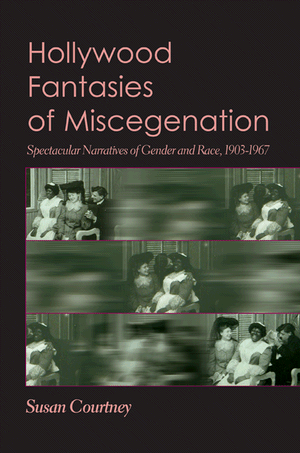
  • Hollywood Fantasies of Miscegenation: Spectacular Narratives of Gender and Race

    Princeton University Press
    2004
    376 pages
    6 x 9, 142 halftones.
    Paperback ISBN: 9780691113050

    Susan Courtney, Associate Professor of English and Film Studies
    University of South Carolina

    Hollywood Fantasies of Miscegenation analyzes white fantasies of interracial desire in the history of popular American film.  From the first interracial screen kiss of 1903, through the [Motion Picture] Production Code‘s nearly thirty-year ban on depictions of “miscegenation,” to the contemplation of mixed marriage in Guess Who’s Coming to Dinner (1967), this book demonstrates a long, popular, yet underexamined record of cultural fantasy at the movies.

    With ambitious new readings of well-known films like D.W. Griffith‘s 1915 epic The Birth of a Nation and of key forgotten films and censorship documents, Susan Courtney argues that dominant fantasies of miscegenation have had a profound impact on the form and content of American cinema.

    What does it mean, Courtney asks, that the image of the black rapist became a virtual cliché, while the sexual exploitation of black women by white men under slavery was perpetually repressed? What has this popular film legacy invited spectators to remember and forget? How has it shaped our conceptions of, and relationships to, race and gender?

    Richly illustrated with more than 140 images, Hollywood Fantasies of Miscegenation carefully attends to cinematic detail, revising theories of identity and spectatorship as it expands critical histories of race, sex, and film. Courtney’s new research on the Production Code’s miscegenation clause also makes an important contribution, inviting us to consider how that clause was routinely interpreted and applied, and with what effects.

    Read the introduction in HTML or PDF format.

  • Black and White and Read All Over: If you’re mixed-race, they never stop asking ‘What are you?’

    Village Voice
    Tuesday, 2006-01-24
     
    Naomi Pabst, Assistant Professor of African American Studies and American Studies
    Yale University

    It’s back in the ’90s in San Francisco. I’m undergoing a wisdom tooth extraction, hovering happily in nitrous oxide–land, when I vaguely hear a voice beam in. The dentist has asked me something. I attempt to focus—has my blissed-out fog really been penetrated by that question, that dreaded demand of the racially ambiguous: “What are you”?.

    “Ummm, uhhhh,” I mumble in universal dental garble. “Well, one thing I am is not so high anymore.”

    As the product of extensive mixing and moving, I hardly know where to begin or end in alleviating people’s curiosity (even yours, dear reader). Let’s just say that if you appear racially indeterminable, you are read all over. As in from head to toe, as in wherever you go. Like any other unstraightforward or indecipherable text, ambiguous bodies are given a close reading, between the lines. And if that fails to clarify matters, any serious reader will consult a primary source: you. You become an informant, other people’s resource for more information. It’s an intervention into your everyday existence that can happen anyplace, anytime, by anyone. You are interpreted, your body a sign, forever decoded and discerned…

    …But what exactly is this so-called “Generation Mix” and this would-be “mixed-heritage baby boom”? Kelley suggests that while there have of course been mixed-race people for as long as different races have resided together, we now see the first critical mass of adamantly multiracial people in America—teens and twentysomethings like these. I agree that race mixing, and not just in the well-known crime of white-on-black rape, has been more prevalent than is generally acknowledged, and that at first glance mixing seems to be a common enough occurrence these days. It is true that intermixing is on the rise, especially in places like New England and more so on the West Coast. But once talk turns to population “booms” and “generations,” we need to note that the numbers remain much smaller than one might think.

    This is especially true for black and white mixing. Currently, approximately 5 percent of all American marriages are between people of different races. And since 1967, the year the Supreme Court legalized marriage between blacks and whites, rates of black-white intermarriage have jumped radically indeed, from 1 percent to around 5 percent of all marriages involving a black person. The relatively small numbers don’t take away from the social significance of race mixing, but rather add to it. That the overwhelming majority of people still stick to “their own” makes the exceptions stand out and seem more common than they actually are, while also exacerbating the widespread fetishization of all things interracial…

    Read the entire article here.