• Black (un)like me: scholar Pabst dismantles stereotypes

    University of Minnesota
    College of Liberal Arts Today
    Spring 2002

    Judy Woodward

    Naomi Pabst (B.A. ’93 summa cum laude, English & African-American Studies) is the intellectual enemy of the stereotype, the easy generalization, and the sweeping statement. As a newly-minted scholar of African-American studies and the history of consciousness, she defines her subject loosely as “what people think of when they say the word ‘black.’”…

    …What engages Pabst is what she finds on the margins of the black experience.

    It’s a territory that she knows fairly well from personal experience. Although the 33-year-old scholar insists, “I don’t want to reduce what I do to my own experience of marginality,” nevertheless she concedes that, as a biracial child growing up in Canada and Germany, her experience was not typical of conventional definitions of black culture.

    But then, her point is that many African-Americans—including black cultural icons—did not have “typical” experiences…

    Read the entire article here.

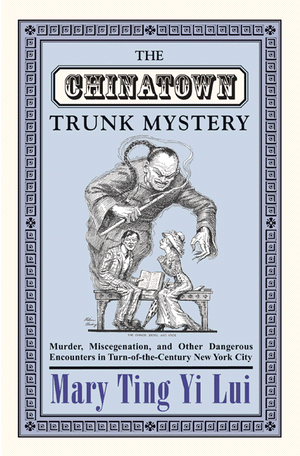
  • The Chinatown Trunk Mystery: Murder, Miscegenation, and Other Dangerous Encounters in Turn-of-the-Century New York City

    Princeton University Press
    November 2004
    320 pages
    6 x 9; 23 halftones. 4 maps.
    Paperback ISBN: 9780691130484

    Mary Ting Yi Lui, Assistant Professor of American Studies and History
    Yale University

    2005 AAAS Book Award, History category

    In the summer of 1909, the gruesome murder of nineteen-year-old Elsie Sigel sent shock waves through New York City and the nation at large. The young woman’s strangled corpse was discovered inside a trunk in the midtown Manhattan apartment of her reputed former Sunday school student and lover, a Chinese man named Leon Ling.

    Through the lens of this unsolved murder, Mary Ting Yi Lui offers a fascinating snapshot of social and sexual relations between Chinese and non-Chinese populations in turn-of-the-century New York City. Sigel’s murder was more than a notorious crime, Lui contends. It was a clear signal that attempts to maintain geographical and social boundaries between the city’s Chinese male and white female populations had failed.

    When police discovered Sigel and Leon Ling’s love letters, giving rise to the theory that Leon Ling killed his lover in a fit of jealous rage, this idea became even more embedded in the public consciousness. New Yorkers condemned the work of Chinese missions and eagerly participated in the massive national and international manhunt to locate the vanished Leon Ling.

    Lui explores how the narratives of racial and sexual danger that arose from the Sigel murder revealed widespread concerns about interracial social and sexual mixing during the era. She also examines how they provoked far-reaching skepticism about regulatory efforts to limit the social and physical mobility of Chinese immigrants and white working-class and middle-class women.

    Through her thorough re-examination of this notorious murder, Lui reveals in unprecedented detail how contemporary politics of race, gender, and sexuality shaped public responses to the presence of Chinese immigrants during the Chinese exclusion era.

  • The Mulatto In The United States: Including A Study Of The Role Of Mixed-Blood Races Throughout The World

    Greenwood Press Reprint
    918 (Reprint Publication Date: 1969-05-08)
    417 pages
    ISBN: 0-8371-0938-8
    ISBN-13: 978-0-8371-0938-1
    DOI: 10.1336/0837109388

    Edward Byron Reuter (1880-1946)

    An historical study of the role of the mulatto in American society, with a discussion of the mixing of races in other parts of the world. Edward Byron Reuter (1880-1946) received his doctoral degree in sociology from the University of Chicago in 1919 for this dissertation. He served (in 1933) as the 22nd President of the American Sociological Society.

    Read the entire book here.

    Commentary by Steven F. Riley

    For 21st century readers this book will most likely considered a racist trope on ‘racial mixing’.

    On page 103 in Rainier Spencer‘s Spurious Issues: Race and Multiracial Identity Politics in the United States, he discusses Reuter and says…

    …It would be best to begin with a frank examination of Reuter’s racial views.  With absolute bluntness Reuter assured his readers that the “lower culture of the Negro people is of course a simple observational fact and is to be accepted as such.  To question is to deny the obvious.”  He was quite clear about the relative cultural merits of the Negro and white races, which he posited as representing “the antipodal degrees of human culture: at the one extreme are the standards of West Africa; at the other, those of Western Europe.”  Nor did Reuter seem to think that there was any bias inherent in this arrangement, feeling certain enough of it to write that “no Negro questioned the superior ability of the white, and probably there is no Negro today who does not subconsciously believe the white man superior”…

    It would be easy (and perhaps desirable) to dismiss the influence of Reuter, but according to his biography at the American Sociological Association:

    …Reuter was an active and influential participant in the development of the sociological profession, serving as president of the American Sociological Society in 1933, as secretary-treasurer of the Sociological Research Association from 1936 to 1938 and as president of this group in 1939. He was a fellow of the American Association for the Advancement of Science. From 1928 until a few months before his death in 1946, he was consulting editor of the McGraw-Hill “Publications in Sociology” series. He served approximately ten years as an advisory editor of The American Journal of Sociology….

  • From Black to Biracial: Transforming Racial Identity Among Americans

    Praeger Publishers an imprint of Greenwood Publishing Group
    1998
    160 pages
    Trim Size: 6 1/8 x 9 1/4
    Paperback ISBN: 0-275-96744-1; ISBN-13: 978-0-275-96744-4

    Kathleen Odell Korgen, Professor of Sociology
    William Paterson University, Wayne, New Jersey

    Is a person with both a white and African American parent black?  Thirty years ago in American society the answer would have been yes. Today, the answer most likely depends on whom you ask. According to the U.S. Census, a person with both a black and a white parent is, in fact, black. However, most young persons who fit this description describe themselves as biracial, both black and white. Most young Americans, whatever their racial background, agree.  Since the Voting Rights Act of 1965 signaled the culmination of the Civil Rights Movement, a transformation has occurred in the racial self-definition of Americans with both an African American and a white parent. This book describes the transformation and explains why it has occurred and how it has come about. Through extensive research and dozens of interviews, Korgen describes how the transformation has its roots in the historical and cultural transitions in U.S. society since the Civil Rights era. A ground breaking book, From Black to Biracial will help all Americans understand the societal implications of the increasingly multiracial nature of our population. From affirmative action to the present controversy over the U.S. Census 2000, the repercussions of the transformation in racial identity related here affect all race-based aspects of our society. Students and faculty in sociology and multicultural studies, business leaders, and general readers alike will benefit from reading this work.

    Table of Contents:

    • Introduction: The Transformation of Racial Identity
    • Biracial Americans: White, Black, Both, Neither
    • Black by Definition or The Best of Both Worlds?
    • The Transformation: From Black to Biracial
    • Turning Points: Biracial College Students and Dating
    • Marginality and the Biracial American
    • Identities and Transformation
    • Public Policy Implications
    • Appendix: Notes on Methodology
    • Bibliography
    • Index
  • Claiming Place: Biracial Young Adults of the Post-Civil Rights Era

    Praeger
    2000-11-30
    208 pages
    Trim Size: 6 1/8 x 9 1/4
    Hardcover ISBN: 978-0-89789-760-0
    Ebook ISBN: 978-0-313-06507-1

    Marion Kilson, Dean of the Graduate School
    Salem State College, Massachusetts

    Born in the 1960s, the middle-class Biracial Americans of this study are part of a transitional cohort between the hidden biracial generations of the past and the visible blended generations of the future. As individuals, they have variously dealt with their ambiguous status in American society; as a generation, they share common existential realities in relation to White culture.

    During the last decade of the 20th century public awareness of mixed race Americans increased significantly, in no small part because there has been a substantial increase in interracial marriages and offspring since 1960. This study, based on ethnographic interviews, provides an historical overview of the study of Biracial Americans in the social sciences, a sociological profile of project participants, sociocultural discussions of family and race as well as racial identity choices, and examinations of racial realities in adult lives and of recurrent systemic and personal life themes. The textual part of the book demonstrates the diversity of perception and experience regarding race and identity of these biracial young adults. The Epilogue not only reviews major findings pertaining to this transitional generation of Biracial Americans but discusses biraciality and the deconstruction of race in contemporary American society. An extensive bibliography of popular and scholarly sources concludes the book.

    Table of Contents:

    Preface
    Biracial American Experience in Post-Civil Rights Era
    Biracial Americans
    Biracial Americans and Their Families
    Biracial American Identity Choices
    Racial Realities in Adult Biracial American Lives
    Biracial American Life Themes
    Biracial American Voices
    Development of Racial Identities
    Childhood Memories of Race
    Family Relationships Remembered
    Assessments of Biracial American Experiences
    Epilogue
    Bibliography

  • Light, Bright, and Damned Near White: Biracial and Triracial Culture in America

    Praeger Publishers an imprint of Greenwood Publishing Group
    2009-03-20
    168 pages
    Trim Size: 6 1/8 x 9 1/4
    Hardcover ISBN: 0-275-98954-2; ISBN-13: 978-0-275-98954-5

    Stephanie Rose Bird

    The election of America’s first biracial president brings the question dramatically to the fore. What does it mean to be biracial or tri-racial in the United States today? Anthropologist Stephanie Bird takes us into a world where people are struggling to be heard, recognized, and celebrated for the racial diversity one would think is the epitome of America’s melting pot persona. But being biracial or tri-racial brings unique challenges – challenges including prejudice, racism and, from within racial groups, colorism. Yet America is now experiencing a multiracial baby boom, with at least three states logging more multiracial baby births than any other race aside from Caucasians.  As the Columbia Journalism Review reported, American demographics are no longer black and white. In truth, they are a blended, difficult-to-define shade of brown.

    Bird shows us the history of biracial and tri-racial people in the United States, and in European families and events. She presents the personal traumas and victories of those who struggle for recognition and acceptance in light of their racial backgrounds, including celebrities such as golf expert Tiger Woods, who eventually quit trying to describe himself as Cablanasin, a mix including Asian and African American.  Bird examines current events, including the National Mixed Race Student Conference, and the push to dub this Generation MIX.  And she examines how American demographics, government, and society are changing overall as a result.  This work includes a guide to tracing your own racial roots.
     
    Table of Contents:

    Chapter I: Premixed Pre-measured: Populace of the New World.
    Chapter II: Too Light to be Black, Too Dark to be White: who is passing for what?
    Chapter III Tan Territory: eparating Fact, Fiction and Fantasy.
    Chapter IV: Some of Americas Best Known Biracials and Triracials Across History.
    Chapter V: Bricolage: Constructed Identities of Les Gens de Couleur Libre and Cane River Negroes
    Chapter VI: From Italian explorers to Sicilian Contandini and Biracial Royals: the Mixed Race Experience as Illustrated by the Italian Diaspora.
    Chapter VIII: When Things Really Go Wrong: Australia’s Black/White Debacle.
    Chapter IX: Profiles of Triumph and Courage.
    Chapter X: Current events: In Government, On Campus, the Internet and in the News.
    Chapter XI: Tool Box for Change/Conclusions

    About the Author:
    Stephanie Rose Bird is an independent scholar and anthropologist. She is herself tri-racial, and has been interviewed on the topic by media including ABC, National Public Radio, and the Public Broadcast System.

  • Relative/Outsider: The Art and Politics of Identity Among Mixed Heritage Students

    Praeger Publishers
    2001-05-30
    200 pages
    Trim Size: 6 1/8 x 9 1/4
    Paperback ISBN: 978-1-56750-551-1
    Hardback ISBN: 978-1-56750-550-4
    e-Book ISBN: 978-0-313-07598-8
    DOI: 10.1336/1567505511

    Kendra R. Wallace, Assistant Professor of Education
    University of Maryland, Baltimore

    The author explores the ethnic and racial identity formation among high school and college students of racially mixed heritage. The portraits in this book provide a thorough examination of the dynamic ethnic and racial lives of a multifaceted and growing segment of students. Unlike most recent projects on mixed heritage people which are narrow in scope and focus on one set of backgrounds (e.g., black and white or black and Japanese), the subjects in this study represent a vast array of heritages, including those of dual minority ancestry.

    The students’ stories speak volumes about the uneven nature of racial and ethnic experience within and across traditional communities in contemporary U.S. society. Unlike studies analyzing broad intergroup processes, this work begins by examining the cultural dynamics of the home, contributing valuable insights into the otherwise invisible lives of mixed heritage families. Processes of enculturation and discourse acquisition are considered in the development of ethnic identity. The book also helps to frame how changes within the U.S. racial ecology lead many recently mixed heritage individuals to see themselves as occupying (un)common ground. Finally, this work offers recommendations for educators concerned with creating school contexts that are critically supportive of human diversity.
     
    Table of Contents

    Preface
    Introduction
    Surveying the U.S. Racial Ecology
    Out of the Borderlands: Interethnic/Interracial Families
    Lessons of Community: Origins of and Approaches to Ethnic Identity
    Constructing Race
    On Being Mixed: Issues and Interpretations
    Conclusions and Educational Implications
    Appendix A: Race-Ethnicity Survey
    Appendix B: Recruitment Flyer
    Appendix C: Expressive Autobioraphical Interview Probes
    References
    Index

  • Who Is Black? One Nation’s Definition

    Penn State Press
    2001 (Originally published in 1992)
    232 pages
    6 x 9
    ISBN 978-0-271-02172-0

    F. James Davis, Professor Emeritus of Sociology
    Illinois State University

    Winner of the 1992 Outstanding Book on the Subject of Human Rights from the Gustavus Myers Center for the Study of Human Rights in the United States.

    Tenth Anniversary Edition

    Reprinted many times since its first publication in 1991, Who Is Black? has become a staple in college classrooms throughout the United States, helping students understand this nation’s history of miscegenation and the role that the “one-drop rule” has played in it. In this special anniversary edition, the author brings the story up to date in an epilogue. There he highlights some revealing responses to Who Is Black? and examines recent challenges to the one-drop rule, including the multiracial identity movement and a significant change in the census classification of racial and ethnic groups.

    Table of Contents

    • PREFACE
    • CHAPTER ONE: THE NATION’S RULE
      • The One-Drop Rule Defined
      • Black Leaders, But Predominantly White
      • Plessy, Phipps, and Other Challenges in Courts
      • Census Enumeration of Blacks
      • Uniqueness of the One-Drop Rule
    • CHAPTER TWO: MISCEGENATION AND BELIEFS
      • Racial Classification and Miscegenation
      • Racist Beliefs About Miscegenation
      • The Judge Brady Paradox
      • Miscegenation in Africa and Europe
      • Race vs. Beliefs About Race
    • CHAPTER THREE: CONFLICTING RULES
      • Early Miscegenation in the Upper South: The Rule Emerges
      • South Carolina and Louisiana: A Different Rule
      • Miscegenation on Black Belt Plantations
      • Reconstruction and the One-Drop Rule
      • The Status of Free Mulattoes, North and South
      • The Emergence and Spread of the One-Drop Rule
    • CHAPTER FOUR: THE RULE BECOMES FIRM
      • Creation of the Jim Crow System
      • The One-Drop Rule Under Jim Crow
      • Effects of the Black Renaissance of the 1920s
      • The Rule and Myrdal’s Rank Order of Discriminations
      • Sexual Norms and the Rule: Jim Crow vs. Apartheid
      • Effects of The Fall of Jim Crow
      • De Facto Segregation and Miscegenation
      • Miscegenation Since the 1960s
      • Development of the One-Drop Rule in the Twentieth Century
    • CHAPTER FIVE: OTHER PLACES, OTHER DEFINITIONS
      • Racial Hybrid Status Lower Than Both Parents Groups
      • Status Higher Than Either Parent Group
      • In-Between Status: South Africa and Others
      • Highly Variable Class Status: Latin America
      • Two Variants in the Caribbean
      • Equality for the Racially Mixed in Hawaii
      • Same Status as the Subordinate Group: The One-Drop Rule
      • Status of an Assimilating Minority
      • Contrasting Socially Constructed Rules
    • CHAPTER SIX: BLACK ACCEPTANCE OF THE RULE
      • Alex Haley, Lillian Smith, and Others
      • Transracial Adoptions and the One-Drop Rule
      • Rejecton of the Rule: Garvey, American Indians, and Others
      • Black Acceptance: Reasons and Implications
    • CHAPTER SEVEN: AMBIGUITIES, STRAINS, CONFLICTS, AND TRAUMAS
      • The Death of Walter White’s Father and Other Traumas
      • Collective Anxieties About Racial Identity: Some Cases
      • Personal Identity: Seven Modes of Adjustment
      • Lena Home’s Struggles with Her Racial Identity
      • Problems of Administering the One-Drop Rule
      • Misperceptions of the Racial Identity of South Asians, Arabs, and Others
      • Sampling Errors in Studying American Blacks
      • Blockage of Full Assimilation of Blacks
      • Costs of the One-Drop Rule
    • CHAPTER EIGHT: ISSUES AND PROSPECTS
      • A Massive Distortion? A Monstrous Myth?
      • Clues for Change in Deviations from the Rule
      • Clues for Change in Costs of the Rule
      • Possible Direction: Which Alternative?
      • Prospects for the Future
    • EPILOGUE TO THE TENTH ANNIVERSARY
    • EDITION
    • WORKS CITED
    • INDEX
  • Notes of a White Black Woman: Race, Color, Community

    Penn State Press
    1995
    206 pages
    6 x 9
    cloth: ISBN 978-0-271-01430-2
    paper: ISBN 978-0-271-02124-9

    Judy Scales-Trent, Floyd H. & Hilda L. Hurst Faculty Scholar, Professor Emerita
    State Univerisity of New York at Buffalo Law School

    “I remember one time in particular, after the cab I was in crashed into the car in front, then backed into the one behind. A policeman stopped to help.  As he was taking down my name and address, I noticed that he had checked the ‘white’ box.  ‘Officer,’ I said politely, ‘you made an error on your form. I am not white. I am black.’ He gave me a long, bored look, decided not to discuss it, and said, ‘Sure, lady.  If you say so.’ If I say so? If I say so!  As if it were my idea!  I was enraged at his assumption that all of this—the categories, the racial purity laws, the lives that are stomped, mangled, ruined because of those categories and those laws ïwas based on my say-so.  If I said so, we would do away with all of it ïthe sickness and fear, the need to classify as a way to control, the need to make some appear smaller so that others can appear larger. ‘If I say so’ indeed.”

    While the “one-drop rule” in the United States dictates that people with any African ancestry are black, many black Americans have white skin.  Notes of a White Black Woman is one woman’s attempt to describe what it is like to be a “white” black woman and to live simultaneously inside and outside of both white and black communities.

    Law professor Judy Scales-Trent begins by describing how our racial purity laws have operated over the past four hundred years.  Then, in a series of autobiographical essays, she addresses how race and color interact in relationships between men and women, within families, and in the larger community.  Scales-Trent ultimately explores the question of what we really mean by “race” in this country, once it is clear that race is not a tangible reality as reflected through color.

    Scales-Trent uses autobiography both as a way to describe these issues and to develop a theory of the social construction of race.  She explores how race and color intertwine through black and white families and across generations; how members of both black and white communities work to control group membership; and what happens to relations between black men and women when thelayer of color is placed over the already difficult layer of race.  She addresses how one can tell–and whether one can tell–who, indeed, is “black” or “white.”  Scales-Trent also celebrates the richness of her bicultural heritage and shows how she has revised her teaching methods to provide her law students with a multicultural education.

  • The Social Construction of Race and Ethnicity in the United States (2nd Edition)

    Prentice Hall
    2001
    525 pages
    Paperback ISBN-10: 0130283231; ISBN-13:  9780130283238

    Edited By:

    Joan Ferrante
    Northern Kentucky University

    Prince Brown, Jr.
    Northern Kentucky University

    For undergraduate courses in race and ethnic relations.

    This groundbreaking collection of classic and cutting edge sociological research gives special attention to the social construction of race and ethnicity in the United States. It offers an in-depth and eye-opening analysis of (a) the power of racial classification to shape our understanding of race and race relations, (b) the way in which the system came into being and remains, and (c) the real consequences this system has on life chances.

    I. THE PERSONAL EXPERIENCE OF CLASSIFICATION SCHEMES.
    Patricia Riley, Adventures of an Indian Princess. Timothy Egan, Expelled in 1877, Indian Tribe is Now Wanted as a Resource. Lawrence Otis Graham, Black Man with a Nose Job. Garrett Hongo, Culture Wars in Asian America. Andrea Kim, Born and Raised in Hawaii, But Not Hawaiian. Yolanda Adams, Don’t Want to Be Black Anymore. Mitzi Uehara-Carter, On Being Blackanese. Joan Ferrante, Six Case Studies. Dympna Ugwu-Oju, What Will My Mother Say. Paul Andrew Dawkins, Apologizing for Being a Black Male. Judy Scales-Trent, Choosing Up Sides. Marilyn Halter, Identity Matters: The Immigrant Children. Sarah Van’t Hul, How It Was for Me. Joseph Tovares, Mojado Like Me. Yuri Kochiyama, Then Came the War.

    II. CLASSIFYING PEOPLE BY RACE.
    Paul Knepper, Historical Origins of the Prohibition of Multiracial Legal Identity in the State and the Nation. Federal Statistical Directive No. 15 THE U.S. OFFICE OF MANAGEMENT AND BUDGET, OMB’s Decisions: Revisions to Federal Statistical Directive. Prince Brown, Jr., Biology and the Social Construction of the “Race” Concept. Ian F. Haney Lopez, The Mean Streets of Social Race. Jack D. Forbes, “Indian” and “Black” as Radically Different Categories. Michael Granberry, A Tribe’s Battle for Its Identity. Madison Hemings, The Memoirs of Madison Hemings. Ariela J. Gross, Litigating Whiteness. Laura L. Lovett, Invoking Ancestors. Angelo N. Ancheta, Race Relations in Black and White . Time Magazine, How to Tell Your Friends From the Japs.

    III. ETHNIC CLASSIFICATION.
    The U.S. Bureau of the Census, Questions Related to Ethnicity. Luis Angel Toro, Directive No. 15 and Self-Identification. Himilce Novas, What’s in a Name? Julie E. Sprott, The Mingling of Alaska Natives with “Foreigners”: A Brief Historical Overview. Mary C. Waters, Choosing an Ancestry. David Steven Cohen, Reflections on American Ethnicity. Yen Le Espiritu, Theories of Ethnicity. Rudolph J. Vecoli, Are Italian-Americans Just White Folk? Peter D. Salins, Americans United by Myths.

    IV. THE PERSISTENCE, FUNCTIONS, AND CONSEQUENCES OF SOCIAL CLASSIFICATION.
    Judy Scales-Trent, On Being Like a Mule. Article XIX, Chinese, Constitution of the State of California, 1872; Repealed, November 4, 1952, State of California. Howard Zinn, Persons of Mean and Vile Condition. Stephen Jay Gould, Science and Jewish Immigration. J. A. Rogers, Remarks on the First Two Volumes of Sex and Race. Prince Brown, Jr., Why “Race” Makes No Scientific Sense: The Case of Africans and Native Americans. Albert Jacquard, Science, Pseudo-science and Racism. Charles A Gallagher, White Reconstruction in the University. Trina Grillo and Stephanie M. Wildman, Taking Back the Center. The U.S. Supreme Court, Plessy v. Ferguson. Cheryl I. Harris, Plessy. Albert Jacquard, Declaration of Athens: Scientists Speak Out Against Racism.

    V. TOWARD A NEW PARADIGM: TRANSCENDING CATEGORIES.
    Vivian J. Rohrl, The Anthropology of Race: A Study of Ways of Looking at Race. Letter from Thomas Jefferson: Virginia’s Definition of a Mulatto. Cruz Reynoso, Ethnic Diversity: Its Historical and Constitutional Roots. Erich Loewy, Making Good Again. Stephen H. Caldwell and Rebecca Popenoe, Perceptions and Misperceptions of Skin Color. Selected Discrimination Cases Handled by the U.S. Department of Justice in 1999. Nicholas Peroff, Indianess. K.C. Cole, Brain’s Use of Shortcuts Can Be A Route to Bias. Richard T. Schaefer, Talking Past One Another. Ward Churchill, Let’s Spread the “Fun” Around: The Issue of Sports Team Names and Mascots. Lawrence Otis Graham, The Rules of Passing. Anthony S. Parent and Susan Brown Wallace, Childhood and Sexual Identity Under Slavery. Patricia Hill Collins, Toward a New Vision: Race, Class, and Gender as Categories of Analysis and Connection. Bruce N. Simon, White-Blindness. Robert Jensen, White Privilege Shapes the U.S. Robert Jensen, More Thoughts on Why the System of White Privilege is Wrong.