• Moving Beyond the Black-White Color Line? Immigration, Diversity, and Multiracial Identification in the United States

    Paper presented at the annual meeting of the American Sociological Association
    Hilton San Francisco & Renaissance Parc 55 Hotel
    San Francisco, CA
    2004-08-14

    Jennifer Lee

    This paper explores theory and evidence about immigration, race/ethnicity, intermarriage, and multiracial identification, and assesses the implications of trends and patterns for changes in America’s color lines, focusing especially on the traditional and relatively persistent black-white color line that has long divided the country. For more than three and a half decades, continued immigration from Latin America and Asia has transformed the United States from a largely biracial society consisting of a large white majority and smaller black minority into a society composed of multiple racial and ethnic groups. At the same time, the rate of intermarriage between whites and nonwhites increased dramatically, and along with its rise, the growth in the multiracial population. For the first time in U.S. history, the 2000 Census allowed Americans the option to mark “more than one race” to self-identify, reflecting the view that race is no longer conceived of as a bounded category. Increases in immigration, intermarriage, and multiracial identification might appear to indicate that race is declining in significance, and racial/ethnic divides, eroding for all groups. However, the trends and patterns of interracial marriage and multiracial reporting indicate that while racial/ethnic boundaries may be loosening for some groups, they are not loosening for all. Moreover, while the traditional black-white divide may be fading, a new divide seems to be emerging-one that separates blacks and non-blacks.

    Read entire paper here.

  • A Practical Approach to Using Multiple-Race Response Data: A Bridging Method for Public-Use Microdata

    September 2006

    Carolyn A. Liebler, Assistant Professor
    Department of Sociology and Minnesota Population Center
    University of Minnesota

    Andrew Halpern-Manners
    Department of Sociology and Minnesota Population Center
    University of Minnesota

    This project was begun while the first author was funded by “IPUMS-Redesign” (NIH GRANT R01-HD043392), Steven Ruggles, P.I. We thank John Robert Warren, Deborah D. Ingram, Elaine M. Hernandez, C. Matthew Snipp, and J. Trent Alexander for their helpful feedback and the Minnesota Population Center for its invaluable research support. Address comments to: Carolyn Liebler, Department of Sociology, 267 – 19th Ave. S., Minneapolis, MN 55455; e-mail: liebler@soc.umn.edu.

    Revised federal policies require that multiple-race responses be allowed in all federal data collection efforts, but many researchers find the multitude of race categories and variables very difficult to use. Important comparability issues also interfere with using multiple-race data in analyses of multiple datasets and/or multiple points in time. These difficulties have, in effect, discouraged the use of the more nuanced new data on race. We present a practical method for incorporating multiple-race respondents into analyses that use public-use Microdata. We extend prior work by the National Center for Health Statistics (NCHS) in which they use multiple-race respondents’ preferred single race and other characteristics to develop a model predicting preferred single race (if forced to choose). In this paper, we apply the NCHS-generated regression coefficients to public-use Microdata with limited geographic information. We include documentation and dissemination tools for this practical and preferable method of including multiple-race respondents in analyses.

    Read the entire paper here.

  • Homelands and Indigenous Identities in a Multiracial Era

    Paper presented at the annual meeting of the American Sociological Association Annual Meeting
    Sheraton Boston and the Boston Marriott Copley Place
    Boston, Massachusetts
    2008-07-31
    27 pages

    Carolyn A. Liebler, Assistant Professor of Sociology
    University of Minnesota

    Although multiple-race responses are now allowed on federal forms like the census, most interracially married single-race parents report their children as single race.  I argue that homelands – physical places with cultural meaning – are an important component of the intergenerational transfer of a single-race identity in multiracial families. I make my case by focusing on families with an interracially married American Indian who was living with his or her spouse and child in 2000 (Census 2000 5% PUMS [Public Use Microdata Series]). Logistic regression reveals that there is a strong effect of living in an American Indian homeland on the child’s chances of being reported as single-race American Indian.  This effect remains even after accounting for family connections to American Indians and other groups, family and area poverty levels, geographic isolation, and the racial composition of the area.  The intergenerational transmission of strong indigenous identities can continue in this multiracial era (as it has for centuries) in the context of culturally meaningful physical places.

    Read the entire paper here.

  • What about the Children?: Black/White Children, Family Approval of Interracial Relationships, and Contemporary Racial Ideology

    Paper presented at the annual meeting of the American Sociological Association
    Marriott Hotel, Loews Philadelphia Hotel
    Philadelphia, PA
    2005-08-12

    16 pages

    Rachel Sullivan, Associate Professor of Sociology
    Montgomery College, Germantown, Maryland

    “Concerns” about the welfare of Black/White biracial children are frequently cited in the discourse opposing interracial relationships. This paper uses data from 44 in-depth interviews with interracial couples and their relatives to examine how contemporary racial ideology shapes discourses on Black/White children.

    In these interviews, worries about biracial children’s place in the current racial order were central to the process of family approval of interracial relationships. Fears about biracial children are the most commonly reason cited for opposing a relatives interracial relationship; however, the origins of those concerns are different for Black relatives and White relatives. Ironically, most Black/White couples reported that having children lead to a decrease in family opposition to their relationship. Since the “what about the children” argument is so prevalent, most members of interracial couples have developed a set of counter discourses trumpeting the advantages of biracial children. They argue that— 1) biracial children have the best of both worlds 2) they are beautiful 3) they have genetic advantages, and 4) they are a sign of racial progress.

    Unfortunately, both the dominant discourses relatives use and couples’ counter discourses are trapped by the logic of colorblindness and racial essentialism. Although counter discourses may represent a change in the racial order, they do not represent an anti-racist challenge to contemporary racial ideology. Acknowledging racism and trying to actively challenge it are very difficult, and the changing politics of race makes this even more difficult for interracial families.

    Read the entire paper here.

  • Examining Health Disparities Through the Lens of Mixed Race

    Paper presented at the annual meeting of the American Sociological Association
    Marriott Hotel, Loews Philadelphia Hotel
    Philadelphia, PA
    2005-08-12

    Cathy J. Tashiro, Associate Professor
    Nursing Program
    University of Washington, Tacoma
     
    Debates are occurring about the relative contribution of genetic vs. social factors to racial health disparities. An ideology of race is manifested in genetic arguments for the etiology of racial health disparities. There is also growing attention to people of mixed race since the 2000 U.S. Census enabled them to be counted. Careful consideration of the complex issues raised by the existence of people of mixed race may bring clarity to the debates about health disparities, offer a challenge to the ideology of race, and afford important insights for the practice of research involving race.

    Read the entire paper here.

  • Recasting Race: women of mixed heritage in further education

    Trentham Books
    January 2008
    160 pages
    234 x 156mm
    ISBN: 9781858564050
    ISBN-13: 978 1 85856 405 0

    Indra Angeli Dewan
    Department of Sociology
    University of East London

    The mixed race population has shown an unprecedented increase in Britain in the last few years, and mixed race is currently heralded as the UK’s fastest growing ethnic group. Whilst this development has been reflected in the recent rapid growth in mixed race studies, this is the first book which specifically examines the relationship between mixed heritage women and the further education sector.

    Drawing on mixed race women’s narratives on identity and further education, this book challenges some of the conceptualisations of race, culture and mixed race identity in contemporary sociological literature, and critically examines government discourses around personhood and equity identifiable in post-compulsory education policy. The data reveal that competing discourses of individualism, essentialism and postmodernism are at work, and that it is necessary to understand the interplay of these discourses in order to do justice to the complexity and multiplicity of ways in which the women in the study speak about their identities and experiences.

    Recasting Race is important reading for those working in the fields of sociology, sociology of education, cultural studies, and gender and feminist studies, as well as for those developing and teaching on undergraduate and graduate courses in education, and PGCE and Cert Ed. courses. It discusses some of the implications the research has for feminist politics, and provides a source for future education policy and practice recommendations which take the experiences of mixed race people into account.

  • 5 Shades of Pink: A Coerced Identity

    In cooperation with The Graduate Association of Rhetoric and Performance Studies.
    A Graduate Thesis Performance Exploring Biracial Identity in the 19th Century.

    Monroe Lecture Center Theater
    California Avenue, South Campus
    Hofstra University
    2009-03-19 19:30 (Local Time)

    by Melissa J. Edwards
    Hofstra University

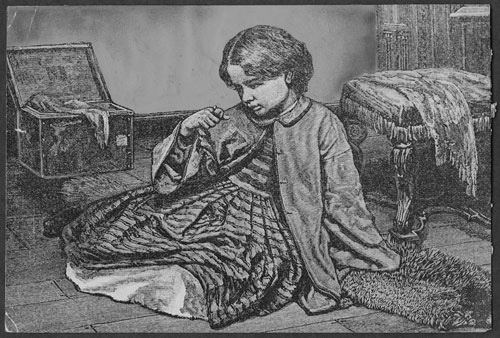
    This performance explores the influences of the 1859 play The Octoroon by Dion Boucicault, miscegenation laws, and the U.S. Census on biracial identity.  All these factors are used in the analysis of the racial identity of [“Pinky”] Sally Maria Diggs, a 9-year-old girl whose freedom was purchased by the congregation [for $900 USD on 1860-02-05] of Plymouth Church, Brooklyn, through the efforts of the Reverend Henry Ward Beecher and his associates.  The performance is intended to educate and present the theories of social impact on racial identity while providing historical fact and content.

    “Freedom Ring” by Eastman Johnson, from the Brooklyn Daily Eagle, 1934-03-21, p. 1
    Courtesy of the Brooklyn Public Library

  • Performing Bi- and Multi-Racial Identity

    Paper presented at the annual meeting of the NCA 94th Annual Convention, TBA
    San Diego, California
    2008-11-20

    13 pages

    Melissa J. Edwards
    Hofstra University

    Bi or Multi Racial identity is not clearly defined within American racial terms. This performative criticism of Kristen A. Renn’s study of college age students who identified themselves as biracial explains the historical, governmental, and social reasons for confusion or the lack of clarification of identity among this group. I explore this phenomenon through various theoretical analyses culminating with a written performance expressing the frustration of the students in this racial identity limbo.

    Read the entire paper here.

  • Gaining Interactional Leverage: School Racial Compositions and Multiracial Youths

    Paper presented at the annual meeting of the American Sociological Association
    Hilton San Francisco & Renaissance Parc 55 Hotel
    San Francisco, California
    2004-08-14
    44 pages

    Simon Cheng,  Associate Professor of Sociology
    University of Connecticut

    One of the most important changes in the contemporary American population is the rapid increase of biracial youths. Given the ongoing interest by sociologists and other social scientists in the potentially difficult life experiences and the social advantages that are associated with biracial youths’ identity formation and peer affiliation, I ask: To what extent are biracial adolescents’ life experiences shaped by contextual factors and types of biracial status? Using data from the National Longitudinal Study of Adolescent Health of 1994-95, I distinguish between white biracial and non-white biracial adolescents, and examine the contextual effects of school racial compositions on three measures of psychological states—school attachment, general happiness, and psychological disorder. Analyses provide evidence that school racial compositions affect the school attachment of monoracial, white biracial, and non-white biracial adolescents in different ways. For monoracial adolescents, their school attachment increases as the number of their same-race students increases in schools. Whereas school racial compositions show no effect on the school attachment of white biracial adolescents, non-white biracials’ school attachment increases only in schools with large proportions of racial minority students, and these effects are the strongest among all the racial groups explored in this study. The contextual effects of school racial compositions disappear when applied to outcome variables that are less related to school environments, such as students’ general happiness and symptoms of psychological disorder. Theoretical implications of these patterns are discussed at the end of this study.

    Read the entire paper here.

  • Parental Communication and Its Influence on Biracial Identity

    Paper presented at the annual meeting of the NCA 93rd Annual Convention, TBA
    Chicago, IL
    2007-11-15

    27 pages
     
    Carolyn Brooks

    The Biracial identity development process has long been overlooked in society and in research. Few models exist and those models in existence are mostly descriptive. This paper focused on one of the major influential factors in a child’s identity development process – parental communication. The Parental Racial Socialization Communication Model (PRSC) is proposed. A parent’s view of the child’s Biracialness and view of the world impact two dimensions that construct a parent’s communication style. Those two dimensions are the approach technique and valence of racial socialization. Four parental racial socialization styles are created from those two dimensions and are examined as predictors of the child’s ethnic identity label (border, protean, transcendent, and traditional) and their racial-esteem (feelings associated with the label). This model is helpful for counseling practitioners working with this population and for the parents of Biracial children who want information on how best to communicate with their children. The Parental Racial Socialization Communication Model is a needed addition to the limited literature on Biracial identity development.

    Introduction

    A topic that has gained much interest over the past few decades is that of Biracial identity. The 2000 Census, which was the first Census providing individuals with the option of identifying with more than one racial group, made it clear that the number of Biracial individuals in the United States is increasing rapidly (Buckley & Carter, 2004). Before this, the historical One-Drop Rule, which stated that an individual with as little as one drop of Black blood would be considered Black, was prevalent (Rockquemore & Brunsma, 2004). Therefore, some concluded that Black identity models were sufficient for Black/White Biracial individuals. In the 1980’s, researchers began to recognize that Biracial individuals experience racial issues differently than Blacks and have begun to delve into various investigations to see what factors influence Biracial identity development. (Rockquemore & Brunsma, 2004).

    The concept “Bi-racial identity,” however, is rarely defined or understood in any consistent manner in the existing literature. In many ways, Biracial identity appears to be a primitive term. However, various researchers examine Biracial identity in quite dissimilar ways, suggesting that the term Biracial identity is far from being understood. I define Biracial identity as an “emergent category of identification” (Rockquemore, 1998, p. 199) – singular, border, protean, or transcendent – for people with parents that are of “two different socially designated racial groups” (Root, 1996, p. ix). This identification, from which one attempts to gain a sense of self, is a choice based on a continuous process of interactions with one’s family, social network, and society, which are largely influenced by one’s appearance. The central question to be explored here is how parents of Biracial children communicatively influence their child’s Biracial identity development.

    This question is not one that appears in most of the literature on this topic. The majority of the models proposed in this field are descriptive, based on qualitative data, and lack process. Thus, an understanding of what factors and how the factors influence Biracial identity has not yet been achieved. Although prior work has primarily been descriptive, they provide a substantial foundation upon which more predictive models can be built (Poston, 1990). The literature on racial identity suggests that parental influence is important in the identity development of their children, as parents are the “primary socializing agents” of their children (Hughes, 2003, p. 15). Hence, the scope of this paper is to examine one of those factors – parental influence and develop a model that has a process and predictive power. The following review of the Biracial identity literature will reveal just how integral parental influence seems to be in the racial identity process for Biracial children…

    Read the entire paper here.