• Taking Assimilation to Heart: Marriages of White Women and Indigenous Men in the United States and Australia, 1887-1937

    University of Nebraska Press
    2006
    278 pages
    Illus.
    hardcover ISBN: 978-0-8032-1829-1
    paperback ISBN: 978-0-8032-2487-2

    Katherine Ellinghaus
    University of Melbourne
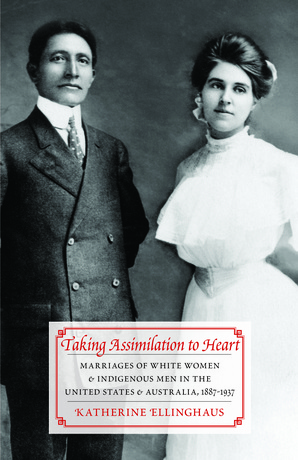
    Taking Assimilation to Heart examines marriages between white women and indigenous men in Australia and the United States between 1887 and 1937.  In these settler societies, white women were expected to reproduce white children to keep the white race “pure”–hence special anxieties were associated with their sexuality, and marriages with indigenous men were rare events. As such, these interracial marriages illuminate the complicated social, racial, and national contexts in which they occurred.

    This study of the ideological and political context of marriages between white women and indigenous men uncovers striking differences between the policies of assimilation endorsed by Australia and those encouraged by the United States. White Australians emphasized biological absorption, in which indigenous identity would be dissolved through interracial relationships, while white Americans promoted cultural assimilation, attempting to alter the lifestyles of indigenous people rather than their physical appearance. This disparity led, in turn, to differing emphases on humanitarian reforms, education policies, and social mobility, which affected the social status of the white women and indigenous men who married each other.

    Shifting from the personal to the local to the transnational, Taking Assimilation to Heart extends our understanding of the ways in which individual lives have been part of the culture of colonialism.
  • The Mulatta and the Politics of Race

    University Press of Mississippi
    2004
    272 pages
    bibliography, index
    ISBN: 157806676X (9781578066766)

    Teresa C. Zackodnik, Professor of English
    University of Alberta, Canada

    An analysis of how black women used the mulatta figure to contest racial barriers.

    From abolition through the years just before the civil rights struggle began, African American women recognized that a mixed-race woman made for a powerful and, at times, very useful figure in the battle for racial justice.

    The Mulatta and the Politics of Race traces many key instances in which black women have wielded the image of a racially mixed woman to assault the color line.  In the oratory and fiction of black women from the late 1840s through the 1950s, Teresa C. Zackodnik finds the mulatta to be a metaphor of increasing potency.

    Before the Civil War white female abolitionists created the image of the “tragic mulatta,” caught between races, rejected by all. African American women put the mulatta to diverse political use.  Black women used the mulatta figure to invoke and manage American and British abolitionist empathy and to contest racial stereotypes of womanhood in the postbellum United States.  The mulatta aided writers in critiquing the “New Negro Renaissance” and gave writers leverage to subvert the aims of mid-twentieth-century mainstream American culture.

    The Mulatta and the Politics of Race focuses on the antislavery lectures and appearances of Ellen Craft and Sarah Parker Remond, the domestic fiction of Pauline Hopkins and Frances Harper, the Harlem Renaissance novels of Jessie Fauset and Nella Larsen, and the little-known 1950s texts of Dorothy Lee Dickens and Reba Lee.  Throughout, the author discovers the especially valuable and as yet unexplored contributions of these black women and their uses of the mulatta in prose and speech.

  • Sweet Liberty: The Final Days of Slavery in Martinique

    University of Pennsylvania Press
    July 2009
    312 pages
    6 x 9; 7 illustrations
    Cloth ISBN: 978-0-8122-4172-3
    Paper ISBN: 978-0-8122-2227-2
    Ebook ISBN: 978-0-8122-0356-1

    Rebecca Hartkopf Schloss, Associate Professor of History
    Texas A & M University

    From its founding, Martinique played an integral role in France’s Atlantic empire. Established in the mid-seventeenth century as a colonial outpost against Spanish and English dominance in the Caribbean, the island was transformed by the increase in European demand for sugar, coffee, and indigo. Like other colonial subjects, Martinicans met the labor needs of cash-crop cultivation by establishing plantations worked by enslaved Africans and by adopting the rigidly hierarchical social structure that accompanied chattel slavery.  After Haiti gained its independence in 1804, Martinique’s economic importance to the French empire increased.  At the same time, there arose questions, both in France and on the island, about the long-term viability of the plantation system, including debates about the ways colonists—especially enslaved Africans and free mixed-race individuals—fit into the French nation.

    Sweet Liberty chronicles the history of Martinique from France’s reacquisition of the island from the British in 1802 to the abolition of slavery in 1848. Focusing on the relationship between the island’s widely diverse society and the various waves of French and British colonial administrations, Rebecca Hartkopf Schloss provides a compelling account of Martinique’s social, political, and cultural dynamics during the final years of slavery in the French empire. Schloss explores how various groups—Creole and metropolitan elites, petits blancs, gens de couleur, and enslaved Africans—interacted with one another in a constantly shifting political environment and traces how these interactions influenced the colony’s debates around identity, citizenship, and the boundaries of the French nation.

    Based on extensive archival research in Europe and the Americas, Sweet Liberty is a groundbreaking study of a neglected region that traces how race, slavery, class, and gender shaped what it meant to be French on both sides of the Atlantic.

    Table of Contents

    • Introduction: Sweet Liberty: The Final Days of Slavery in Martinique
    • 1. “That Your Hearts Will Blossom and Again Become French”: The Early Napoleonic Period
    • 2. “Happy to Consider Itself an Ancient British Possession”: The British Occupation of Martinique
    • 3. “Your French and Loyal Hearts”: The First Decade of the Restoration
    • 4. “In the Colonies, It Is Impossible That a White Would Align Himself With Slaves”: Shifts in Colonial Policy
    • 5. “To Ensure Equality Before Those Laws to Free Men, Whatever Their Color”: Changing Ideas of French Citizenship
    • 6. “Amelioration of the White Race” and “The Sacred Rights of Property”: The End of Slavery in the French Atlantic
    • Conclusion
    • List of Abbreviations
    • Notes
    • Index
    • Acknowledgments
  • Forgetting the Alamo, Or, Blood Memory: A Novel

    University of Texas Press
    September 2009
    198 pages
    6 x 9 in.; 1 map
    ISBN: 978-0-292-71920-0 (hardcover, no dust jacket)
    ISBN: 978-0-292-72128-9 (paperback)

    Emma Pérez, Associate Professor and Chair of Ethnic Studies
    University of Colorado

    This literary adventure takes place in nineteenth-century Texas and follows the story of a Tejana lesbian cowgirl after the fall of the Alamo. Micaela Campos, the central character, witnesses the violence against Mexicans, African Americans, and indigenous peoples after the infamous battles of the Alamo and of San Jacinto, both in 1836. Resisting an easy opposition between good versus evil and brown versus white characters, the novel also features Micaela’s Mexican-Anglo cousin who assists and hinders her progress. Micaela’s travels give us a new portrayal of the American West, populated by people of mixed races who are vexed by the collision of cultures and politics. Ultimately, Micaela’s journey and her romance with a black/American Indian woman teach her that there are no easy solutions to the injustices that birthed the Texas Republic.

    This novel is an intervention in queer history and fiction with its love story between two women of color in mid-nineteenth-century Texas. Pérez also shows how a colonial past still haunts our nation’s imagination. The battles of the Alamo and San Jacinto offered freedom and liberty to Texans, but what is often erased from the story is that common people who were Mexican, Indian, and Black did not necessarily benefit from the influx of so many Anglo immigrants to Texas. The social themes and identity issues that Pérez explores—political climate, debates over immigration, and historical revision of the American West—are current today.

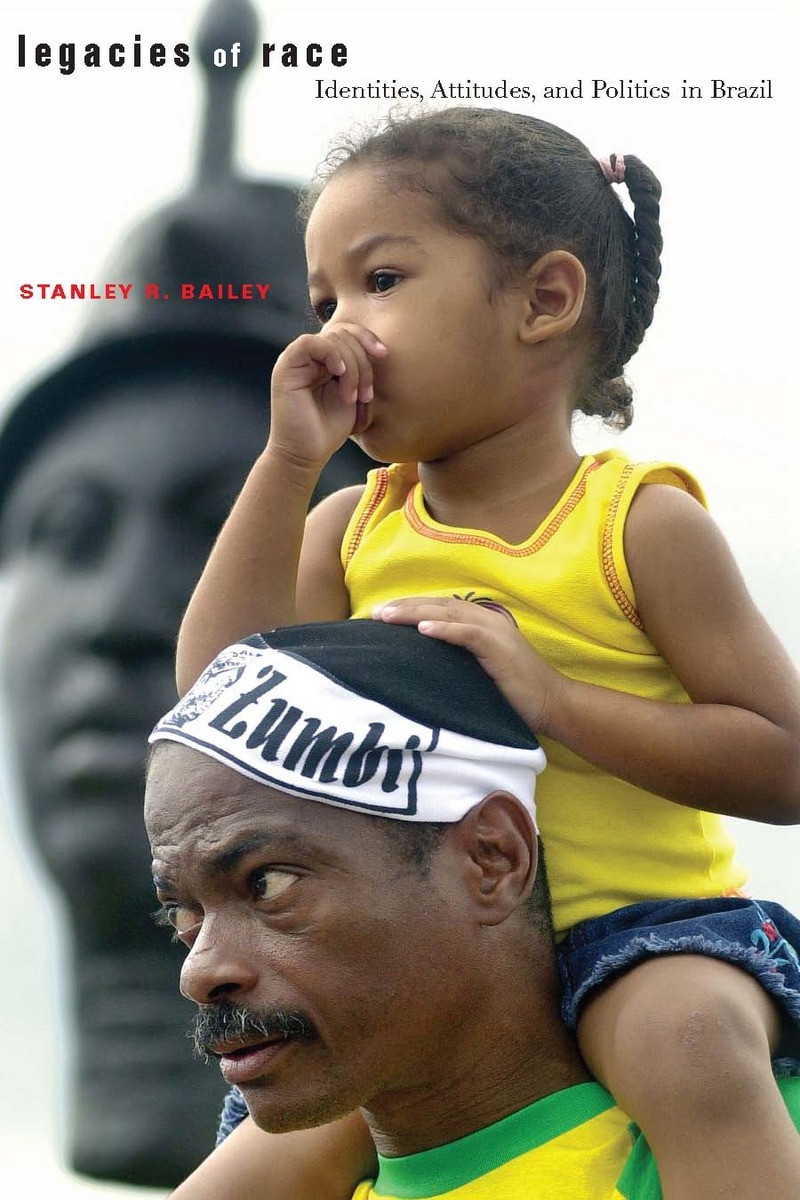
  • Legacies of Race: Identities, Attitudes, and Politics in Brazil

    Stanford University Press
    2009
    304 pages
    31 tables, 2 figures, 1 illustration.
    ISBN-10: 0804762775
    ISBN-13: 9780804762779

    Stanley R. Bailey, Associate Professor of Sociology
    University of California, Irvine

    The United States and Brazil were the largest slave-trading societies of the New World. The demographics of both countries reflect this shared past, but this is where comparisons end. The vast majority of the “Afro-Brazilian” population, unlike their U.S. counterparts, view themselves as neither black nor white but as mixed-race.  Legacies of Race offers the first examination of Brazilian public opinion to understand racial identities, attitudes, and politics in this racially ambiguous context.

    Brazilians avoid rigid notions of racial group membership, and, in stark contrast to U.S. experience, attitudes about racial inequality, African-derived culture, and antiracism strategies are not deeply divided along racial lines.  Bailey argues that only through dispensing with many U.S.-inspired racial assumptions can a general theory of racial attitudes become possible. Most importantly, he shows that a strict notion of racial identification in black and white cannot be assumed universal.

  • Amalgamation is a now largely archaic term for the intermarriage and interbreeding of different ethnicities or races. In the English-speaking world, the term was in use into the twentieth century. In the United States, it was partly replaced after 1863 by the term miscegenation. While the term amalgamation could refer to the interbreeding of different white as well as non-white ethnicities, the term miscegenation referred specifically to the interbreeding of whites and non-whites, especially African Americans.

    The term amalgamation was derived from metallurgy (see amalgam). It has been linked to the metaphor of the melting pot, which also originated in the US, and which described the cultural assimilation and intermarriage of different ethnicities. The intermarriage of whites with African Americans and, to a lesser degree, other non-whites was until recently in social disfavor in the United States, despite the long history of informal liaisons between white men and nonwhite women during the long years of slavery and after emancipation. Until 1967, interracial marriages were prohibited in many US states through anti-miscegenation laws.

    Wikipedia

    See also book: The Amalgamation Waltz: Race, Performance, and the Ruses of Memory.

  • In social science research, snowball sampling is a technique for developing a research sample where existing study subjects recruit future subjects from among their acquaintances. Thus the sample group appears to grow like a rolling snowball.  As the sample builds up, enough data is gathered to be useful for research.  This sampling technique is often used in hidden populations which are difficult for researchers to access; example populations would be drug users or commercial prostitutes.

    Because sample members are not selected from a sampling frame, snowball samples are subject to numerous biases. For example, people who have many friends are more likely to be recruited into the sample.

    It was widely believed that it was impossible to make unbiased estimates from snowball samples, but a variation of snowball sampling called respondent-driven sampling has been shown to allow researchers to make asymptotically unbiased estimates from snowball samples under certain conditions. Respondent-driven sampling also allows researchers to make estimates about the social network connecting the hidden population.

    Wikipedia

  • Mixed Heritage in Young Adult Literature

    The Scarecrow Press, Inc.
    March 2009
    272 pages
    Cloth ISBN: 0-8108-5969-6; ISBN-13: 978-0-8108-5969-2

    Nancy Thalia Reynolds

    Mixed-heritage people are one of the fastest-growing groups in the United States, yet culturally they have been largely invisible, especially in young adult literature. Mixed Heritage in Young Adult Literature is a critical exploration of how mixed-heritage characters (those of mixed race, ethnicity, religion, and/or adoption) and real-life people have been portrayed in young adult fiction and nonfiction.

    This is the first in-depth, broad-scope critical exploration of this subgenre of multicultural literature. Following an introduction to the topic, author Nancy Thalia Reynolds examines the portrayal of mixed-heritage characters in literary classics by James Fenimore Cooper, Mark Twain, and Zora Neale Hurston—staples of today’s high school English curriculum—along with other important authors. It opens up the discussion of young-adult racial and ethnic identity in literature to recognize—and focus on—those whose heritage straddles boundaries. In this book teachers will find new tools to approach race, ethnicity, and family heritage in literature and in the classroom.  This book also helps librarians find new criteria with which to evaluate young adult fiction and nonfiction with mixed-heritage characters.

  • Exiles at Home: The Struggle to Become American in Creole New Orleans

    Harvard University Press
    2009
    400 pages
    6-1/8 x 9-1/4 inches
    19 halftones in 20 p mock insert
    Hardcover ISBN: 9780674023512

    Shirley Elizabeth Thompson, Associate Professor in American Studies
    University of Texas, Austin

    New Orleans has always captured our imagination as an exotic city in its racial ambiguity and pursuit of les bons temps.  Despite its image as a place apart, the city played a key role in nineteenth-century America as a site for immigration and pluralism, the quest for equality, and the centrality of self-making.

    In both the literary imagination and the law, creoles of color navigated life on a shifting color line. As they passed among various racial categories and through different social spaces, they filtered for a national audience the meaning of the French Revolution, the Haitian Revolution of 1804, the Civil War and Reconstruction, and de jure segregation.

    Shirley Thompson offers a moving study of a world defined by racial and cultural double consciousness. In tracing the experiences of creoles of color, she illuminates the role ordinary Americans played in shaping an understanding of identity and belonging.

  • The Amalgamation Waltz: Race, Performance, and the Ruses of Memory

    University of Minnesota Press
    2009
    248 pages
    18 b&w photos | 6 x 9
    ISBN: 978-0-8166-5613-4 (paper)
    ISBN: 978-0-8166-5612-7 (cloth)

    Tavia Nyong’o, Associate Professor of Performance Studies
    New York University

    Does racial hybridity offer a future beyond racial difference?

    At a time when the idea of a postracial society has entered public discourse, The Amalgamation Waltz investigates the practices that conjoined blackness and whiteness in the nineteenth and twentieth centuries. Scrutinizing widely diverse texts—archival, musical, visual, and theatrical—Tavia Nyong’o traces the genealogy of racial hybridity, analyzing how key events in the nineteenth century spawned a debate about interracialism that lives on today.

    Deeply interested in how discussions of racial hybridity have portrayed the hybrid as the recurring hope for a distant raceless future, Nyong’o is concerned with the ways this discourse deploys the figure of the racial hybrid as an alibi for a nationalism that reinvents the racist logics it claims to have broken with.  As Nyong’o demonstrates, the rise of a pervasive image of racially anomalous bodies responded to the appearance of an independent black public sphere and organized politics of black uplift.  This newfound mobility was apprehended in the political imaginary as a bodily and sexual scandal, and the resultant amalgamation discourse, he argues, must be recognized as one of the earliest and most enduring national dialogues on sex and sexuality.

    Nyong’o tracks the emergence of the concept of the racial hybrid as an ideological modernization of the older concept of the mongrel and shows how this revision brought race-thinking in line with new understandings of sex and gender, providing a racial context for the shift toward modern heterosexuality, the discourse on which postracial metaphors so frequently rely.  A timely rebuttal to our contemporary fascination with racial hybridity, The Amalgamation Waltz questions the vision of a national future without racial difference or conflict.

    Table of Contents

    • Introduction: Antebellum Genealogies of the Hybrid Future
    • 1. The Mirror of Liberty: Constituent Power and the American Mongrel
    • 2. In Night’s Eye: Amalgamation, Respectability, and Shame
    • 3. Minstrel Trouble: Racial Travesty in the Circum-Atlantic Fold
    • 4. Carnivalizing Time: Decoding the Racial Past in Art and Installation
    • Conclusion: Mongrel Pasts, Hybrid Futures
    • Acknowledgments
    • Notes
    • Bibliography
    • Index