• The Interethnic Imagination: Roots and Passages in Contemporary Asian American Fiction

    Oxford University Press
    October 2009
    216 pages
    Hardback ISBN13: 9780195377361; ISBN10: 0195377362

    Caroline Rody, Associate Professor of English
    University of Virginia

    In the wake of all that is changing in local and global cultures–in patterns of migration, settlement, labor, and communications–a radical interaction has taken place that, during the last quarter of the twentieth century, has shifted our understanding of ethnicity away from ‘ethnic in itself’ to ‘ethnic amidst a hybrid collective’.  In light of this, Caroline Rody proposes a new paradigm for understanding the changing terrain of contemporary fiction. She claims that what we have long read as ethnic literature is in the process of becoming ‘interethnic’.  Examining an extensive range of Asian American fictions, The Interethnic Imagination offers sustained readings of three especially compelling examples: Chang-rae Lee‘s ambivalent evocations of blackness, whiteness, Koreanness, and the multicultural crowd in Native Speaker; Gish Jen‘s comic engagement with Jewishness in Mona in the Promised Land; and the transnational imagination of Karen Tei Yamashita‘s Tropic of Orange.  Two shorter “interchapters” and an epilogue extend the thematics of creative “in-betweenness” across the book’s structure, elaborating crossover topics including Asian American fiction’s complex engagement with African American culture; the cross-ethnic adoption of Jewishness by Asian American writers; and the history of mixed-race Asian American fictional characters.

    Features

    • Examines three major yet under-studied contemporary Asian American novelists: Chang-rae Lee, Karen Tei Yamashita, and Gish Jen.
    • Considers major Asian American fiction alongside African American and Jewish American authors.
    • In lucid writing, provides a valuable and innovative paradigm for interpreting the burgeoning field of ethnic literature in the U.S.
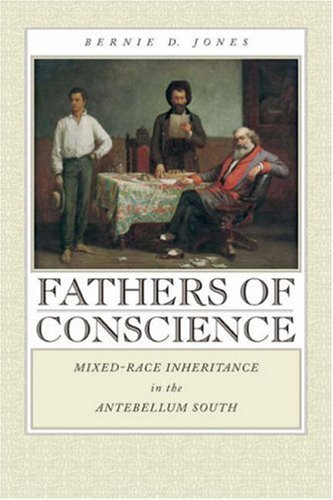
  • Fathers of Conscience: Mixed-Race Inheritance in the Antebellum South

    University Of Georgia Press
    February 2009
    216 pages
    6 x 9 in.
    ISBN: 0820332518 (paper), 0820329800 (cloth)

    Bernie D. Jones, Associate Professor of Law
    Suffolk University

    How the courts dealt with wills bequeathing property or freedom to mixed race children.

    Fathers of Conscience examines high-court decisions in the antebellum South that involved wills in which white male planters bequeathed property, freedom, or both to women of color and their mixed-race children. These men, whose wills were contested by their white relatives, had used trusts and estates law to give their slave partners and children official recognition and thus circumvent the law of slavery. The will contests that followed determined whether that elevated status would be approved or denied by courts of law.

    Bernie D. Jones argues that these will contests indicated a struggle within the elite over race, gender, and class issues-over questions of social mores and who was truly family. Judges thus acted as umpires after a man’s death, deciding whether to permit his attempts to provide for his slave partner and family. Her analysis of these differing judicial opinions on inheritance rights for slave partners makes an important contribution to the literature on the law of slavery in the United States.

    Contents

    • Preface
    • Introduction. Inheritance Rights in the Antebellum South
    • Chapter One. Righteous Fathers, Vulnerable Old Men, and Degraded Creatures
    • Chapter Two. Slavery, Freedom, and the Rule of Law
    • Chapter Three. Justice and Mercy in the Kentucky Court of Appeals
    • Chapter Four. Circling the Wagons and Clamping Down: The Mississippi High Court of Errors and Appeals
    • Chapter Five. The People of Barnwell against the Supreme Court of South Carolina: The Case of Elijah Willis
    • Conclusion. The Law’s Paradox of Property and Power: The Significance of Geography
    • Appendix One. Case Indexes
    • Appendix Two. Opinions on the Emancipation of Slaves during George Robertson’s Tenure as Chief Justice
    • Appendix Three. Supplementary Information Regarding Willis v. Jolliffe
    • Notes
    • Bibliographic essay
    • Index
  • Understanding the Epistemology of Ethnic Identity Development in Multiethnic College Students

    Journal of College Student Development
    Volume 49, Number 5, September/October 2008
    pages 443-458
    E-ISSN: 1543-3382 Print ISSN: 0897-5264
    DOI: 10.1353/csd.0.0028

    Prema Chaudhari
    University of Pittsburgh

    Jane Elizabeth Pizzolato, Assistant Professor
    Department of Education
    University of California, Los Angeles

    We examined the nuances of multiethnic identity in 22 self-identifying mixed ethnic college students ranging from 17 years of age to 27 years of age via semistructured interviews. Majority of the sample was predominantly female. The participants were recruited from two institutions in a metropolitan area of the Eastern United States. Results suggest an expansion of the definition of situational identity (Renn, 2000) and a triplaned understanding of ethnic identity development and assessment in relation to epistemology for this population.

  • Feeling Ancestral: The Emotions of Mixed Race and Memory in Asian American Cultural Productions

    positions: east asia cultures critique
    Volume 16, Number 2, Fall 2008
    pages 457-482

    Jeffrey Santa Ana, Assistant Professor English Department
    Stony Brook University

    The current era of war, militarism, and neocolonialism in the Pacific is a time in which capitalist expansion simultaneously generates and conceals the negative human consequences of globalization — for example, the tremendous upheaval and migration of Asian people. Diaspora, dislocation, exile, and immigration born of economic necessity are the depressing contradictions to a capitalist paradise that has been optimistically envisaged as the end of history.   Critics of globalization have theorized the ways in which the commercialization of human feeling conceals the anxieties, fears, and other negative affects that express the harsh underside of transnational capitalism.  Nowhere is this commercialization of emotion more obvious than in the marketing of multiculturalism and racial difference in global commerce. The commercial use of racial mixture is especially provocative in the way it signals, conditions, and manages distressing experiences, while assimilating them symmetrically and seamlessly into the transnational stage of capitalism. Clearly, racial mixture is a hot commodity in today’s global market. Particularly in North America, the fascination with and consumption of multiraciality is evident in the notable increase in scholarship about multiraciality in the academy and the profusion of mixed-race productions in the culture industry, both of which reflect the commercialization of racial mixture in a globalized world.

    In the last ten years, there has been an explosion of cultural productions about mixed-race people, and particularly of multiracial Asian Americans. Ruth Ozeki’s My Year of Meats and Halving the Bones, Kip Fulbeck’s Paper Bullets and Part Asian, 100 Percent Hapa, Paisley.

  • Second Glances: Two African-American Women Take a Closer Look at their Jewish Identities

    Bridges: A Jewish Feminist Journal
    Volume 13, Number 2 (Autumn 2008)
    pages 52-63

    Amy André

    Nzinga Koné-Miller

    This conversation is co-written by two African American women, one who converted to Judaism and one who was born Jewish. They dialogue about the differences and similarities of their experiences in regard to religious practice, family, community, and hopes for a future that includes practical and widespread recognition of Jews of all races.

  • From: KNPR in Nevada: A Conversation About Race and Ethnicity in America  (2008-08-22)

    We continue our conversation about race and ethnicity in America when we host a joint broadcast [on 2008-08-22] with KCEP-FM.  KCEP’s Patricia Cunningham joins us with UNLV [University of Nevada at Las Vegas] Professor Rainier Spencer and Pastor Robert Fowler of The Victory Missionary Baptist Church.

    Rainer Spencer appears at 09:35 in the program and discusses ‘Generation Mix’ and other issues.


    Pictured right are: KCEP Radio Host Patricia Cunningham, KNPR’s State of Nevada Show Host Dave Berns, KCEP IT Mgr and Asst Program Coordinator Ashton Ridley, Prof Rainier Spencer, KCEP Program Mgr Craig Knight and Pastor Robert Fowler (left to right).

    Listen the recorded audio (00:47:28) stream here.
    Download the recorded audio (00:47:28) file here.

  • “If, however, one is critical of race, it then becomes apparent that there is an inherent contradiction in the idea of multiraciality; for if race is a myth, then multirace must of necessity be a myth as well.  Yet how is one to self-identify, to assert an identity, when the only language seeming available is infused with the terminology of racialism?  The answer lies in challenging rather than acceding to the hemogeny of race and rejecting the premise that personal identity need be race based to begin with.

    Rainier Spencer, Spurious Isses: Race and Multiracial Identity Politics in the United States, p. 89

  • “Who Am I? Mental Health & Dual Heritage” Conference Report

    At GMCVO, ST. THOMAS CENTRE
    Ardwick Green North, Manchester, M12 6FZ
    This event was held on 2009-06-10, from 08:00Z to 13:00Z

    Programme:

    08:00Z Registration
    08:30Z Mixed Heritage Identities; the issues and challenges
    Bradley Lincoln
    Multiple Heritage Project Manchester
    09:00Z Women; mixed heritage and mental health
    Lindsey Cook
    Women’s Services Manager, Imagine Ltd
    09:30Z Coffee / Tea
    10:00Z Voices from Experience; young people and identity
    Laura Jenkin
    Youth Worker – Newcastle
    10:30Z Across the Boundaries; challenges of faith and culture
    Atif Kamal
    Community Development Worker, SEVA Team, Manchester
    11:00Z Group Discussions
    12:00Z Lunch
  • A ‘Marginal Man’ is a fictional archetype created in 1927 by sociologist Robert Ezra Park (1864-1944) (and further developed by Everett Stonequist (1901-1979)) as a way  to describe a person descended from two “opposing” ethnic or racial groups.  He stated, “The marginal man…is one whom fate has condemned to live in two societies and in two, not merely different but antagonistic cultures….his mind is the crucible in which two different and refractory cultures may be said to melt and, either wholly or in part, fuse.”   The arc for ‘Marginal Man’ was similar to that of  the ‘Tragic Mulatto‘ because he too, attempted to “pass” as white, however he could change course and take a hypodescendent path and if he were fortunate become a leader of his “lesser” lot.

    See, Everett V. Stonequist’s July 1935 article “The Problem of the Marginal Man.”

  • From Wikipedia: The Tragic mulatto is a stereotypical fictional character that appeared in American literature during the 19th and 20th centuries. The “tragic mulatto” is an archetypical mixed race person (a “mulatto”), who is assumed to be sad or even suicidal because he/she fails to completely fit in the “white world” or the “black world”. As such, the “tragic mulatto” is depicted as the victim of the society he/she lives in, a society divided by race. Because of society’s reluctance to acknowledge ambiguity in racial classifications, this character is particularly vulnerable…

    Generally, the tragic mulatta archetype falls into one of three categories:

    • A woman who can “pass” for white attempts to do so, is accepted as white by society and falls in love with a white man. Eventually, her status as a bi-racial person is revealed and the story ends in tragedy.
    • A woman appears to be white. It is believed that she is of Greek or Spanish descent. She has suffered little hardship in her life, but upon the revelation that she is mixed race, she loses her social standing.
    • A woman who has all the social graces that come along with being a middle-class or upper-class white woman is nonetheless subjected to slavery.

    A common objection to this character is that she allows readers to pity the plight of oppressed or enslaved races, but only through a veil of whiteness — that is, instead of sympathizing with a true racial “other,” one is sympathizing with a character who is made as much like one’s own race as possible. The “tragic mulatta” often appeared in novels intended for women, also, and some of the character’s appeal lay in the lurid fantasy of a person just like them suddenly cast into a lower social class after the discovery of a small amount of “black blood” that renders her unfit for proper marriage…

    Wikipedia

    Please visit the Tragic Mulatto Myth site at the Jim Crow Museum of Racist Memorabilia at Ferris State University.

    Comentary by Steven F. Riley

    The social stigma of ‘race mixing’ and the social upheaval which it was believed to have caused, was firmly imprinted into the American mindset with the publication of the 1842 anti-slavery short story, The Quadroons by Lydia Maria Child (1802-1880).  Child, a Unitarian abolitionist and women’s rights activist, introduced the world to the archetype that would be known as the ‘Tragic Mulatto’ that would last well into the middle of the 20th century.  There are various trajectories for the ‘Tragic Mulatto’, but generally he (or usually she) is a person of mixed race, who passes for white and in doing so, becomes extremely successful in some endeavor (usually love).  Inevitably, the ‘Tragic Mulatto’ is exposed and rejected by both racial groups, and the story ends — as one might guess — tragically.  Though it was not Child’s intent, the ‘Tragic Mulatto’ archetype was yet another tool (this time literary) used to preserve white hegemony.  It did this by: Firstly reinforcing the notion of  “white purity” that anyone not 100% ‘white’ was not white at all; secondly, further denigrating non-whites by implying that they all somehow secretly wished to be white and escape their lot in life; thirdly, effectively isolating mixed race individuals from both the whites they allegedly “wished to be” and the non-whites they wish to allegedly “wish to flee”; and fourthly, It leveled scorn upon those interracial unions that would bring such “hybrids” into the world.