Mixed Race Studies

Scholarly perspectives on the mixed race experience.

    • About This Site
    • Bibliography
    • Contact Information
    • Date and Time Formats
    • Forthcoming… (Updated 2021-09-01)
    • Likely Asked Questions
    • List of Book Publishers
    • List of Definitions and Terms
    • My Favorite Articles and Papers
    • My Favorite Posts
    • My Recent Activities
    • Praise for Mixed Race Studies
    • Tag Listing
      • Tag Listing (Ordered by Count)
    • US Census Race Categories, 1790-2010
    • 1661: The First ‘Mixed-Race’ Milestone
    • 2010 U.S. Census – Some Thoughts

recent posts

  • The Routledge International Handbook of Interracial and Intercultural Relationships and Mental Health
  • Loving Across Racial and Cultural Boundaries: Interracial and Intercultural Relationships and Mental Health Conference
  • Call for Proposals: 2026 Critical Mixed Race Studies Conference at UCLA
  • Participants Needed for a Paid Research Study: Up to $100
  • You were either Black or white. To claim whiteness as a mixed child was to deny and hide Blackness. Our families understood that the world we were growing into would seek to denigrate this part of us and we would need a community that was made up, always and already, of all shades of Blackness.

about

  • Twitter
  • Facebook
  • Instagram
  • The Paradox of the First Black President

    2015-10-08

    The Paradox of the First Black President

    New York Magazine
    2015-10-07
    Jennifer Senior


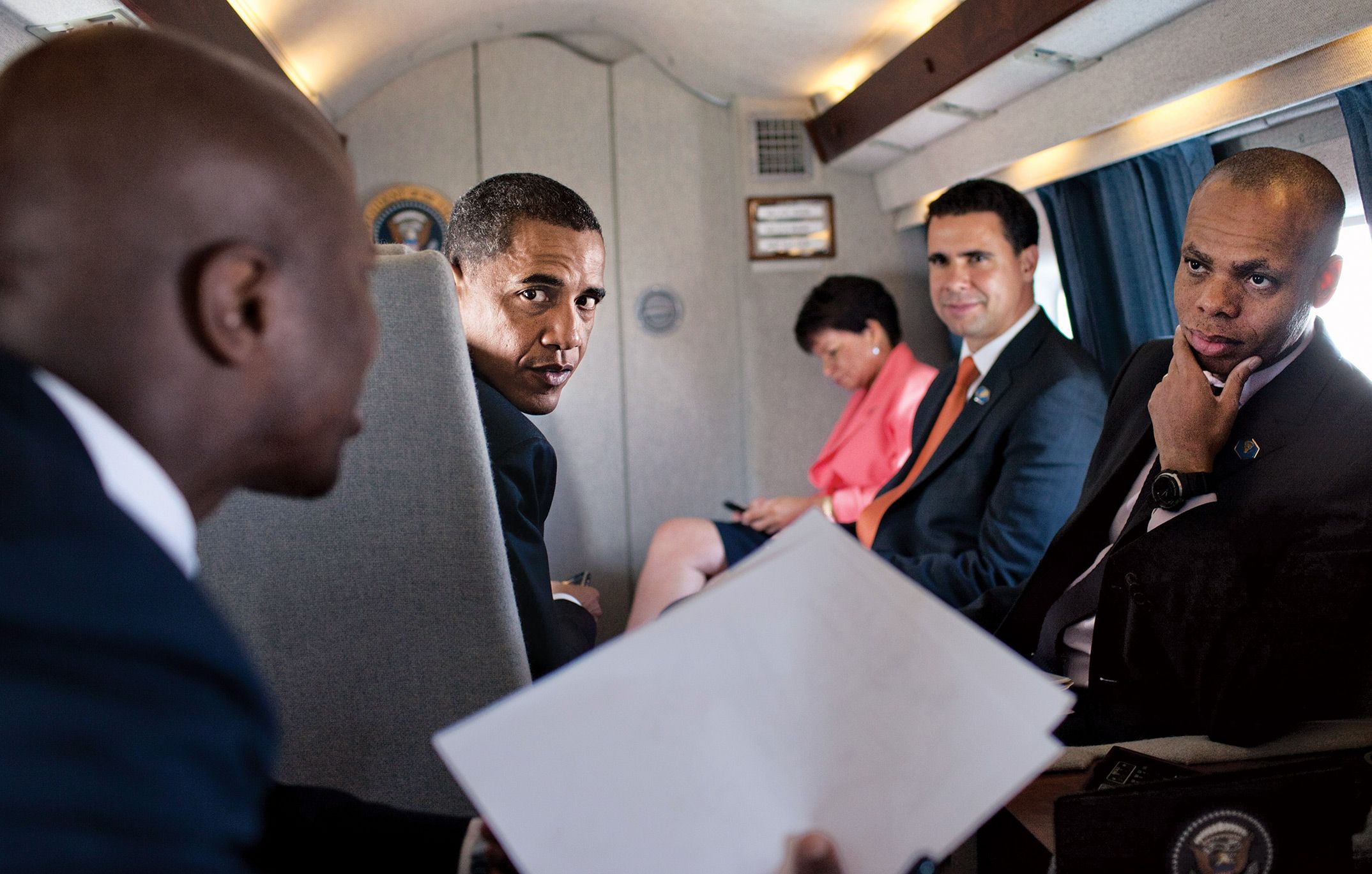
    President Barack Obama talks with, from left, personal aide Reggie Love, Senior Advisor Valerie Jarrett, Deputy Press Secretary Bill Burton, and Director of Political Affairs Patrick Gaspard, aboard Marine One during the flight from White House to Joint Base Andrews, Maryland, Aug. 9, 2010. (Pete Souza)

    As the historic administration nears its final year, African-American leaders debate: Did Barack Obama do enough for his own community?

    There is a photo by Pete Souza, the White House’s canny and peripatetic photographer, that surfaces from time to time online. The setting is Marine One, and it features a modest cast of five. Valerie Jarrett, dressed in a suit of blazing pink, is staring at her cell phone. Barack Obama, twisted around in his seat, is listening to a conversation between his then–body guy, Reggie Love, and Patrick Gaspard, one of his then–top advisers. Obama’s former deputy press secretary, Bill Burton, is looking on too, with just the mildest hint of a grin on his face.

    In many ways, it’s a banal shot — just another photo for the White House Instagram feed, showing the president and his aides busily attending to matters of state. Stare at it a second longer, though, and a subtle distinction comes into focus: Everyone onboard is black. “We joked that it was Soul Plane,” says Burton. “And we’ve often joked about it since — that it was the first time in history only black people were on that helicopter.”

    Souza snapped that shot on August 9, 2010, but it didn’t make any prominent appearances in the mainstream press until mid-2012, when it appeared in The New York Times Magazine. The following summer, July 2013, the president had a group of civil-rights leaders come visit him in the Roosevelt Room of the White House, and the optics, as they like to say in politics, were similar: An all-star cast of minorities (African-American and Latino this time) gathered in a historic place to which the barriers to entry were once insuperably high…

    …But now, as Obama’s presidency draws to a close, African-American intellectuals and civil-rights leaders have grown increasingly vocal in their discontents. They frame them, for the most part, with love and respect. But current events have broken their hearts and stretched their patience. A proliferation of videos documenting the murders of unarmed black men and women — by the very people charged with their safety — has given rise to a whole movement defined by three words and a hashtag: #BlackLivesMatter.

    “That’s one of the fundamental paradoxes of Obama’s presidency — that we have the Black Lives Matter movement under a black president,” says Fredrick Harris, a political scientist at Columbia University. “Your man is in office, and you have this whole movement around criminal-justice reform asserting black people’s humanity?”…

    Read the entire article here.

  • Rupert Murdoch implies Obama is not ‘real black president’ in tweet praising Ben Carson

    2015-10-08

    Rupert Murdoch implies Obama is not ‘real black president’ in tweet praising Ben Carson

    The Guardian
    2015-10-07

    Ben Jacobs, Political Reporter

    Media mogul says Republican contender could ‘properly address the racial divide’ in tweets criticising Obama’s record in office

    Media mogul Rupert Murdoch has suggested that Barack Obama was not a “real black” president in a tweet praising Republican candidate Ben Carson on Wednesday night…

    …However, his earlier tweet directly implied that Obama, whose mother was a white American and whose father was a Kenyan studying in the United States, did not deserve to be classified as African American. Both of Carson’s parents were black and born in the United States…

    Read the entire article here.

  • How the Hawaiian word ‘hapa’ came to be used by people of mixed heritage

    2015-10-08

    How the Hawaiian word ‘hapa’ came to be used by people of mixed heritage

    Public Radio International (PRI)
    2015-09-15

    Nina Porzucki, Producer

    Recently, an old friend of mine, Julie Jimenez had a language question she wanted me to investigate: Where does the word “hapa” come from?

    Julie considers herself hapa. Her father is from Chile, her mom is Japanese American. And she calls herself “hapa,” that is, half Asian, half something else. Julie had never questioned this definition before until one day she was at the market and she met a women who she thought was hapa like herself.

    “She looked half Chinese and half white and I said, ‘Oh, you’re hapa!’ and she said ‘that’s a Hawaiian word, you’re not supposed to use it.’ And I had never heard anyone say that before. I was kind of shocked because I had never thought it was offensive,” she said…

    Listen to the story (00:38:09) here. Download the story here.

  • Illicit Labor: MacArthur’s Mistress and Imperial Intimacies

    2015-10-06

    Illicit Labor: MacArthur’s Mistress and Imperial Intimacies

    Radical History Review
    Volume 2015, Number 123 (October 2015)
    pages 87-114
    DOI: 10.1215/01636545-3088168

    Vernadette Vicuña Gonzalez, Associate Professor of American Studies
    University of Hawaii, Mānoa

    This essay examines a brief affair between General Douglas MacArthur and a mixed-race Filipina vaudeville actress named Isabel Rosario Cooper. It focuses on Cooper’s little-documented and underexamined life as a way to understand how the intimate politics of the bedroom overlapped with the libidinal economies of the cosmopolitan Philippine entertainment industry, American military occupation, and broader geopolitical relations of imperial desire. Cooper and MacArthur’s liaison was constitutive of as well as constituted by the larger international “romance” between the United States and the Philippines that MacArthur himself oversaw in the early and middle part of the twentieth century. Going beyond the salacious details of an illicit love affair, this study seeks to illuminate how intimacy made up a type of imperial labor writ small, which served to underpin the project of US imperialism as crucially as colonial administration or military occupation.

    Read or purchase the article here.

  • “I think she [Rachel Dolezal] was a bit of a hero, because she kind of flipped on society a little bit.”

    2015-10-06

    “I think she [Rachel Dolezal] was a bit of a hero, because she kind of flipped on society a little bit. Is it such a horrible thing that she pretended to be black? Black is a great thing, and I think she legit changed people’s perspective a bit and woke people up.” —Rihanna (Robyn Rihanna Fenty)

    Lisa Robinson, “Rihanna in Cuba,” Vanity Fair, November 2015. http://www.vanityfair.com/hollywood/2015/10/rihanna-cover-cuba-annie-leibovitz.

  • Something Old, Something New

    2015-10-06

    Something Old, Something New

    BBC Radio 4
    2015-10-06

    Johny Pitts, Host

    Peter Meanwell, Producer


    Recorded & mixed! Finished @BBCRadio4 (Engineer Steve Hellier with Johny Pitts) Source: Peter Meanwell

    From Sheffield to South Carolina, Johny Pitts explores alternative Black British identity.

    What happens when your Dad’s an African-American soul star [Richie Pitts] and your Mum’s a music-loving girl from working class Sheffield? Are your roots on the terraces at a Sheffield United match, or in the stylings of a Spike Lee film? For writer and photographer Johny Pitts, whose parents met in the heyday of Northern Soul, on the dance floor of the legendary King Mojo club, how he navigates his black roots has always been an issue. Not being directly connected to the Caribbean or West African diaspora culture, all he was told at school was that his ancestors were slaves, so for BBC Radio 4, he heads off to the USA, to trace his father’s musical migration, and tell an alternative story of Black British identity.

    From Pitsmore in Sheffield, to Bedford Stuyvesant in New York, and all the way down to South Carolina, where his grandmother picked cotton, Johny Pitts heads off on a journey of self-discovery. On the way he meets author Caryl Phillips, Kadija, a half sister he never knew, and historian Bernard Powers. He visits the Concorde Baptist Church in Brooklyn, New York, and the Bush River Missionary Baptist Church, in Newberry, South Carolina. He tracks down a whole host of long-lost cousins, and talks to Pulitzer winning writer Isabel Wilkerson. On the way he shines a light on the shadows of his ancestry, and finds stories and culture that deliver him to a new understanding of his own mixed race identity and history.

    Listen to the story here.

  • The most famous ‘Indian’ on 1950s American TV

    2015-10-06

    The most famous ‘Indian’ on 1950s American TV

    The Times of India
    2015-10-04

    Malini Nair

    Korla Pandit was the first African American to have a TV show to himself – by pretending to be an exotic Indian musician

    The story is almost unbelievable. In the US of the 1940s, a light-skinned African American youth discovers his prodigious talent at playing the electric organ. The mystical Orient and all its clichés are in vogue at the time and radio shows like Chandu the Magician and films like Midnight Shadow are the rage, featuring fakirs and assorted Indian exotica. The ambitious African American, John Roland Redd, decides to reinvent himself for the TV music market – as Korla Pandit, the mysterious Indian musician.

    Deeply kohled eyes fixed in a hypnotic gaze, a bejewelled turban on his head, Pandit would play the Hammond B2 organ and piano with both virtuosity and theatricality on TV shows. Around him, a stagey exotic east played out – smoky haze, play of light and shade, Oriental dancers undulating in shimmery lehengas and short dhotis.

    “I was born in New Delhi, India,” he announced silkily in a TV interview with an anchor seeking the backstory to Pandit (pronounced ‘panned-it’). He was, he claimed, the son of a Brahmin priest and a French opera singer who was sent to the US to study. Pandit reached the peak of his popularity with the ’50s TV show ‘Adventures in Music with Korla Pandit’, where he appeared as some kind of Indian musician-maharaja–swami. What he played on the organ and the piano was called exotica music – the closest it comes to contemporary music is trance or lounge. Before long, he came to be known as the Godfather of Exotica…

    Read the entire article here.

  • Boy, Snow, Bird by Helen Oyeyemi review – serious issues, fairytale narrative

    2015-10-06

    Boy, Snow, Bird by Helen Oyeyemi review – serious issues, fairytale narrative

    The Guardian
    2015-10-04

    Anthony Cummins

    Oyeyemi, Helen, Boy, Snow, Bird: A Novel (New York: Riverhead Press, 2014)

    Oyeyemi’s fifth novel finds her treating the horrors of racism in 1950s America with gentle, magical style

    Helen Oyeyemi, a Granta best of young British novelist, was born in Nigeria, grew up in London and has lived around Europe and North America. She specialises in unorthodox, freewheeling plots, rooted in myth and narrated in an innocent-seeming style. Her fifth novel is a historical narrative of American racism set in the 1950s and 60s.

    At the start a woman named Boy Novak tells us how she ran away aged 20 from New York to escape her rat-catcher father, Frank, a drunk who beat her (her mother was absent). She pitches up in a small town in Massachusetts to marry a widowed jeweller and former historian, Arturo, who has a seven-year-old daughter, Snow, whose mother died after complications in childbirth.

    The central crisis of the novel comes when Arturo has another daughter, with Boy – named Bird – and she is born dark-skinned. Arturo’s family accuse Boy of being unfaithful but the truth, as they all know, is that they have been passing for white. What follows is the painful background to that decision, as Arturo’s family recount the horrors of life in the south and their disappointed hopes for how things might improve when they moved north…

    Read the entire book review here.

  • “I don’t like when people put me in the woman box or the Latina box or the political artist box… That limits who I am as an individual. I want to instead embrace the possibility of who I can be. That’s where ulti­mate freedom is.”

    2015-10-05

    “I don’t like when people put me in the woman box or the Latina box or the political artist box,” she says. “That limits who I am as an individual. I want to instead embrace the possibility of who I can be. That’s where ulti­mate freedom is.” —Favianna Rodriguez

    Thea Singer, “How art can disrupt our ideas and identities,” news@Northeastern, September 23, 2015. http://www.northeastern.edu/news/2015/09/how-art-can-disrupt-our-ideas-and-identities/.

  • How art can disrupt our ideas and identities

    2015-10-05

    How art can disrupt our ideas and identities

    news@Northeastern
    Northeastern University, Boston, Massachusetts
    2015-09-23

    Thea Singer

    Artist Favianna Rodriguez makes bold, sparkling works that light up a room even as they reveal dark cul­tural inequities.

    She is known for her activism and political posters addressing issues such as racism, women’s rights, displacement, and climate change. Now, for the first time, her abstract prints—multilayered col­lages of vibrant colors and rever­ber­ating shapes—are on dis­play: 27 of them line the walls in Northeastern’s Gallery 360 in an exhibit called “The Multiverse of Identity” as she begins her week­long stint at North­eastern as artist in res­i­dence. The exhibit opened ealier this month and runs through mid-December.

    Rodriguez will be talking about her vision of art as both an agent of social change and individual narrative on Wednesday, Sept. 23, at 6 p.m., in Blackman Auditorium…

    …Her process

    Rodriguez’s process for making her abstract works—intaglio printing, using an etching plate—is “very, very elaborate.” Each piece takes months. To start, she applies ink to create tex­ture on mul­tiple sheets of Japanese paper, pro­ducing a “library of colors.” “I think of the prac­tice as creating the container in which I’m going to play,” she says. She then cuts the paper into shapes—now spikey, now undulating—and arranges them in a “playful way.” “The arranging—repeating shapes, refining them—is what gives each piece its own char­acter,” she says.

    The colors smack you in the face. “For me, color is about possibility,” she says. It characterizes both her art and her com­mit­ment to breaking apart assumptions—for herself, for all of us. “I don’t like when people put me in the woman box or the Latina box or the political artist box,” she says. “That limits who I am as an individual. I want to instead embrace the possibility of who I can be. That’s where ulti­mate freedom is.”…

    Read the entire article here.

Previous Page
1 … 539 540 541 542 543 … 1,428
Next Page

Designed with WordPress