• Remixing Reggaetón: The Cultural Politics of Race in Puerto Rico

    Duke University Press
    2015
    240 pages
    11 illustrations
    Cloth ISBN: 978-0-8223-5945-6
    Paperback ISBN: 978-0-8223-5945-6

    Petra R. Rivera-Rideau, Assistant Professor of Africana Studies
    Virginia Polytechnic Institute and State University
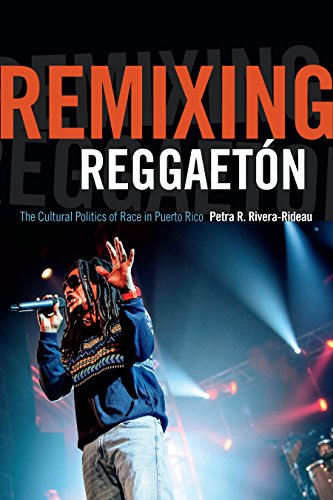
    Puerto Rico is often depicted as a “racial democracy” in which a history of race mixture has produced a racially harmonious society. In Remixing Reggaetón, Petra R. Rivera-Rideau shows how reggaetón musicians critique racial democracy’s privileging of whiteness and concealment of racism by expressing identities that center blackness and African diasporic belonging. Stars such as as Tego Calderón criticize the Puerto Rican mainstream’s tendency to praise black culture but neglecting and marginalizing the island’s black population, while Ivy Queen, the genre’s most visible woman, disrupts the associations between whiteness and respectability that support official discourses of racial democracy. From censorship campaigns on the island that sought to devalue reggaetón, to its subsequent mass marketing to U.S. Latino listeners, Rivera-Rideau traces reggaetón’s origins and its transformation from the music of San Juan’s slums into a global pop phenomenon. Reggaetón, she demonstrates, provides a language to speak about the black presence in Puerto Rico and a way to build links between the island and the African diaspora.

    Table of Contents

    • Acknowledgments
    • Introduction. Reggaetón Takes Its Place
    • 1. Iron Fist against Rap
    • 2. The Perils of Perreo
    • 3. Loíza
    • 4. Fingernails con Feeling
    • 5. Enter the Hurbans
    • Conclusion. Reggaetón’s Limits, Possibilities, and Futures
    • Notes
    • Bibliography
    • Index
  • Unlike the continental United States, Hawaii has no group that is the racial majority, and people can identify with multiple races and ethnicities over several generations. This is the norm, rather than an anomaly.

    Early social scientists, the tourist industry, and visitors credit this long history of mixing to the “aloha spirit,” or culture of tolerance and inclusivity, that is the hallmark of living in Hawaii. True, Hawaii is a place where a mixed-race person like myself can blend in, and where people of color are not seen as a curiosity. And yes, people generally get along here.

    But even the aloha spirit has its limits. We must be mindful that the present multicultural society grew from the collapse of the Native Hawaiian population and the dispossession of their land.

    Rudy P. Guevarra, Jr., “Is Hawaii a Racial Paradise?,” Zócalo Public Square, September 15, 2015. http://www.zocalopublicsquare.org/2015/09/15/is-hawaii-a-racial-paradise/ideas/up-for-discussion/.

  • The most unique disadvantage of formal identities, relative to ascriptive and elective ones, is that they are confounded by dynamic identities: identities that change over time or depend on context. Formalities leave documentary traces that “inhibit forgetting.” The idea that a past formality might estop an individual from claiming a different identity is based on an understanding of identity as impervious to change or reformulation depending on context. But people do not always experience identity in this static and acontextual way. Researchers have found that many multiracial individuals change their racial identifications in different situations and over their lifetimes. For example, consider a multiracial woman who is only willing to identify as such if she believes her employer’s diversity program is genuine as opposed to tokenizing. The effects can be passed down through the generations, as one whose ancestors did not sign the Dawes Rolls may not have a claim to tribal membership. Or a person whose parents brought her to the United States without pursuing immigration formalities may find herself estopped from claiming U.S. citizenship. This estoppel problem is a growing risk as technology facilitates better collection and retention of records.

    Jessica A. Clarke, “Identity and Form,” California Law Review, Volume 103, Number 4 (August 2015), 882. http://www.californialawreview.org/1identity_form/.

  • Is Hawaii a Racial Paradise?

    Zócalo Public Square
    2015-09-15

    Rudy P. Guevarra, Jr., Associate Professor of Asian Pacific American Studies
    Arizona State University

    Nitasha Sharma, Associate Professor of African-American Studies and Asian-American Studies
    Northwestern University, Evanston, Illinois

    David A. Swanson, Professor of Sociology
    University of California, Riverside

    Lee A. Tonouchi (“Da Pidgin Guerilla”)
    Hawaii

    Roderick Labrador, Associate Professor of Ethnic Studies
    University of Hawaii, Mānoa (also Director of the UCLA Hawaii Travel Study Program)

    Maile Arvin, Assistant Professor of Ethnic Studies
    University of California, Riverside

    Races, Ethnicities, and Cultures Mix More Freely Than Elsewhere in the U.S., But There Are Limits to the Aloha Spirit

    Early in the 2008 film Forgetting Sarah Marshall, Jason Segal, playing a guy who travels to Hawaii to get over a breakup, drunkenly pours out his feelings to two people in his hotel, a newlywed man and a bartender. The new husband encourages Segal to think there’s still hope for the relationship, but the bartender, Dwayne, has no sympathy for Segal’s sadness.

    “You’ve gotta move on,” Dwayne says. “It’s that easy, I promise you it is. I lived in South Central. South Central. And I hated it. So I moved to Oahu. Now I can name you over 200 different kinds of fish!” He starts naming them.

    The scene is hilarious, but it also hints at one of America’s fundamental Gordian knots—race—and the various ways we’ve tried to untie it. The story uses Los Angeles’ “South Central” neighborhood as a code word for a place where gangs are divided along color lines, racial tensions can erupt in violence, and residents feel stuck in the cycle. The implication is that Dwayne, who’s black, escaped all that by coming to Hawaii. He puts forth Hawaii as a paradise—a place where the only thing he has to worry about is learning how to pronounce Humuhumunukunukuapua`a.

    Hawaii is one of America’s most diverse and happiest states. Some would contend people get along better here than almost anywhere else. But tossing different groups together also means there are frictions—ones that perhaps are too often are obscured by the sunshine and ukuleles in tourist guides.

    So what’s the actual nature of racial relations in Hawaii? And what can the rest of us learn from it? In advance of the “What It Means to Be American” event “What Can Hawaii Teach America About Race?,” we asked a variety of experts on and off the islands that same question…

    Read the entire article here.

  • Biases in the Perception of Barack Obama’s Skin Tone

    Analyses of Social Issues and Public Policy
    Volume 14, Issue 1, December 2014
    pages 137–161
    DOI: 10.1111/asap.12061

    Markus Kemmelmeier, Professor of Sociology
    University of Nevada, Reno

    H. Lyssette Chavez
    University of Nevada, Reno

    White Americans higher in prejudice were less likely to vote for Barack Obama than other Americans. Recent research also demonstrated that supporters and opponents of Mr. Obama engaged in skin tone biases, i.e., they perceive Mr. Obama’s skin tone as lighter or darker in line with more positive or negative views of him. Across two studies we hypothesized that skin tone biases occur as a function of two independent sources: racial prejudice, which is always related to skin tone bias, and political partisanship, which is related to skin tone bias primarily during elections. Study 1 assessed perceptions of Mr. Obama’s skin tone shortly before and after the 2008 Presidential election, and shortly after the first inauguration. Study 2 assessed perceptions in the middle of his first term, immediately prior to the 2012 Presidential election, and 1 year into his second term in office. Consistent with our hypothesis, we found that partisan skin tone bias was limited to the election period, whereas prejudice-based skin tone biases occurred independent from any election.

    Read or purchase the article here.

  • We have not moved beyond race.

    St. Louis does not have a proud history on this topic, and we are still suffering the consequences of decisions made by our predecessors.

    However, it’s important to understand that racial inequity in our region is not the same as individual racism. We are not pointing fingers and calling individual people racist. We are not even suggesting that institutions or existing systems intend to be racist.

    What we are pointing out is that the data suggests, time and again, that our institutions and existing systems are not equal, and that this has racial repercussions. Black people in the region feel those repercussions when it comes to law enforcement, the justice system, housing, health, education, and income.

    Rev. Starsky Wilson, Rich McClure, et. al., “Forward Through Ferguson: A Path Toward Racial Equity,” The Ferguson Commission, September 14, 2015. 7. http://forwardthroughferguson.org/wp-content/uploads/2015/09/FergusonCommissionReport_091415.pdf.

  • Do Children See in Black and White? Children’s and Adults’ Categorizations of Multiracial Individuals

    Child Development
    Published Online: 2015-08-28
    DOI: 10.1111/cdev.12410

    Steven O. Roberts
    Department of Psychology
    University of Michigan

    Susan A. Gelman, Heinz Werner Distinguished University Professor of Psychology and Linguistics
    University of Michgan

    Categorizations of multiracial individuals provide insight into the development of racial concepts. Children’s (4–13 years) and adults’, both White (Study 1) and Black (Study 2; N = 387), categorizations of multiracial individuals were examined. White children (unlike Black children) more often categorized multiracial individuals as Black than as White in the absence of parentage information. White and Black adults (unlike children) more often categorized multiracial individuals as Black than as White, even when knowing the individuals’ parentage. Children’s rates of in-group contact predicted their categorizations. These data suggest that a tendency to categorize multiracial individuals as Black relative to White emerges early in development and results from perceptual biases in White children but ideological motives in White and Black adults.

    Read or purchase the article here.

  • Racist Hysteria to Pragmatic Rapprochement? The German Debate about Rhenish ‘Occupation Children’, 1920–30

    Contemporary European History
    Volume 22, Issue 2, May 2013
    pages 155-180
    DOI: 10.1017/S0960777313000039

    Julia Roos, Associate Professor of History
    Indiana University, Bloomington

    This essay revisits 1920s German debates over the illegitimate children of the Rhineland occupation to examine hitherto neglected fluctuations in the relationship between nationalism and racism in Weimar Germany. During the early 1920s, nationalist anxieties focused on the alleged racial ‘threats’ emanating from the mixed-race children of colonial French soldiers. After 1927, plans for the forced sterilisation and deportation of the mixed-race children were dropped; simultaneously, officials began to support German mothers’ paternity suits against French soldiers. This hitherto neglected shift in German attitudes towards the ‘Rhineland bastards’ sheds new light on the role of debates over gender and the family in the process of Franco–German rapprochement. It also enhances our understanding of the contradictory political potentials of popularised foreign policy discourses about women’s and children’s victimisation emerging from World War I.

  • Identity and Form

    California Law Review
    Volume 103, Number 4 (August 2015)
    pages 747-838

    Jessica A. Clarke, Associate Professor of Law
    University of Minnesota

    Recent controversies over identity claims have prompted questions about who should qualify for affirmative action, who counts as family, who is a man or a woman, and who is entitled to the benefits of U.S. citizenship. Commentators across the political spectrum have made calls to settle these debates with evidence of official designations on birth certificates, application forms, or other records. This move toward formalities seeks to transcend the usual divide between those who believe identities should be determined based on objective biological or social standards, and those who believe identities are a matter of individual choice. Yet legal scholars have often overlooked the role of formalities in identity determination doctrines. This Article identifies and describes the phenomenon of “formal identity,” in which the law recognizes those identities individuals claim for themselves by executing formalities. Drawing on Lon Fuller’s classic work on the benefits of formality in commercial law contexts, it offers a theory explaining the appeal of formal identity. But it concludes that reformers should be skeptical of the concept. Formal identity may set traps for the unwary, eliminate space for subversive or marginal identities, and legitimize identity-based systems of inequality. Ultimately, this Article urges critical examination not merely of formal identity, but of the functions identity categories serve in the law.

    • Introduction
    • I. Models of Identity
      • A. Ascriptive Identity
      • B. Elective Identity
      • C. Formal Identity
    • II. Functions of Formal Identity
      • A. Formal Citizenship
      • B. Formal Family
      • C. Formal Sex
      • D. Formal Race
    • III. Dysfunctions of Formal Identity
      • A. Commodification
      • B. Bureaucratization
      • C. Discrimination
      • D. Pigeonholing
      • E. Legitimation
    • IV. Rethinking the Legal Functions of Identities
      • A. Questioning Channels
      • B. Inducing Proportionate Caution
      • C. Assessing the Role of Evidence
    • Conclusion

    Read the entire article here.

  • Penn Lightbulb Café Presents ‘Fatal Invention: Re-creating Race in Genomic Era’

    World Cafe Live Upstairs
    3025 Walnut Street
    Philadelphia, Pennsylvania
    Tuesday, September 15, 18:00-19:00 EDT (Local Time)

    Dorothy Roberts, Penn Integrates Knowledge Professor; George A. Weiss University Professor of Law and Sociology, Raymond Pace and Sadie Tanner Mossell Alexander Professor of Civil Rights, Professor of Africana Studies, and director of the Program on Race, Science and Society
    University of Pennsylvania

    After the human genome was mapped, there was an unexpected resurgence of scientific interest in genetic differences between races. Some scientists are defining race as a biological category written in our genes, while the biotechnology and pharmaceutical industries convert the new race science into race-based products, such as race-specific medicines and ancestry tests. Professor Roberts argues that the genetic interpretation of race is not only mistaken but also masks the continuing impact of racism in a supposedly post-racial society. Instead, she calls for affirming common humanity by working to end social inequities supported by the political system of race.

    The talk is part of the Penn Lightbulb Café free public-lecture series presented by Penn Arts & Sciences and the Office of University Communications that takes arts, humanities and social-sciences scholarship out of the classroom for a night on the town. Each hour-long talk begins at 6 p.m., and the presentation will be followed by an audience Q&A. Café events are free and open to the public. Food and beverages will be available for purchase. Seating is limited.

    For more information, click here.