• African Heritage and Memories of Slavery in Brazil and the South Atlantic World

    Cambria Press
    428 pages
    2015-02-06
    6 x 9 in or 229 x 152 mm Case Laminate
    ISBN: 9781604978926

    Edited by:

    Ana Lucia Araujo, Professor of History
    Howard University, Washington, D.C.
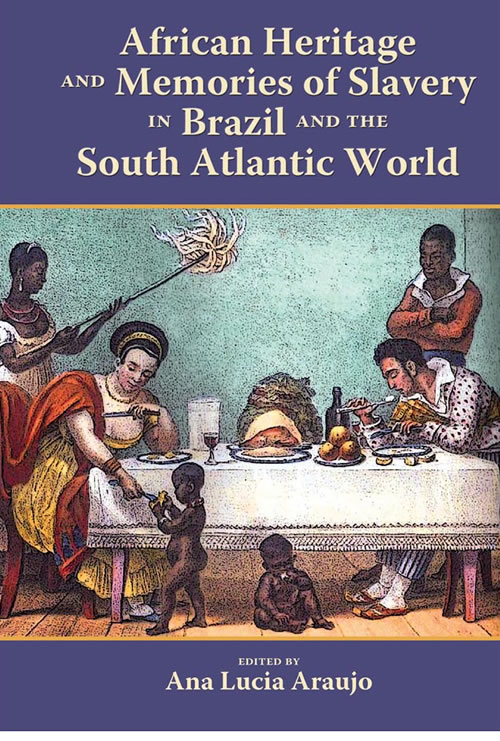
    This book explores the history of African tangible and intangible heritages and its links with the public memory of slavery in Brazil and Angola. The two countries are deeply connected, given how most enslaved Africans, forcibly brought to Brazil during the era of the Atlantic slave trade, were from West Central Africa. Brazil imported the largest number of enslaved Africans during the Atlantic slave trade and was the last country in the western hemisphere to abolish slavery in 1888. Today, other than Nigeria, the largest population of African descent is in Brazil. Yet it was only in the last twenty years that Brazil’s African heritage and its slave past have gained greater visibility. Prior to this, Brazil’s African heritage and its slave past were completely neglected.

    Even after the abolition of slavery in Brazil, African culture continued to be marginalized. Carnival, religious festivals, as well as Candomblé ceremonies, and capoeira (an Afro-Brazilian martial art) created important spaces of black assertion and insurgency. These cultural traditions were contested by white elites and public authorities, but starting in the 1930s, capoeira became a national symbol and Candomblé temples were gradually officially added to Brazil’s list of heritage sites.

    In spite of these developments, the Atlantic slave past has remained absent from the public landscape of Brazilian and Angolan former slave ports, suggesting how difficult it is for these countries to address the painful legacies of slavery. African art and material culture also continued to be excluded from museums and other official institutions. In the rare instances that African artifacts were shown, they would be confined to only certain places dedicated to popular culture and associated with the religious sphere.

    Even though public attention on slavery was growing internationally through national and international initiatives (e.g., The Slave Route Project by UNESCO), Brazil and Angola developed very few initiatives for the memorialization of slavery and the Atlantic slave trade. This has started to change slowly in the last decade as Brazil has begun engaging in more initiatives to memorialize slavery and underscore the importance of its African heritage.

    Brazil’s slave past and African heritage are emerging gradually in urban and rural areas through different kinds of initiatives led not only by activists but also by scholars in association with black communities. Although in their early stages, most of these projects are permanent programs supported by official agencies. This new configuration suggests that––unlike the case in Angola––in Brazil, slavery and the Atlantic the slave trade are becoming recognized as foundational chapters of the country’s history.

    This is the first book in English to focus on African heritage and public memory of slavery in Brazil and Angola. This interdisciplinary study examines visual images, dance, music, oral accounts, museum exhibitions, artifacts, monuments, festivals, and others forms of commemoration to illuminate the social and cultural dynamics that over the last twenty years have propelled––or prevented––the visibility of African heritage (and its Atlantic slave trade legacy) in the South Atlantic region.

    The book makes a very important contribution to the understanding of the place of African heritage and slavery in the official history and public memory of Brazil and Angola, topics that remain understudied. The study’s focus on the South Atlantic world, a zone which is sparsely covered in the scholarly corpus on Atlantic history, will further research on other post-slave societies.

    African Heritage and Memories of Slavery in Brazil and the South Atlantic World is an important book for African studies and Latin American studies. It is especially valuable for African Diaspora studies, African history, Atlantic history, history of Brazil, history of slavery, and Caribbean history.

    Table of Contents

    • List of Figures
    • Introduction: Wounded Pasts: Memory of Slavery and African Heritage in Brazil (Ana Lucia Araujo)
    • Chapter 1: Collectionism and Colonialism: The Africana Collection at Brazil’s National Museum (Rio de Janeiro) (Mariza de Carvalho Soares)
    • Chapter 2: Race and Visual Representation: Louis Agassiz and Hermann Burmeister (Maria Helena Machado)
    • Chapter 3: Counter-Witnessing the Visual Culture of Brazilian Slavery (Matthew Francis Rarey)
    • Chapter 4: Angola in Brazil: The Formation of Angoleiro identity in Bahia (Matthias Röhrig Assunção)
    • Chapter 5: Memories of Captivity and Freedom in São José da Serra Jongo Festivals: Cultural Heritage and Black Identity (1888–2011) (Martha Abreu and Hebe Mattos)
    • Chapter 6: From Public Amnesia to Public Memory: Re-Discovering Slavery Heritage in Rio de Janeiro (André Cicalo)
    • Chapter 7: Uncomfortable Pasts: Talking About Slavery in Angola (Marcia C. Schenck and Mariana P. Candido)
    • Chapter 8: “Bahia is a Closer Africa”: Brazilian Slavery and Heritage in African American Roots Tourism (Patricia de Santana Pinho)
    • Chapter 9: Preserving African Art, History, and Memory: The AfroBrazil Museum (Kimberly Cleveland)
    • Chapter 10: The Legacy of Slavery in Contemporary Brazil (Myrian Sepúlveda dos Santos)
    • Bibliography
    • Index
    • About the Contributors
  • James Blake and the Myth of an Unarrestable Black Man

    The Daily Beast
    2015-09-10

    Tomás Ríos

    Bill Bratton said race ‘had nothing at all to do’ with tennis star James Blake’s wrongful collaring and arrest. The numbers tell a different story.

    What does a non-white person have to do for the police to leave them alone? The ready answer is that you have to be more famous than former tennis star James Blake.

    Blake was leaving his Midtown Manhattan hotel to make corporate appearances at the U.S. Open when five white, plainclothes New York City police officers tackled and handcuffed him on Wednesday.

    The real answer, of course, is that not being white means there is no escape from the consequences of not being white.

    Among those who buy into the mythic moral righteousness of our police forces, there is a belief that people of color need only be perfect little humans to cancel out the realities of a racist society. Go to college, smile, pull up your pants, don’t smile at white women, and the prescription for transcending race goes on and on.

    It seems not even James Blake—who attended Harvard, overcame scoliosis and a broken neck to become a world-class tennis player, and is now a cancer research philanthropist—can be that perfect. The numbers on incarceration make that much clear…

    Read the entire article here.

  • In its focus on genetics and race, global newspaper coverage of athletics is far from “post-racial”

    The LSE’s daily blog on American Politics and Policy
    The London School of Economics and Political Science
    London, United Kingdom
    2015-09-10

    Matthew W. Hughey, Associate Professor of Sociology
    University of Connecticut

    Devon R. Goss, Ph.D. Candidate in Sociology
    University of Connecticut

    With the years of racially segregated sports now long behind us, many would consider that sports coverage is color-blind and post-racial. In new research which examines newspaper coverage of race, sport and genetics from 2003 to 2014, Matthew W. Hughey and Devon R. Goss find that this is not the case. They write that the media persistently reinforces the notions that African American’s athletic success is based on biology, while whites’ comes from hard work and intelligence. They also debunk the ideas often seen in the media that race has a biological reality which can be defined by genes, and that the historic process of slavery somehow eliminated ‘weaker genes’ from the African American population, making them a more athletic race.

    For many, sport represents the ultimate color-blind space, affording a level playing field where only one’s training and skills are the hallmarks of competition. Hence, racist and prejudicial beliefs and phenomena are both literally and figuratively, out-of-bounds. Moreover, sport has been understood as an activity that promotes racial harmony amongst both participants and observers. But such a claim is a bit simplistic.

    To make sense of the correlation between different racial groups’ success and failures amidst different athletic events, many draw from the deep well of scientific racism to quench their thirst for explanatory knowledge. For instance, some research has found that many athletes believe that white sporting success is attributable to intelligence, while nonwhite success is accredited to genetically predisposed bodies—a longstanding cultural trope known as “white brains versus black brawn”—that has been around for at least a century. After African American boxer Jack Johnson became the heavyweight champion of the world in 1908, he precipitated a slow reconsideration of the assumption of nonwhites’ physical inferiority—a central tenet of early 20th century racial science and eugenics. Fast forward to our contemporary moment and the banal ubiquity of this trope among sports commentators is well known, and was even recently panned by the comic duo Key & Peele

    Read the entire article here.

  • Vulnerability as Empowerment in the Classroom

    Education Week
    2015-09-09

    Christina Torres, Middle and high school English and Drama Teacher
    University Laboratory School, Honolulu, Hawaii

    It’s back-to-school time for many students and teachers this week. For many, it means that 20 to 120 new faces enter our classrooms and our lives.

    Jessica, a fifth-grade teacher in Chicago, wrote this beautiful piece on the vulnerability of her new students after asking them to share how they saw themselves reflected in literary characters:

    I was in awe of the bravery of these kids. To speak this freely in front of their classmates. To tell these things to me, their teacher, who they barely even know at this point. That is bravery.

    What they showed me is their capability to make themselves vulnerable. To be willing to share the deepest parts of themselves. To leave behind the worry of how others would react and share these moments and glimpses into their lives with us all.

    The piece hits on an aspect of education that is often forgotten: students not only look to us for content, they also can experience either empowerment or oppression based on the culture of our classrooms

    We have to face this with our students head on. We must not only acknowledge this truth with students but also attempt to build trust in a space that has failed to validate their identities.

    Here’s the thing: we have all been biased, and we have been hurt by biases. As Jay Smooth discusses in his seminal talk, “How I Learned to Stop Worrying and Love Discussing Race,” “the race constructs that we live in in America were shaped … for centuries by a need to rationalize and justify indefensible acts.” Because of this, we “will never bat a thousand when it comes to dealing with race issues.” We’re going to mess up, which is difficult when the stakes feel so high…

    Read the entire article here.

  • Serena Williams, Tiger Woods and racial identity in sports

    ESPN
    2015-09-05

    Mike Wise, Senior Writer

    Mike Wise writes that Serena Williams has embraced her blackness and found a spiritual home while Tiger Woods has been proudly biracial and found a perhaps unintended kind of isolation

    You can’t miss the term “black excellence” pulsating through Claudia Rankine’s provocative story on Serena Williams in last week’s New York Times magazine. Though Serena never goes there herself, the acclaimed poet and professor takes the journey for her, living vicariously through Serena’s sass and brass. “Serena’s grace comes because she won’t be forced into stillness; she won’t accept those racist projections onto her body without speaking back.”

    Rankine’s affection for Serena’s defiance is so deeply personal, she almost channels John Carlos and Tommie Smith, raising their black-gloved fists into a Mexico City summer night some five decades ago.

    Step off, backward white folk.

    Between black excellence and her picture next to the Twitter hashtag #BlackGirlMagic, Serena is clearly playing for more than herself and history at the US Open this week.

    Meanwhile, a term not found with a Google search: “Cablanasian excellence.”

    This is possibly because Tiger Woods has not won a major since the Bush administration, and he has been careful not to singularly co-opt any one part of his multiracial identity (African-American, Thai, Caucasian, American Indian, Chinese and beyond).

    But now that we’re routinely taking stock of two seminal athletes of color, both of whom dominated their Downton Abbey-white sports at different times in their careers, it’s fair to delve into how they both handled race and ask a simple question:

    Is the importance of a strong racial identity — especially being viewed as authentically black — something to fall back on during career and life struggles?…

    Read the entire article here.

  • Hapa-palooza 2015: Celebrate mixed heritage and own your identity

    Vancouver Observer
    Vancouver, British Columbia, Canada
    2015-09-06

    Jordan Yerman

    Mixed-race, outsider, or ‘half-breed’: you’re not alone at Hapa-palooza. Get in on Canada’s largest celebration of mixed heritage.

    Tôi là người lai mỹ means “I’m an American half-breed”. Author and publisher Brandy Liên Worrall wrote it in her journal while sitting at an outdoor cafe during her first trip to Vietnam. She wrote in Vietnamese for the benefit of the locals who were reading over her shoulder. Worrall’s Vietnamese mother laughed at first, and then asked why her daughter didn’t just say she was Vietnamese. “Because, Mom,” replied Worrall, “I’m not just Vietnamese. I’m not just American. I’m gonna recognize that I’m người lai, and I’m going to own that word.”

    “In that country, where I have origins,” says Worrall in a DTES cafe, “[being mixed-race] is still that stigmatized.” We’re sitting with Anna Ling Kaye, editor of Ricepaper Magazine and co-founder of Hapa-palooza, which returns for its fifth year on September 16. Kaye says, “In Taiwan, my extended family is certainly nonplussed by me. They’re complimentary: ‘Oh, you don’t need to perm your hair! You’re so curvy!’” Contrasting that was an encounter with a Chinese woman in Vancouver who told her, “You look how I feel!” The woman saw herself as presenting as Chinese, but feeling Canadian. “We don’t feel Hapa-palooza is only for people of mixed heritage. It’s for anyone who wants to talk about identity.”…

    Read the entire article here.

  • Love Across the Color Line: Remembering Alan Kaplan

    KCET TV
    Burbank, California
    2015-09-10

    Erin Aubry Kaplan

    Fourteen years ago I wrote an article for Salon.com published for Valentine’s Day about how I met my husband, Alan Kaplan. I ended the article on a cautionary note: our hugely improbable, racially romantic story did not mean that we’d solved the problems of the color line. Far from it. Strip away the circumstances that I was a reporter and he was the reluctant subject of an interview for a story I was writing at the time, and we were merely a black woman and a Jewish man from different parts of L.A. who shared the same politics and bottomless outrage about the historic effects of that color line. He taught about it–for 33 years at Hamilton High School’s humanities magnet– I wrote about it. That was the most obvious thing we shared in common, but there were other things too, ordinary couple things like a complicated love of the Dodgers, eating out (neither of one us cooked), movies, sifting through stories in the latest issue of the New Yorker or the Atlantic Monthly. A few years into the marriage we discovered that we both loved dogs, and rescuing dogs; we adopted one post-Hurricane Katrina and eventually accumulated a whole houseful.

    And yet matters of the color line suffused all the small and wonderful–and not so wonderful–things that make a relationship. I don’t mean it smothered our marriage or tempered the joy. I mean that race was always present, like any other condition you might marry into. I know people prefer to think that intimacy is colorblind by definition; they assume that to be racially conscious of someone you love, especially your own spouse, must be the very antithesis of happiness. But that view is based on an ancient American fear of difference, not on reality. Alan and I knew that…

    Read the entire article here.

  • Grits and Sushi: Mitzi Uehara Carter muses on being black and Okinawan

    Metropolis Magazine
    2015-09-06

    Baye Mcneil


    Mitzi Uehara Carter

    Though Mitzi Uehara Carter was born on the opposite side of the Pacific, she’s kept herself anything but distant from her hereditary home. This Texas-native daughter of an African-American father and an Okinawan mother is currently a PhD candidate in the anthropology department at UC Berkeley, where she has recently completed her doctoral dissertation. She’s spent years doing research, including a year of field work collecting the personal stories of Okinawan families. In 2010, she started the blog Grits and Sushi to chronicle her musings on Okinawa, race, militarization, and blackness.

    “I started the blog so I could have a place to think about my anthropological work and my personal life and experiences. It was a good way for me to merge those two worlds,” Uehara Carter explains. “Anthropology studies at Berkeley can be very intense and theoretical, so I wanted my blog to be a place where I could reflect on some of the field work I was doing in Okinawa, and have a landing page where I could also engage with other people dealing with similar questions about their lives, their identities, and about race.”

    Grits and Sushi has since grown into a resource, an open journal, and a communal space, attracting readers from around the globe interested in things black and Okinawan, including interracial marriages, mixed-race citizens, and issues surrounding American military bases in Okinawa…

    “I created these forums where I brought together black military personnel, Okinawan activists, and residents of Okinawa to have a conversation, a kind of ‘talk-story’,” she says, explaining the Okinawan term, “yuntaku.”…

    Read the entire article here.

  • Vancouver’s Hapa Festival, All Grown Up

    The Tyee
    Vancouver, British Columbia Canada
    2015-09-03

    Christopher Cheung

    From one generation to another, an identity conversation continues.

    Jeff Chiba Stearns is about to be a father in November, and there’s an important conversation he wants to have with his daughter that he never had with his own family growing up.

    It’s not about anything like table manners or the birds and the bees: it’s a conversation on race and ethnicity.

    Stearns grew up in Kelowna in the 1980s, where most people were white. His mother was Japanese and his father had British, Scottish, Russian and German roots (one grandmother makes classic cabbage rolls), but “being mixed meant you were a full minority.”

    Like many others with a multiethnic background, Stearns had confusion navigating his identity and faced being called things like “half-breed.”

    “Not everyone goes through identity crises in their lives, but everyone has a story,” said Stearns. “Either they’ve rejected the fact they’re part of a minority group, or they’ve embraced that, or they’ve just wanted to be human [and say] I just want to blend in and fit in.”

    There are a lot of different names for those with a colourful heritage. Sometimes it’s mixed-race or multiethnic, but it’s really up to the individual…

    Read the entire article here.

  • The twisted irony of the NYPD wrongly assaulting and detaining black tennis star James Blake

    The Daily Kos
    2015-09-10

    Shawn King

    Yeah. This really happened.

    Retired black tennis star James Blake, in an NYPD double-fault, was slammed to a Manhattan sidewalk and handcuffed by a white cop in a brutal case of mistaken identity.

    The 35-year-old Blake, once ranked No. 4 in the world, suffered a cut to his left elbow and bruises to his left leg as five plainclothes cops eventually held him for 15 minutes Wednesday outside the Grand Hyatt Hotel.

    “It was definitely scary and definitely crazy,” Blake told the Daily News. “In my mind there’s probably a race factor involved, but no matter what there’s no reason for anybody to do that to anybody.”

    Of course, Blake is right. This absolutely should not have happened, but that much is a obvious to all of us. There are questions we should be asking, though…

    Read the entire article here.